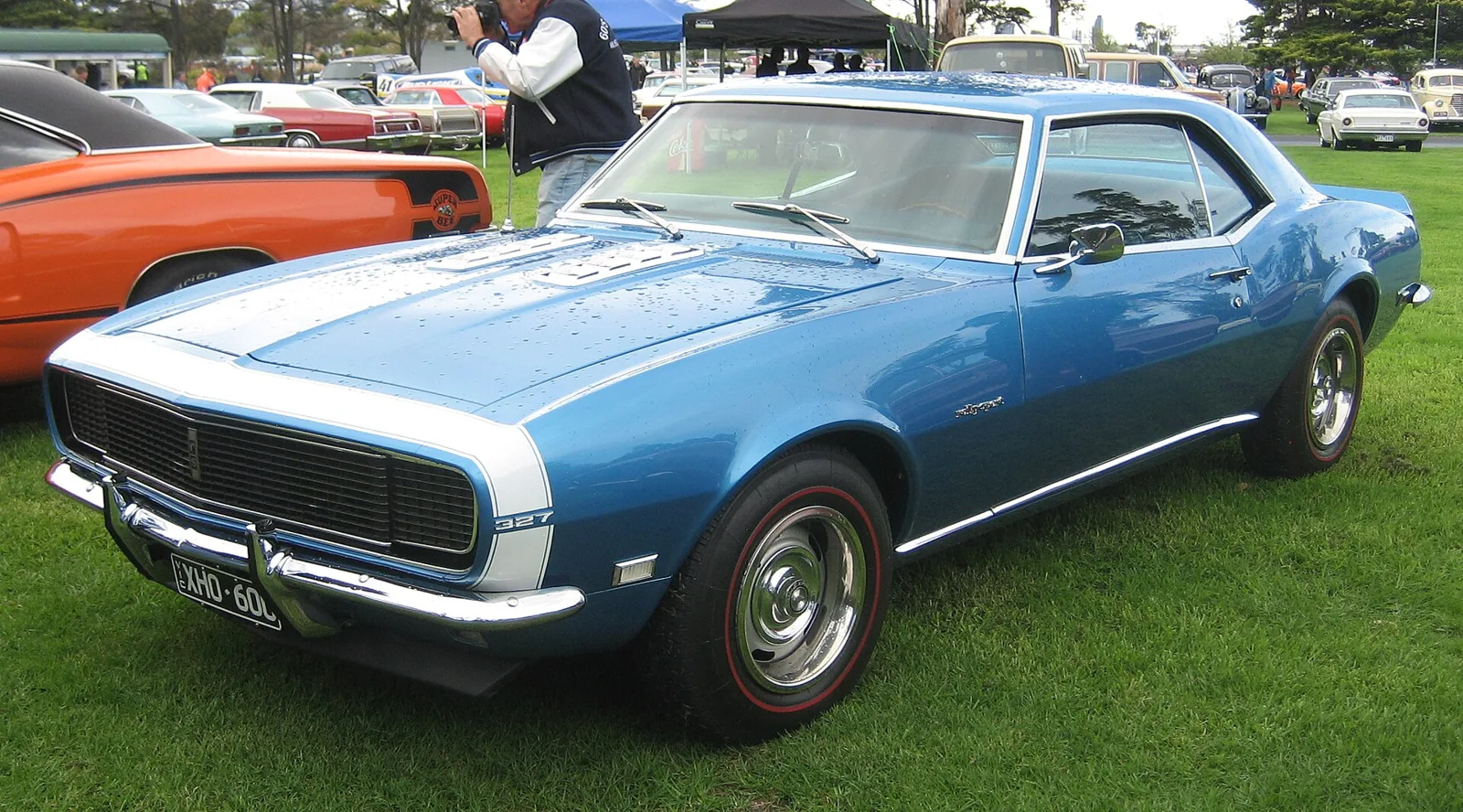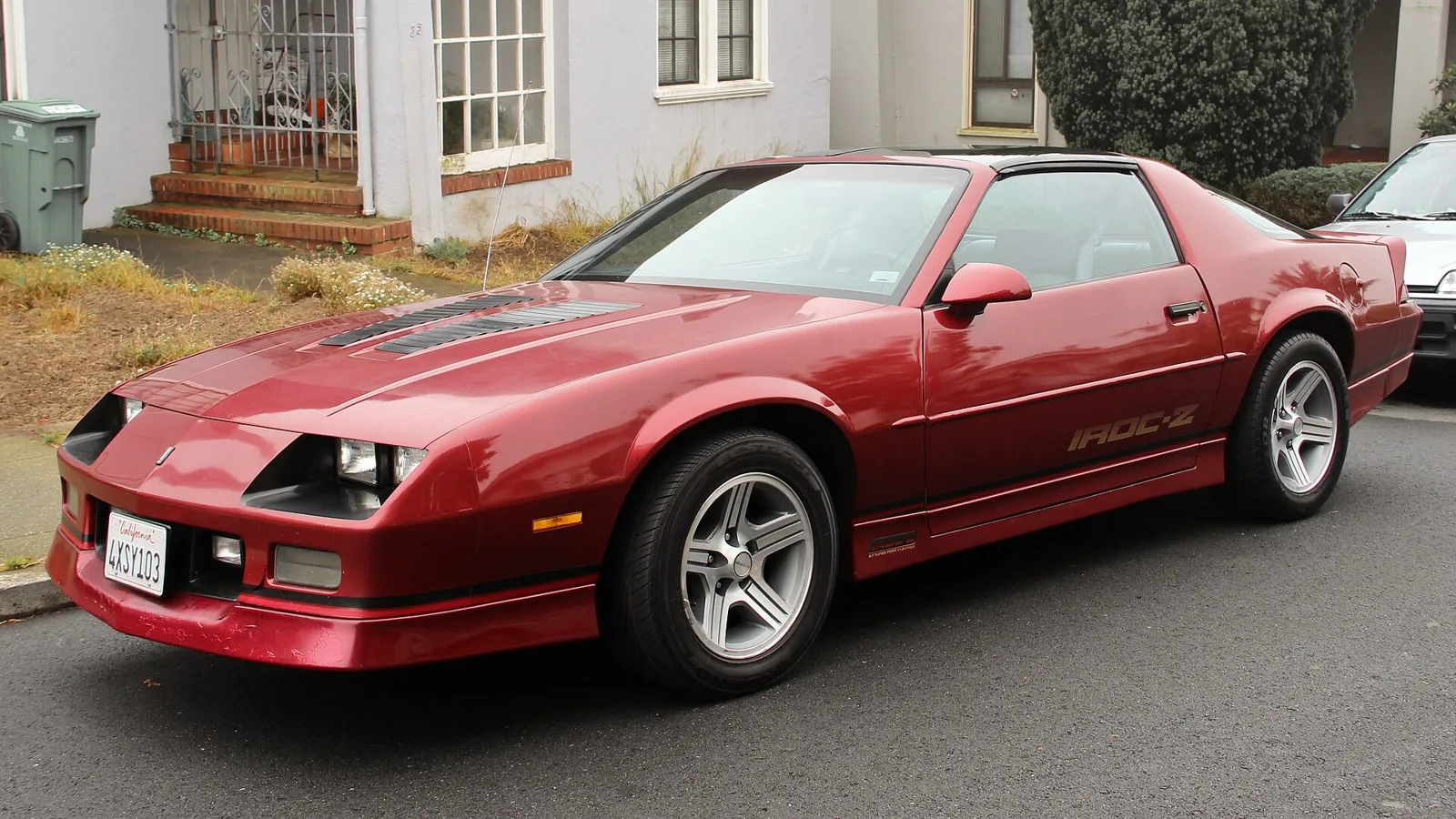
From the 1982 hatchback to the 1LE racers of 1992, the third-generation Camaro carried the Z28 and IROC-Z names through a decade of changes.
The third-generation Chevrolet Camaro ran from 1982 to 1992 on General Motors' F-body platform. It was the first Camaro with hatchback bodies and factory fuel injection, and it also brought four-cylinder engines and 16-inch wheels, while the Z28 and IROC-Z models carried its performance image.
The third-generation Camaro went on sale for 1982 as a hatchback with factory fuel injection, and it was the first Camaro offered with a four-cylinder engine and 16-inch wheels. It stayed in production until 1992, and the Z28 and IROC-Z models carried the car's performance image through the decade.
What did the third-generation Camaro look like?
The third-generation car broke with the earlier design. Its large, complex rear window reflected the latest advances in glass design, and the windscreen was raked at 62 degrees, beyond an internal GM limit of 60 degrees. The car was offered in Sport Coupe, Berlinetta and Z28 trim for 1982.
Folding the rear seat down enlarged the cargo area behind a large rear hatch. Production began on 12 October 1981, and the car was released for sale in December 1981, ready for the 1982 model year.
The 1982 model introduced the hatchback body, factory fuel injection and the four-cylinder engine. Motor Trend named the Z28 its Car of the Year for 1982, although critics pointed to the car's modest power ratings.
Fuel injection, hatchback bodies and the Z28 gave the third-generation Camaro its character.
Which engines were offered in 1982?
The Sport Coupe came with a 2.5-litre four-cylinder as standard, with a 2.8-litre V6 and a 5.0-litre V8 as options. The Berlinetta came with the 2.8-litre V6 as standard, and the Z28 came with a 5.0-litre V8 rated 145 hp (108 kW) as standard.
The mix of engines sold was 12 percent four-cylinder, 37 percent V6 and 51 percent V8. The V8 was clearly the choice of enthusiast buyers.
The Z28 could be had with a four-speed manual or a three-speed TH200 automatic. The optional LU5 Cross Fire Injection 5.0-litre, rated 165 hp (123 kW), was offered only with the automatic.
The car that paced the 1982 Indianapolis 500 used a highly modified all-aluminium 5.7-litre V8 that the replica cars never received. Dealers sold more than 6,000 appearance-package replicas, which carried a two-tone silver and blue paint scheme and a silver and blue interior.
What was the Z28-E?
The Z28-E was a limited export model shown at the 1982 Geneva Motor Show. British National Type Approval was granted to it in 1982, and it carried the RPO code ZK3 on its body tag. It was built without the emissions equipment fitted to US cars, which meant open exhausts.
It used a carburetted 5-litre V8 producing 157 PS (155 hp; 115 kW), and a 2.8-litre V6 with 108 PS (107 hp; 79 kW) was added soon after. Limited-slip differential and rear disc brakes were standard, which the regular Z28 did not offer.
The Z28-E continued for overseas markets in 1983, and a Japanese commercial showed it on screen. For 1984 and 1985 it returned in very small numbers, and it kept the no-catalyst specification for export.
How did the IROC-Z change the Camaro?
For 1985 Chevrolet introduced the IROC-Z, an option package on the Z28 named after the International Race of Champions. It added an upgraded suspension, a lower ride height, Delco-Bilstein shocks and a steering brace known as the wonder bar. The car also received new aluminium five-spoke wheels.
The optional Tuned Port Injection system came from the Corvette. The LB9 TPI 5.0-litre was rated 215 hp (160 kW) in 1985, and the car used 245/50VR16 Goodyear Gatorback tyres. The L69 IROC-Z tally for that year came to 2,497 cars.
The IROC-Z package became standard on the Z28 in 1988, when the base Z28 was dropped. 1990 was the final IROC-Z year, because Chevrolet did not extend its deal with the International Race of Champions.
What were the 1LE and B4C cars?
The 1LE was an option combination aimed at SCCA Showroom Stock racers. It was triggered by the G92 Performance Axle with no air conditioning, and it brought 11.65-inch rotors with PBR calipers, an aluminium driveshaft and a baffled fuel tank.
The 1LE cars were lightly optioned, most with the base interior, and some were built without radios. A total of 201 cars were built as radio deletes in 1992.
The B4C Special Service Package was offered to law enforcement and government agencies from 1991. It paired a Z28 powertrain and suspension with an RS body, and in 1992 it gained the 1LE brakes, with 589 sold.
Were there convertibles in the third generation?
Convertibles returned for 1987 as a regular production option, converted from T-top coupes by American Sunroof Company. The first year produced 1,007 cars, and each carried a dash badge marking the 20th anniversary of the model. The conversions were carried out by an outside firm after the cars had been built.
The 1987 car was the 20th-anniversary model year, and the open cars were counted among its anniversary editions. The option brought an open-top Camaro back to the range after a long gap.
Some T-top cars were converted into convertibles after the customer had already taken delivery, so the VIN code does not always match the body style on those cars.
How did the engines develop from 1983 to 1992?
The L69 High-Output V8 arrived in April 1983 with 190 hp (142 kW) and was initially available only with a manual, with 3,223 sold for the 1983 model year. The L69 gained an automatic option for the first time in 1984.
The 350 TPI L98 came in 1987. It was first offered in the IROC-Z and was available only with an automatic. It made 225 hp at 4,400 rpm, with 330 lb ft arriving at 2,800 rpm, and its bumper decal read 5.7L to tell it apart from the 305 TPI.
By 1988 every engine was fuel-injected. The 305 TPI with manual transmission was rated 220 hp, the automatic 195 hp, and the 350 TPI 230 hp at 4,400 rpm. The 2.8-litre V6 produced 135 hp at 4,900 rpm.
In 1990 the 3.1-litre V6 replaced the 2.8-litre, and the 350 TPI was rated 245 hp at 4,400 rpm. The 1991 cars carried a facelift with ground effects, a high-rise spoiler and hood blisters, and the 305 TPI was rated 230 hp at 4,200 rpm.
From 1987 the IROC-Z and the tuned-port Z28 cars carried 145 mph speedometers, while carbureted models kept the 85 mph unit.
What changed between 1984 and 1986?
The 1984 model year brought a revised dash pad, with electronic readouts in the Berlinetta, and a fibreglass hood was replaced with a steel one. Road and Track named the 1984 Camaro among twelve best cars in the world, and Car and Driver named the Z28 the best-handling car built in America that year.
The 1986 model year added a Center High Mounted Stop Lamp on the hatch, and the 305 HO L69 was built for the last time. Of the 74 built, 63 went to racing teams in Canada's Player's series and 11 were sold to the public.
Car and Driver also placed the 1985 IROC-Z on its Ten Best list for that year. Braking performance for 1986 was 139 feet from 60 mph. The Berlinetta trim level ended after 1986, and the LT model replaced it in 1987.
The 1986 model year also made the 2.8-litre V6 the standard engine on base models, replacing the four-cylinder.
How did the 1988 and 1989 models change?
For 1988 the slow-selling LT was discontinued and the base Z28 was dropped, leaving only the base coupe and the IROC-Z. The 2.8-litre V6 was rated 135 hp at 4,900 rpm, while the 305 TBI gained throttle body injection and reached 170 hp.
The 1989 model year brought back the RS designation as the base model, with ground effects and a standard 2.8-litre fuel-injected V6. The G92 Performance Axle package was sold on 1,426 IROC-Z coupes that year, and it added four-wheel disc brakes and a tachometer redlining at 5,500 rpm.
Power on the 1989 305 TPI rose to 230 hp with a manual gearbox and dual catalytic converter exhaust, and the 350 TPI reached 240 hp with the same exhaust, which was available only with the automatic.
What changed in 1990 and 1991?
The 1990 model year was the lowest for production, at 35,048 cars, because the run was cut short and the facelifted 1991 models arrived early. It was also the first year an airbag appeared in any F-body car, and it came with a half-moon gauge cluster.
The 1991 facelift gave the Z28 a new wheel design and a high-rise spoiler. The CHMSL moved back to the top of the hatch, and the 1LE package was produced in 478 units that year.
The 1991 engine figures were 245 hp at 4,400 rpm for the 350 TPI, 230 hp at 4,200 rpm for the 305 TPI, and 170 hp at 4,000 rpm for the 305 TBI. The B4C option gave police and government users Z28 power in an RS body.
Why did the 1992 Camaro end production?
The 1992 model year was the last for the third generation, and it was the final year of Camaro production in the United States until 2015. The 25th anniversary was marked with a Heritage Package, a graphics option with badges and rally stripes, rather than the planned aluminium-headed engine and six-speed gearbox.
The 1LE package reached its highest production that year, with 705 cars, although 589 of those were B4C cars with 1LE brakes. That left only 116 true 1LE-only cars with no air conditioning and no special service equipment.
The last third-generation Camaro was a red Z28 coupe, built on 27 August 1992 at Van Nuys, California, and it carried signatures of the assembly line workers.
How did the Z28 wheels and IROC-Z hardware develop?
The 1982 Z28 used new 15x7-inch cast aluminium five-spoke wheels in silver or gold, with a three-piece rear spoiler and a three-colour lower body stripe. The Z28 also carried badges on its right rear bumper and along the side valances. These wheels were new for the 1982 model.
Early Z28s could be ordered with Conteur sport seats, but a production shortage meant the passenger seat on the first cars was a mismatched high-back bucket. In 1984 a steel bonnet took the place of the fibreglass one.
The IROC-Z used 16-inch aluminium five-spoke wheels from 1985 onwards, with different front and rear offsets marked on the wheels. The 1988 IROC-Z gained redesigned wheels with two lines in each spoke instead of one.
The 1989 G92 Performance Axle package moved the rear ratio to 3.45 on the manual 305 and 3.27 on the 350, and it added dual-converter exhaust and four-wheel disc brakes.
Specifications at a glance
| Specification | Detail |
|---|---|
| Production | 1982 to 1992, General Motors F-body platform |
| Sport Coupe engine (1982) | 2.5-litre four-cylinder LQ9, 151 cu in |
| Z28 engine (1982) | 5.0-litre LG4 V8; 145 hp (108 kW) |
| Z28 engine (1983) | 5.0-litre L69 High-Output V8; 190 hp (142 kW) |
| IROC-Z (1985) | LB9 TPI 5.0-litre; 215 hp (160 kW) |
| 350 TPI (1991) | 245 hp at 4,400 rpm; 345 lb ft at 3,200 rpm |
| 1982 sales | 173,000 Camaros in the United States |
| Convertible (1987) | 1,007 cars in the first year |
| Final year | 1992, Van Nuys, California |