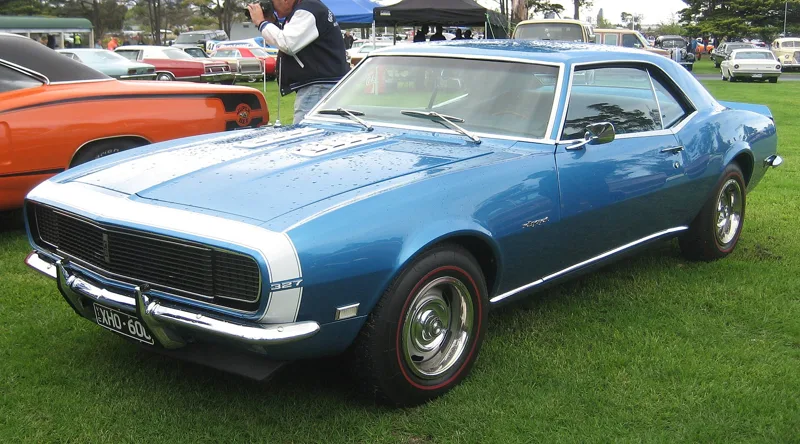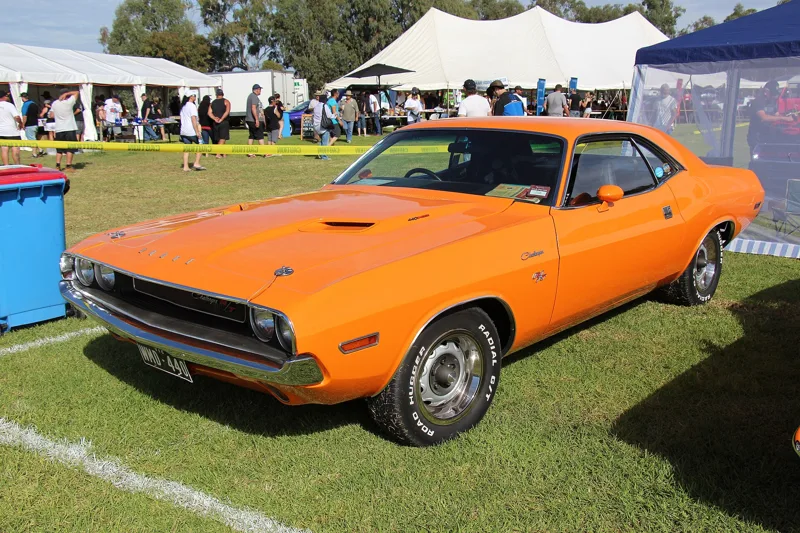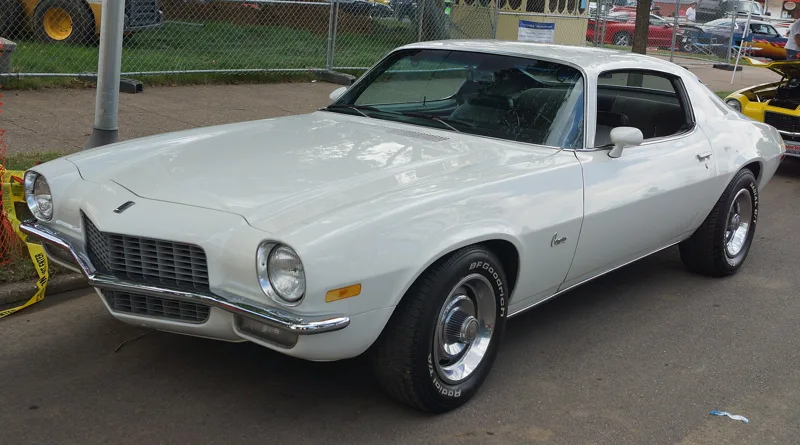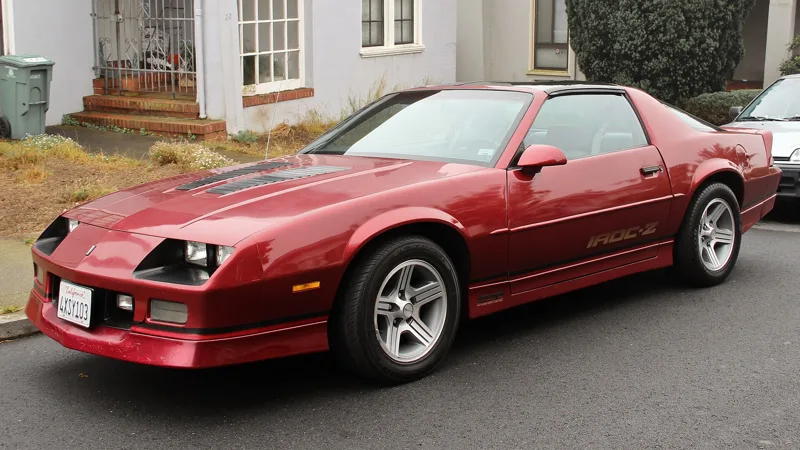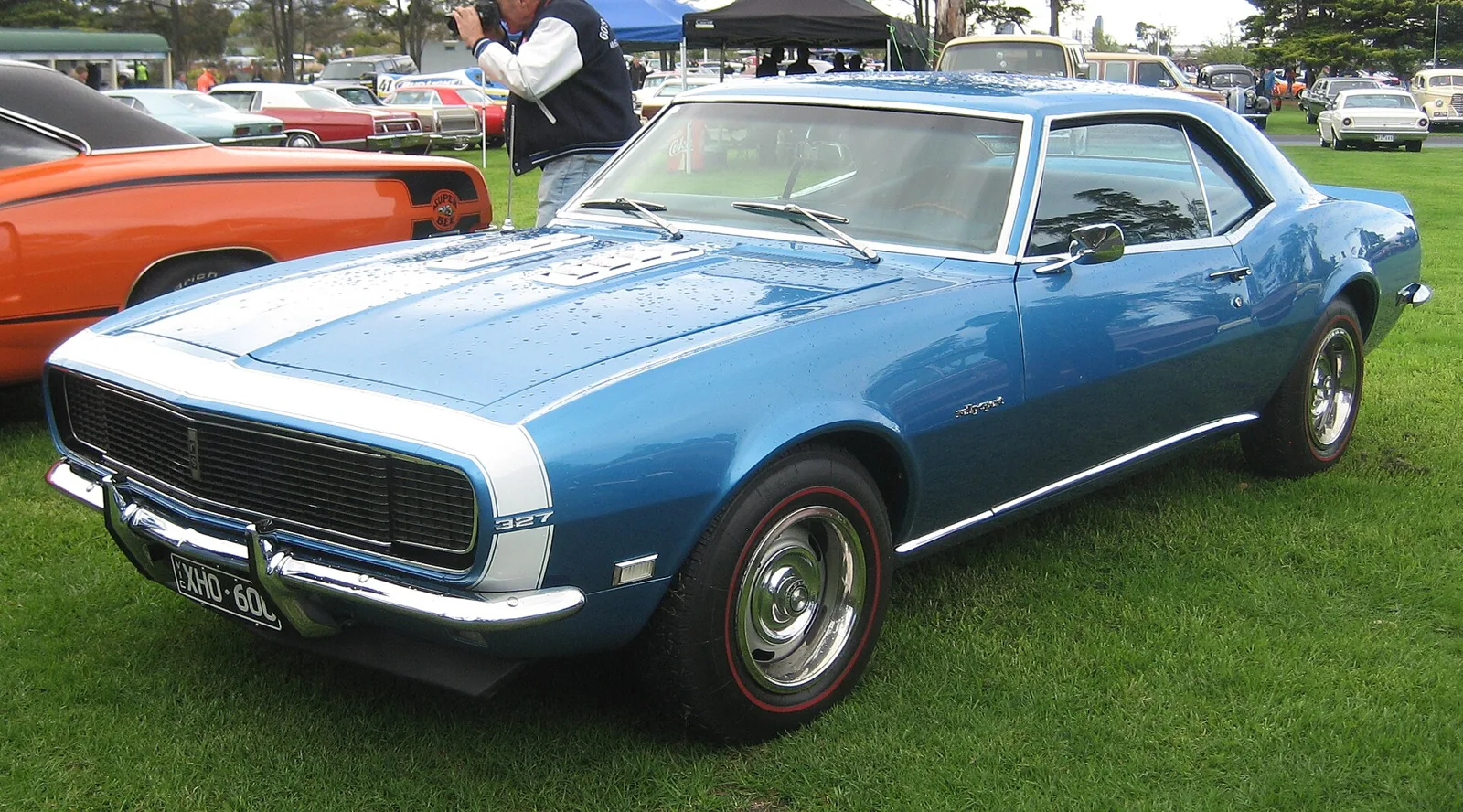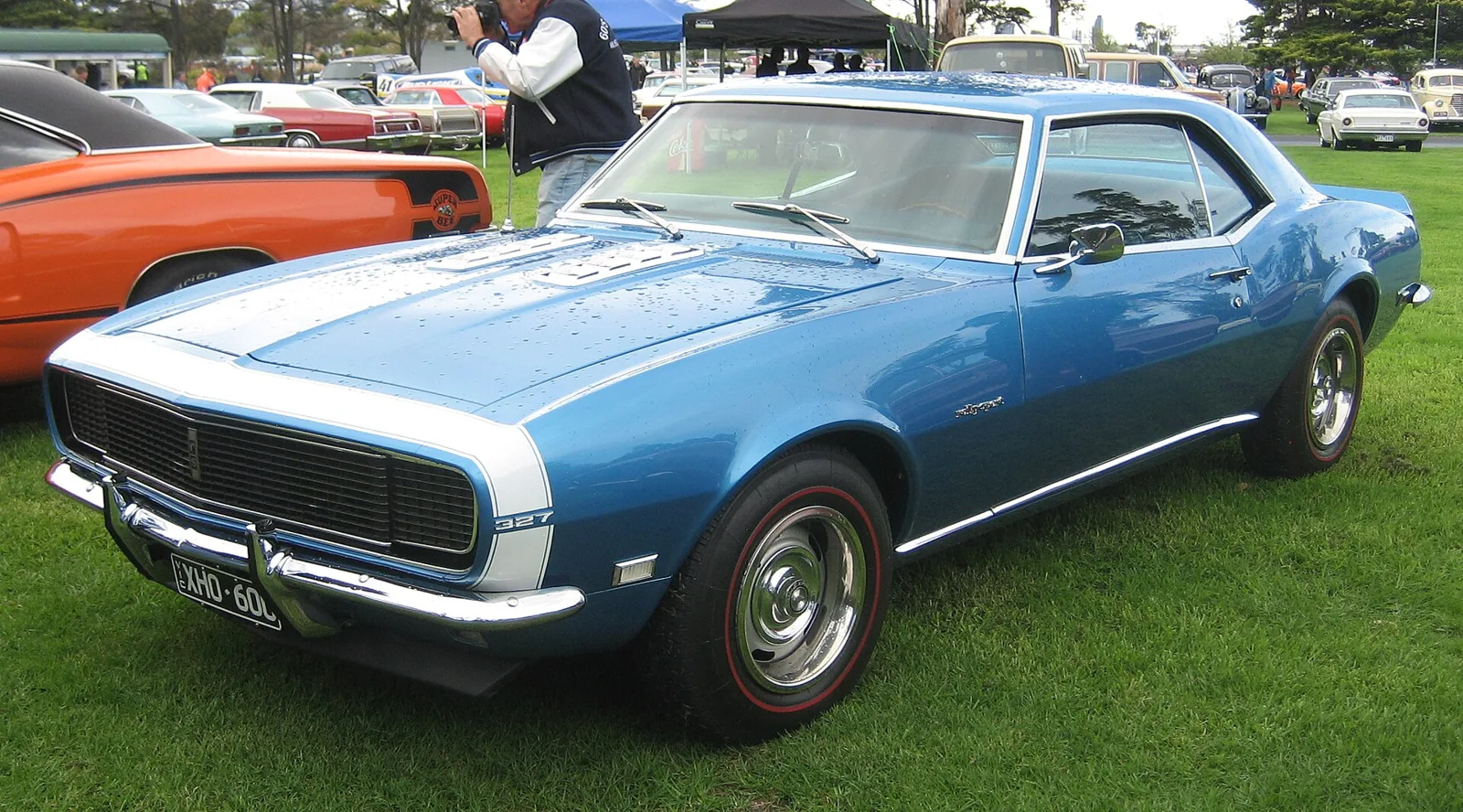
A 1967 Camaro with a Trans-Am bred Z/28 option against a 2005 Mustang whose GT used a 300 hp V8.
The first-generation Chevrolet Camaro was a 1967 to 1969 pony car with a 230 cu in six and a Z/28 V8 built for Trans-Am racing. The fifth-generation Ford Mustang, built from 2005 to 2014, used a 210 hp V6 base and a 300 hp V8 GT on a modern chassis.
The first-generation Chevrolet Camaro and the fifth-generation Ford Mustang are two pony cars separated by nearly four decades, so this comparison is about ideas as much as about machines. The Camaro arrived in the crowded pony car niche in 1967, while the 2005 Mustang revived Ford's name with a retro-futurist look. Each answered the market of its own day, and only one moment in their histories put them head to head.
Did the two ever compete head to head?
The direct contest came in 1969. The Z/28 was built to compete in the SCCA Trans-Am series, and it took Ford until 1969 to mount a head-to-head competitor, the Boss 302 Mustang.
The fifth-generation Mustang came decades later. Its story was about a retro design and about the live-axle chassis that critics attacked, and it was a showroom car rather than a race car on the day it went on sale.
Two pony cars from different decades, joined by a single head-to-head moment: the Z/28 meeting the Boss 302.
What did the first Camaro offer buyers?
The Camaro debuted in autumn 1966 as a 1967 model. Its rear-wheel-drive chassis was a fresh GM F-body design, one that the Pontiac Firebird shared throughout every generation. Buyers could choose a two-door, a 2+2 hardtop or a convertible, and the car was built at Norwood, Ohio and Van Nuys, California, with five more plants outside the United States in the Philippines, Belgium, Switzerland, Venezuela and Peru.
The standard engine was a 230 cu in (3.8 L) straight-six rated at 140 hp (104 kW) at 4,400 rpm, with 220 lb-ft (298 N m) of torque at 1,600 rpm. A three-speed manual was the standard gearbox. Chevrolet offered eight engines in 1967, ten in 1968 and twelve in 1969, along with the two-speed Powerglide, a four-speed manual and, from 1968, the Turbo Hydra-Matic 350 on most V8s.
The 1967 styling came from the team that had drawn the second-generation Corvair. The Camaro shared its subframe and semi-unibody design with the 1968 Chevy II Nova, and it was offered with almost 80 factory options plus about 40 dealer-installed ones. Packages such as the RS, SS and Z/28 gave shape to the range.
How did the SS and RS packages differ?
The SS package was built around V8 power. It included a 350 cu in (5.7 L) engine that produced 295 bhp (299 PS; 220 kW) at 4,800 rpm and torque reached 380 lb-ft (515 N m) by 3,200 rpm. The big-block 396 cu in (6.5 L) options came in two outputs, 325 bhp (330 PS; 242 kW) and 375 bhp (380 PS; 280 kW), peaking at 415 lb-ft (563 N m) at 3,600 rpm. The SS also featured non-functional hood inlets, special striping and SS badging.
The RS package was an appearance option that could be fitted to any model. It hid the headlights behind doors that retracted horizontally, and it added revised taillights with back-up lights under the rear bumper and RS badging. By 1969 the RS option had reached 37,773 orders, and it cost $131.65 on top of the car.
What made the Z/28 a street-legal race car?
The Z/28 option code went into the catalogue in December 1966, a brainchild of Vince Piggins, who wanted race-ready Camaros to be available from any Chevrolet dealer. The package was not mentioned in sales literature, so most buyers never knew it existed. Its 302 cu in (4.9 L) V8 had been designed for the 5-litre class of Trans-Am racing, with a strongly over-square bore of 4 in (101.6 mm) and a stroke of 3 in (76.2 mm).
Chevrolet rated the 302 at 290 hp (216 kW) at 5,300 rpm, deliberately under the true output. Keeping the claimed figure below one horsepower per cubic inch helped with insurance premiums and racing classification. Upgrades included firmer suspension, power front disc brakes, a four-speed Muncie close-ratio manual and a 12-bolt rear axle, along with 15-inch wheels and a pair of wide stripes down the hood and boot.
Sales grew quickly. The Z/28 found 602 buyers in 1967, nearly 7,200 in 1968 and more than 20,000 in 1969. The 1969 version kept the 302 but rated it at 290 hp (294 PS; 216 kW) at 5,800 rpm and 290 lb-ft (393 N m) arriving at 4,200 rpm, with 11:1 compression and forged internals.
Which Camaros were built for the drag strip?
Chevrolet used a special ordering route for its most extreme cars. A General Motors edict kept engines above 400 cu in (6.6 L) out of mid-size models, but dealers had been fitting 427 cu in (7.0 L) engines themselves. Chevrolet responded with two Central Office Production Orders for 1969, numbers 9560 and 9561.
COPO 9561 used a cast-iron L72 big block rated at 425 hp (317 kW) gross, and 460 lb-ft (624 N m) peak torque. Don Yenko ordered 201 of them for conversion into Yenko Camaros, and about 1,000 Camaros in all were fitted with the L72. COPO 9560 was a different animal, an all-aluminum ZL1 built for drag racing, with 69 examples made. Its engine alone cost more than US$4,000, which was more than a base V8 Camaro.
What changed in 1968 and 1969?
The 1968 car was very close to the 1967 design. Astro Ventilation replaced the side vent windows, side marker lights were added for safety, and the mirrors changed from round to square. A 396 cu in engine rated at 350 hp (261 kW) became an SS option, and almost 7,200 Z/28s were sold that year. Chevrolet even built a Z/28 convertible in the Central Office Production Order programme, which its general manager, Pete Estes, approved after driving it.
The 1969 Camaro had new sheet metal apart from the hood, trunk lid and roof, with a grille that had sharper V shapes and deeper-set headlights. Four-wheel disc brakes with four-piston calipers were offered that year under RPO JL8, borrowed from the Corvette. Only 206 were built, and the brakes were a key part of the Trans-Am title win. The model year ran into November 1969 because of production problems with the second generation.
What did the 2005 Mustang bring?
The fifth-generation Mustang, coded S197, was a two-door, four-seat pony car sold as a coupe and a convertible from 2004 to 2014. It was built at the Flat Rock Assembly Plant in Flat Rock, Michigan. Production started on September 7, 2004, and the first 2005 car rolled off the line on September 27. The car was based on the Ford D2C platform and received a facelift for the 2010 model year.
Its design was credited to Sid Ramnarace, and two pre-production concepts were shown at the 2003 North American International Auto Show. The design was frozen in July 2002, with Hau Thai-Tang as chief engineer. J Mays, Ford's design chief, is associated with a look that has been described as retro-futurism, and the car drew inspiration from the 1964 to 1970 Mustang.
How did the 2005 Mustang perform?
The base car used Ford's 4.0 L Cologne SOHC V6, rated at 210 hp (157 kW) at 5,300 rpm; torque of 240 lb-ft (325 N m) arrives at 3,500 rpm. The standard gearbox was a Tremec T-5 five-speed manual, with Ford's 5R55S five-speed automatic as an option. Motor Trend tested a V6 convertible with the automatic and recorded 0 to 60 mph in 7.3 seconds, which was 1.4 seconds quicker than a 2006 Pontiac G6 convertible.
The GT used a 4.6 L three-valve Modular V8 making 300 hp (224 kW) at 5,750 rpm; its torque is 320 lb-ft (434 N m) at 4,500 rpm. The GT completed the quarter mile in 13.7 seconds at 103 mph and ran 0 to 60 mph in 4.9 seconds. It had 12.4-inch front brake discs against 11.4 inches on the V6, and 17-inch wheels with 18-inch wheels optional from 2006.
The live rear axle drew heavy criticism from the motoring press. The rear used a three-link system with a Panhard rod, which kept cost and weight down. Ford said an independent rear would have added $5,000 to the showroom price, and it kept the live axle anyway.
Which trims and options were on offer?
A cheaper V6 Standard model arrived for 2006, starting at US$19,115 MSRP for the coupe and US$23,940 for the convertible. It was US$100 below the V6 Deluxe, with black steel wheels and plastic covers in place of alloys. It was dropped after the 2006 model year, leaving the Deluxe as the base car.
Options grew through the run. The Pony Package from 2006 added GT-derived suspension, 17-inch wheels and a rear deck spoiler to the V6. The V6 Appearance Package, a US$2,398 option in 2008, brought a billet grille and scoops, and the GT/CS package of 2006 brought 18-inch polished wheels. A glass roof for 2009 cost US$1,995, and Shaker premium audio systems were available too.
Specifications side by side
| Feature | Chevrolet Camaro (first generation) | Ford Mustang (fifth generation) |
|---|---|---|
| Years built | 1967 to 1969 | 2005 to 2014 (2004 production start) |
| Body styles | 2-door, 2+2 hardtop and convertible | Two-door coupe and convertible |
| Platform | GM F-body, shared with the Pontiac Firebird | Ford D2C |
| Base engine | 230 cu in (3.8 L) straight-six, 140 hp (104 kW) | 4.0 L Cologne SOHC V6, 210 hp (157 kW) |
| Performance engine | 302 cu in (4.9 L) Z/28 V8, 290 hp (216 kW) | 4.6 L Modular V8 GT, 300 hp (224 kW) |
| Top engine | Big block 396 cu in (6.5 L), up to 375 bhp (280 kW) | Not listed |
| Transmission | Three-speed manual; four-speed manual; automatics | Tremec T-5 five-speed manual; 5R55S five-speed automatic |
| Brakes | Z/28 power front discs; four-wheel discs (JL8, 1969) | GT 12.4-inch front discs; V6 11.4-inch |
| Rear axle | 12-bolt on the Z/28 | Live axle with three-link and Panhard rod |
| Top sales year | Z/28 over 20,000 in 1969 | Not listed |
| Assembly | Norwood, Ohio; Van Nuys, California | Flat Rock, Michigan |
| Designer | Styling team behind the 1965 Corvair | Sid Ramnarace |
Which pony car suits which buyer?
The Camaro suits an enthusiast who wants a car that is part of the first pony-car era, with a choice of straight-six economy or Z/28 race-bred power and a range of packages to build the car around. Its limited-run specials, including the COPO cars and the 1969 disc brakes, are the most distinctive parts of its story.
The 2005 Mustang suits a buyer who wants a modern pony car with a choice of V6 and V8 power, automatic or manual gearboxes and a long list of trims. Its GT offers 300 hp and a 4.9-second 0 to 60 mph run, while the V6 Standard that arrived in 2006 started at US$19,115 for the coupe.
On the evidence here, the two cars cannot be ranked against each other, because they were built about four decades apart. The Camaro brings the rivalry with the Boss 302 and the Trans-Am history, while the Mustang brings a modern chassis, a wider choice of trims and a higher base price. The better car for a given buyer depends on which of those two stories they want to own.