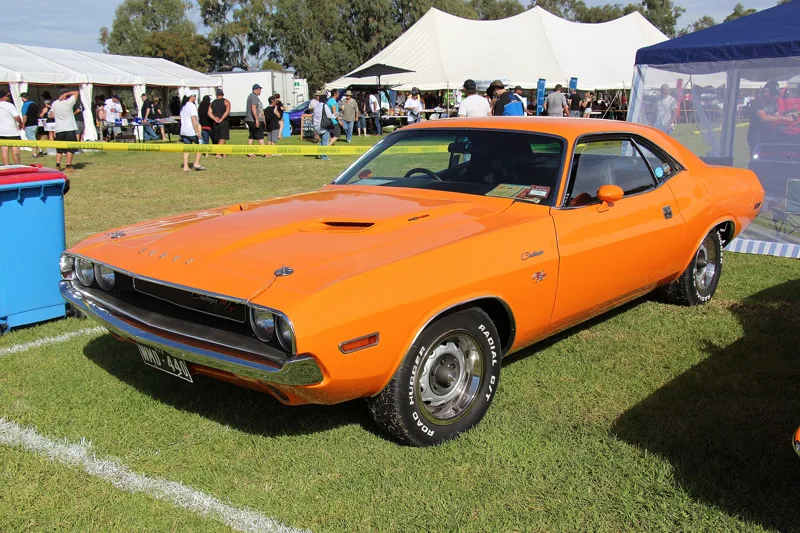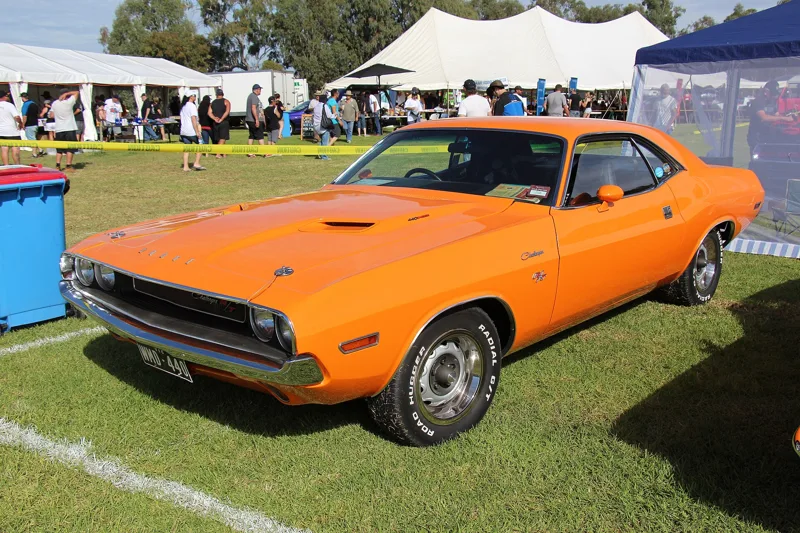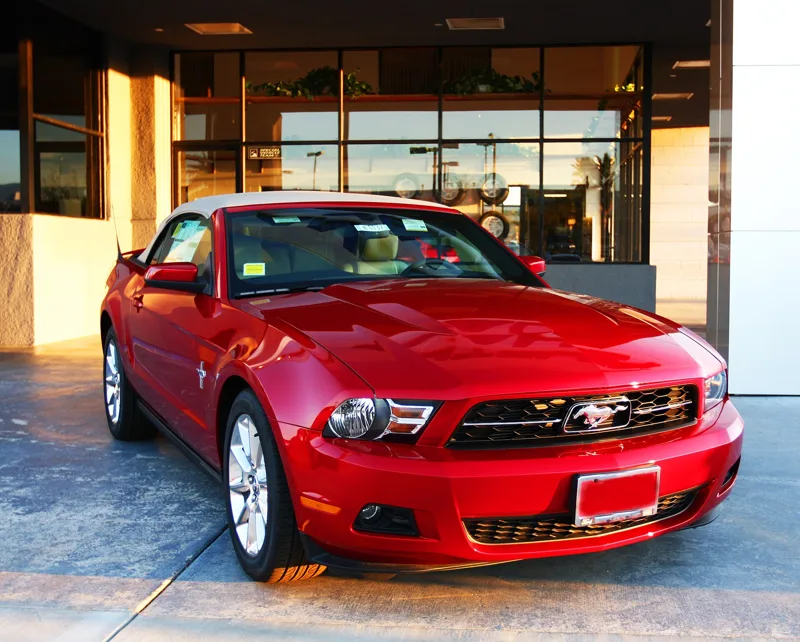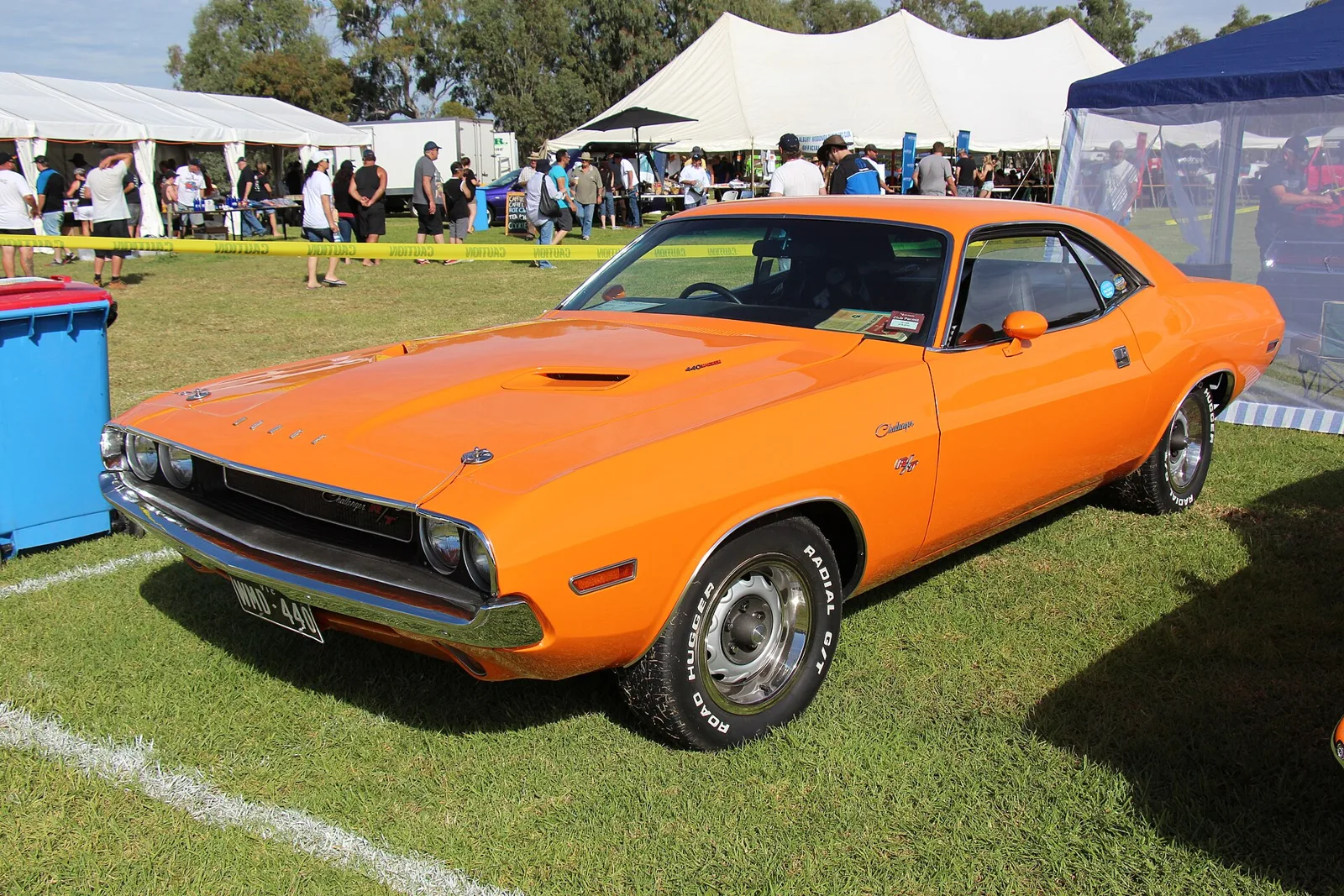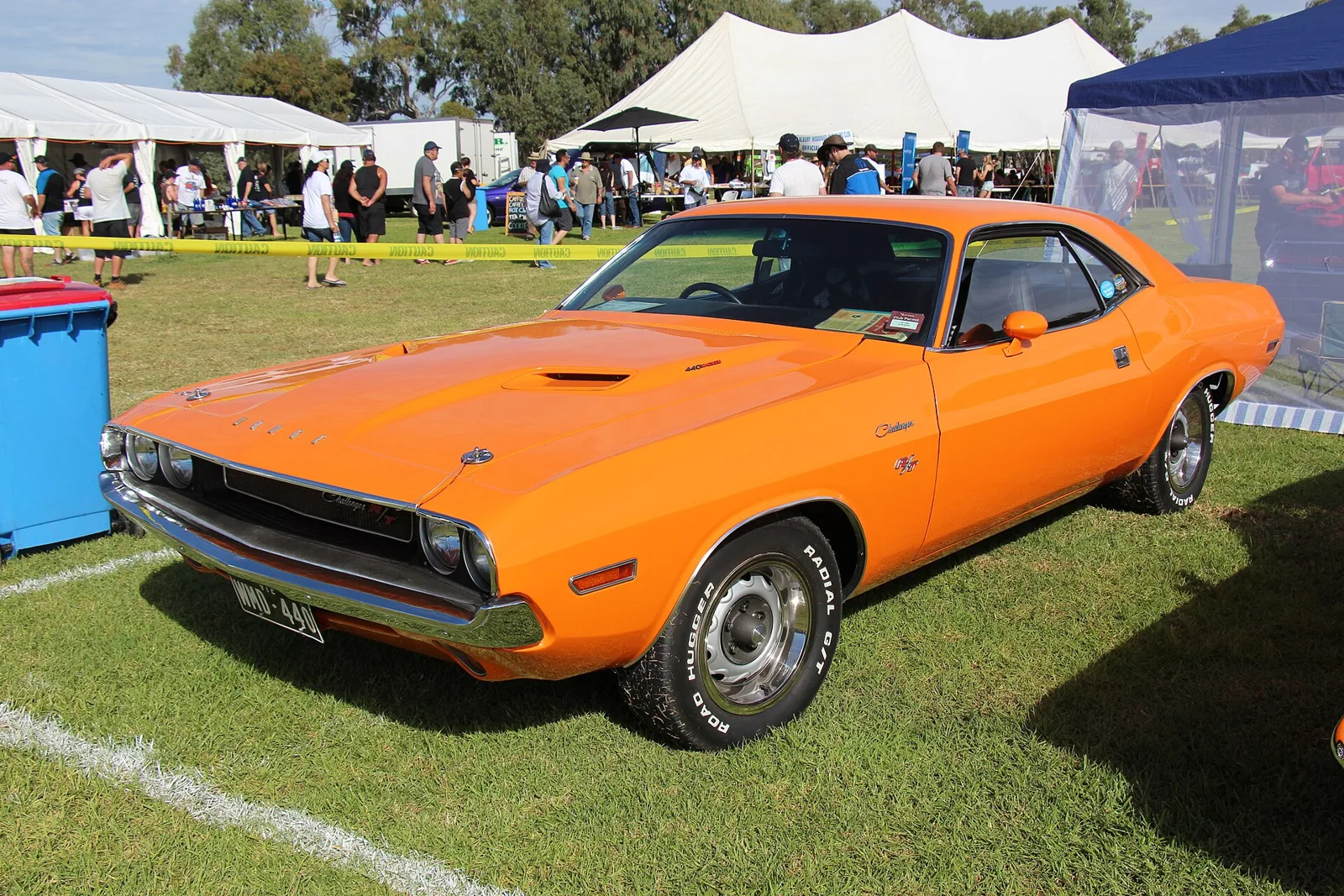
Dodge's 1970 Challenger arrived six years after the Mustang's 1964 debut, and its most potent version was built to answer it.
The 1970 Dodge Challenger was a late answer to the Ford Mustang, which debuted in April 1964, with a 426 cu in Hemi option and a 2,399-car T/A racing homologation. The Challenger was built from 1970 to 1974, while the Mustang in this comparison is the fifth-generation car sold from 2005 to 2014.
The Dodge Challenger of 1970 was a late arrival in the pony car market. The Ford Mustang had debuted in April 1964, and the Challenger followed in the autumn of 1969, shaped to be the most potent pony car Chrysler had ever built. This comparison sets that 1970 Dodge against the Mustang of 2005, a car from a different generation and a different era, so the pairing says as much about the rivalry as about the metal.
Why was the Challenger a late rival?
The Challenger was described as a rather late response to the Mustang, and by the time it arrived the pony car segment was already declining. It sat at the upper end of the market, against the Mercury Cougar and the Pontiac Firebird rather than the Mustang alone. The longer stance, extra size and plusher cabin were a reaction to the 1967 Mercury Cougar, which had set a bigger and more expensive template for the class.
Sales told the rest of the story. The model fell sharply after 1970, and although 27,800 cars were sold for the 1973 model year, production stopped midway through 1974. Some 165,437 first-generation cars were made in all. Chrysler had hoped for the most potent pony car ever, and the figures show a niche that was shrinking by the time the car reached showrooms.
A late pony car with a 425 hp Hemi option, set against a Mustang whose own history began in April 1964.
How was the Challenger built?
The first-generation Challenger used the Chrysler E platform for model years 1970 to 1974. It came as a hardtop or a convertible and shared major components with the Plymouth Barracuda. The Challenger's 110 in (2,800 mm) wheelbase was 2 in (51 mm) longer than the Barracuda's, and the two cars looked different at the front, with the Challenger carrying four headlights against the Barracuda's two in every year except 1971.
Carl Cameron penned the exterior, and he had also been responsible for the 1966 Dodge Charger. The grille borrowed from an earlier, unbuilt 1966 Charger concept, one meant to carry a turbine. The body style itself stayed the same across the five-year run.
What engines did the 1970 Challenger offer?
The base Challenger came with a 225 cu in (3.7 L) straight-six, and the higher trims used a 318 cu in (5.2 L) V8 with a two-barrel carburetor. Optional V8s included the 340 and 383 cu in (5.6 and 6.3 L) and the 440 and 426 cu in (7.2 and 7.0 L). Most were paired with a standard three-speed manual, while the 290 hp 383 came only with the TorqueFlite automatic.
The performance car was the R/T, which used a 383 cu in (6.3 L) Magnum V8 rated at 335 hp (250 kW) for 1970 and 300 hp (224 kW) for 1971 after a drop in compression. Upgrades included a 375 hp (280 kW) 440 Magnum, a 390 hp (291 kW) 440 Six-Pack and the 426 cu in Hemi, rated at 425 hp (431 PS; 317 kW) at 5,000 rpm with 490 lb-ft (664 N m) of torque at 4,000 rpm.
The R/T's Rallye cluster included a 150 mph speedometer and an 8,000 rpm tachometer, and an oil pressure gauge. The shaker hood scoop was dropped after 1971, and a low-priced Deputy coupe joined the range mid-year in 1970, named after a sheriff-type character Dodge used in its television commercials.
What was the Challenger T/A?
The 1970 T/A was a homologation car for the SCCA Trans-Am Sedan Championship. Dodge produced a road version of the race car, which took the 340 engine and fitted three two-barrel carburetors on an aluminum intake to make the 340 Six Pack. Dodge rated it at 290 hp (216 kW), only 15 hp more than the standard 340, and the same rating appeared on the Camaro Z/28 and the Ford Boss 302 Mustang.
The T/A had a matte-black fiberglass hood with a suitcase-sized air scoop, a dual exhaust that exited in chrome-tipped outlets ahead of the rear wheels, and a Rallye suspension with heavier parts. It was one of the first American muscle cars with different tyre sizes front and rear, E60x15 at the front and G60x15 at the back. Front disc brakes were standard. A total of 2,399 T/As were made.
How did the T/A fare in racing?
Dodge contracted Ray Caldwell's Autodynamics of Marblehead, Massachusetts to run its factory Trans-Am team. Posey was behind the wheel of No. 77, a car built up from a model taken off a dealer's floor. The No. 76 arrived mid-season on a chassis from Dan Gurney's All American Racers, and Ronnie Bucknum and Tony Adamowicz drove it at Seattle and Riverside.
The T/As scored a few top-three finishes, but Dodge had no development budget and the race engines built by Keith Black were short-lived. The company left the series at the end of the season. The street car was also known for severe understeer in fast corners, largely because of its smaller front tyres.
How did the Challenger change from 1971 to 1974?
In 1971 the Coupe took over as the entry-level car, offered with a straight-six or a V8, and it kept the fixed rear quarter windows that the Deputy had carried. The split grille of 1971 gave way in 1972 to a design that extended beneath the front bumper, which owners nicknamed the sad-mouth.
For 1972 the options lists were cut back drastically. The convertible was dropped, along with leather seats, power windows and the big-block engines. The Rallye series took the place of the R/T, and the engine list shrank to a 225 cu in slant-six, a 318 V8 and a 340 V8 with a four-barrel carburetor. All three were detuned to run on lead-free petrol, and their ratings were restated in the more accurate SAE net figures.
The 1973 and 1974 models carried the 1972 front and rear and added the mandatory 5 mph bumpers, and the six-cylinder engine was dropped. For 1974 a 360 cu in (5.9 L) unit rated at 245 hp (183 kW) took over from the 340, and production ended in late April 1974.
How did the Challenger sell abroad?
Dodge mainly built the Challenger for the United States and Canada. Chrysler sold it in Switzerland through AMAG, based at Schinznach-Bad, near Zurich. Just a handful crossed each year, and AMAG completed the final assembly and converted them to Swiss specification. Those cars are now highly prized, with fewer than five Swiss Challengers thought to survive in North America. Chrysler also tried France, through its Chrysler France Simca operation. Ford was selling the Mustang there in small numbers, but few Challengers were exported, and the company eventually dropped the idea.
Why are Challengers prized today?
Low total production and poor survival rates have turned almost any surviving Challenger into a valuable car. The Edmunds Inside Line team reviewed the model years in hindsight and ranked 1970 as a great year and 1971 as a good one, then described the three years that followed as progressively weaker. That ranking shows why collectors focus on the first model year.
How did the 2005 Mustang come to market?
Work on the fifth-generation car, coded S197, began in 1999, led by chief engineer Hau Thai-Tang and a little after the 1998 New Edge facelift of the earlier car. Design work started under Ford design chief J Mays from the second half of 1999, and the design was frozen in July 2002. Two pre-production concepts were built in that window, a convertible and a coupe.
The coupe concept was a Tungsten Silver GT with a glass roof, functional hood scoops and a supercharged 4.6 L engine rated at 400 hp (298 kW; 406 PS). The convertible was a Redline Red Metallic GT with 20-inch wheels and 13.8-inch cross-drilled Brembo brakes. Both were shown at the 2003 North American show, and Barrett-Jackson's 2009 Palm Beach sale took US$175,000 for each before buyer premium.
What did the 2005 Mustang include as standard?
The 2005 car came with power windows and mirrors, central locking with remote keyless entry, dual front airbags, an AM/FM stereo with CD player, and 16-inch painted aluminum wheels. The brakes were larger than the previous Mustang's, with twin-piston calipers at the front. Anti-lock brakes with traction control were standard on the GT.
Options included Ford's MyColor instrument cluster and brushed aluminum panels, both part of the Interior Upgrade package, plus the Shaker 500 and Shaker 1000 premium audio systems, leather seating and a six-way power driver seat. The Pony Package arrived for the V6 in 2006, adding GT-style suspension and 17-inch wheels, and in 2009 a glass roof costing US$1,995 was added as a new option.
The 2008 model year brought seats made partly from soy-derived material, in keeping with some of Henry Ford's ideals. Ford Sync reached the 2009 model only as a kit fitted by dealers.
Specifications side by side
| Feature | Dodge Challenger (1970) | Ford Mustang (fifth generation, 2005) |
|---|---|---|
| Introduced | Autumn 1969, 1970 model year | 2005 model year (production from September 2004) |
| Body styles | Hardtop and convertible; Deputy coupe | Coupe and convertible |
| Platform | Chrysler E platform, shared with the Barracuda | Ford D2C platform |
| Base engine | 225 cu in (3.7 L) straight-six | 4.0 L Cologne SOHC V6, 210 hp (157 kW) |
| Top engine | 426 cu in Hemi, 425 hp (431 PS; 317 kW) | 4.6 L Modular V8 GT, 300 hp (224 kW) |
| Performance package | R/T and T/A (340 Six Pack, 290 hp) | GT and Shelby GT-H (319 hp) |
| Transmission | Three-speed manual; TorqueFlite automatic; four-speed option | Tremec T-5 five-speed manual; 5R55S five-speed automatic |
| Brakes | Front discs standard on the T/A | GT 12.4-inch front discs; V6 11.4-inch |
| Quarter mile or 0 to 60 mph | Not listed | GT 13.7 seconds at 103 mph; 0 to 60 mph in 4.9 seconds |
| Rear axle | Not listed | Live axle with three links and a Panhard rod |
| Sales | 165,437 first-generation cars | Not listed |
| Racing record | Factory Trans-Am team, 2,399 T/As built | Not listed |
Which pony car suits which buyer?
The Challenger suits a buyer who wants a late-1960s and early-1970s muscle car with a choice of engines that ran from a straight-six to a 425 hp Hemi. The T/A adds a racing story, with its Trans-Am homologation and its different-sized tyres, and the 1970 cars are the ones most often rated the strongest.
The 2005 Mustang suits a buyer who wants a modern pony car with a choice of V6 or V8 power, manual or automatic gearboxes and a long list of options. Its GT offers 300 hp and a quarter mile in 13.7 seconds at 103 mph, while the V6 Standard began at US$19,115 for the coupe in 2006.
On the evidence here, neither car is a clear winner, because they were built nearly four decades apart. The Challenger brings the Hemi, the T/A and a place in the late pony car story, which Edmunds Inside Line rated as a great model year for 1970, while the Mustang brings a modern chassis, a wider trim list and a longer production run in its own generation. The choice depends on whether the buyer wants a car of its period or a car for daily use.