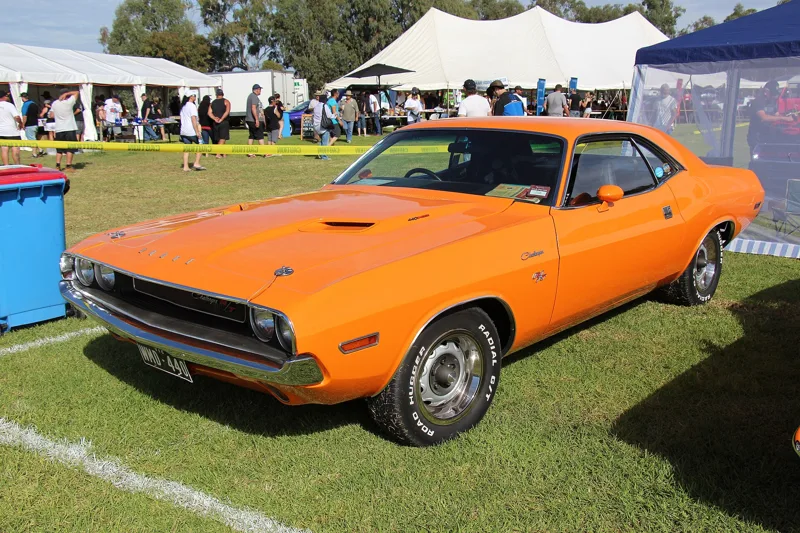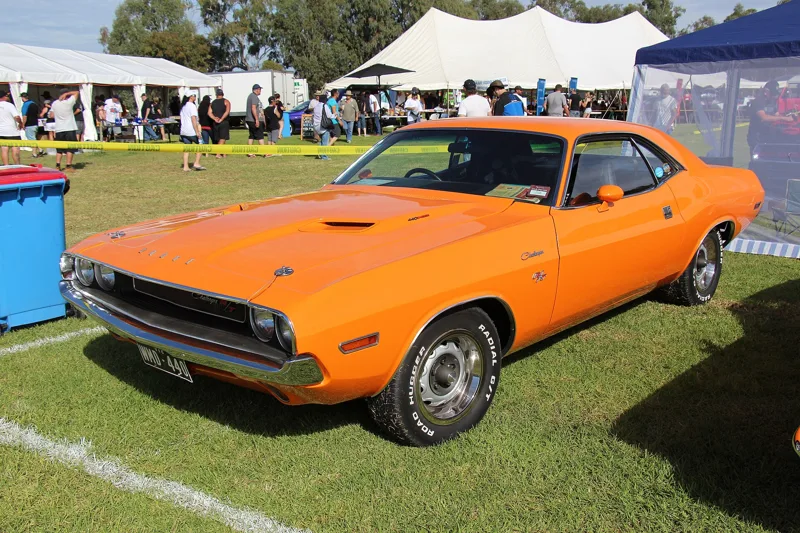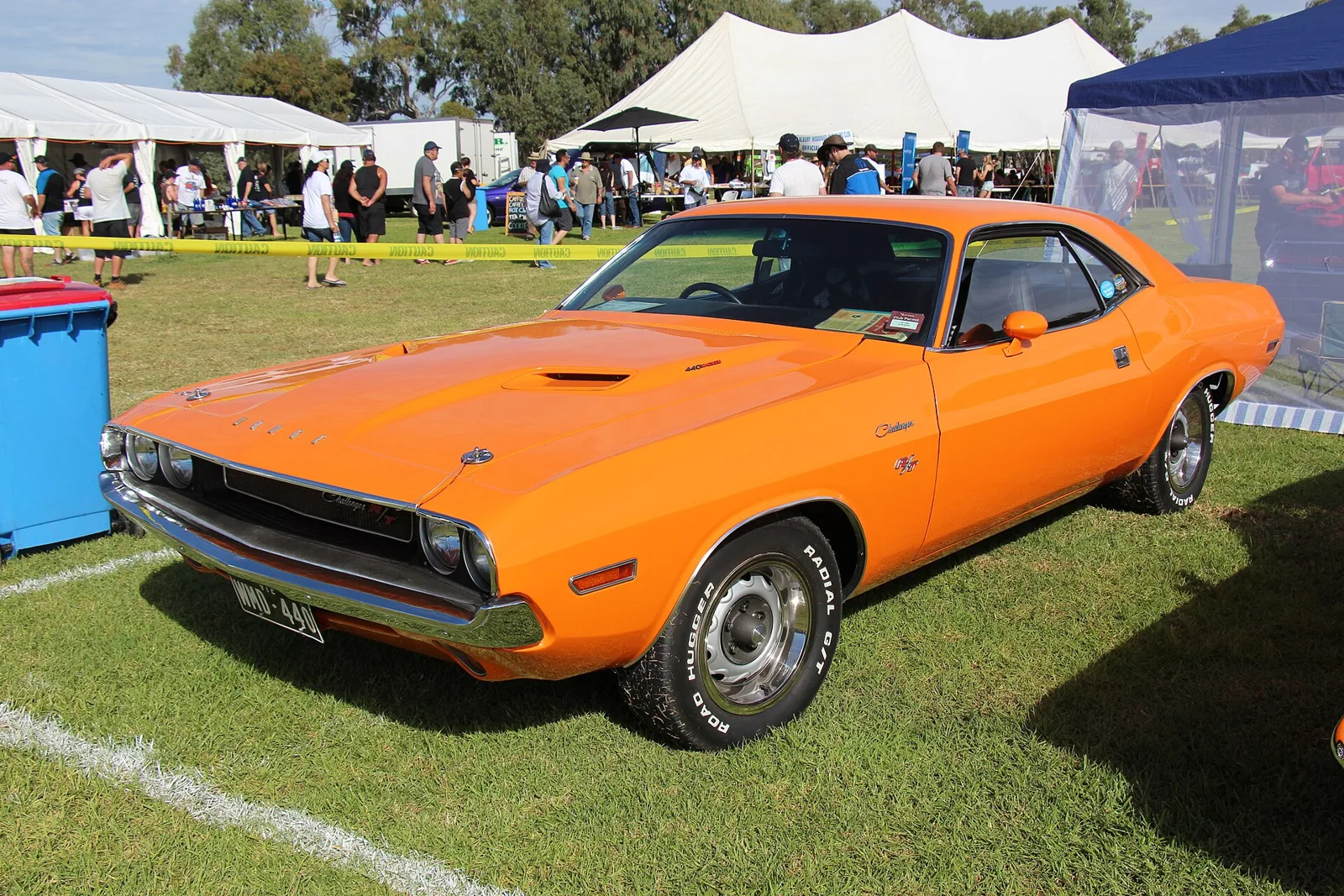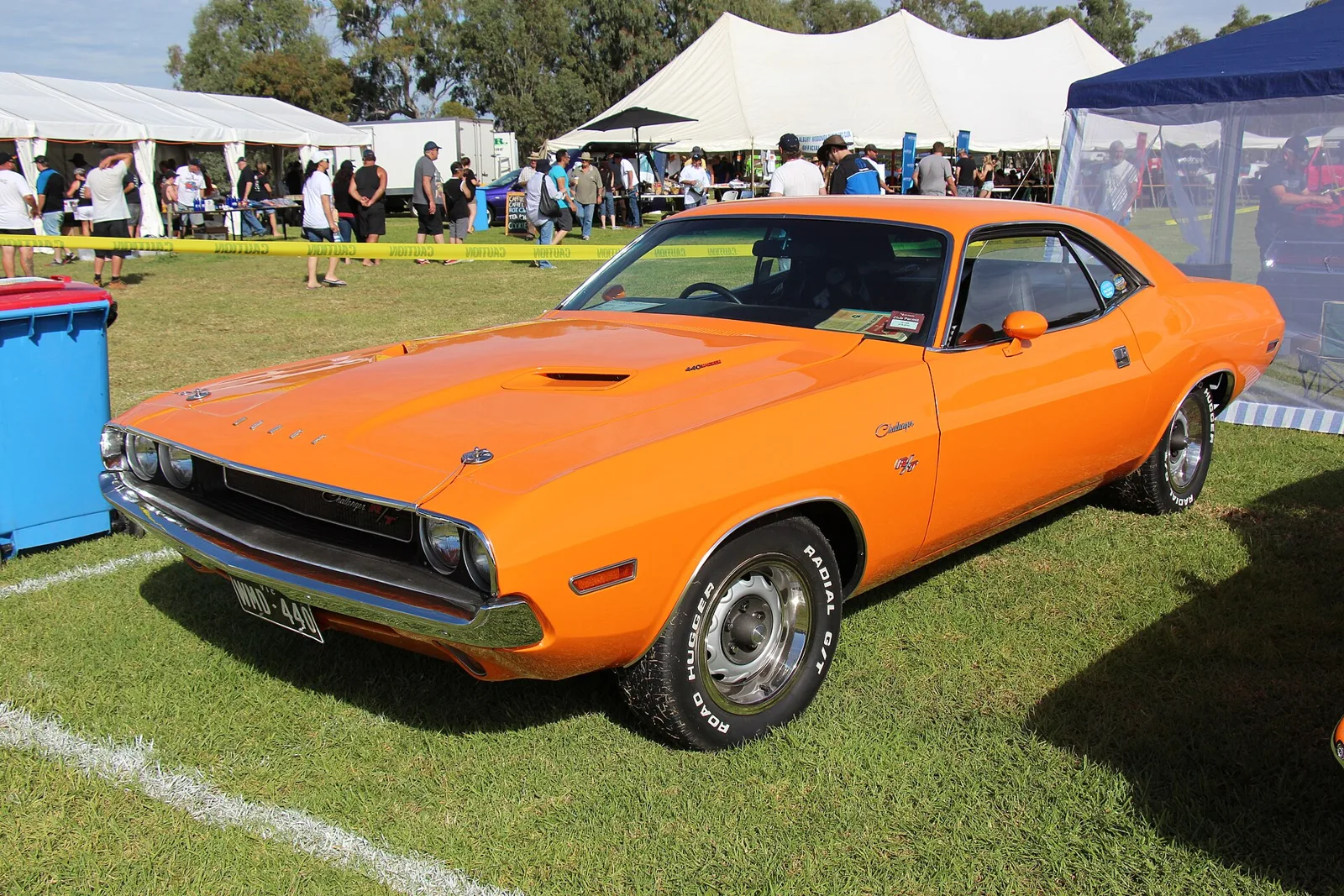
A late pony car on Chrysler's E platform, sharing its hardware with the Plymouth Barracuda, with a Trans Am homologation special and a short production run.
Built from 1970 to 1974 on the Chrysler E platform, the first-generation Challenger was a pony car with hardtop and convertible bodies. The 426 Hemi was the most powerful engine offered, and 165,437 cars were sold across its five-year run.
Dodge's first Challenger arrived for 1970 as a hardtop and convertible pony car, sharing much of its hardware with the Plymouth Barracuda. Production ran until late April 1974, and 165,437 first-generation cars were sold in that time.
Why did Dodge enter the pony car market in 1970?
Dodge introduced the Challenger in autumn 1969, aimed at the 1970 model year, as a late answer to the Ford Mustang, which had debuted in April 1964. Chrysler meant it to be the most potent pony car ever, and it competed with the Mercury Cougar and Pontiac Firebird.
The name had a history of its own. Dodge first used Challenger in 1959, for a value version of the full-size Coronet Silver Challenger, and the 1970 car revived it for a very different machine.
Alongside the Barracuda, the Challenger formed a pair of Chrysler E-body cars, and the Barracuda was the slightly smaller of the two. Its longer wheelbase and larger dimensions were a response to the 1967 Mercury Cougar, a larger and pricier pony car aimed at well-off young buyers.
The Challenger stood 2 in (51 mm) further between the axles than the Barracuda, at 110 in (2,800 mm), and the sheet metal differed substantially between the two cars. Buyers could add air conditioning and a rear window defogger, and the front ends differed too, with the Challenger's four headlights set against the Barracuda's two, except in 1971.
A late answer to the Mustang, built on the E platform and aimed at the top of the pony car market.
Who designed the Challenger's look?
Carl Cameron penned the exterior, and he had also drawn the 1966 Dodge Charger. Cameron drew the grille from a sketch made years earlier for a 1966 Charger prototype that never reached production and would have used a turbine.
The pony car segment was already in decline when the Challenger arrived. Sales fell sharply after 1970, although the 1973 model year pulled up to over 27,800 cars sold before the end came.
What engines did the 1970 Challenger offer?
The base car used a six of 3.7 L (225 cu in), while higher trims came with a V8 of 5.2 L (318 cu in) and a two-barrel carburettor. Bigger options were the 5.6 L (340 cu in) and 6.3 L (383 cu in) V8s, then 7.2 L (440 cu in) and 7.0 L (426 cu in) units at the top.
Only the TorqueFlite automatic could be paired with the 383 that made 216.3 kW (290 hp), while the rest of the range could take a four-speed manual, apart from the six and the two-barrel 383.
On the R/T, the Magnum V8 displaced 6.3 L (383 cu in) and produced 250 kW (335 hp) in 1970, before 224 kW (300 hp) for 1971 after a compression cut. The Hemi, a 7.0 L (426 cu in) unit, put out 317 kW (425 hp) and 664 N m (490 lb ft) of torque, reached at 4,000 rpm.
What did the R/T package include?
The R/T, or Road/Track, was the performance model and came as a hardtop or convertible. Its Rallye cluster had a 150 mph (240 km/h) speedometer and an 8,000 rpm tachometer, and a three-speed manual was standard.
Further up the R/T list came the 440 Magnum at 280 kW (375 hp), the 440 Six-Pack at 291 kW (390 hp), and the 426 Hemi. The shaker hood scoop was not offered after 1971.
A mid-year Challenger Deputy coupe, with fixed rear quarter windows, was a low-priced alternative. It took its name from a sheriff-type character that Dodge featured in its television commercials.
What was the Challenger T/A?
The Challenger T/A, short for Trans Am, was a racing homologation special for 1970 only. To qualify for the series, Dodge built a street version of the race car, and only 2,399 T/As were made.
Street T/As took the 340 and added three two-barrel carburettors on an aluminium intake, creating the 340 Six Pack, rated at 290 hp (216 kW), 15 hp (11 kW) above the standard 340. Air entered through a suitcase-sized scoop in the matt-black fibreglass hood.
From the stock muffler spot, the exhaust doubled back to megaphone outlets at the front of the rear wheels, finished in chrome. Front disc brakes were standard, and the Rallye suspension used heavy-duty parts and firmer rear springs.
It was among the earliest American muscle cars to run different tyre sizes front and rear, with E60x15 Goodyear Polyglas at the front and G60x15 at the rear. A fibreglass ducktail spoiler and a front spoiler completed the look, while the interior matched other Challengers.
How did the T/A fare in the Trans Am series?
Dodge's factory Trans Am effort was run by Caldwell's Autodynamics team, based in Marblehead, Massachusetts, with Sam Posey at the wheel of the No. 77 car. Posey's team scored a few top-three finishes, but Dodge left the series at season's end.
The No. 77 car was painted sub-lime and started life on a dealer's showroom floor. The second car, No. 76, reached the team mid-season as a chassis that Autodynamics completed; it came from Dan Gurney's All American Racers, while Posey shared time between them.
At Seattle the No. 76 went to Ronnie Bucknum, and at Riverside to Tony Adamowicz. The street version suffered severe understeer in fast corners, largely because of its smaller front tyres.
Production totalled 2,399 T/As. An advertised 1971 version with a 340 four-barrel never got built, because Dodge had already withdrawn from the race series.
What changed for 1971 and 1972?
For 1971 the Coupe became the entry-level model, with fixed rear quarter windows and a basic steering wheel. For 1972 the options were slashed, the R/T gave way to the Rallye, and the convertible was dropped.
The 1972 engine list shrank to three: a 3.7 L (225 cu in) slant-six, a 5.2 L (318 cu in) V8, plus a 5.6 L (340 cu in) V8 breathing through a four-barrel carburettor, with dual exhausts. All were detuned for lead-free petrol and rated on the more realistic SAE net figures.
The Rallye had simulated vents on its front fenders, with matte black strobe stripes running from them. The grille extended beneath the front bumper, and the tail lamps were replaced, while the performance axle ratios were almost gone.
A few convertibles built late in 1971 wore the 1972 front end. The clue is the fender tag, where a dealer order number beginning with R marks a special car.
How did the 1973 and 1974 cars differ?
The 1973 and 1974 cars kept the 1972 grille and tail-lamp arrangement, added mandatory 5 mph bumpers, and dropped the six-cylinder engine. For 1974, the 340 gave way to a 360 cu in (5.9 L) engine rated at 245 hp (183 kW).
Sales rose for 1973, though the pony car market had weakened, and the line stopped in late April 1974. The 1974 cars also got bigger rear guards to satisfy the rear 5 mph impact rule.
How can you tell the model years apart?
The grille is the main clue. The 1971 cars had a split grille, while 1972 onward had the extended grille that owners called the sad-mouth. The 1972 cars had flush bumpers without guards, while the 1973 and 1974 cars had protruding 5 mph bumpers.
The taillights changed too. The 1970 units spanned the full rear, with the backup light set in the middle, the 1971 backup lights moved to the sides, and from 1972 the car had four individual rectangular lamps.
What was the Challenger's export story?
Chrysler sold Challengers officially in Switzerland through AMAG in Schinznach-Bad, near Zurich. AMAG did the final assembly and converted each car to Swiss specification, and few of those cars survive.
Challengers were mainly built for the US and Canada. Chrysler also tried France through Chrysler France Simca, but only a few cars were sent and the idea was dropped.
Did the Challenger race beyond the Trans Am?
Dodge's early to mid-1970s Kit Car programme for short-track late-model stock cars used a Challenger, but fewer than 12 were made. The Challenger line was ended in 1974, and the stock-car work moved to the Dart Sport and Aspen bodies over a steel-tube chassis.
Are first-generation Challengers collectible?
Enthusiasts still value the E-body cars, and low production plus poor survival rates make any example worth a substantial sum. Edmunds Inside Line rated 1970 as a great year, 1971 as a good one and the three years after as progressively weaker.
What were the Challenger's core specifications?
| Specification | Detail |
|---|---|
| Model years | 1970-1974 |
| Platform | Chrysler E-body, shared with the Barracuda |
| Wheelbase | 110 in (2,800 mm) |
| Base engine | 3.7 L (225 cu in) straight-six |
| Top engine, 1970 | 7.0 L (426 cu in) Hemi, 317 kW (425 hp) at 5,000 rpm |
| R/T engine | 6.3 L (383 cu in) Magnum, 250 kW (335 hp) in 1970 |
| T/A engine | 340 Six Pack, 216 kW (290 hp) |
| Challenger T/A built | 2,399 |
| Total built | 165,437 |
| Production end | Late April 1974 |
The Challenger's engine range ran from the straight-six base car to the 426 Hemi, the most powerful option of 1970. Its wheelbase and body set it apart from the shorter Barracuda, even though the two cars shared much of their hardware.