Carroll Shelby's company turned British bodies and American V8s into the Cobra, won Le Mans with the GT40, then reshaped the Mustang before several revivals.
Shelby American was founded by racing driver Carroll Shelby, whose Venice, California shop opened in 1962. It built the Cobra, ran Ford's GT40 to Le Mans wins and produced the GT350 and GT500 Mustangs, and it has since been revived several times.
Shelby American is the company Carroll Shelby founded to turn British sports car bodies and American V8s into the Cobra, then to race the GT40 for Ford and to build the Mustang GT350 and GT500. Its original Venice, California shop opened in 1962, and the name has since been used by several legally distinct companies. Its story runs from Le Mans wins to a Chrysler partnership and a short-lived sports car project.
Who founded Shelby American and where did it start?
Carroll Shelby, a racing driver, founded Shelby American. He first opened a sports car dealership in Dallas in 1957 with Dick Hall, selling Maseratis across the American Southwest. In April 1962 he leased a building in Venice, Los Angeles, and founded Shelby American, Inc. there.
The Dallas partners raced Maseratis in the 1957 SCCA National Sports Car Championship. Across the Atlantic, Brian Lister's company had found racing success by fitting a Jaguar XK engine to its sports cars, and Shelby and Hall visited Lister in England with the idea of putting a Chevrolet small-block into a Lister body.
They returned to Dallas with six cars, sold five, and used the sixth for the Chevrolet engine, which Hall raced in the SCCA National Championship. That was Shelby's first experience of fitting an American V8 to a British sports car body.
In 1959, with funding from the oil-drilling businessman and amateur racer Gary Laughlin, Shelby and Hall approached General Motors for a Corvette chassis and engine in a lighter aluminium body. Three cars were delivered with bodies by Carrozzeria Scaglietti, but General Motors then refused to supply more rolling chassis, fearing the cars would compete with its own Corvette.
A British body, an American V8 and a founder whose racing record ran from Le Mans to the Mustang.
How did the Cobra come about?
The Cobra began when AC Cars of Britain agreed in September 1961 to let Shelby fit American V8s to its sports car body. Ford supplied two Windsor V8s in November 1961, and the first AC body arrived in February 1962. Shelby and Dean Moon installed the engine and a Borg-Warner T-10 gearbox to make the first Cobra.
AC needed a new engine source because Bristol Cars had stopped making the six-cylinder engine that AC used in its Ace. Under the deal, AC would ship bodies from its Thames Ditton works in Surrey to Shelby in California, provided a suitable American V8 could be found. General Motors had already turned down Shelby's request for Chevrolet V8s, so he turned to Ford.
Shelby leased the Venice building that Lance Reventlow's Scarab company had been using, and Phil Remington, Scarab's chief engineer, was hired to keep working on the Cobra.
Did the Cobra win races?
Yes, though the record depended on the series. Shelby American began racing the Cobra in autumn 1962 with Bill Krause at the Los Angeles Times Grand Prix on 13 October, and Cobras dominated the SCCA United States Road Racing Championship in 1963. The open-top body held the car back in the FIA World Sportscar Championship.
Krause did not finish that first race after breaking an axle shaft, but the car was competitive with the Corvette Sting Ray Z06, which was making its own racing debut. The problem was aerodynamics. The open Cobra could not reach the top speeds of hardtop rivals, particularly the Ferrari 250 GTO.
What was the Daytona coupe?
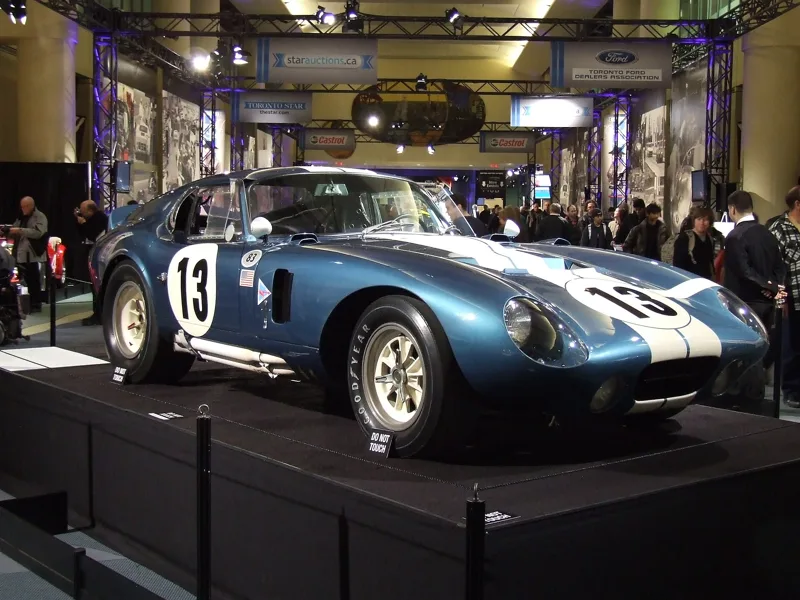
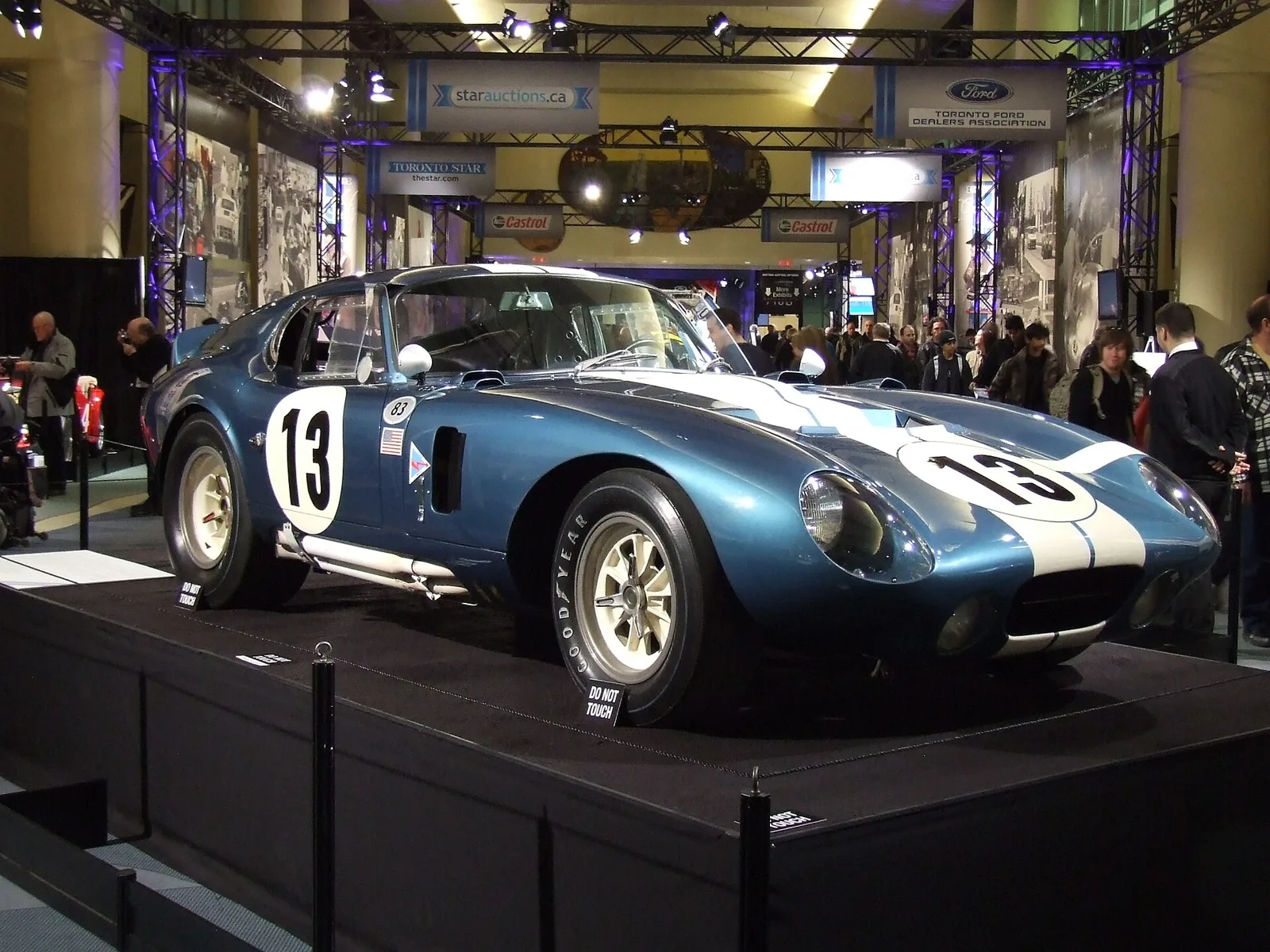
The Daytona coupe was a 1964 aerodynamic body that Pete Brock designed for the Cobra chassis. It was capable of speeds over 190 mph, and it was named for its first race at the Daytona International Speedway. Only one was completed at Shelby American, and the other five had their bodywork finished at Carrozzeria Gransport in Modena, Italy.
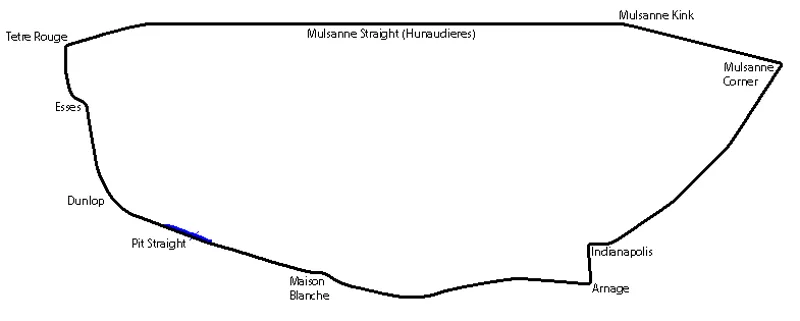
Driven by Dan Gurney and Bob Bondurant, the Daytona finished fourth overall at the 1964 24 Hours of Le Mans, and it topped the GT classes. Only two prototype Ferraris, the 275 P and the 330 P, finished ahead of it. The Daytona later won the GT Division III class in 1965 on the strength of wins at Daytona, Sebring, Monza and the Nurburgring.
That 1965 form gave Shelby the International Championship for GT Manufacturers, and with it the first international FIA world title won by an American constructor.
How did Shelby end up running the Ford GT40?
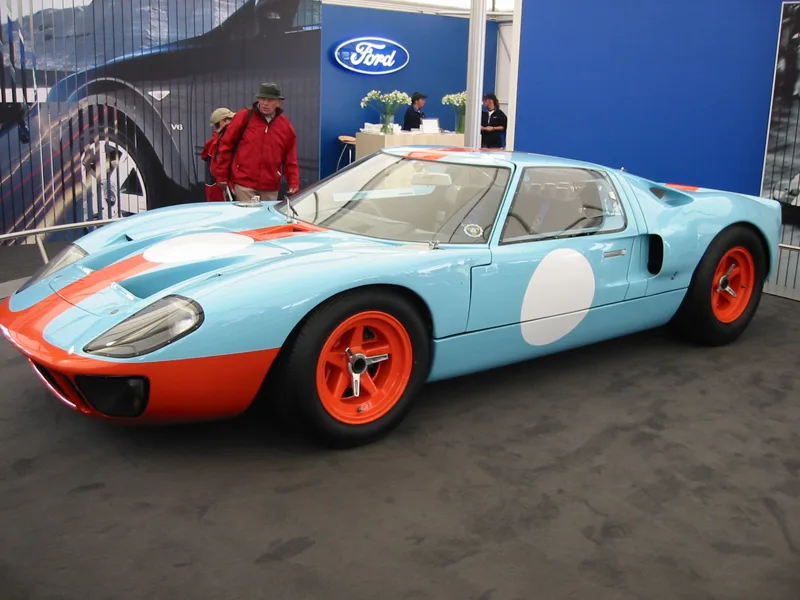
Ford handed control of the GT40 programme to Shelby American in December 1964, after none of its three cars entered at Le Mans that year had finished. Under Shelby's management, Lloyd Ruby and Ken Miles won the first GT40 race of 1965 at Daytona, and Miles and Bruce McLaren took the prototype class at Sebring.
Shelby worked with Ford to re-engineer the GT40 for 1966, replacing the 289 cubic inch (4.7 L) engine with Ford's larger 427 cubic inch (7.0 L) unit. The Mk II GT40 won at Daytona, Sebring and Le Mans, and those results carried Ford to the 1966 International Manufacturer's Championship.
At Le Mans McLaren and Chris Amon won, while Ken Miles and Denny Hulme finished second. Miles and Ruby also won at Daytona and Sebring. Gurney and Jerry Grant were second at Daytona, and they would have been second at Sebring too, had their car not broken down on the last lap. Gurney pushed it across the line, which led to automatic disqualification.
What happened to the GT40 after Ken Miles died?
Ken Miles died on 17 August 1966 while testing a J-car at Riverside, only a couple of months after Le Mans. The car was re-engineered with better safety features and aerodynamics and became the GT40 Mk IV. It won the only two races it entered in 1967, at Sebring and at Le Mans.
McLaren and Mario Andretti won Sebring in 1967, while Gurney and A. J. Foyt won Le Mans, with McLaren and Mark Donohue fourth. After that season the FIA changed the prototype rules and the 7.0 L engine became ineligible. Ford wound up its Ford Advanced Vehicles group, and Shelby American withdrew from the World Sportscar Championship.
Control passed to John Wyer's J.W. Automotive Engineering, whose GT40s won the 1968 and 1969 races at Le Mans. That gave the GT40 programme four consecutive wins, a feat matched only by the Porsche 956 in the 1980s.
How did the Mustang GT350 come about?
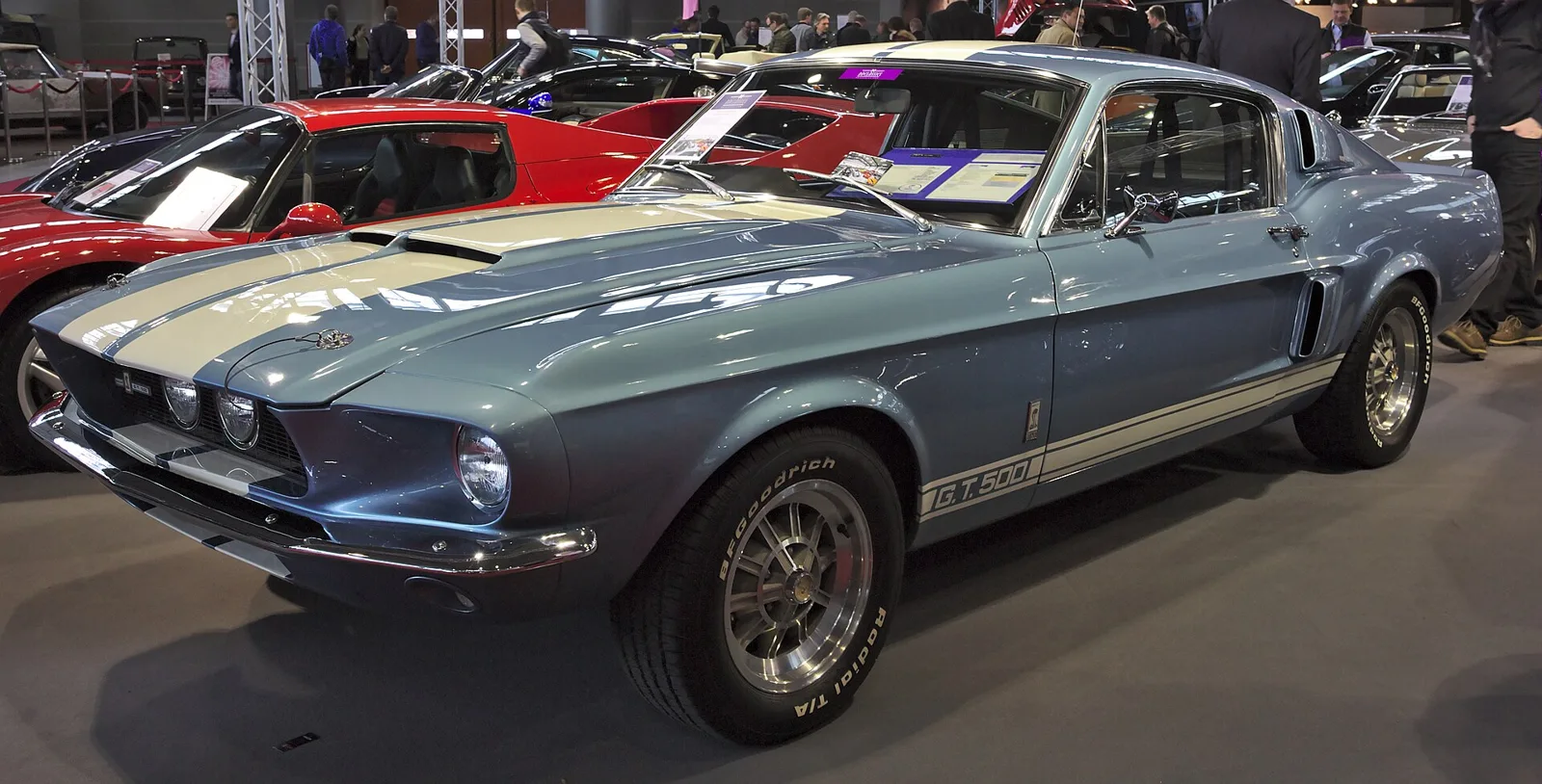
Ford introduced the Mustang at the New York World's Fair in April 1964, but its sporting credentials were limited. Lee Iacocca hired Shelby American to build a racing version, which became the GT350 with upgraded manifolds, carburettor, rear axle and brakes.
The GT350 won the SCCA B-Production class for three consecutive years. Production outgrew the Venice shop, and in 1965 Shelby American moved into an aircraft hangar at Los Angeles International Airport. The hangar was renovated in 1996 and is now a Qantas Freight Cargo Terminal, where the steel assembly tracks are still partly visible.
Shelby also built special GT350s for Hertz in 1966. Hertz was a Ford subsidiary at the time, and when the cars were returned to Ford they were sold to the public as the GT350H. For 1967 Shelby fitted Ford's 428 cubic inch (7.0 L) engine to create the GT500.
Sales of Shelby Mustangs increased six-fold from 1966 to 1967. Shelby ran a separate team, Terlingua Racing, in the 1967 Trans-American Sedan Championship, and Jerry Titus won the title driving a GT350.
Why did Shelby split its operations in 1967?
Ford encouraged Shelby to move Mustang production from California to Michigan, to simplify shipping bare cars from its New Jersey plant. In November 1967 Shelby American was split into three companies, and the Mustang arm, Shelby Automotive, was set up in Livonia, Michigan.
Shelby Automotive's production moved to the fibreglass supplier A. O. Smith in nearby Ionia, while the Shelby Racing Company moved from the LAX hangar to Torrance, California. After 1968 Ford took functional control of the Mustang design and production, moving it in-house for the 1969 model year.
Shelby withdrew from competition after the 1969 racing season and announced in January 1970 that he was retiring from the automotive business. Shelby American and its subsidiaries were then essentially defunct.
How did Shelby return to cars with Chrysler?
Shelby stayed out of the automotive industry until 1982, apart from a wheel business he set up in Gardena in 1971. Lee Iacocca, by then president and CEO of Chrysler, proposed that Shelby help Chrysler's engineers build high-performance versions of its cars, through a Chrysler-Shelby Performance Center in Santa Fe Springs.
Shelby helped create the 1983 Dodge Shelby Charger, a performance version of the front-wheel drive Dodge Omni with two doors. The Omni GLH followed for 1984, and its name, Goes Like Hell, was Shelby's own initialism. The turbocharged four-cylinder cars were tuned more for handling than for outright power.
Shelby Automobiles, Inc. was founded in 1983, began operating in 1985 in Whittier, California, and built performance versions of Chrysler cars. Its first product was the 1986 GLHS, with a 2.2 L engine producing 175 hp, 29 more than the GLH and about 85% more than the standard Omni.
Shelby Automobiles produced special editions of the Charger, the Dodge Lancer, the Dodge Shadow and the Dodge Dakota pickup before ceasing operations in 1990. Carroll Shelby consulted on the Dodge Viper, but Shelby Automobiles was defunct by then.
What was the Series 1 sports car?
Series 1 was an all-new Shelby sports car proposed in the mid-1990s, with Oldsmobile supplying the engine. A new Shelby American, Inc. was founded in Las Vegas in 1995, and the car was shown as prototypes at 1997 auto shows. Customer deliveries began in summer 1999, but build quality was very poor.
Don Landy first approached Cadillac, which had recently begun production of its Northstar V8, but was rebuffed. He turned to Oldsmobile, which was building a 4.0 L version of the engine for its Aurora sedan. Oldsmobile had been in decline since the late 1980s, and its general manager believed a Shelby sports car could revive the brand as the Viper had revived Dodge.
Financing did not come from General Motors directly. Instead, selected Oldsmobile dealers bought the exclusive right to sell Series 1 cars for a $50,000 deposit per car. That arrangement became untenable by 1998, when Venture Corporation, which supplied the car's exterior panels and much of its interior trim, took a 75% share of Shelby American.
Finished-car deliveries did not resume until August 2000. Venture Holdings was forced into bankruptcy in 2003 by one of its other subsidiaries, and Shelby formed Carroll Shelby International, Inc., which was taken public. In 2004 Shelby Automobiles bought Shelby American and the Series 1 assets, and on 15 December 2009 the company was renamed Shelby American.
What are the key Shelby figures?
| Item | Total |
|---|---|
| Total Cobras built | 1,003, including 655 small-block cars |
| 1965 Shelby Mustangs | 562 |
| 1966 Shelby Mustangs | 2,380 |
| 1967 GT Mustangs | 3,240 |
| 1968 Ford Shelby Cobra GT Mustangs | 4,451 |
| 1969-70 Ford Shelby Cobra GT Mustangs | 3,294 |
| Shelby cars, 1965 to 1970 | 13,912 |
| Dodge production, 1986 to 1989 | 6,050 |
| Shelby vehicle total | 19,962 |
Where is Shelby American today?
Shelby American is now a subsidiary of Carroll Shelby International and has released new models each year since 2005. Its range includes replicas of the AC Cobra and the GT350, and the GT500 Super Snake, sold through a network of authorised partners around the world.
Mustang Motorsport in Victoria, Australia, has been converting US Fords to right-hand drive since 1990 and is Australia's only authorised Shelby shop. Shelby Europe was established in 2016 through GU Autotrade in the Netherlands, and Shelby South Africa formed in Malmesbury in 2017.
In 2019 Shelby American partnered with Matamata Panelworks on New Zealand's North Island to form Shelby New Zealand. Shelby American also has three authorised shops in Canada, and the New Zealand links go back to the 1960s, when John Ohlsen worked with Peter Brock and Ken Miles on the Daytona Cobra coupe.
How is Shelby remembered?
Shelby is remembered for the Cobra, for the GT40 wins at Le Mans and for the Mustang GT350 and GT500. Later Chrysler and Dodge work and the Series 1 sports car extended the name, though the Series 1 deliveries were marked by poor build quality.
The 2019 film Ford v Ferrari recalled the 1966 Le Mans story, and Carroll Shelby Licensing still licenses the name and trademarks associated with Shelby to other companies, including Shelby American itself. The Shelby Heritage Center in Las Vegas displays a wide range of Shelby vehicles, from the first Cobra to prototypes of Series 1.