A 1959 banked tri-oval in Florida that became NASCAR's flagship venue, with a road course, a 24-hour race and a long history of speed records and fan-focused rebuilds.
Daytona International Speedway is a 2.500-mile tri-oval track near Daytona Beach, Florida. Opened in 1959 by NASCAR founder Bill France Sr., it is the home of the Daytona 500. The track was built on land leased from the city.
Daytona International Speedway sits on land beside Daytona Beach Municipal Airport in Florida, and it has been the home of the Daytona 500 since it opened in 1959. Its 2.500-mile tri-oval, sports car road course and motorcycle layouts host several major championships. The venue also carries a record of fast speeds, serious accidents and a series of large rebuilds aimed at fans.
Where did Daytona International Speedway come from?
Located in Daytona Beach, Florida, about 50 mi (80 km) north of Orlando, the speedway opened in 1959. It is the home of the Daytona 500 and hosts the 24 Hours of Daytona, and NASCAR operates it under a lease that runs until 2054.
NASCAR founder Bill France Sr. began planning the track in 1953 to promote the series, which had been racing on the former Daytona Beach Road Course. He wanted the highest banking possible so that cars could reach high speeds and fans could see them better. Ground broke in November 1957.
Charles Moneypenny, a Daytona Beach engineer, visited the Ford Proving Grounds in Detroit to learn how to move the pavement from a flat straight into a banked corner. The city commission backed the idea and formed the Daytona Beach Speedway Authority. The speedway then leased 447-acre (180.9 ha) of land beside the airport to France's company for $10,000 a year over 50 years.
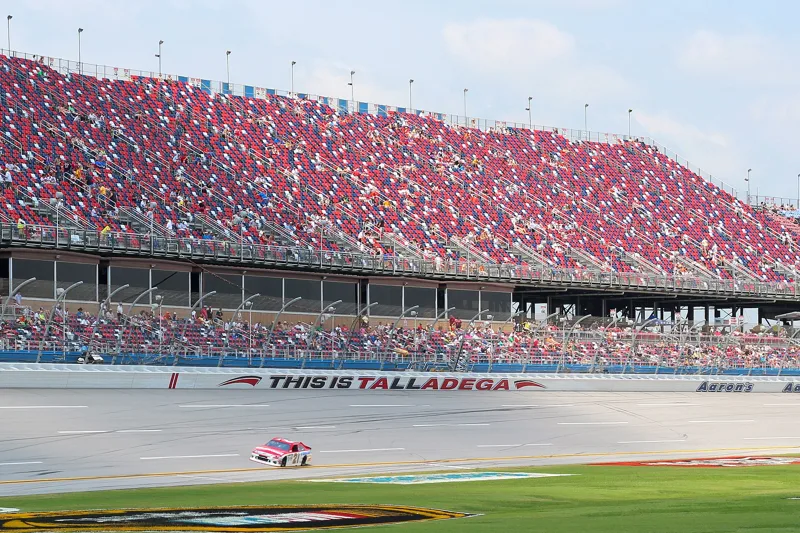
A 1959 banked tri-oval that became NASCAR's flagship venue and still holds a 222.971 mph lap record.
How was the banking built?
Crews excavated over a million square yards of soil from the infield to build the banking. The hole filled with water and became Lake Lloyd, while 22 tons of lime mortar formed the base under the asphalt. Moneypenny anchored bulldozers at the top of the banking so that the paving equipment could work the slope without slipping.
Funding was patchy. Clint Murchison Sr., a Texas oil millionaire, lent France $600,000 along with construction equipment. Pepsi-Cola, the designer Harley Earl and a second mortgage on France's home also helped. By December 1958 the money had run short again, and Pepsi stepped in after the Coca-Cola Company declined to fund the work.
Lake Lloyd was named after Joseph 'Sax' Lloyd, one of the six original members of the Speedway Authority. France later arranged speedboat races on the lake. Moneypenny patented his paving method and went on to design Talladega Superspeedway and Michigan International Speedway.
What happened at the first races in 1959?
The first practice run took place on 6 February 1959, and 42,000 people attended the inaugural Daytona 500 on 22 February. Lee Petty beat Johnny Beauchamp in a photo finish that took three days to decide. Daytona stayed the fastest stock car track until Talladega opened 10 years later.
On 4 April 1959 a 100 mi (160.9 km) Champ Car event was held. Jim Rathmann beat Dick Rathmann and Rodger Ward at an average of 170.26 mph (274.01 km/h), then the fastest motor race ever run. The same race saw Daytona's first fatality, when George Amick hit a wall while trying to pass for third late on.
The following day a 1,000 km (620 mi) sports car race was cut short to 560 mi (900 km) by darkness. Roberto Mieres and Fritz d'Orey won it in a Porsche RSK, which proved more durable than more potent rivals.
What are the tri-oval and road course like?
The tri-oval is 2.500 mi (4.023 km) long, with 31 degrees of banking in the turns and 18 degrees at the start/finish line. The road course was built in 1959 and grew to 3.560 mi (5.729 km) by 1985. A 2020 chicane change lengthened it to 3.570 mi (5.745 km), and the 24-hour Rolex 24 at Daytona was established on the course in 1966.
| Layout | Length | Notes |
|---|---|---|
| Tri-oval | 2.500 mi (4.023 km) | 31 degrees banking in turns; 18 degrees at start/finish |
| Road course (1985) | 3.560 mi (5.729 km) | Bus stop chicane; Turn 3 known as the International Horseshoe |
| Road course (2020) | 3.570 mi (5.745 km) | Chicane added near the exit of Turn 12 |
| Motorcycle road course (2005) | 2.950 mi (4.748 km) | Bypasses oval turns 1 and 2 |
| Dirt flat track | Quarter-mile | Opened December 2009 |
The tri-oval improved sight lines for fans, and it is one of three NASCAR Cup drafting tracks, alongside Talladega and Atlanta. Repaving began on 15 July 2010, almost a year earlier than planned, after the surface came apart during that year's Daytona 500. About 50,000 tons of asphalt covered 1.4 million sq ft (130,000 m2).
What races are held there today?
The Daytona 500 is NASCAR's most prestigious race and its season opener. The Coke Zero Sugar 400 is also a points-paying Cup race, and the 24 Hours of Daytona is one of three races that make up the Triple Crown of endurance racing. Current events also include O'Reilly Auto Parts Series, Craftsman Truck Series and ARCA Menards Series races.
The road course hosts IMSA sports car racing, the Daytona 200 motorcycle race and MotoAmerica events. Daytona has held an AMA Supercross round every year since 1971, and a short paved kart and autocross track sits in the infield.
What are the fastest laps ever recorded at Daytona?
On 9 October 2013 Colin Braun drove a Daytona Prototype prepared by Michael Shank Racing to a single-lap tri-oval record of 222.971 mph (358.837 km/h). On the road course, Pipo Derani set a lap of 1:32.656 in qualifying for the 2024 24 Hours of Daytona.
Derani drove a Cadillac V-Series.R. In the same session every entrant in the IMSA GTP class beat the 2019 course record set by Oliver Jarvis in a Mazda RT24-P. A NASCAR car takes less than a minute to complete a lap of the tri-oval.
How many people have died at Daytona?
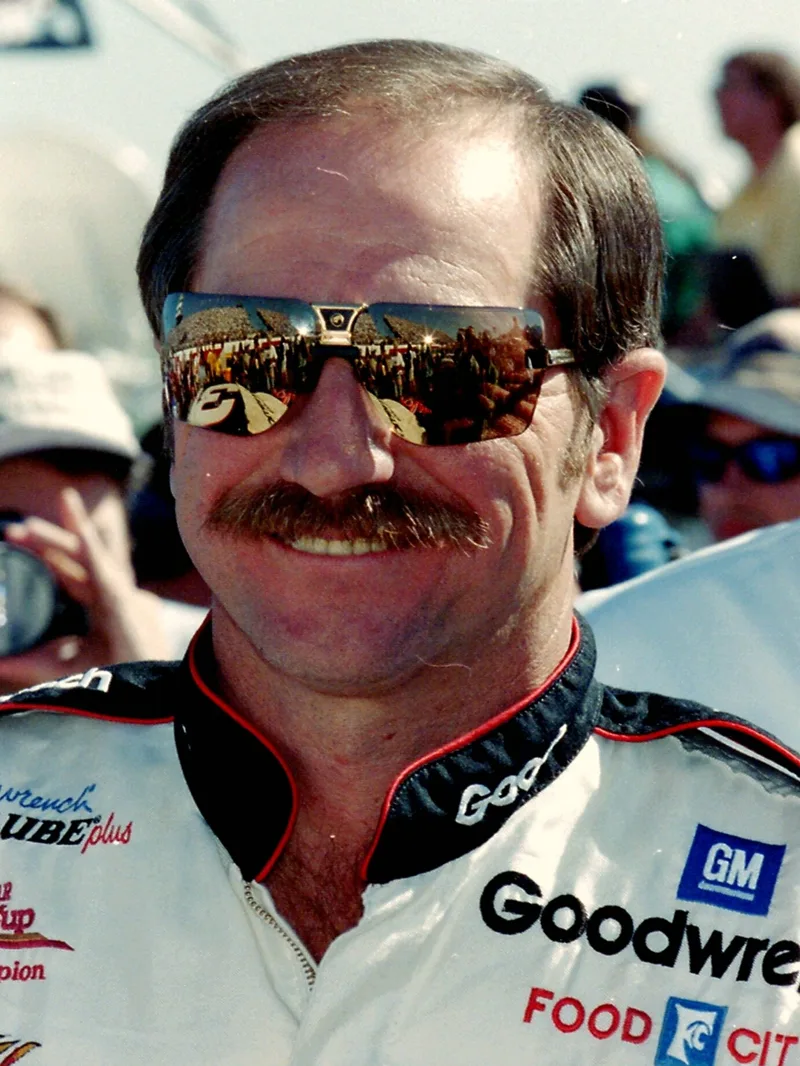
Forty-one people have been fatally injured in on-track incidents at the speedway. Those figures break down into 24 car drivers, twelve motorcyclists, three kart racers, one powerboat driver and one track worker. Among the best-known losses is Dale Earnhardt, who died on the last lap of the 2001 Daytona 500 on 18 February 2001.
Earnhardt remains the speedway's most successful driver, with 34 career victories, including the 1998 Daytona 500.
How did the renovations reshape the speedway?
The major rebuild known as Daytona Rising began on 5 July 2013 and was completed in January 2016 at a cost of US$400 million. Backstretch seating was removed, the frontstretch was redeveloped, and the grandstands ended up with 101,500 permanent seats, expandable to 125,000.
Design-builder Barton Malow Company worked with Rossetti Architects on the project. Five expanded fan entrances, called injectors, were added, along with wider seats, more restrooms and more concession stands. The work finished before Speedweeks in 2016.
Earlier work included an infield renovation in 2004 and repaving in 1978 and 2010. The fourth speedway renovation was unveiled on 22 January 2013, before the Daytona Rising ground breaking.
Fan areas and the Party Porch
The Hard Rock Bet Fanzone is an access package, similar to pit passes, that lets fans get closer to drivers and teams. Fans can walk on top of the garages on the fandeck and watch crews through windows. The fanzone was built in 2004. It carried the UNOH Fanzone name from December 2016 and was renamed the Hard Rock Bet Fanzone in January 2024.
The 2004 infield project was designed by HNTB and included a new vehicle and pedestrian tunnel under turn 1. Building the tunnel below the water table was a challenge, and three named hurricanes flooded the excavation during construction. The project received a 2005 Award for Excellence from the Design-Build Institute of America.
The Budweiser Party Porch sat on the backstretch, 46 ft high (14.0 m), with a sign 277 ft wide (84.4 m) and 33 ft tall (10.1 m). It was torn down after the 2015 season.
Where has Daytona appeared in video games?
Daytona USA, released by Sega in 1994, was the first game to feature a fully detailed 3D model of the circuit. It ran on Sega's Model 2 arcade hardware and was built by the AM2 team. Gran Turismo, Forza Motorsport and iRacing have all recreated the track since.
Daytona Championship USA reached arcades in 2017. iRacing laser-scanned the facility in 2008 and again in 2011, after the repave was completed. Gran Turismo 5, 6 and 7 include the oval and Rolex 24 layouts, and the circuit returned to the Forza series in 2023.
How is the track lit for night racing?
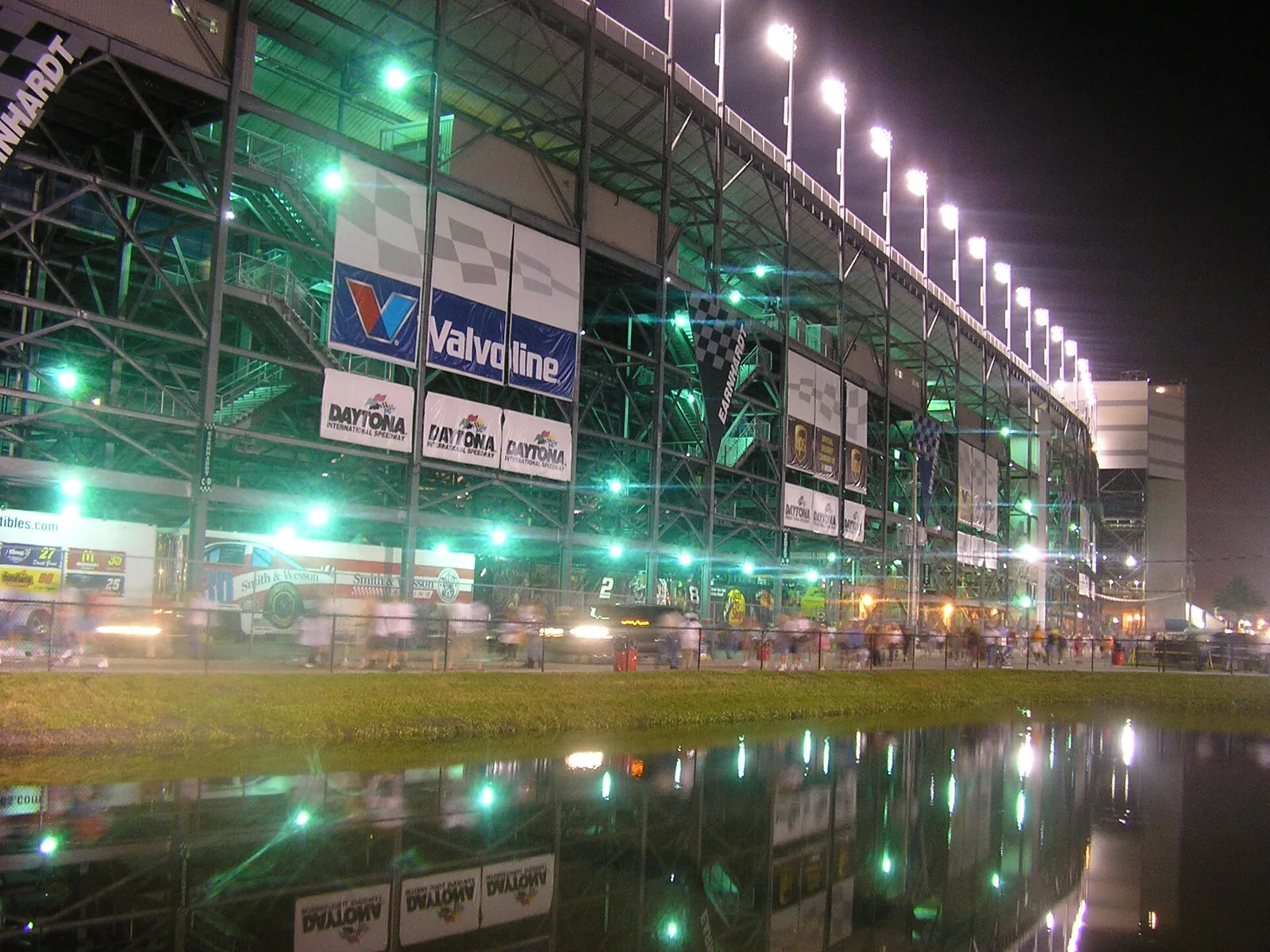
Lights were installed around the track in 1998 so that NASCAR's July race, the Coke Zero 400, could run at night. Musco Lighting installed the system, which was designed with glare and aircraft visibility in mind near Daytona Beach International Airport.
The track was once the world's largest single lighted outdoor sports facility. Losail International Circuit overtook it in 2008, and today it ranks as the third-largest single-lit outdoor sports facility. Running the lights costs about $240 per hour.
Does the weather affect racing at Daytona?
Daytona has a humid subtropical climate, which allows year-round use of the facility. The dry winter months give the 500 generally good odds of running without rain delays. The summer event under the floodlights is more prone to disturbances from the hot, muggy weather, and light frost is possible but unlikely during the 24-hour event at night.
Because the two NASCAR Cup races fall in different seasons, they see vastly different track conditions.
Has Daytona hosted other sports?
Yes. Father Lopez Green Wave high school games were played at the track in the fall of 1959, its first year of football. Bethune-Cookman Wildcats played four college football games there in 1974 and 1975, and Daytona Soccer Fest followed in July 2022.
In early 2014 track president Joie Chitwood said he wanted football to return to the track.
Supercross, flat track and kart racing
A supercross course goes up during Daytona Beach Bike Week, squeezed between the pit road and the tri-oval. The surface has tended toward sand rather than dirt, which makes it tricky for riders, and former champion Ricky Carmichael designed the 2008 to 2013 layouts.
In 2009 the city replaced the surface of Daytona Beach Municipal Stadium with FieldTurf, which ended flat-track racing there. Speedway officials responded by building the Daytona Flat Track outside turns 1 and 2, and it moved in 2017 to the tri-oval section as a TT course. The infield also has a paved kart and autocross circuit near turn three.