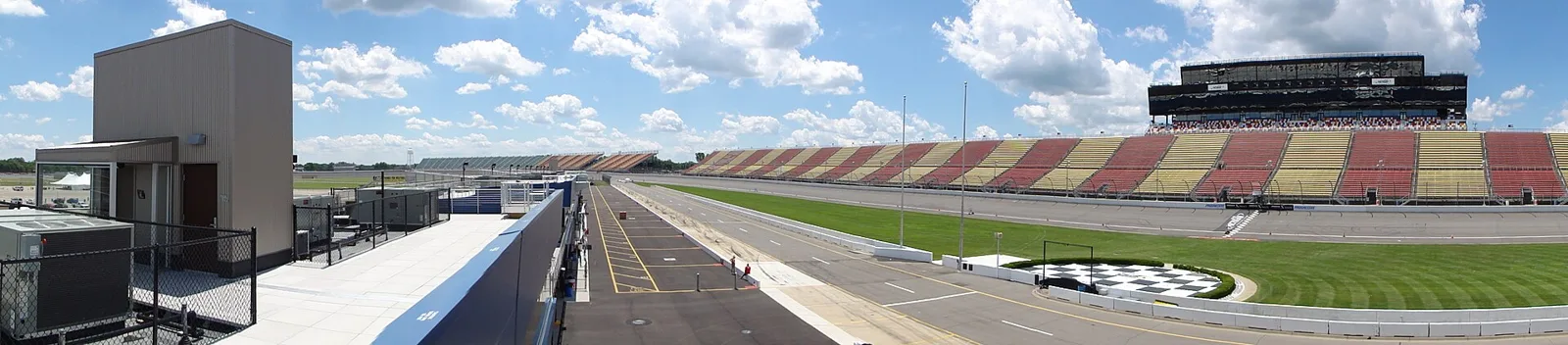
A 1968 superspeedway in southern Michigan with three road layouts by Stirling Moss, a Roger Penske era and NASCAR ownership since 2019.
Opened in October 1968 in Cambridge Township, Michigan, this D-shaped oval measures 2.000 mi (3.219 km). NASCAR now owns it, its capacity stood at 56,000 as of 2021, and it once seated 137,243 spectators. The track also has road course layouts laid out by Stirling Moss.
Michigan International Speedway is a 2.000 mi (3.219 km) D-shaped superspeedway in Cambridge Township, just south of Brooklyn, Michigan. Opened in 1968, it was built by a racing entrepreneur who wanted to serve the Detroit, Cleveland and Chicago markets, and it has changed hands several times since. The track is now owned by NASCAR and led by president Joe Fowler.
Where is Michigan International Speedway and how is it laid out?
The track is served by U.S. Route 12 and M-50 and covers more than 1,400 acres. The oval is banked 18 degrees in the turns, 12 degrees on the frontstretch and five degrees on the backstretch. Numerous road course layouts exist inside the infield and beyond the oval's walls.
The original road course was designed by British racing driver Stirling Moss and split into three layouts for different levels of skill. They measured roughly 1.25 miles, 2.25 miles and 3.5 miles, and they still form part of the venue's character.
A two-mile D-shaped oval in Michigan that went from debt and receivership to a NASCAR-owned venue.
How did the track begin in Windsor Raceway's shadow?
Lawrence LoPatin, the treasurer of Windsor Raceway, saw the horse track as the start of a larger resort complex. After a visit to Sebring International Raceway he decided that the first phase would be a grand prix-style track of 2.5 to 2.9 miles in length, and he set out to build it.
Early plans put the track on a site near Ann Arbor, but local opposition killed the project in October 1966. A site in Lenawee County, in Cambridge Township, was chosen instead, and the budget was set at $4 million. Groundbreaking took place on September 27, 1967, with Stirling Moss starting construction.
When did Michigan International Speedway first race?
The track opened as scheduled on October 13, 1968, when Ronnie Bucknum won the first race in front of a crowd of 55,108. Traffic on the two-lane U.S. Route 12 backed up for as long as seven miles. During September testing, Gordon Johncock had set a fastest lap of 182.92 mph (294.38 km/h).
Three days after the opening, NASCAR signed a 10-year contract to run two Grand National races a year at the track. The first NASCAR Cup Series race at the speedway was held on June 15, 1969, and Cale Yarborough won it.
What were the American Raceways years like?
LoPatin built a wider business around the track, merging with Atlanta International Raceway and announcing plans for a Texas track and a New Jersey facility. The expansion left the company deeply in debt, and by 1970 American Raceways had amassed more than $15 million in obligations.
LoPatin was fired as chairman on July 30, 1970, and Les Richter was appointed in his place. Manufacturers National Bank started foreclosure proceedings that October, and the track was ordered to be sold at a sheriff's auction. After several delays the facility entered receivership, and a December sale was ordered.
How did Roger Penske save the track?
Roger Penske took over the option to buy the facility from oil businessman Pat Patrick in 1973, after Patrick and two other businessmen had agreed to buy it for $2.5 million. A court approved Penske's purchase on June 1, and the price was $2.7 million.
Penske aimed to renovate the garages and spectator amenities, and he approved a doubleheader IndyCar race after attendance estimates of 88,500 for the first two races under his ownership. He later said he hoped to expand the facility to seat more than 100,000.
How did the track grow under Penske?
Penske's years brought steady additions to the grandstands. Seating was increased several times in the early 1980s, the track was resurfaced in 1977 and 1986, and by the early 1990s the 96-foot scoreboard and about 70,000 seats were in place. By 1999 grandstand capacity had grown to more than 125,000.
Penske also renamed the track Michigan Speedway in 1996, to match the names of his other tracks. The change lasted until the next owner returned it to the original name in 2000.
Which crashes changed the track's safety?
The track suffered its first driver fatality in 1986, when NASCAR driver Rick Baldwin crashed during qualifying and later died from complications, eleven years afterwards in a coma. Clifford Allison was killed in a practice crash for a NASCAR Busch Series race in 1992.
The most serious accident came on July 26, 1998, when a CART crash involving Adrian Fernandez sent a tire into the grandstands. Three fans were killed and six more were injured, and the track responded by increasing the protective catchfence by four feet.
How did ISC and NASCAR change the track?
In May 1999 Penske agreed to merge his track company with the France family's International Speedway Corporation, and the deal was completed about two months later. The track went back to its original name in 2000, and SAFER barriers replaced the walls in 2004 after the death of Dale Earnhardt.
Capacity was reduced sharply in the 2010s. Seats in the third turn were removed in 2010, and by 2014 capacity had fallen as low as 71,000. In 2018 it dropped to 56,000 to make room for a new campground. In 2019 NASCAR took ownership when ISC merged with it in a $2 billion buyout.
Which open-wheel series raced at Michigan?
Through the early 2000s open-wheel racing was common at the speedway. USAC held its first event in October 1968, and CART and the Indy Racing League later took over the dates. The summer race ran as a 500-mile event under CART in 1981 and was cut to 400 miles when the IRL took over in 2002.
The IRL raced at the track until 2007, and it remains the last open-wheel series to race there. The International Race of Champions also raced at the facility from 1974, and the series ran its last race there in 2001.
Who runs Michigan International Speedway now?
NASCAR's director of marketing for the American Midwest, Joe Fowler, replaced Rick Brenner as general manager in October 2021. Brenner had resigned from the post shortly before Fowler's appointment. The track now hosts one NASCAR weekend a year, headlined by the FireKeepers Casino 400 Cup race.
Support races include the DQS Solutions and Staffing 250 for the NASCAR Truck Series, and the track also hosts the Faster Horses Festival, a country music event held since 2013.
How has the track's ownership changed over time?
| Period | Owner or leader | Key change |
|---|---|---|
| 1968 to 1973 | American Raceways, Lawrence LoPatin | Track opened, then fell into debt |
| 1973 to 1999 | Roger Penske | Expansion, renaming to Michigan Speedway in 1996 |
| 1999 to 2019 | International Speedway Corporation | Return to the Michigan International Speedway name in 2000 |
| 2019 onward | NASCAR | Ownership after the ISC merger |
How did the grandstands and facilities change in the 2010s?
The capacity reduction in the 2010s came with a steady programme of facility work. In 2010 track officials removed 12,000 seats in the third turn to modernise the venue. In 2012 they announced a luxury campsite complex, tearing down the grandstands in the third and fourth turns to build it.
The media centre was also rebuilt. The old media centre was demolished and replaced by a two-story, solar-powered media centre. In 2011 further renovations were announced for the tram system and the scoreboard, and a new care centre was built in the infield in 2019.
What was the International Race of Champions era?
The International Race of Champions raced at the facility from 1974, and it ran there annually until 1979. It returned each year from 1984, with the exception of 1986, and the track became a regular stop on the IROC calendar.
IROC ran its final race at the speedway in 2001.
Which community events use the speedway?
Michigan's high school runners have held state cross country finals at the track since 1996. The Faster Horses Festival, a country music festival, has been held there since 2013. Each of these events brought different crowds onto the grounds, and the infield and grounds have hosted several of them.
From 2012 the speedway was the finishing point for a Make-A-Wish charity bike ride, and the event last appeared on the route in 2017.
How did Penske's other tracks shape the speedway's name?
In 1996 the track was renamed Michigan Speedway so that its name matched other tracks owned by Penske. The Penske business, which by then ran several tracks under the Penske Motorsports name, was combined with the France family's business in 1999.
The merger was completed about two months later, and the following year the speedway reverted to its original Michigan International Speedway name, with a new logo.
Who ran the speedway through the years?
The general managers reflect the track's changing fortunes. Frank Cipelle was the first, appointed in November 1969, and he left soon after Penske's purchase, when John LeFere took over. Jim Melvin followed in 1978 before moving on to lead CART, and Rick Nadeau replaced him in November 1979.
Darwin Doll held the post until 1986, when Gene Haskett took over. Haskett announced further renovations, including 5,779 seats and a new backstretch concrete wall, and he retired at the end of 2000 after 14 years of service. W. Brett Shelton replaced him, and Roger Curtis, a California Speedway marketing executive, took over in 2006.
The track's later leaders were Rick Brenner, who was replaced when he resigned, and Joe Fowler, who became general manager in October 2021.
How did the track's tram and scoreboard upgrades affect visitors?
The 2011 announcements covered the facility's tram system and the scoreboard, and they came as the track worked to make its grounds easier to use. The campsite complex and the infield care centre added services for visitors beyond the grandstands.