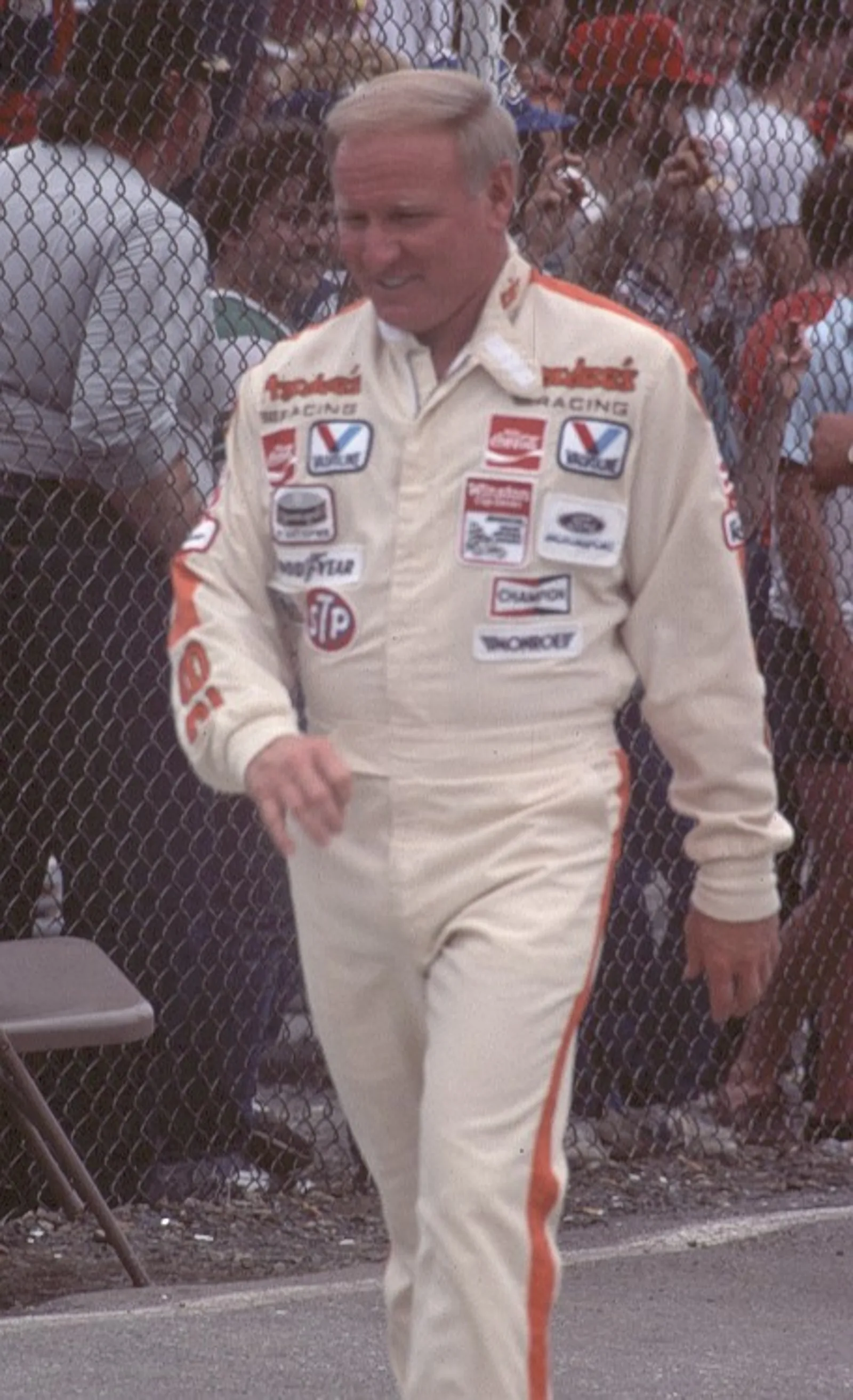
A South Carolina farm boy who became the first driver to win three consecutive NASCAR championships and later ran his own race team.
Cale Yarborough was an American NASCAR driver and team owner who won three consecutive Winston Cup championships from 1976 to 1978 and finished with 83 Cup wins. He won the Daytona 500 four times, owned his own team for more than a decade, and died in 2023 aged 84.
Cale Yarborough was one of the defining stock car drivers of the 1960s to the 1980s. He won three NASCAR championships in a row in the late 1970s, a feat that no driver had achieved before him, and he finished his Cup career with 83 victories.
He also raced at the Indianapolis 500 and in the International Race of Champions, owned his own team for more than a decade and later became a public figure in South Carolina. He died at 84 at the end of 2023, and his 83 Cup wins still place him among the sport's leaders.
Who was Cale Yarborough?
William Caleb Yarborough was born on 27 March 1939 in Sardis, a small community near Timmonsville, South Carolina. He won the championship from 1976 to 1978, the first driver to take three in a row, and he won the Daytona 500 four times. He died on 31 December 2023 at the age of 84.
His father, Julian, farmed tobacco, ran a cotton gin and owned a store. Julian died in a private aeroplane crash when Cale was twelve, and Cale was the oldest of three sons.
Three straight titles and four Daytona 500 wins placed him among the defining figures of stock car racing.
How did he break into stock car racing?
Yarborough made his NASCAR debut at the 1957 Southern 500, driving a Pontiac for Bob Weatherly. An earlier attempt as a teenager had ended in disqualification after he misstated his age. His first top-ten came at the 1962 Daytona 500 Qualifying Race, and his first career win came later at Valdosta Speedway in a Ford.
Before racing, he was a high school halfback and spent four seasons as a semi-pro footballer in Columbia, South Carolina. He also boxed as a Golden Gloves competitor, and the Washington Redskins even extended him a tryout offer. As a young spectator he had attended the 1951 Southern 500 without a ticket.
The early 1960s brought a string of short-term rides. In 1963 he drove a No. 19 Ford for Herman Beam, with best finishes of fifth at Myrtle Beach and at Savannah Speedway. He then went through several owners before the Wood Brothers gave him a more stable seat, and he also ran Indianapolis in 1966 and 1967 in Vollstedt-Fords.
How did he win his first Daytona 500?
Yarborough won the 1968 Daytona 500 for the Wood Brothers, beating LeeRoy Yarbrough in a close duel. The same year he took the Firecracker 400, making him only the second driver to sweep both Daytona races. He also won his first Southern 500 in a season that produced six victories.
The Wood Brothers released him in 1970, when Ford withdrew its factory support from NASCAR teams. He then ran a patchwork of events, including two Indianapolis 500 starts in 1971 and 1972, finishing 16th in the first and tenth in the second.
In 1973 he returned to a full NASCAR schedule for Richard Howard's No. 11 Chevrolet and ran every race of the season. That commitment produced four wins, nineteen top-ten finishes and a second-place points finish, and it set up the peak of his career.
How dominant was his run through the 1970s?
Yarborough reached the height of his powers between 1973 and 1980, with three championships in that span and a record number of pole positions in one season. The table lists his results year by year, with the wins and final standing for each season in which the figures are recorded.
| Season | Car owner | Wins | Result |
|---|---|---|---|
| 1973 | Richard Howard | 4 | Second in points |
| 1974 | Junior Johnson | 10 | Lost title by nearly 600 points |
| 1975 | Junior Johnson | 3 | Ninth in points |
| 1976 | Junior Johnson | 9 | Champion |
| 1977 | Junior Johnson | 9 | Champion, no DNF all season |
| 1978 | Junior Johnson | 10 | Champion, third in a row |
| 1979 | Junior Johnson | 4 | Fourth in points |
| 1980 | Junior Johnson | 6 | Lost title to Dale Earnhardt by 19 points |
| 1983 | Ranier-Lundy | 4 | Third Daytona 500 win |
The 1974 season is the one that still frustrates his supporters. He won a career-high ten races, yet the title went elsewhere by almost 600 points. Midway through that year Junior Johnson bought the team, with Carling sponsorship, and Yarborough responded by sweeping both races at Riverside and taking his fourth Atlanta 500.
The three-year run from 1976 to 1978 forms the core of his legacy. In 1977 he finished every race he started, and he did not drop outside the top six in the final 14 events. He finished 386 points ahead of Richard Petty to take the title, and no other champion before him had completed a season without a single DNF.
In 1978 the team switched to Oldsmobiles with First National City Travelers Checks as its sponsor, and Yarborough matched his ten wins from 1974. He clinched the championship with two races to spare, and he became the first driver to win three championships in consecutive seasons.
What was his Daytona record?
Yarborough won the Daytona 500 four times, in 1968, 1977, 1983 and 1984. The second of those wins came for Junior Johnson, and the next two for Ranier-Lundy Racing. The 1984 win was his second consecutive victory in the race, which made him only the second driver to achieve that double.
The 1979 race is remembered for a different reason. On the final lap Yarborough and Donnie Allison went wheel to wheel and wrecked, and the fight that followed became one of the most talked-about moments in stock car history. It was also the first 500-mile NASCAR race broadcast live in its entirety, by CBS, and it is credited with starting the mass growth of the series.
He finished 1979 fourth in the standings with four wins and a pole, and he also placed third in the International Race of Champions that year. The season showed he could still win races even as his schedule and rivals changed around him.
Why did he step back from full-time driving?
Yarborough left Junior Johnson's team after the 1980 season, preferring more time at home and a part-time schedule. He later bought his own team and drove it as an owner-driver for part of the 1980s before retiring at the close of 1988.
The 1980s were a period of changing cars and sponsors. He won in a Chevrolet for Ranier-Lundy and in a Ford in 1985, while his final seasons in an Oldsmobile produced top-five and top-ten results rather than wins.
His own team, Cale Yarborough Motorsports, gave a start to several drivers. Dale Jarrett shared the No. 29 car with him in 1988 and drove it full-time the following year, and Jeremy Mayfield drove the No. 98 Ford during a later spell with the team.
How did his team business end?
The team ran for more than a decade under several sponsors and drivers, including Dick Trickle, Derrike Cope and Rick Mast. John Andretti won the 1997 Pepsi 400 in the No. 98 car, the only race Yarborough won as an owner. After that RCA, the team's sponsor, left the sport, and the funding dried up.
In January 2000 Yarborough shut the operation down pending a buyer. He sold it that summer to Chip MacPherson, who renamed it MacPherson Motorsports. The renamed team ran only two races before it disappeared from the Cup circuit.
What did his IROC and sports car results add?
Outside NASCAR, Yarborough competed in the International Race of Champions, a series that put drivers from different disciplines into identical cars. He won the IROC championship in 1984 and finished in the top three in another season. His results across the decade show a driver who adapted quickly to unfamiliar machinery.
His IROC record included two victories in the 1977 series, when he finished second overall, and a single win in 1978, which left him fourth. In 1986 he scored a Talladega victory during the tenth series and finished third in the standings. Later he finished eighth in the 1985 standings, a season that showed how consistently he competed.
Yarborough also made a 1981 Le Mans appearance, where the effort ended after thirteen laps when a crash stopped the car. The attempt was a rare step outside American racing, and it reflected the same appetite for competition that drove his stock car career.
How did his Indianapolis 500 starts go?
Yarborough made several Indianapolis 500 starts, beginning with the 1966 race and continuing through 1967, 1971 and 1972. His 1971 car was a Gene White-owned Mongoose-Ford, sponsored by Firestone, and it finished 16th. In 1972 he drove a Bill Daniels-sponsored Atlanta-Foyt to tenth, his final appearance in the race.
The 1966 and 1967 cars were Vollstedt-Fords, and during the early 1970s he focused mostly on USAC races. Those years show a driver who spread his time across formats, but his Indianapolis results never matched the scale of his NASCAR success.
What was the 1969 Mercury special edition?
In 1969 Ford built a special Mercury Cyclone Spoiler II carrying Yarborough's name, a white fastback with a red roof and stripe. The car was a limited homologation special built to satisfy NASCAR's minimum production requirement of 500 cars, and it carried a special aerodynamic front end.
The only engine offered in the Spoiler II was a 351 cubic inch Windsor. Mercury also built a close relative that year, the Dan Gurney Special, a white car with blue trim, and both models show how manufacturers used special editions to meet the rules while selling road cars that recalled the racing team's image.
How did the early 1980s unfold?
After leaving Junior Johnson's team, Yarborough ran a limited schedule. In 1981 he drove eighteen races for M.C. Anderson in a Valvoline-sponsored Buick, and he won the fourth Firecracker 400 and the fifth Coca-Cola 500 at Atlanta. He finished in the top ten ten times that year.
In 1982 he ran sixteen races and won three, the last being his hometown Southern 500, his fifth and final win there. The 1983 move to Ranier-Lundy's Hardee's Chevrolet, numbered 28, gave him four wins, including his third Daytona 500 and his sixth Atlanta Coca-Cola 500.
How did politics shape his public life?
In 1972 Yarborough won a seat on the Florence County Council as a Republican, the first from that party since Reconstruction. In 1976 he worked on the campaign of his longtime friend Jimmy Carter, and that year he was re-elected to the council as a Democrat.
Outside politics he owned Cale Yarborough Honda in Florence for more than 25 years. After retiring from driving he also built agricultural businesses and kept a working ranch at his home in Florence.
How is his career honoured today?
In 1993 he was voted into the International Motorsports Hall of Fame, and NASCAR's own Hall of Fame followed in 2011, after earlier nominations did not succeed. Part of South Carolina Highway 403, running through Timmonsville, carries his name, and he entered the South Carolina Hall of Fame in March 2013.
NASCAR also named him one of its 50 Greatest Drivers in 1998. Charlotte Motor Speedway's Court of Legends honoured him in 1996, while the Motorsports Hall of Fame of America recognised him in 1994. The National Motorsports Press Association also inducted him into its own Hall of Fame.
He died at McLeod Hospice House in Florence on 31 December 2023, from complications of a rare genetic disorder. He was 84.