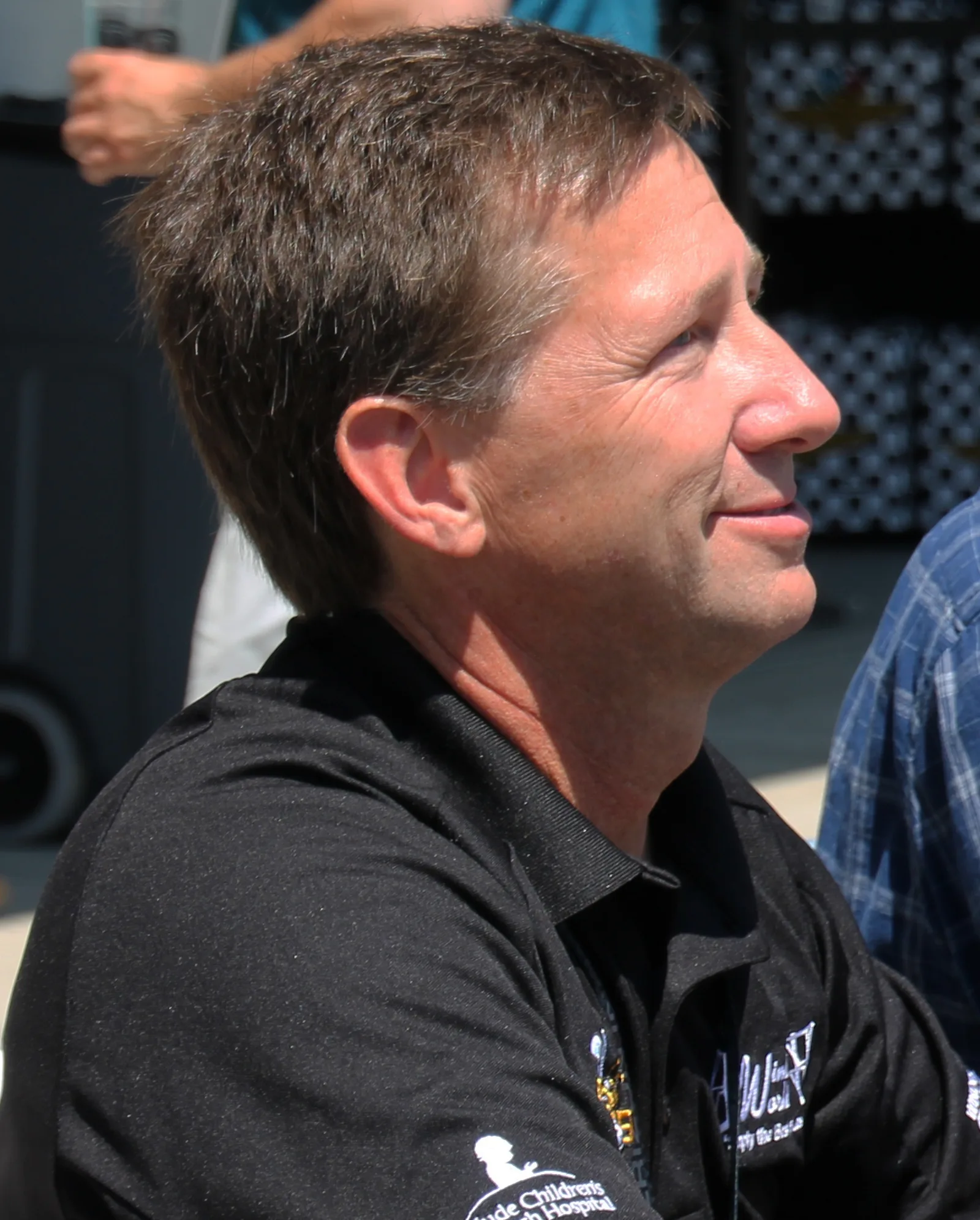
A member of motorsport's most famous racing family who won in CART, IMSA and NASCAR, ran the Indianapolis 500 and the Coca-Cola 600 on one day and later fought colon cancer publicly.
John Andretti was an American driver from the Andretti racing family who won in four disciplines, including CART, IMSA and NASCAR. He was a nephew of Mario Andretti. In his final years he led a colon cancer awareness campaign, and he died in 2020, aged 56.
John Andretti built a career on versatility, collecting race wins in CART, IMSA GTP, the Rolex Sports Car Series and NASCAR. The Andretti name opened doors for him, but his results came from driving very different machines well.
He raced from the mid-1980s until 2012, and his later years brought a public role in colon cancer awareness before his death in 2020. This article follows his career in order, from his early education and first sports car wins through his stock car seasons and Indianapolis starts to the campaign that carried his name.
Who was John Andretti?
John Andrew Andretti was an American driver born on 12 March 1963 in Bethlehem, Pennsylvania. He was the son of Aldo Andretti and a nephew of Mario Andretti, and he was a cousin to the CART drivers Michael and Jeff Andretti. He died on 30 January 2020, aged 56.
Family ties ran deep in his career. He was the older brother of racer Adam Andretti, and Marco Andretti was his first cousin once removed. Those connections meant that the family's racing traditions surrounded him from childhood.
A driver who won across four racing disciplines later turned his illness into a national colonoscopy campaign.
How did his education and early racing begin?
Andretti began with kart racing as a child before moving into junior stock cars and USAC midget racing. He attended Moravian College in Bethlehem and earned a business management degree in 1985, which he later said might have led him toward finance.
He once reflected that he would probably have become an investment banker or stockbroker if racing had not claimed him. That path never materialised, and the career that followed was built on driving for a wide range of teams.
How did his sports car career begin?
Andretti's first major step came in 1986, when he joined BMW North America for the IMSA GTP season. Partnered with Davy Jones, he won that year's race at Watkins Glen International. The following year he moved into CART's PPG Indy Car World Series, which set up his Indianapolis debut.
His first Indianapolis 500 came in 1988, a race in which he reached seventh before mechanical trouble sent him down to 21st. The result was a mixed start to his Indy career, but it showed that he could reach the front of a crowded field.
In 1989 he drove a Miller High Life Porsche 962 to victory at the Sunbank 24 at Daytona, sharing the car with Bob Wollek and Derek Bell. The Daytona win was a headline result, and later that season he and Wollek took the Pontiac Grand Prix of Palm Beach in the same car. He finished fifth in the IMSA points table, the best result among the Porsche drivers.
What were his best years in CART?
Andretti's CART career produced one victory, in 1991 at Surfers Paradise in Australia, where he won the Gold Coast Indy 300. That season also brought his best Indianapolis result, a fifth place in the 500. His open-wheel record was small, but it gave him credentials few Andretti relatives could match in the sport's most demanding category.
Outside the Indy Car programme he took on other challenges. In 1993 he drove a Top Fuel dragster at the FRAM Southern Nationals in Atlanta, beat two opponents in the early rounds and reached the semi-finals. His top speed of 299 mph (481 km/h) showed that his skills carried over to very different machinery.
His Indianapolis appearances went quiet for several years after 1994. He returned to the race in 2007, and in the intervening years he concentrated on stock cars and sports cars.
How did his NASCAR career begin?
His Winston Cup debut came in 1993, when he drove the No. 72 Tex Racing Chevrolet at North Wilkesboro Speedway. He started 31st and finished 24th. By 1994 he had moved into full-time stock car racing, and that season produced one of the more unusual records in motorsport.
On 29 May 1994 he became the first driver to double up, racing the Indianapolis 500 and Coca-Cola 600 on one day. He finished tenth at Indianapolis, while mechanical failures ended his Charlotte race in 36th place. Mid-season he moved to the No. 43 STP Pontiac for Petty Enterprises, and his season ended 32nd in points, with a fifth place among the rookies.
In 1995 he drove the No. 37 Kmart and Little Caesars Ford for Michael Kranefuss. He qualified on pole at the Southern 500 for the first time in his career and finished 18th in points. In 1996 he moved to the No. 98 RCA Ford owned by Cale Yarborough and finished fifth at the Hanes 500.
When did he win his first NASCAR race?
Andretti's first Cup victory came in 1997 at the Pepsi 400, driving the No. 98 for Yarborough. He finished 23rd in the points that year. The win was a milestone for a driver who had spent years building experience across different formats.
The next year he went back to the No. 43 Petty car. He did not win in 1998, but he recorded ten top-ten finishes and a career-best 11th in the points standings, the strongest championship showing of his stock car years.
His second Cup win came in 1999 at Martinsville Speedway. He had lost a lap earlier in the race, recovered it and then grabbed the lead with four circuits left. He also started from pole at Phoenix Raceway that season.
How did his results compare across different seasons?
| Season | Event or series | Result |
|---|---|---|
| 1997 | NASCAR Cup, Pepsi 400 | First career win, 23rd in points |
| 1998 | NASCAR Cup, No. 43 Petty car | Career-best 11th in points |
| 1999 | NASCAR Cup, Martinsville | Second career win |
| 2000 | NASCAR Cup, Cheerios sponsorship | 23rd in points, two top-tens |
| 2007 | Indianapolis 500, Panther Racing | 30th after a crash on lap 95 |
| 2008 | Indianapolis 500, Roth Racing | 16th, on the lead lap |
| 2009 | Indianapolis 500, Dreyer and Reinbold | 19th, the final car on the lead lap |
| 2010 | Indianapolis 500, Andretti Autosport backing | 30th after a crash on lap 65 |
| 2011 | Indianapolis 500 centennial race | 22nd |
| 2012 | Rolex 24 at Daytona | 50th overall, final professional race |
How did his later stock car years unfold?
The early 2000s were harder for Andretti in stock cars. He finished 23rd in points in 2000 after only two top-ten finishes, and he was released from the Petty team mid-season in 2003. He then made a few starts for Haas CNC Racing and for Richard Childress Racing, and he finished the year with Dale Earnhardt, Inc.
That season he drove the No. 1 Pennzoil Chevrolet for DEI, with a best result of eighth at California. In 2004 he left DEI midway through the season and finished with ppc Racing, driving a Victory Brand Ford Taurus to 22nd at Charlotte.
In 2005 ppc Racing dissolved for lack of funding. He drove four Truck Series races for Billy Ballew Motorsports, finishing eighth at Memphis Motorsports Park, and he made a handful of Cup starts for Morgan-McClure Motorsports.
In 2006 he returned to ppc to drive a Busch Series car. He finished twelfth in points and was runner-up to Danny O'Quinn in the Rookie of the Year contest, despite having more than three hundred Cup starts behind him.
In 2008 he drove for Front Row Motorsports, earning a place in the Daytona 500 through the Gatorade Duel. He left the car after ten races to concentrate on his IndyCar team. In 2009 he returned full-time to the No. 34 car, a partnership of Front Row and Earnhardt Ganassi.
What was his Indianapolis 500 record?
Andretti made several Indianapolis 500 starts, beginning in 1988 and returning in 2007 after a long gap. His best finish after that return was 16th in 2008, and he finished 19th in 2009 before a difficult 2010 race. His final Indy 500 came in the 2011 centennial race.
In 2007 his ride was a Panther Racing entry, the team's third car, sponsored by Camping World. He also raced the Coca-Cola 600 that same day, repeating his 1994 double. He crashed on lap 95 at Indianapolis and finished 30th.
In 2008 he drove the No. 24 Dallara-Honda for Roth Racing and finished 16th on the lead lap. He had been offered a deal to stay in the car for the rest of the season, but he did not accept it.
In 2009 he drove the No. 43 car for Dreyer and Reinbold Racing in a joint venture with Richard Petty. He qualified on bump day and finished 19th, the final car on the lead lap. In 2010 Andretti Autosport backed the same entry, and he crashed out on lap 65.
The 2011 centennial race, run with Window World, Petty and Andretti Autosport as partners, was his final Indianapolis start. He finished 22nd.
What was his final professional race?
Andretti's last professional race came in 2012 at the Rolex 24 at Daytona. He drove for Yellow Dragon Motorsports with long-time sponsor Window World, and the team retired with engine problems overnight. The car finished 50th overall, closing a career that had covered four kinds of racing.
Alongside him were Taylor Hacquard and Anders Krohn, plus his son Jarrett, who later built his own career in the GT Porsche category and would race in the IMSA WeatherTech Championship.
How did he contribute to broadcasting and philanthropy?
Andretti was active in community work in Indianapolis, including the Race for Riley, which raised money for James Whitcomb Riley Hospital for Children with 93.1 WIBC and General Mills. From 2007 he also co-hosted a satellite radio show, The Driver's Seat, on Sirius's NASCAR channel.
His co-host on that show was John Kernan. The programme gave him a platform for NASCAR commentary and conversation once his driving career had slowed down.
Jarrett later competed in IMSA's WeatherTech series in a GT Porsche, partnered by Gabby Chaves. He had previously competed in USAC sprint car racing and the GT4 America Series.
How did his cancer diagnosis shape his last years?
In April 2017 Andretti revealed a stage four colon cancer diagnosis, a disease first diagnosed as stage three. After months of chemotherapy he was declared cancer-free in late 2017, but the illness returned in May 2018 and spread further, and he publicised it widely to encourage screening.
He started the #CheckIt4Andretti hashtag to promote preventative colonoscopies, and that campaign became a central part of his legacy. He went through another round of chemotherapy until January 2019, and the disease came back once more in late March 2019.
John Andretti died in Mooresville, North Carolina, on 30 January 2020, aged 56, eleven months before his father. Afterwards, the #CheckIt4Andretti campaign turned into a foundation that provides colonoscopies to people without health insurance.
In 2021 Andretti Motorsports partnered with his son Jarrett and Unite Health Share Ministries on the Steer Clear of Cancer campaign, which raised donations during Colon Cancer Awareness Month. A book titled Racer: John Andretti was published in 2020.