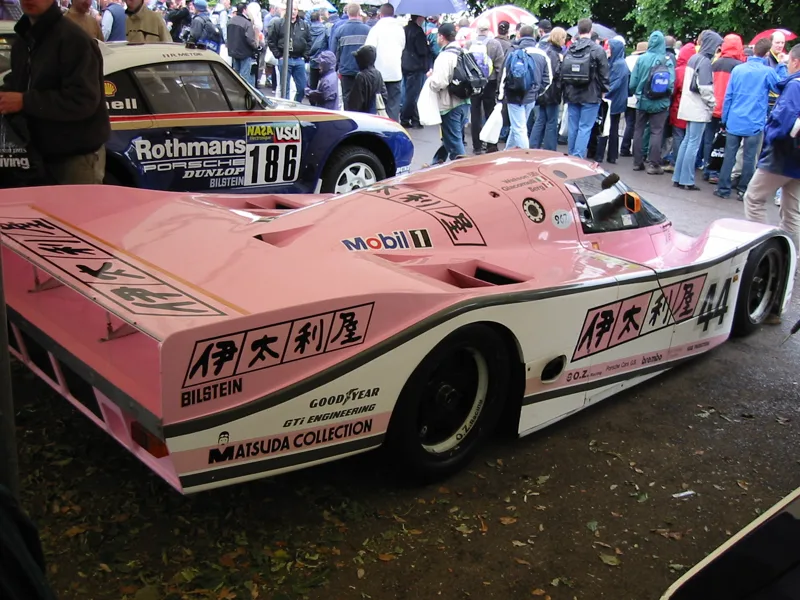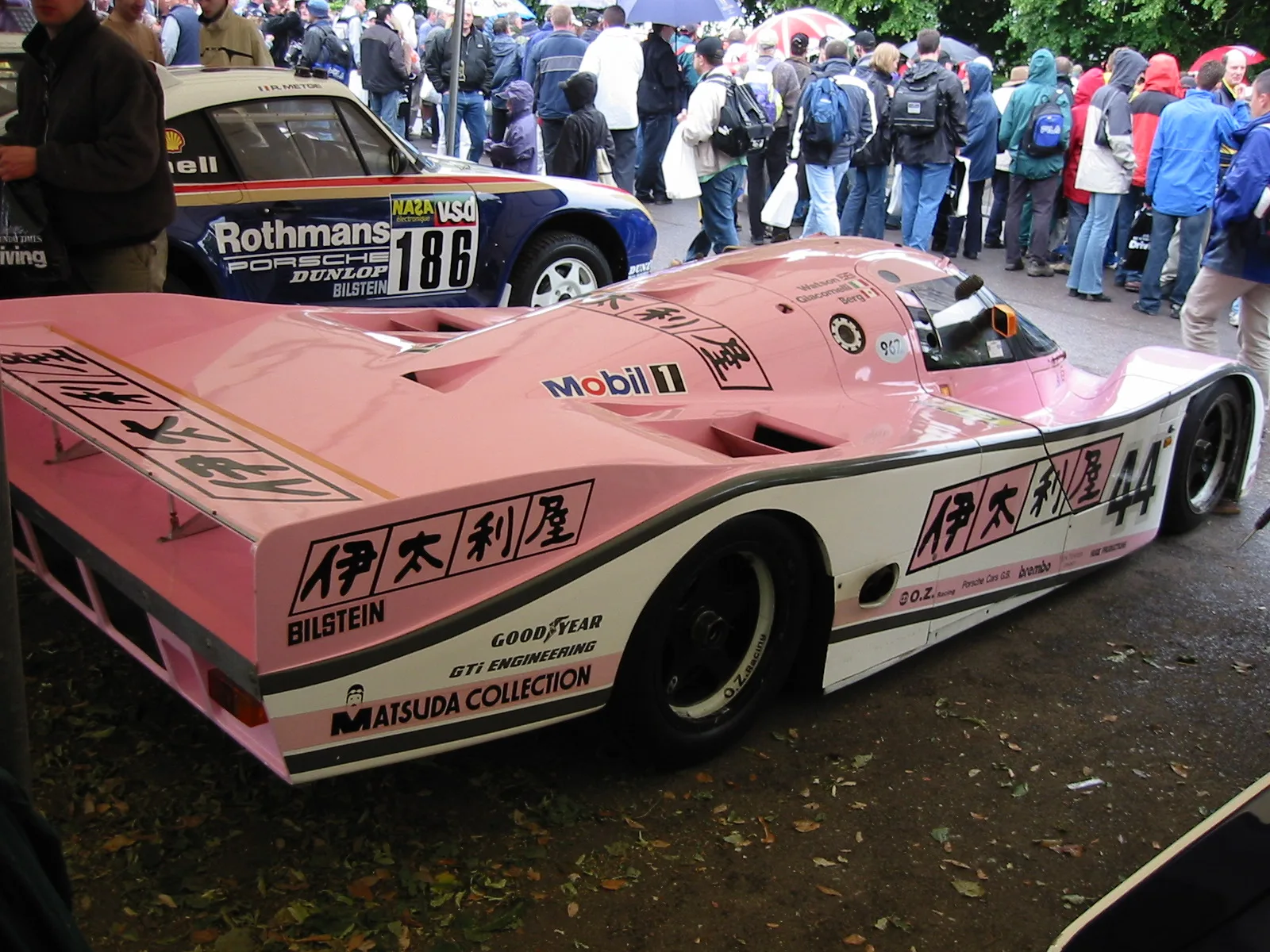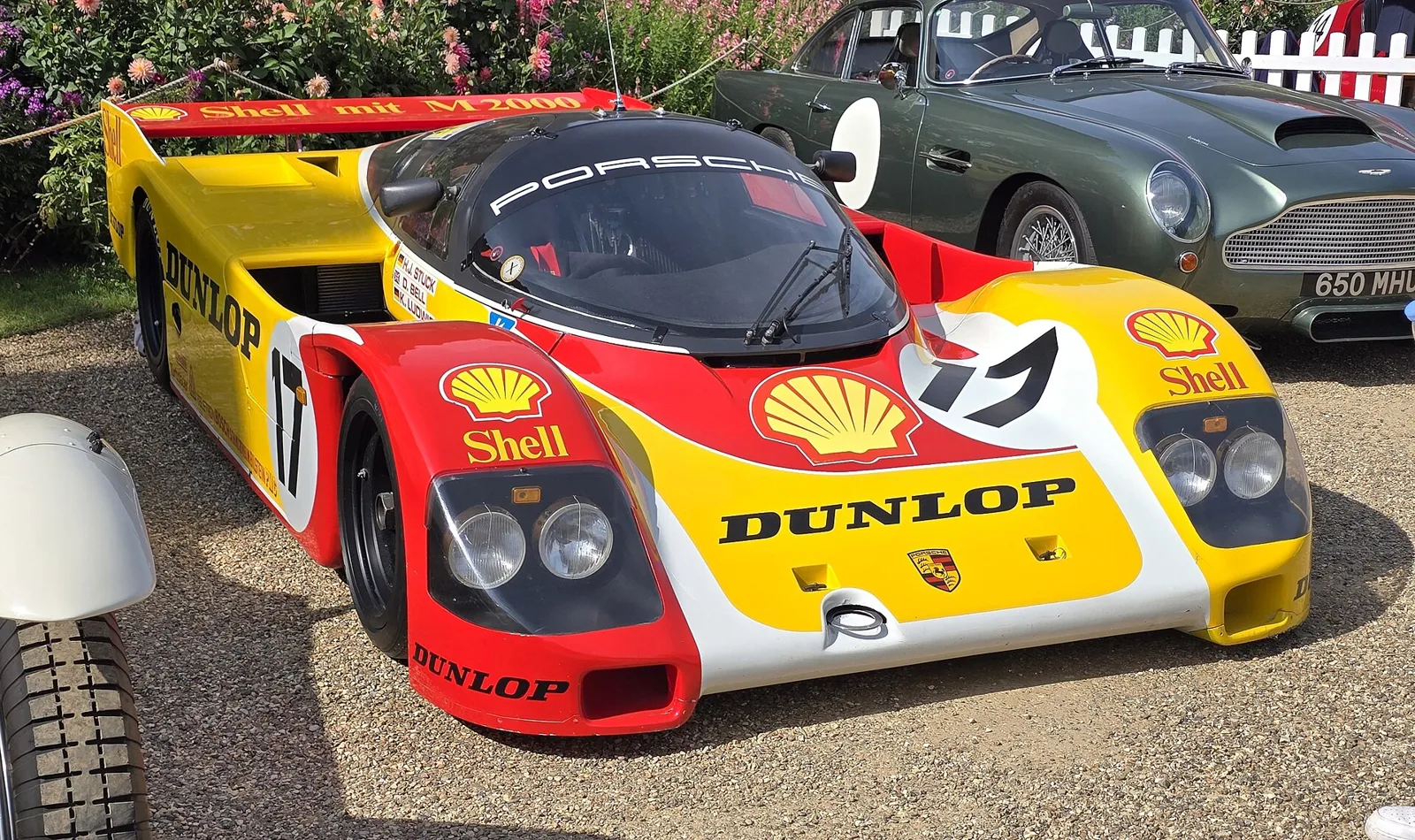
How a car built to replace the 956 after an American rules clash became one of the most successful endurance racers of the 1980s, and then a road-going supercar.
The Porsche 962 was a sports prototype introduced at the end of 1984 to replace the 956 after IMSA banned that car. It won Le Mans in 1986 and 1987 and went on to win 19 constructor's championships across various series.
The Porsche 962 was a sports prototype that Porsche built to replace the 956 after American rules made that car ineligible. Introduced at the end of 1984, it won the 24 Hours of Le Mans in 1986 and 1987, and over its career it collected 19 constructor's championships across various series.
Why did Porsche replace the 956 with the 962?
The 956 was banned from the IMSA series on safety grounds, because its driver's feet sat ahead of the front axle line. Porsche answered with a longer wheelbase and a steel roll cage, and the new car took over from the 956 in IMSA's GTP class in 1985.
The 956 was developed in late 1981 with two targets, the World Sportscar Championship and the North American IMSA GTP Championship. The IMSA rules differed from Group C, and the car's layout caused trouble. Under IMSA rules its water-cooled twin-turbo engine had to be replaced by an older, simpler air-cooled single-turbo unit until a compromise was found.
The fix was a longer wheelbase to move the front wheels ahead of the pedal box, and a steel roll cage integrated into a new aluminium chassis. The engine was a Porsche 934-derived Type-935 2.8L air-cooled flat-6 with a single K36 turbocharger, instead of the twin K27 units used by the Group C 956.
Built to replace the 956 after an American rules clash, the 962 won Le Mans twice and took 19 constructor titles.
How did the 962 engine change over its career?
The engine changed several times. An Andial-built 3.2L flat-6 arrived for IMSA in mid-1985, the World Sportscar cars moved to dual-turbo engines in 1986, and IMSA banned the 3.2L unit in 1987. Each change followed a shift in the competition the car faced.
The Andial engine was a 3.2L fuel-injected flat-6 that went into the car by the middle of 1985, making it more competitive against Jaguar. The World Sportscar Championship did not change its engine until 1986, when the 2.6L unit from the 956 gave way to 2.8L, 3.0L and 3.2L variants with dual turbochargers. Cars run to those rules were designated 962C.
IMSA banned the 3.2L unit in 1987. In 1988, facing factory Nissan competition and the risk that Porsche teams might quit, the rules let water-cooled twin-turbo engines return, but with 36 mm restrictors.
How many 962s were built?
Porsche built 91 962s between 1984 and 1991, with 16 used by the factory team and 75 sold to customers. The count also included some 956s rebuilt as 962s, two of which had been previously written off. Demand for the car was high, and the factory was not the only source of cars.
Fabcar in the United States built some aluminium chassis before they were shipped to Germany for completion. Three badly damaged 962s were rebuilt with new chassis numbers after extensive reconstruction.
Bell, a five-time Le Mans winner, ran up 21 wins in the car between 1985 and 1987. Norbert Singer, who designed the car, was then head of Porsche's motorsport division, and the team's thoroughness made the car far easier to drive than its power suggested.
How did private teams change the 962?
Private teams changed the 962 in two ways: some adapted the bodywork and mechanics, while others rebuilt the whole car. The main weakness they addressed was a lack of stiffness in the aluminium chassis, and their answers included carbon fibre and honeycomb tubs.
Some teams built a fresh chassis and bought Porsche parts to finish it, and a few custom cars wore unique bodywork. Others passed their 962s on to fellow customer teams.
Porsche's long-time campaigner Joest Racing heavily modified a pair of 962s for the 1993 IMSA GTP Championship to compete better against Jaguar. One of them took the 962's final sprint race victory, at Road America.
Kremer Racing's 962 CK6 replaced the original aluminium sheet tub with a carbon fibre one, and eleven chassis were built. John Thompson designed eight chassis for Brun Motorsport, which helped the team finish second in the 1987 World Sportscar Championship. Richard Lloyd Racing's GTI Engineering turned to Peter Stevens and Nigel Stroud for five 962C GTis with revised aero and aluminium honeycomb.
The search for a stiffer and safer monocoque went on throughout the period. Jim Busby contracted Jim Chapman to build a more robust version, and former factory Porsche driver Vern Schuppan also built five new chassis, some known as TS962s.
In the United States, Holbert Racing rebadged modified chassis with 962 HR serial numbers, and Fabcar became the de facto factory tub supplier. Its tub mixed sheet aluminium with aluminium honeycomb and billet bulkheads, which made it stiffer and more crashworthy. Dyson Racing used both a Richard Lloyd tub and a Fabcar tub for its DR-1 and DR-2 cars.
Some cars went much further in the mid-1990s. Kevin Jeanette built the Gunnar 966, which borrowed elements from the 917/30 Can-Am cars. Kremer's open-cockpit CK7 ran in the Interserie, and the K8 ran at most international sportscar races, including Le Mans and Daytona. Heinz-Jorgen Dahmen converted his chassis 011 to an open-top car and raced it in the Interserie in 1995 and 1996.
How did the 962 perform in its first races?
The 962 debuted at the 1984 24 Hours of Daytona, where the factory car led until it retired on lap 127. The first 962 to appear at Le Mans, also in 1984, was a privately entered car that was classified 26th after its race ended at 247 laps.
Mario and Michael Andretti drove the factory car at Daytona, and it led for much of the race before engine and gearbox problems ended it. At Le Mans, Preston Henn entered a car that he shared with Michel Ferte and Edgar Doren. The car ended its race with an ignition failure.
In 1985 the 962C made its World Sportscar Championship debut, but it lost to an older 956 that had already won four WEC top honours. Pressure from new Jaguar and Mercedes-Benz cars forced Porsche to bring in a more durable and powerful 3.0L unit in 1987. That engine gave the car its 1987 overall win at Le Mans, Porsche's seventh straight victory at the race.
Which championships did the 962 win?
The 962 and its teams won the World Sportscar Championship in 1985 and 1986, and the IMSA GT Championship every year from 1985 to 1988. Its wins also included the Interserie, the ADAC Supercup and the All Japan Sports Prototype Championship, and the car counted 19 constructor's championships in total.
| Series | Years | Result for the 962 |
|---|---|---|
| World Sportscar Championship | 1985 and 1986 | Championship titles |
| IMSA GT Championship | 1985 to 1988 | Title in every year |
| Interserie | 1987 to 1992 | Championship from 1987 until 1992 |
| ADAC Supercup | 1986 to 1989 | All four years of the series |
| All Japan Sports Prototype Championship | 1985 to 1989 | Championship titles |
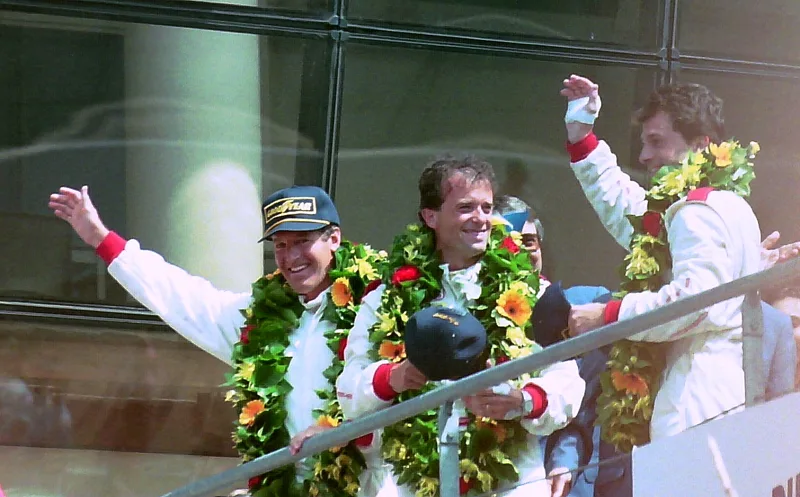
| 24 Hours of Le Mans | 1986 and 1987 | Overall wins with Bell, Holbert and Stuck |
| 24 Hours of Le Mans (Dauer 962) | 1994 | Overall win as a road-legal GT1 car |
Bell, Holbert and Stuck shared the 1986 and 1987 Le Mans wins. Under the Dauer 962 badge it won again in 1994.
The car stayed dominant in the American IMSA series well into the 1990s. Like the 917K, 935 and 956 before it, the 962 became a leading car in its era, and its efficiency and reliability made it sought after by private teams.
Did the 962 keep winning in the 1990s?
Yes, though less often. Strong factory teams such as Jaguar, Mercedes-Benz, Nissan and Toyota made the privateer 962s less successful in the late 1980s, but the cars still took lone victories in the IMSA GT and Interserie seasons until 1993.
Team Taisan took an All Japan Grand Touring Car Championship round at Fuji Speedway in August 1994. That was the last victory for an original 962C, just over ten years after the car first raced. Dauer's 1994 Le Mans success used a heavily modified car, which the ACO rules let in as a road-legal GT1 car.
Were 962s converted for the road?
Yes. Towards the end of the car's racing life, privateer teams and tuners converted 962s for road use, with names including C62, DP62, 962CR and Dauer 962 Le Mans. The runs were small, and some are poorly documented. The idea was simple: a car that had performed so well on the track would make an ideal supercar for the road.
An almost standard car was registered as BB-PW 962 and briefly driven for a German magazine, but its headlight height and underbody configuration made it illegal under German regulations.
Koenig Specials was the first company outside Porsche to convert a 962 for the road. Its C62 was completed in 1991 with new bodywork to suit German regulations, and the engine was expanded to 3.4L with a newer Motronic system. How many were built is unknown.
German tuner DP Motorsports completed three DP62 road cars in 1992, built on existing racing chassis. The headlights were raised to meet German requirements, and each car received a 3.3L twin-turbo flat-6. In 1991 Vern Schuppan created the 962CR for Japanese customers at a list price of 195 million Yen, or UK 830,000 pounds.
At least two 962R (LM) cars were built before the CR run. The first was little modified from its racing days, and its British-built aluminium honeycomb chassis set it apart from most street versions. It appeared in UK and Australian magazines in the summer of 1991.
Jochen Dauer used original racing chassis for his GT1 versions, the Dauer 962 Le Mans, for both road and race use. Their bodywork was all new but kept many elements of the original car. One Derek Bell edition road car was finished with a 580 bhp (430 kW) engine from the 993 GT2.