A TWR-Porsche repeated its 1996 victory after works Porsches led most of the race, and a rookie driver began the nine wins that made him Le Mans' most successful driver.
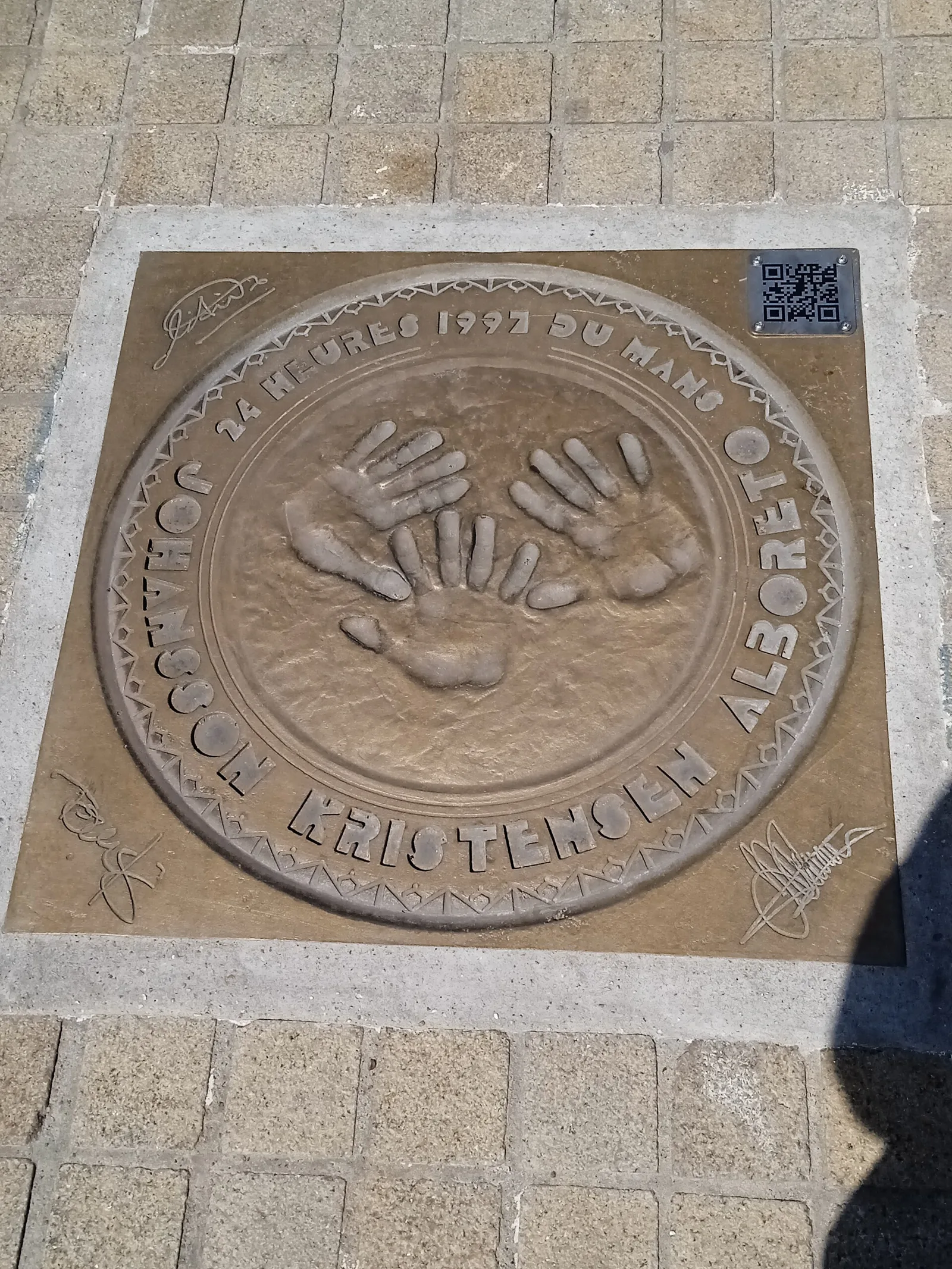
The 1997 24 Hours of Le Mans, the 65th running, was held on 14 and 15 June 1997. A TWR-Porsche WSC-95 won it, with Alboreto, Johansson and Kristensen sharing the drive, while a works Porsche's second car burst into flames two hours from the end.
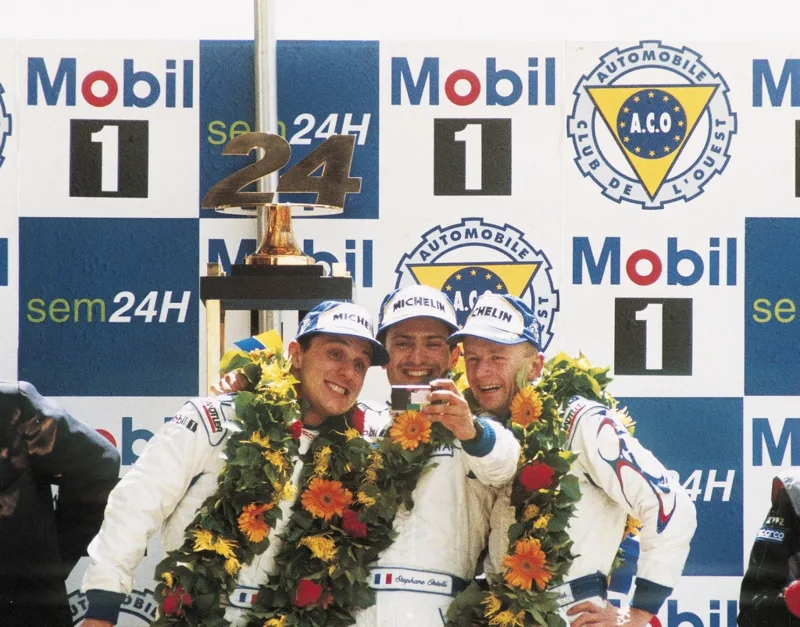
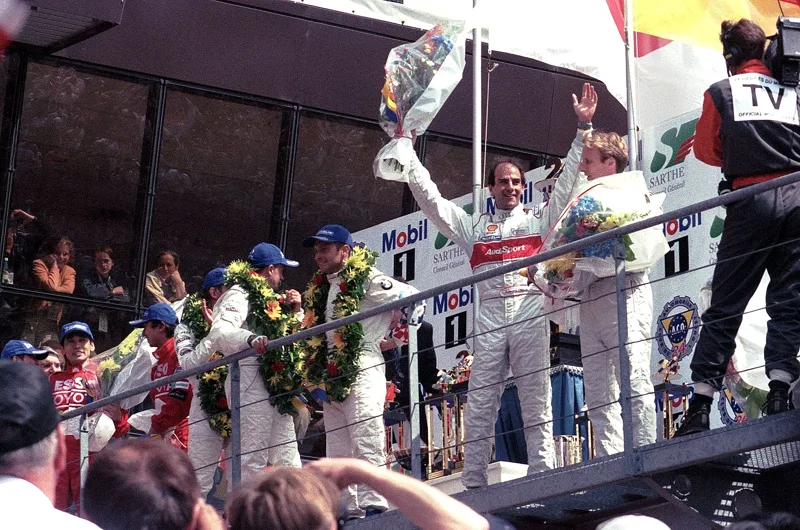
Michele Alboreto, Stefan Johansson and Tom Kristensen won the 1997 24 Hours of Le Mans in a TWR-Porsche WSC-95, the same car that had won the race the year before. It was the first of a record nine Le Mans victories for Kristensen, who was racing at the circuit for the first time. The works Porsche team had dominated most of the race, but a fire in its second car changed the outcome.
What changed in the rules and the circuit for 1997?
The Automobile Club de l'Ouest made no notable changes to its technical specifications for 1997. The circuit was adjusted slightly at the request of the FIM, the motorcycle governing body, with the chicane after the Dunlop Bridge modified and the run-off area enlarged for safety. The lap grew by 5 metres as a result.
Prototypes and GT1 cars were required to run white headlights, while GT2 cars used yellow ones to help identification at night. GT2 cars were also allowed carbon brakes when their road-going versions used them.
The rules for automatic entries also changed, so that places went to class victories in named races rather than to chosen manufacturers. The BPR Global GT Series had proved so successful that the FIA promoted it to World Championship status for 1997, with 8 races in Europe, 1 in Japan and 2 in the United States. The organisation stayed with the Stephane Ratel Organisation.
A new, non-championship series, the International Sports Racing Series, ran four European races after Le Mans. The grid was arranged so that the first ten of each class started together, with prototypes on one side and GT cars on the other.
A works Porsche led most of the race, but the TWR car that had won in 1996 took the flag, and a Le Mans career that would win nine times began.
How big was the 1997 entry list?
There were 86 applications for the 1997 race, and 76 were accepted for pre-qualifying, which was held that May. That weekend chose the 46 starters, and the numbers were tight in every class. 13 prototypes competed for 10 places, 29 GT1 cars for 22 places, and 21 GT2 cars for 16.
The ACO gave six automatic entries, to the 1996 class winners at Le Mans and at the Coupe d'Automne, along with the BPR Global series winner. Those six came from Joest Racing, Porsche AG, Roock Racing, Welter Racing, Larbre Competition and the Gulf team.
Fully half the cars that came out of Pre-Qualifying could be called works entries, and ten manufacturers fielded cars in GT1.
Which prototypes led the field?
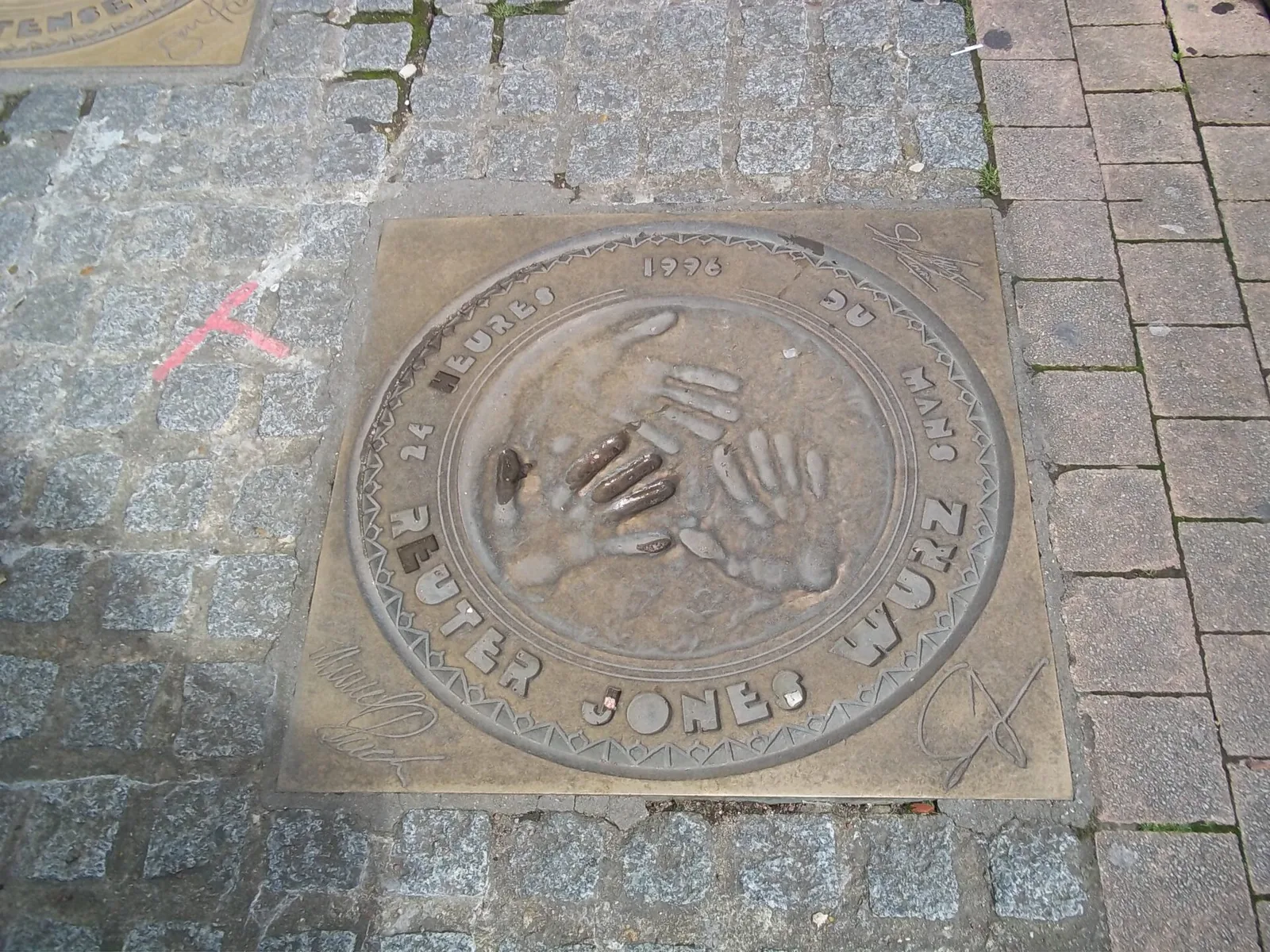
Joest Racing returned with the TWR-Porsche that had won the previous year, while the second car had been sent back to the Porsche factory. Alboreto led the car, with Johansson alongside him. Their rookie co-driver was Tom Kristensen, who was leading the F3000 championship after three races.
Reinhold Joest used the automatic entry to defend the title, this time without factory back-up, and very little extra work was done on the car.
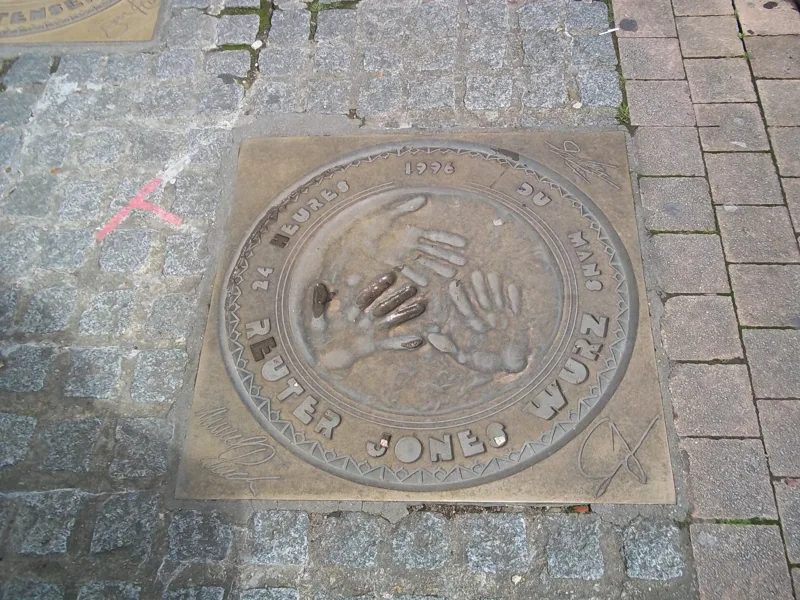
The team approached Kristensen only nine days out, to take the seat of the injured Davy Jones. Jones had won for the team in 1996, but a single-seater accident in January meant he could not drive. Kristensen went on to become Le Mans' most successful driver over the following decade.
Courage Competition entered four cars, including a C41 adapted to the ACO prototype rules. It was painted to celebrate the 40th anniversary of the French comic Michel Vaillant. Three C36 spyders completed the team, one of them shared by Mario Andretti and his son Michael with Olivier Grouillard. The Elf La Filiere academy car had Henri Pescarolo as its veteran, alongside Jean-Philippe Belloc and Emmanuel Clerico.
Kremer Racing ran its K8 Spyders again, and little work was done on them, because the team's focus was on its GT cars in the BPR series. Tomas Saldana and Carl Rosenblad were joined by Jurgen Lassig, while the second car carried Giovanni Lavaggi, Jean-Luc Maury-Laribiere and Bernard Chauvin. Two Ferrari 333 SP cars were entered from the IMSA GT Championship. Gianpiero Moretti, at 57 years old, returned to Le Mans for the first time since 1970, when he had raced a Ferrari 512S. Michel Ferte's Pilot Racing had bought its car from EuroMotorsports, and the car had been idle since 1994, the year it gave the 333 SP its first IMSA win.
How did the Mazda and BRM entries fare?
Mazdaspeed's DLM4 was built around the Mazda R26B quad-rotor engine that had powered the 787B winner of 1991. Jim Downing had won IMSA's approval for the quad-rotor in the WSC series, and the ACO insisted the car compete in the LM-P875 class, with WSC-style rules. The engine was limited to 560 bhp.
Downing again raced with Yojiro Terada and Franck Freon, the pairing he had used for the past two years.
Dave Lynn designed the chassis, which was stretched in wheelbase to suit the bigger engine, and the car was fitted with a five-speed gearbox and iron brakes. It was the tenth Kudzu chassis built by the team. Engine heat and aerodynamic drag were the main problems. The DLM4 was 150 kg heavier than the previous ultralight P2 DLM, which hurt its top speed. It failed pre-qualifying at first and only got in after the withdrawal of the WR team gave it a reprieve.
BRM returned with a P301 converted from the P351 it had raced in 1992. That chassis had been bought from Keith Wiggins's Pacific Racing team, which had recently left Formula One. The open-top spyder had its rear end reworked around a 3.0-litre Nissan V6 turbo engine, replacing the 3.5-litre V12 of the earlier car. Harri Toivonen, Eliseo Salazar and Jesus Pareja drove it.
How strong were the GT1 cars?
Porsche's 911 GT1 Evo kept the chassis and engine of the car that had debuted in 1995. ABS brakes were banned, and the FIA's smaller air restrictors hurt its competitiveness in the Championship, though the water-cooled 3.2-litre unit remained capable of 590 bhp under the ACO's lighter limits.
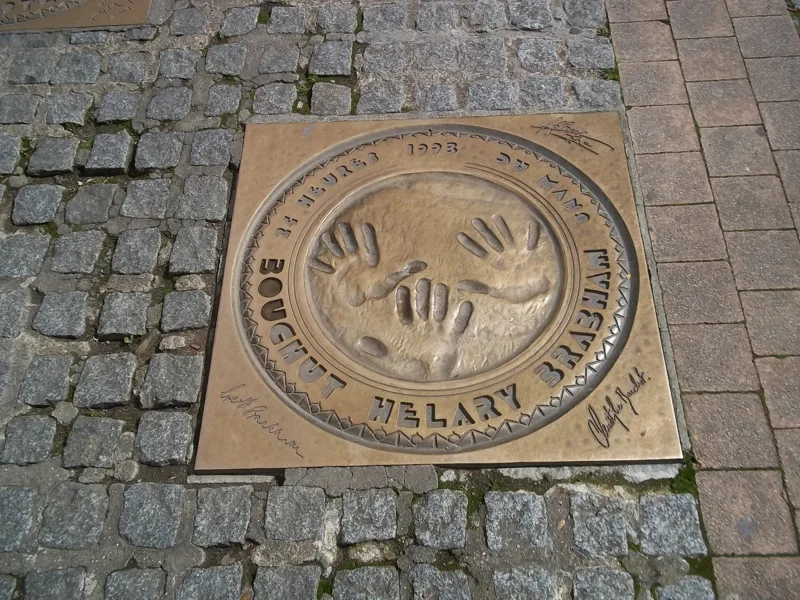
Thirty road-going versions of the 911 GT1 were sold over the close season, at about 450,000 pounds each, and six customer cars were entered at Le Mans. Kremer Racing backed its prototypes with a GT1 driven by Christophe Bouchut, Bertrand Gachot and Andy Evans, and the German teams Roock and Konrad, which had stepped up from GT2, were among the customer entries.
McLaren's F1 GTR was being outclassed by the newer designs, so the team cut weight and added downforce. BMW reduced the engine capacity slightly to 5990cc and took 25 kg from it, and a new Xtrac six-speed sequential gearbox was installed. The BMW works cars could produce up to 650 bhp because their road-going versions had ABS brakes and therefore allowed larger air restrictors.
New GT1 cars arrived from Nissan and the small American company Panoz. Nissan's R390 GT1 was new for 1997, and it was driven by a mix of experienced endurance drivers and former Formula One men. Martin Brundle and Wayne Taylor had the lead car, with rookie Jorg Muller, while Riccardo Patrese, Eric van de Poele and Aguri Suzuki ran the second. It was designed by Tony Southgate and built in England under a deal with Tom Walkinshaw Racing, with five cars commissioned. Its 3.5-litre VRH35L V8 made 600 bhp through a six-speed sequential gearbox, and the car completed 6000 km of testing at Estoril.
Late in the preparation Nissan learned of a new FIA requirement for a defined 125-litre luggage space, only ten days before the race. The team appealed, but the rushed changes to create the space forced a redesign of the airflow that cooled the gearbox.
Lister, Lotus and the BMW works team
Lister's works team returned with the Storm GTL, lengthened to improve the diffuser and with more than 80 kg pruned from the chassis and engine. Its 7.0-litre Jaguar V12 was tuned in-house to 650 bhp. The team entered two cars, but one was wrecked in the first round of the British GT series, and a replacement was built in three weeks. Both cars passed pre-qualifying with ease.
The drivers were Geoff Lees, Tiff Needell and George Fouche in one car, and Julian Bailey, Thomas Erdos and the two-time Australian Touring Car champion Mark Skaife in the other. Both arrived for race week in Newcastle United's black and white colours, a livery they had worn before.
Lotus came back with its new Elise in GT1, having last entered at Le Mans in 1994 with the Esprit in GT2. The BMW Schnitzer works team had won the first three rounds of the Championship, with JJ Lehto and Steve Soper among its winners, and Roberto Ravaglia and Peter Kox also in its line-up.
How did the race unfold through the night?
The Porsche works team dominated most of the race, but the TWR-Porsche held the lead for the first two hours. The works Porsches then took over and led into and through the night, while the TWR car and the best McLarens gradually lost ground.
At dawn the works challenge faltered. Bob Wollek, hounded by his team-mate, hit a curb and wrecked the suspension on the leading Porsche. The other works car took over at the front. It was looking comfortable at the front until the closing hours.
With two hours to go, Ralf Kelleners flagged an engine issue on the radio, and the car burst into flames almost as he pulled over. The second works car was out, and the TWR car moved forward and kept the lead for the rest of the race.
The finishing order at Le Mans
| Position | Entry | Result |
|---|---|---|
| First | TWR-Porsche WSC-95, Alboreto, Johansson, Kristensen | Winner, the first of Kristensen's record nine |
| Second and third | Gulf Team Davidoff McLaren and works BMW McLaren | Finished behind the winner |
| GT2 class | Haberthur Porsche 911 | Won the GT2 class in a race of attrition |
| Retired | Works Porsche 911 GT1, Ralf Kelleners | Burst into flames with two hours to go |
The GT2 class was a battle between Chrysler Vipers and Porsche 911s, and it was decided by attrition rather than pace. The Haberthur Porsche team came through it, while the rest of the class fell away.
Why did the 1997 result matter?
It was only the third time in the race's history that the same car and chassis had won in consecutive years. Joest had done the same in 1984-85. The win also marked the start of Kristensen's record run of victories at the circuit. The late change of driver, made only nine days before the race, did not stop the Joest car from winning.
Porsche had led most of the race, yet its works cars were struck by a series of mechanical and accident problems that handed the victory to Joest.
The McLarens were the only other cars in contention at the end. The Gulf and BMW works cars came home second and third, behind the winner.