From a hillclimb driver's first prototype in 1982 to Porsche power, Nissan engines and a 2007 sale to Oreca, the Le Mans team that nearly won in 1995.
Courage Competition was a Le Mans team and chassis maker founded by Yves Courage in 1982. Its best overall result was second place in 1995, and Oreca bought the business in 2007.
Courage Competition was a racing team and chassis builder based in Le Mans, France, close to the Circuit de la Sarthe. Founded by the hillclimb driver Yves Courage in 1982, it built prototypes for the 24 Hours of Le Mans for more than two decades. Oreca bought the business in 2007, and Courage later revived the name for electric racing projects.
Who founded Courage Competition?
Courage Competition was founded by Yves Courage, a French driver who had made his name in hillclimbs during the 1970s. After winning the under-2-litre sport class at Le Mans in 1981, he decided to build his own prototypes, and the first C01 raced at Le Mans in 1982.
Courage began racing in 1972 and, by 1980, had won more than 80 hillclimb events, including the Mont-Dore. He moved into sports car racing in 1977 and entered his first 24 Hours of Le Mans that year.
The 1981 race was the turning point. Partnered by Jean-Philippe Grand, he drove a Lola-BMW to victory in the sport class and saw it through to the finish. The result convinced him that a Courage-built chassis could compete at the very top of endurance racing.
A hillclimb driver's first prototype became a Le Mans team whose closest prize was second overall in 1995.
What were the first Courage cars?
The C01 made its debut in the 1982 race at Le Mans, in the Group C class, powered by a Ford Cosworth DFL V8. It lasted only 78 laps before retiring. Its follow-up, the C02, carried on the programme, and the team picked up sponsorship from Primagaz.
The chassis were renamed Cougar rather than Courage, a practice that continued for years. The team did not finish at Le Mans in 1983 or 1984. For 1985 that search ended with a deal to use Porsche units in place of the Ford engines.
How did the Porsche partnership succeed?
The Porsche deal gave Courage a competitive engine. The team finished 20th at Le Mans in 1985 and 18th in 1986, then reached its high point in 1987. That year a Courage car took third overall, ahead of everything except the factory Porsche 962 and a second 962 run by the team itself.
The same year Courage took part in part of a World Sportscar Championship season, finishing eighth in the teams standings with its C20 and Porsche 962 entries. Yves then retired from driving to concentrate on running the factory, because he believed that the chassis and the team could win at Le Mans.
Results were patchy afterwards. The team failed to finish any of its three Le Mans entries in 1988, but in 1989 it won the C2 class from a 14th-place finish and took 11th in the championship. In 1990 it went back to the C1 class and finished seventh overall, followed by 11th in 1991.
| Year | Le Mans result | Car |
|---|---|---|
| 1982 | Retired after 78 laps | C01 with Ford Cosworth V8 |
| 1985 | 20th overall | Cougar C12 with Porsche turbo flat-six |
| 1987 | Third overall | Cougar C20 with Porsche power |
| 1989 | 14th overall, C2 class win | Porsche-powered entry |
| 1992 | Sixth overall, C3 class win | C28LM, driven by Henri Pescarolo |
| 1995 | Second overall | C34 with Bob Wollek, Eric Helary and Mario Andretti |
| 1996 | Seventh and 13th overall | Porsche-powered entries |
| 1998 | 15th and 16th overall | Porsche-powered entries |
| 2003 | Seventh overall | C60 with Judd V10 |
| 2005 | Eighth overall | C60 as a hybrid prototype |
How did rule changes affect Courage?
Rule changes pushed Courage into smaller classes. The team ran in C2 at Le Mans in 1991 and in C3 in 1992, the class for Porsche-powered cars. Its turbocharged flat-six was no longer legal in the World Sportscar Championship, which was itself shrinking.
The C28LM still won its class in 1992 and finished sixth overall, driven by Porsche factory driver Henri Pescarolo. Pescarolo went on to build a long working relationship with Courage. When the championship ended in 1993, the team returned to C2 and finished tenth and 11th at Le Mans, followed by seventh in 1994.
How close did Courage come to winning Le Mans?
The closest Courage came to overall victory was in 1995, when the team finished second. Bob Wollek, Eric Helary and Mario Andretti battled at the front in the No. 13 Courage C34 and finished one lap down to a McLaren F1 GTR.
The 1996 race brought better reliability, with seventh and 13th overall and second and third in the Le Mans Prototype class. One of those entries belonged to Pescarolo, who began to build his own team in association with Courage. In 1997 the team took fourth, seventh and 16th overall.
By 1998 the Porsche engine was more than a decade old, and the team's pace had slipped. The Porsche-powered cars finished 15th and 16th, behind newer Porsche, Ferrari, Nissan and Toyota prototypes, which marked the end of the Porsche years. Pescarolo kept an older Porsche-powered Courage running in 1999 and took an unexpected ninth place with it.
Why did the Nissan partnership matter?
Nissan wanted an open-cockpit prototype for 1999, and it asked Courage to help develop a chassis and to supply its engine for testing mileage. In 1998 two Nissan-powered Courages joined the Porsche entries, using the Nissan VRH35Z turbo V8 that also powered the R390 GT1. Both Nissan cars failed to finish.
For 1999 Nissan bought a C52 for its own team, alongside its R391 prototype, while Courage continued to develop the Nissan engine in its own car. Courage finished sixth, Nissan eighth and Pescarolo's old Courage-Porsche ninth. The R391 failed to finish, and Nissan left sports car racing and ended its involvement with Courage.
What were the C60 and C65 chassis?
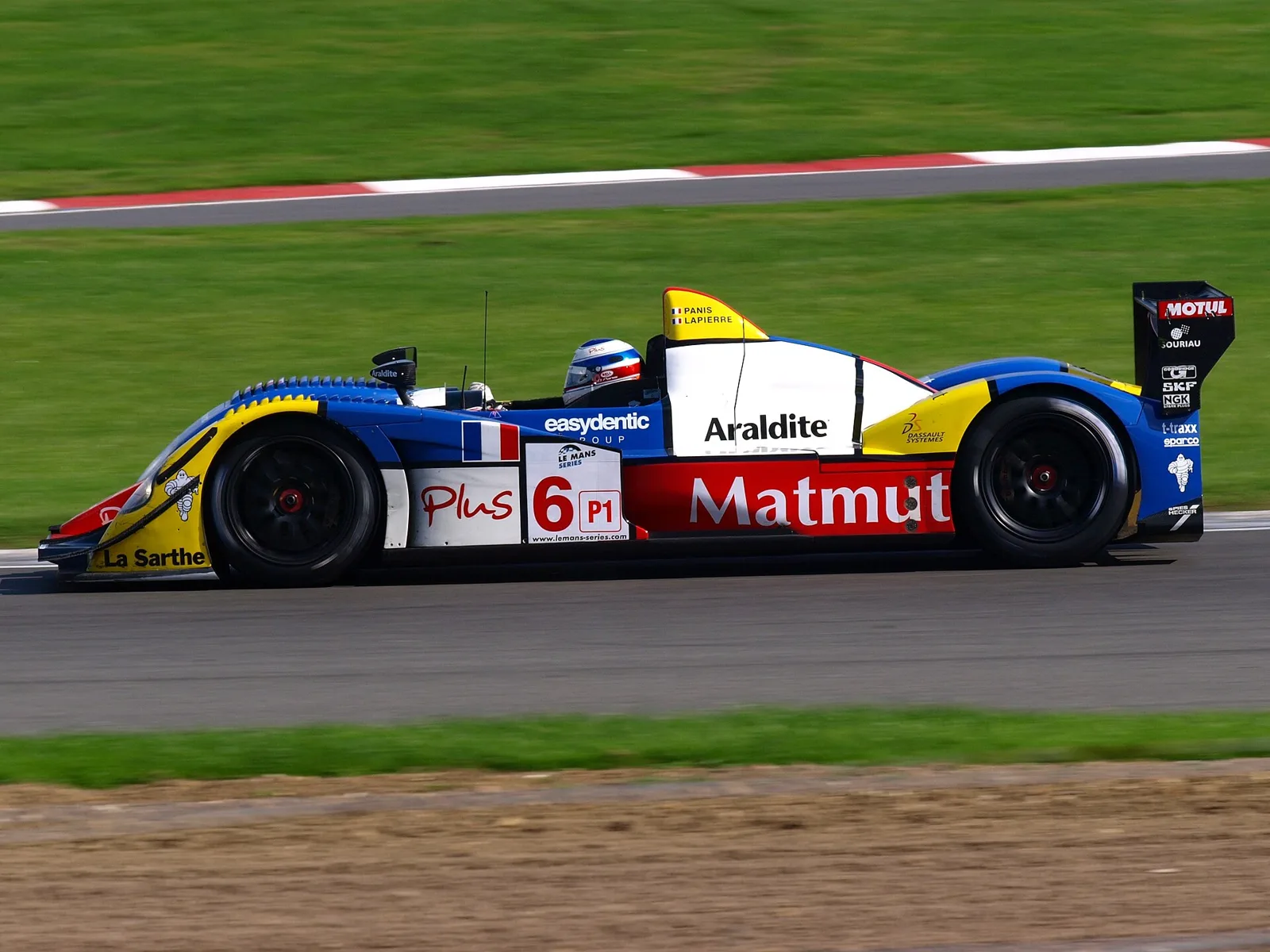
The C60 was a new LMP1 chassis for 2000, fitted with an all-new Judd V10 after the Nissan engine had gone. Pescarolo bought C60s as well, and changed them so much that by 2004 they were known as Pescarolo C60s. Courage's own car reached its highest point in 2003, finishing seventh overall.
The C65 was built for the smaller LMP675 class, later LMP2. It debuted in 2003 at an exhibition race held at Le Mans, taking class victory and fourth overall. In 2004, when the Le Mans Endurance Series began, a C65 secured the LMP2 teams title in the opening season, though the squad did not complete the Le Mans race.
Customers bought C65s too. Paul Belmondo's squad, Epsilon Sport in France, and Miracle Motorsports in the US were among the first buyers. Ten C65s were eventually produced, giving Courage the biggest share of the LMP2 market at that point.
How did the LC70 era go?
In 2006 Courage ran two cars in the Le Mans Series, backed by Yokohama Rubber and Mugen Motorsports. Mugen replaced the Judd V10 with its own V8, and the aging C60 was succeeded by the LC70 LMP1 car. A fourth LC70 was sold to the Swiss Spirit team.
Pescarolo dominated that year's LMS LMP1 championship with its modified C60, winning all five races, while Courage's teams took eighth and tenth. At Le Mans the Pescarolo C60s finished second and fifth, and the factory LC70s failed to finish. The Mugen engine caused reliability problems that undermined an otherwise competitive car.
What happened after Oreca bought Courage?
Oreca announced its plan to buy Courage Competition on 14 September 2007. Yves Courage stayed with the company, and Oreca intended to draw on his engineering knowledge to build a new prototype for Le Mans. Chassis work continued under the new ownership, and the Le Mans programme entered a new phase.
After 2007 Courage introduced the LC75, an LMP2 chassis, as the successor to the C65. Acura acquired three for the American Le Mans Series, where they were reworked extensively and homologated as the Acura ARX-01a. Courage also ended its work with Mugen and used AER power in its factory cars.
An Indian Le Mans project was announced around the same time, with the aim of bringing Indian drivers to Le Mans, but it never came to fruition. Pescarolo, meanwhile, moved to the Pescarolo 01 to meet the 2007 rules, and the two teams continued to help one another with development.
Yves Courage later refounded the business as Courage Technology in 2010, with the aim of developing electric racing cars.