A permanent track that shares public roads with the 24 Hours of Le Mans, grew from a city route into a 13.626 km circuit and holds one of motorsport's darkest records.
Set in Le Mans, France, this circuit's 24-hour configuration runs 13.626 km (8.467 mi) and carries the 24 Hours of Le Mans. Its best-known record is Roger Dorchy's 407 km/h (253 mph) on the Mulsanne Straight in 1988.
The Circuit de la Sarthe is a permanent motor racing track in Le Mans, France, and the home of the 24 Hours of Le Mans. It combines purpose-built race sections with public roads that are closed only during the race, and its 24-hour configuration runs 13.626 km (8.467 mi). The circuit is also remembered as the scene of the 1955 Le Mans disaster, which is widely regarded as motorsport's worst tragedy.
What is the Circuit de la Sarthe made of?
The track is a mix of private race-specific sections and public roads. Those roads are used only during the 24 Hours, and they remain open to the public for most of the year. Its present 24-hour layout is one of the longest circuits in the world, and its shape has changed many times since the 1920s.
The Musee des 24 Heures du Mans, a motorsport museum devoted to the race, stands at the main entrance of the venue. The nearby Bugatti Circuit, a separate permanent track, has a capacity of 100,000 spectators, and it shares pit facilities and its first corner with the full circuit.
A race circuit built on public roads, where a straight of several kilometres once tested cars close to 407 km/h.
Why was the 1955 Le Mans disaster so serious?
The 1955 Le Mans disaster is widely regarded as the deadliest event in motorsport history. The accident happened in a race run on the classic road circuit, where the pit area was part of the road itself with no physical separation.
The pit straight was only about 3.7 m (12 ft) wide before 1955, and it was widened in 1956. The race track and the pits were still not separated for another 15 years, until an Armco barrier was added to the pit straight in 1971.
How did the Le Mans circuit change over time?
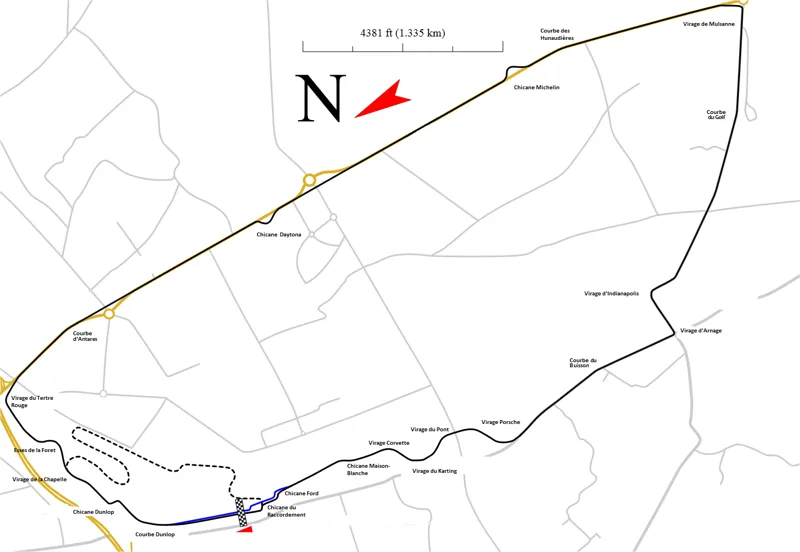
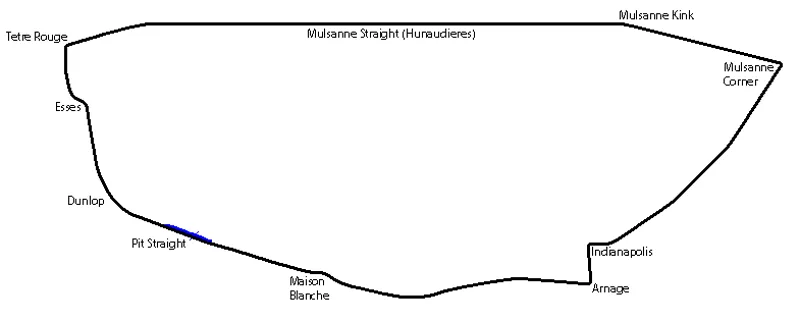
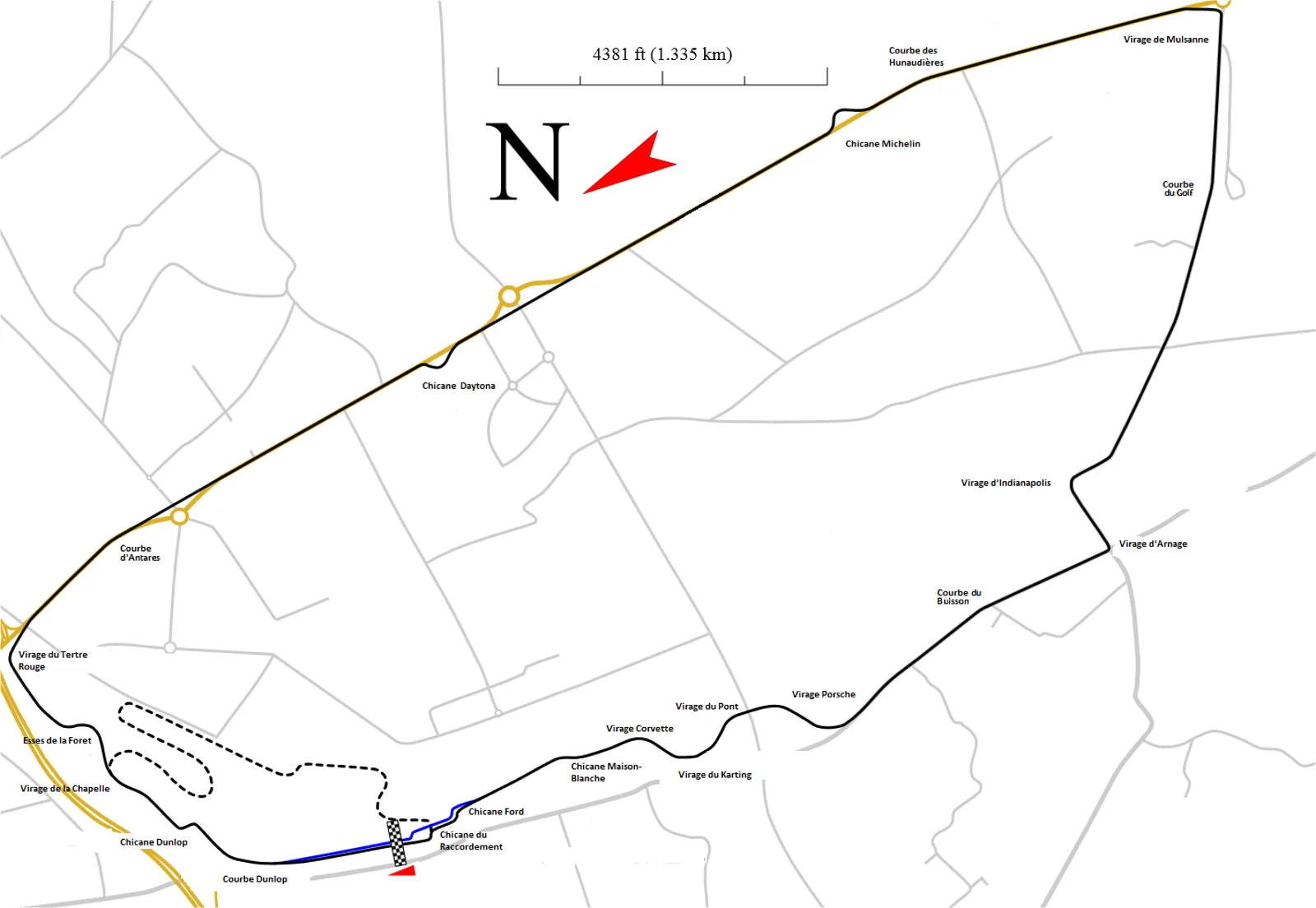
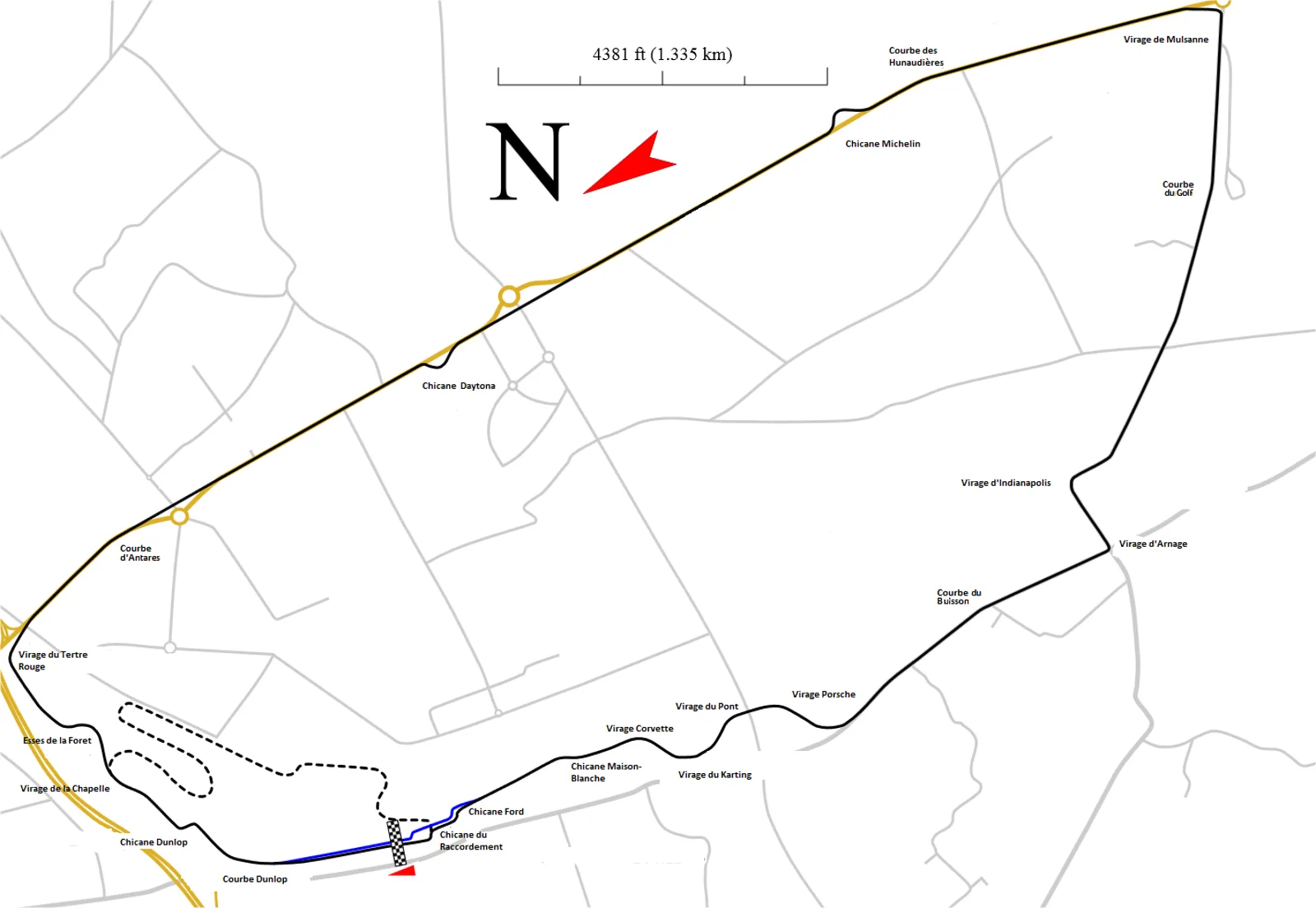
Early on, racers left the pits on Rue de Laigne and ran into town through a sharp right-hand corner near Pontlieue bridge. The city route was shortened in 1929 and bypassed completely in 1932, when a new section ran from the pits by the Dunlop Bridge to the Esses and Tertre Rouge. This classic configuration measured 13.492 km (8.384 mi) and stayed almost unaltered after the 1955 tragedy.
Speeds rose sharply in the 1960s. The smaller Bugatti Circuit was added in 1965, a Ford chicane was placed before the pits in 1968, and Armco barriers were fitted for the 1969 race. The Maison Blanche kink claimed many cars, including three Ferrari 512 variants, and it was the scene of several fatal accidents. 1971 was the last year of the classic circuit, and the 1972 revamp cost 300 million francs and introduced the Porsche curves to bypass Maison Blanche.
What is the Mulsanne Straight?
The Mulsanne Straight, known in France as the Ligne Droite des Hunaudieres, is a straight of about 6 km (3.7 mi) that runs toward the village of Mulsanne. After Tertre Rouge, roughly half the lap is run flat out before the Mulsanne corner braking zone, which can slow them from over 322 km/h (200 mph) to about 100 km/h (62 mph).
Top speeds rose steadily as turbocharged engines returned. The long-tailed Porsche 917 of 1969 to 1971 reached 362 km/h (225 mph), and the Porsche 935 turbo was clocked at 367 km/h (228 mph) in 1978. Group C prototypes passed 400 km/h (250 mph) in the late 1980s. The straight also claimed lives, and the high-speed accidents of Jean-Louis Lafosse in 1981 and Jo Gartner in 1986 led to concerns about the growing speeds.
Two chicanes were added to the straight before the 1990 race. The changes were also driven by a rule from the FIA, which would no longer sanction a circuit with a straight longer than 2 km (1.2 mi). The fastest qualifying average still fell only from 249.826 km/h to 243.329 km/h (155.235 mph to 151.198 mph) in 1992.
What was the 407 km/h speed record?
In 1988 the Team WM Peugeot entry, a car nicknamed Project 400, was built to exploit the outstanding straight-line aerodynamics of a Welter Racing design. Roger Dorchy drove it down the Mulsanne Straight at 407 km/h (253 mph). The official team entry was named WM Secateva, and the car retired on lap 59 with an overheating engine.
Peugeot then advertised the run as a 405, because it had just launched its 405 road car. That led many people to record the figure as 405 km/h (252 mph). Dorchy's best run was in fact 407 km/h (253 mph), and that figure is the one that stands in the record books.
How have the corners changed since the 1970s?
The Le Mans layout has been reshaped many times, and each change has tried to balance speed with safety. The table below lists the main corner and layout changes from the late 1970s to the current configuration, which has been in use since 2018.
| Year | Change |
|---|---|
| 1979 | Tertre Rouge reprofiled into a faster double-apex corner, and the second Dunlop Bridge removed |
| 1986 | A new roundabout at Mulsanne corner created a right-hand kink before it |
| 1987 | A chicane added to the Dunlop curve, cutting the speed from 290 km/h (180 mph) to 180 km/h (110 mph) |
| 1994 | Dunlop chicane tightened |
| 2002 | Run to the Esses reconfigured after renovations to the Bugatti Circuit |
| 2006 | Area between the Dunlop curve and Tertre Rouge redeveloped, with a new Bugatti pit exit |
| 2013 and 2018 | Tertre Rouge radius moved about 200 m (220 yd) after a fatal crash, with new tyre barriers; the current layout dates from 2018 |
The changes in 2013 followed the death of the Danish driver Allan Simonsen at the exit of Tertre Rouge, and the fresh profile was adopted for safety reasons. For 2026 the old Dunlop Bridge has switched to Goodyear branding.
What is the Bugatti Circuit?
The Bugatti Circuit, 4.185 km (2.600 mi) long, was built inside the 24-hour complex in 1965 and named after Ettore Bugatti. It was the base of Pescarolo Sport, the team founded by the French driver Henri Pescarolo, and it now stages a motorcycle endurance race and a MotoGP round.
The Bugatti Circuit also has a notable place in Formula One history, because the 1967 French Grand Prix was held there, the only time the world championship used the track. It also hosts the 24 Rollers, a 24-hour race on inline skates or quads, and it closes the FIA European Truck Racing Championship.
What events take place at Le Mans through the year?
The calendar begins in March with the Fun Cup France and runs through April with the FIM Endurance 24 Heures Motos and the Sidecar World Championship. The French motorcycle Grand Prix and the Red Bull MotoGP Rookies Cup follow in May, before the year's centrepiece in June, the FIA World Endurance Championship 24 Hours of Le Mans.
July brings the Le Mans Classic and the GT3 Revival Series, and September hosts the European Truck Racing Championship's 24 Heures Camions. McLaren Trophy Europe is listed for 2027. Between these events the circuit has been used by other championships and series, from Porsche Carrera Cup France to the NASCAR Whelen Euro Series, which ran there from 2009 to 2014.
How does the weather affect the 24-hour race?
Meteo France runs a weather station at Le Mans, and the city has an oceanic climate. Because the 24-hour race and the French MotoGP round both take place before the peak of summer, the conditions are often cool, and rain can be a factor. Nights can drop into the single digits during the 24-hour race, yet frost has never been logged in June.
The station is at the local airport, near the grandstand and pit lane.