A race won on distance, shared by three drivers, with three classes sharing one 13.6 km circuit and manufacturers still lining up to win it.
The 24 Hours of Le Mans is an endurance race near Le Mans, France, first run in 1923. The winner is the car that covers the greatest distance in 24 hours, shared by three drivers, with Hypercar, LMP2 and LMGT3 cars racing together on the 13.626 km circuit.
Le Mans is decided not by the fastest car but by the one that covers the greatest distance in a full day and night. The record is 5,410 km, set in 2010, over six times as far as the Indianapolis 500.
What is the 24 Hours of Le Mans?
It is an endurance sports car race held each year near the city of Le Mans in France. The first edition ran on 26 and 27 May 1923, which makes it the longest-running endurance event still held anywhere. The Automobile Club de l'Ouest, or ACO, organises it on the Circuit de la Sarthe, which mixes closed public roads with dedicated track.
The most recent running, the 94th, took place on 13 and 14 June 2026. In 2025 the event drew 332,000 spectators.
The race is won by the car that covers the greatest distance in 24 hours, not by the first across the line.
How is the 24 Hours of Le Mans won?
Unlike races decided by a set distance and a minimum time, Le Mans goes to the car that covers the most ground in 24 hours. The start is in mid-afternoon, and the finish comes at the same hour the next day. Modern cars typically exceed 5,000 km (3,110 mi), and the 2010 record of 5,410 km (3,360 mi) is about 18 times the length of a Formula One Grand Prix.
The date, in mid-June near the summer solstice, gives the shortest night of the year and often very hot conditions, especially in closed cockpits with poor ventilation. Rain is common too. Teams must balance speed against the car's ability to last, and manage fuel, tyres and braking materials across the whole day.
How do the drivers share the car?
Current regulations require three drivers in each car. No one may drive for more than 4 hours in any 6-hour period, or more than 14 hours in total. In the early decades there were no limits, and some drivers, among them Pierre Levegh and Eddie Hall, tried to run the whole race alone to save time lost in driver changes. That practice was later banned.
By the end of the 1980s at least three drivers were required, and the 1990s brought fatigue rules capping a stint at 240 minutes and a total at 840 minutes. Careful planning means a car can finish with only two drivers, though most teams still field three. In 2014 Jeroen Bleekemolen and Cooper MacNeil managed it with two. Since 2017 officials can also impose an 80-minute limit on consecutive driving with a 30-minute rest break, but only when the air temperature reaches at least 32 degrees Celsius.
How do the classes mix on track?
| Class | Type of car | Key rule |
|---|---|---|
| Hypercar (LMH or LMDh) | Custom-built top-class prototype | Debuted in 2021; rules aimed at preventing cost escalation |
| LMP2 | Prototype on an approved chassis | One of four chassis, powered by the standard 4.2-litre Gibson V8 |
| LMGT3 | Production-based grand tourer | Similar to road sports cars, slower than prototypes |
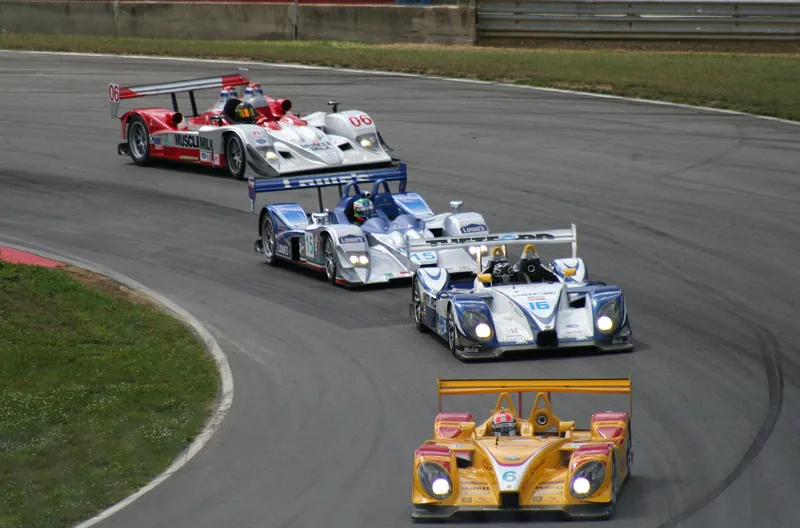
Since 2019, 62 cars have entered each race. All of them run together on the same circuit, so faster prototypes must pass slower GT cars throughout the night, while each class has its own prize and there is one overall winner. LMP2 teams must choose from ORECA, Ligier, Dallara or Multimatic and Riley chassis, with ORECA the most common. The older LMP1 class, which Hypercar succeeded, faced no chassis or engine restrictions, and those cars, with more power, less weight and more elaborate aerodynamics, lapped much quicker.
Cars need space for a second seat rather than the seat itself, and since 2017 every prototype must have a closed cockpit. The Garage 56 banner, introduced in 2012, lets concept cars testing new technology run as classified entries that are not expected to be competitive.
What are the unusual Le Mans rules and traditions?
Engines must be switched off during refuelling, which is safer and also tests whether a car restarts reliably many times. Mechanics may not work on the car while fuel goes in, apart from helping a driver in or out, so teams have developed clever ways to shorten the stops. Drivers can swap during refuelling. For many decades, cars also had to run for an hour before topping up fluids other than fuel.
The start is waved with the French tricolour, usually after a flypast by jets trailing blue, white and red smoke. On the final lap marshals wave their safety flags to congratulate the finishers.
The winner's champagne has a Le Mans origin. When Dan Gurney and A. J. Foyt won in 1967, Gurney was handed a magnum on the podium and saw Henry Ford II, Carroll Shelby and some journalists who had forecast failure for the pair. He shook the bottle and sprayed everyone nearby, in the first televised instance of a winner doing so. He later gave it to a photographer, which he turned into a lamp for years.
How long is the Circuit de la Sarthe?
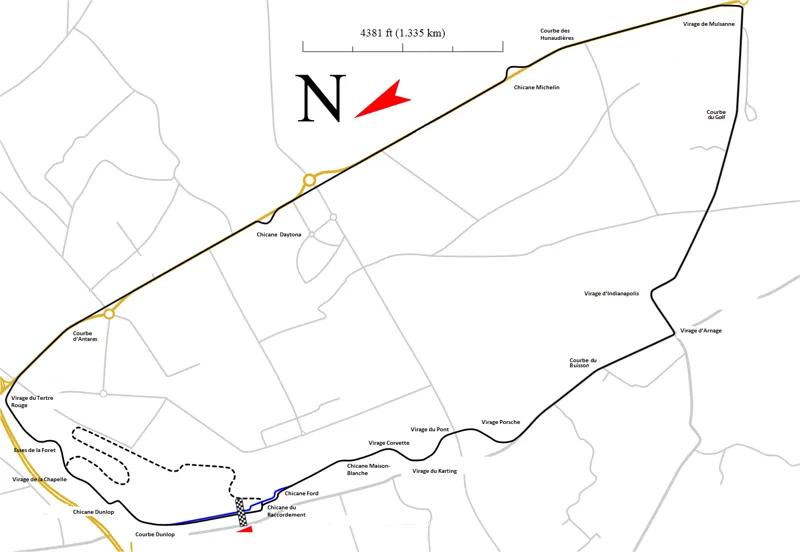
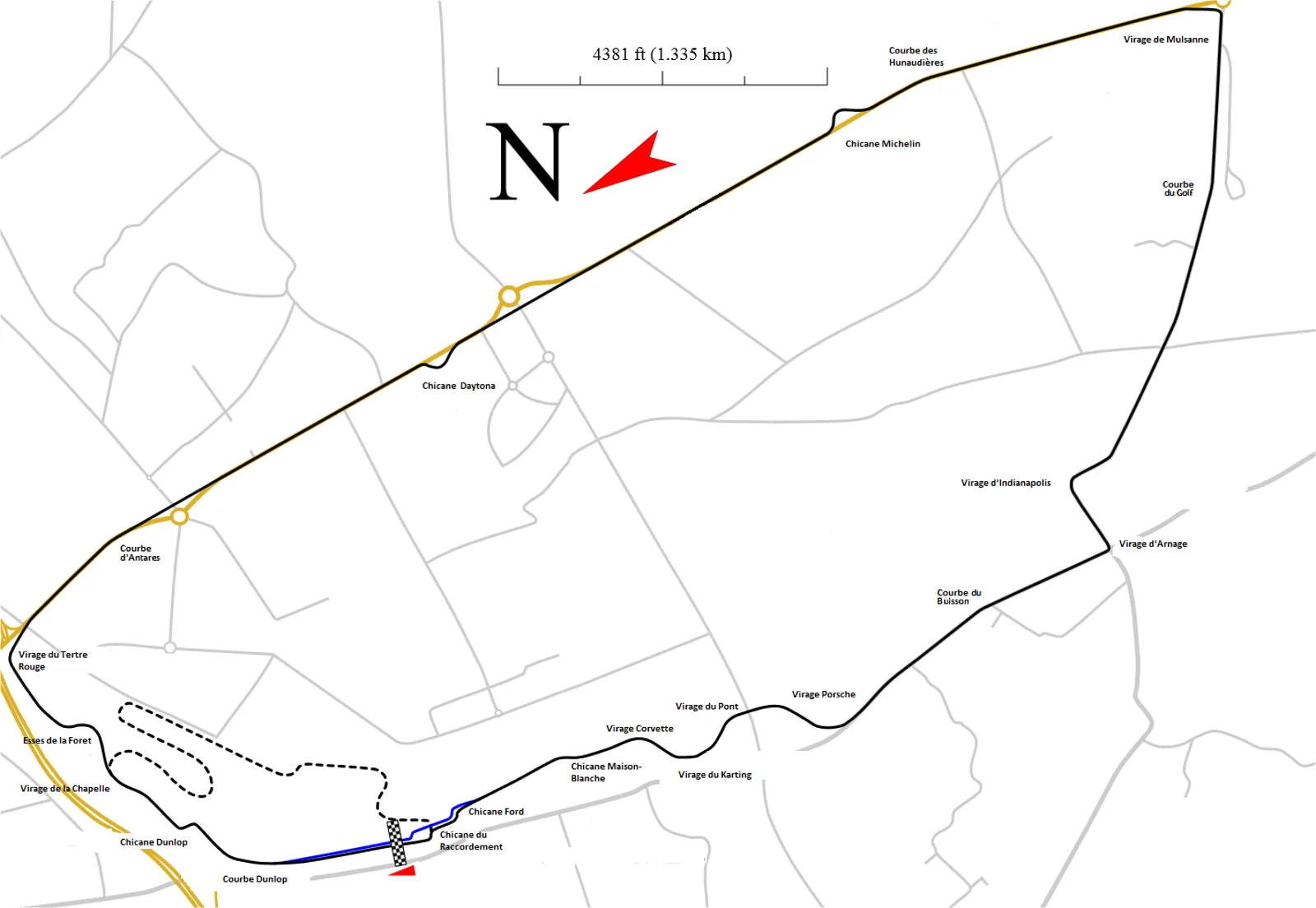
On its 24-hour layout a lap is 13.626 km (8.467 mi), among the longest circuits anywhere. Up to 85 per cent of a lap is spent flat out, which puts huge stress on engines and drivetrains, and the brakes and suspension suffer too. Braking for the tight Mulsanne corner means dropping from 322 km/h (200 mph) and more to roughly 100 km/h (62 mph).
Prototypes average more than 240 km/h (150 mph) a lap. The circuit is famous for the 6 km (3.7 mi) Ligne Droite des Hunaudieres, usually called the Mulsanne Straight in English. Few European circuits had a straight of comparable length, which meant cars needed stability and aerodynamics at very high speeds.
What is the Bugatti Circuit?
Named after Ettore Bugatti and opened in 1965, the Bugatti Circuit measures 4.185 km (2.600 mi) and is a permanent track inside the Le Mans site. It shares the pit complex, the Ford chicane and the straight under the Dunlop bridge with the big circuit, and then turns off on its own infield section.
It hosted the 1967 French Grand Prix, the only time Formula One used it, and now stages the French motorcycle Grand Prix. A 24-hour motorcycle race and a 24-hour truck race are also held on the site, and the Le Mans Classic and Le Mans Legend races fill the calendar around the main event.
How fast has Le Mans been?
In 1988 a WM Peugeot nicknamed Project 400 was timed at 407 km/h (253 mph) on the straight, the highest speed recorded there. The car, designed by Welter Racing, was built with the goal of becoming the first to reach 400 km/h. After 3.5 hours in the pits with engine trouble, Roger Dorchy took it out for the run. It retired on lap 59 with an overheating engine.
The team advertised the achievement as 405 to promote the new Peugeot 405, which is why the record is often misquoted as 405 km/h (252 mph). Before it, the long-tail Porsche 917 had reached 362 km/h (225 mph) between 1969 and 1971, and a 1978 Porsche 935 managed 367 km/h (228 mph).
Fatal high-speed accidents involving Jean-Louis Lafosse in 1981 and Jo Gartner in 1986 raised concern about the straight. Two roughly equally spaced chicanes were added before the 1990 race, partly because the FIA had ruled that it would not approve any circuit with a straight over 2 km (1.2 mi). The fastest qualifying average dipped only slightly by 1992, to 243.329 km/h (151.198 mph) from 249.826 km/h (155.235 mph).
How has the circuit changed since the 1920s?
In the 1920s the lap ran through the city and measured 17.261 km (10.725 mi), unpaved, with a hairpin that was removed in 1929. The city was bypassed in 1932, creating the classic 13.492 km (8.384 mi) circuit that stayed almost unchanged even after the 1955 disaster, which remains the deadliest event in motorsport history. The narrow pit straight, about 3.7 m (12 ft) wide, was widened in 1956, but it took another 15 years to separate the track from the pits.
Speeds rose sharply in the 1960s. The Bugatti Circuit arrived in 1965, the Ford chicane was added for 1968 and Armco barriers for 1969. The classic circuit was last used in 1971, and in 1972 a revamp costing 300 million francs added the Porsche curves, which bypassed the dangerous Maison Blanche kink. In 1987 a chicane at Dunlop curve cut the speed there from 180 mph (290 km/h) to 110 mph (180 km/h).
Danish driver Allan Simonsen died in 2013 at the exit of Tertre Rouge, which was re-profiled with its radius moved in by about 200 m (220 yd) and new tyre barriers. The current layout has been in use since 2018.
Why do manufacturers still fight to win Le Mans?
Le Mans was created as a different test from Grand Prix racing. Rather than rewarding the maker of the fastest machine, it was meant to reward sporty yet reliable cars, which encouraged reliability and fuel economy. After the early 1970s oil crisis, organisers adopted a fuel economy formula, and hybrid systems have been championed in the prototype class since the 2000s.
Innovations from the race can trickle down to consumer cars. Teams include competition departments of road car makers keen to show their products are the best, and winning Le Mans is often considered more important than winning the championship itself. It is also one leg of two informal Triple Crowns, one linking it with the Monaco Grand Prix and the Indianapolis 500, the other with Daytona's 24 Hours and Sebring's 12 Hours.
Championship rules recognise its weight. In the FIA World Endurance Championship, points at Le Mans are worth roughly double the normal amount, so a win that earns 25 points elsewhere earns roughly twice that here.
How are the classes changing?
After manufacturer interest in LMP1 declined, the FIA ordered a study that led to the Le Mans Hypercar class. The proposal moved away from Le Mans Prototypes and cut reliance on hybrid technology, with the aim of making the championship more appealing to car makers. The Hypercar class first appeared in 2021 with entries from Alpine, Glickenhaus and Toyota, and from 2023 LMDh cars could compete full-time alongside LMH.
In 2021 the ACO announced it would drop its two LMGTE classes after a rapid fall in manufacturer interest. The 2022 season was the last for LMGTE Pro, and from 2024 a GT3-based category replaced LMGTE Am. Richard Mille, who heads the FIA Endurance Commission, described the aim as a customer-focused category in which manufacturers cannot enter officially. In 2024 LMP2 was missing from the championship grid for the first time, although at Le Mans a minimum of 15 slots stays reserved for it.
When does the race take place?
Le Mans is usually run on the second weekend of June. Cars are inspected on Monday and Tuesday, and qualifying takes place on Wednesday and Thursday in two separate two-hour sessions each evening. Friday is a day of rest, with a parade of drivers through the city.
The date has moved a few times. The race was held in July in 1956, in September in 1968 after political turmoil in May, in September in 2020 because of COVID-19 and in August in 2021. It has been cancelled ten times, in 1936 after a labour strike and between 1940 and 1948 during the Second World War. It joined the World Sportscar Championship in 1953, became part of the Intercontinental Le Mans Cup in 2011 and has been in the FIA World Endurance Championship since 2012.