A Toyota trio won the first Le Mans race run under the Hypercar rules, with Ferrari taking both GT classes in a wet, pandemic-delayed August.
The 2021 24 Hours of Le Mans was the 89th running of the race, held on 21 and 22 August at the Circuit de la Sarthe. Toyota's Conway, Kobayashi and Lopez won in a GR010 Hybrid after 371 laps, the first Le Mans win under the new Hypercar rules.
Staged on 21 and 22 August near Le Mans, the 2021 event was the 89th edition of the race and the first to use the Hypercar rules as its top class. A Toyota trio led most of the way to victory, Ferrari took both GT classes, and a rain-soaked start gave way to a long night of safety car periods.
Why was the 2021 race moved to August?
The race had been planned for June, but the organisers postponed it to August to improve the chance of admitting spectators during the COVID-19 pandemic in France. The event became the fourth round of the 2021 FIA World Endurance Championship, rather than the third. Around 50,000 spectators were admitted, roughly 20 percent of the usual attendance at the circuit.
Entry to the circuit was restricted. Visitors needed proof of vaccination, a negative test, or proof of recovery from COVID-19. Face masks were compulsory, and the paddock was kept apart from each fan section. These measures shaped the whole weekend, from the crowd numbers to the way teams moved around the site.
The organisers also held a test day a week before the race, on 15 August. Every entrant had to take part in the test. Several well-known names took part, including the actor Michael Fassbender, who drove a Porsche.
A Hypercar race, a fuel filter problem and two Ferrari GT wins made 2021 Le Mans a year of firsts.
What changed with the Le Mans Hypercar class?
The Le Mans Hypercar class replaced the older LMP1 category as the top class at Le Mans. The new rules aimed to cut costs and improve competition, and they allowed manufacturers to build either road-based cars or purpose-built prototypes. Those cars could be hybrid or non-hybrid, and their minimum weight and maximum power output were both capped.
Balance of performance adjustments were used to keep the Hypercar and LMP2 classes apart. The Alpine A480 had its maximum stint energy allowance cut to 844 MJ, The Glickenhaus and Toyota Hypercars received no changes before the event.
Some adjustments went the other way. Porsche and Ferrari received changes to weight and fuel capacity, and the WEC committee later cut the Corvette's minimum weight. The Ferrari's fuel capacity was reduced by 3 L.
How was the 62-car entry list put together?
The organisers granted 62 invitations across the Hypercar, LMP2, LMGTE Pro and LMGTE Am classes. Entries were open from 4 December 2020 until 23 February 2021, and the full list was then published. Teams that had won their class at the 2020 race or won European, Asian or Michelin series championships earned automatic places.
Of the 62 invitations, 33 were guaranteed WEC entries. Another 14 came from the European Le Mans Series, five from IMSA, seven from the Asian Le Mans Series and two were one-off Le Mans entries. Further entries were held in reserve in case any invitations were withdrawn or refused.
The Garage 56 concept returned after a long absence. The slot went to La Filiere by SRT41, which ran a converted Oreca with a braking, clutch and throttle system that paraplegic drivers Takuma Aoki and Nigel Bailly could operate from a hand-controlled steering wheel. Their co-driver Matthieu Lahaye could drive the car normally. The team had raced the car in the four-hour European rounds in France and Spain as a precursor to the longer event at Le Mans.
How did practice and qualifying set the grid?
Practice produced close lap times across the Hypercar class, and the Toyota of Kamui Kobayashi was fastest when it mattered most. The Hyperpole shootout ended with a 3:23.900 lap by Kobayashi, his fourth pole position at Le Mans. Felix da Costa took LMP2 pole for Jota with a 3:27.950 lap.
Qualifying itself ran in two parts. A first session set the grid, apart from the fastest cars in each class. Those fastest cars went into a shootout called Le Mans Hyperpole, which decided pole in all four classes. Every Hypercar started ahead of the other classes, whatever its lap time.
In LMP2, Felix da Costa took the pole for Jota with a 3:27.950 lap. The three GTE manufacturers occupied the first places in LMGTE Pro, and Porsche took the top place in LMGTE Am. Estre lost control of a Porsche near the Indianapolis corner and damaged its rear end, which stopped the session.
How did the race start in the wet?
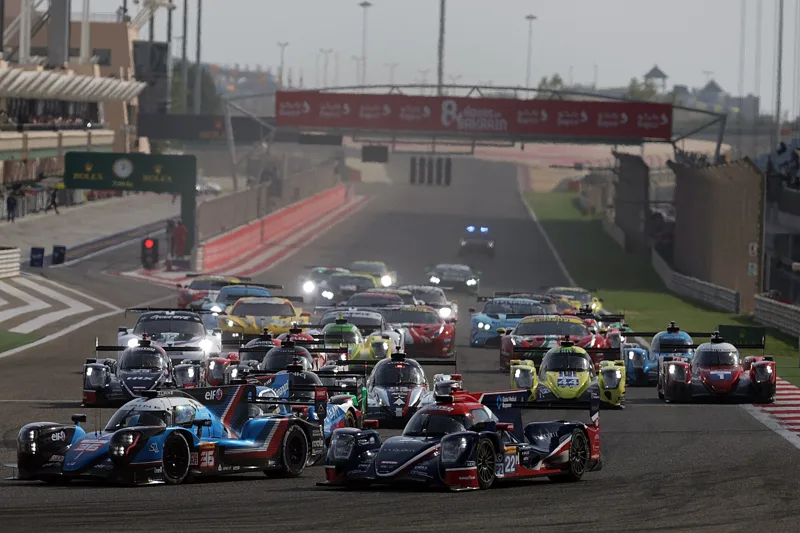
The circuit was still wet from a heavy shower before the start, and race control ran three formation laps behind the safety car. John Elkann, Ferrari's chairman, waved the French tricolour to start the race in front of around 50,000 spectators. The early running was messy from the first lap.
Calado's Ferrari hit Milner's Corvette at the start after the front windscreen fogged up, damaging the Corvette's diffuser. Pla then locked his Glickenhaus brakes in the wet and hit Buemi's Toyota, sending it spinning. Race control handed Pla a 10-second penalty, and Buemi lost more than 90 seconds while he reset the car.
Green-flag running soon followed. Most teams switched from intermediate to dry tyres once the track began to dry.
How did the race turn in the night?
The race was a long contest of safety cars, pit stops and punctures. Race control deployed safety cars four times in total, and each period bunched the field and reshuffled the leaders. A series of incidents, including several crashes and debris, led to repairs and recovery stops.
Kobayashi led at the halfway point, and his teammate Hartley was not far behind. Vaxiviere beached his Alpine at the first Mulsanne chicane when he locked the wheels on a damp patch, and the Alpine had to be extracted. That mistake promoted the Glickenhaus of Pipo Derani to third overall, while Lapierre later brought the Alpine back up.
Several cars left the race in the middle of the night. Gomes's Aston Martin hit the tyre barrier after touching artificial grass, and Andrade crashed a G-Drive car backwards into the tyre barrier at the Dunlop Bridge. Cooper MacNeil lost control of a WeatherTech Porsche on the Ford Chicane kerbs, and the car was retired with heavy damage on its right side.
What happened in the LMP2 and GT battles?
The LMP2 class produced some of the closest racing of the night, with several teams swapping places in the hours before dawn. Stoffel Vandoorne and Boyd fought for the class lead, and the pair collided several times before Boyd pulled clear in slower traffic. Those exchanges kept the class interesting long after the Hypercar leaders had settled.
Colapinto later lost control of his G-Drive car at high speed entering the Porsche Curves and hit the car he was passing, the Richard Mille entry driven by Sophia Florsch. Florsch was checked by the medical team and cleared to continue, but her car was retired. Safety cars were needed again while the barriers and debris were cleared.
In LMGTE Pro, the contest between the two AF Corse Ferraris and the Corvette remained close through the night. Bird lost time after a collision with Iribe's Inception car at the Ford Chicane, and his team still held second in the class. The GT fights, not the Hypercar race, decided the overall GT picture.
How did Toyota cope with its fuel problem?
Toyota's winning pair had to deal with a fuel problem that could have cost them the race. Engineers found that the fuel pump filters were clogging, traced to contaminated fuel in the pit lane bowsers. Stints were cut back from the usual 13 laps, and drivers used a steering-wheel button to clear the filter.
With eight hours left, Toyota's engineers had to act quickly. Buemi's car fell more than three minutes behind Kobayashi's leading Toyota after a brief stop to reset gear settings. Lead systems engineer Dominique Gardener came up with the steering-wheel procedure to help the pumps build pressure. The strategy worked well enough to keep the leading car in front.
In the closing stages, Ye's WRT car stopped with a broken throttle sensor, which handed the LMP2 lead to Frijns. Frijns then held off Blomqvist's Jota in slower GT traffic and crossed the line ahead, winning by 0.727 seconds. WRT had debuted in the class and won it at the first attempt.
What were the class results?
The Toyota led most of the race, and the GT classes were decided by a mix of pace and misfortune. The table lists each class winner and the margin of victory, along with the leading teams. Two Ferrari wins stand out, because the marque also won its class for the first time in LMGTE Am.
| Class | Winning car | Winning drivers | Margin |
|---|---|---|---|
| Hypercar | Toyota GR010 Hybrid | Conway, Kobayashi, Lopez | Second place two laps behind |
| LMP2 | Team WRT | Frijns, Habsburg, Milesi | 0.727 seconds ahead of Jota |
| LMGTE Pro | Ferrari 488 GTE Evo, AF Corse | Calado, Ledogar, Pier Guidi | 41.686 seconds ahead of Corvette |
| LMGTE Am | Ferrari 488 GTE Evo, AF Corse | Nielsen, Perrodo, Rovera | A lap ahead of TF Sport Aston Martin |
Ferrari won both GT classes, but the margins differed sharply. The LMGTE Pro winner finished 41.686 seconds ahead of the Corvette, while the LMP2 result was settled by 0.727 seconds.
What did the 2021 result mean for the championships?
Toyota's win moved the team's leading trio to the top of the Hypercar Drivers' Championship with 120 points. Buemi, Hartley and Nakajima stayed second, and Lapierre, Negrao and Vaxiviere held third. Toyota left the event as the Hypercar World Endurance Championship leader.
Ferrari's GT victories were its first win in LMGTE Pro since 2019, and the Italian team also took its first LMGTE Am win. Calado and Pier Guidi moved to the top of the GTE Drivers' Championship on 124 points, while Estre and Jani fell to 112. Ferrari left the event as the GTE Manufacturers' Championship leader.
The result also meant something for WRT. Its LMP2 win was the first by a debuting team since 2012, and it was the team's fourth time winning a major endurance event at its first attempt. The team had been fighting for the class in close company with Jota all through the final hours.
How did the drivers react after the race?
Winners and runners-up described a race that had rewarded patience and punished mistakes. Conway said that winning Le Mans had been a long time coming, Buemi felt lucky to avoid major damage on the first lap, and Alpine's team principal called third place an excellent result. Each team took something different from the finish.
Lopez said the final hours had been stressful because Toyota was coping with a fuel problem. Kobayashi said that the losses the three drivers had shared at Le Mans had strengthened their bond. Frijns said WRT had led both of its cars into the night and brought them home unscathed, and Blomqvist said it was hard to lose the class win by 0.727 seconds.
Pier Guidi said the rain had made the race hard for everyone, and the Ferrari had needed to push hard to stay ahead. Catsburg was pleased to finish second in class with the Corvette, and Garcia said the fight with Ferrari had been a close one-on-one contest to the end.