A rule loophole, a flat-12 pushed to 5 litres and a short-tail fix that turned an unstable prototype into the dominant sports racer of 1970 and 1971.
The Porsche 917 was a 5-litre flat-12 sports racer that Porsche built to exploit the 1968 rule changes. After the short-tail 917K fix in 1970, it won Le Mans in 1970 and 1971, and later 917/10K and 917/30 Can-Am cars dominated the American series.
The Porsche 917 was a sports prototype that Porsche built to exploit new racing rules at the end of the decade. It was introduced in 1969, sharpened over the next two seasons, and gave Porsche its first overall win at the 24 Hours of Le Mans in 1970, a result it repeated in 1971. Its short-tail version later became the basis of Can-Am machines that dominated the American series.
Why did Porsche build the 917?
Porsche built the 917 because the rules changed in 1968. The governing body allowed large five-litre sports cars to compete alongside three-litre prototypes, and Porsche decided to design a new car rather than rely on its existing 908. Its stated goal was a first overall win at Le Mans.
The CSI, the independent competition arm of the FIA at the time, set the International Championship of Makes to run for three-litre Group 6 prototypes from 1968 through 1971. The aim was to slow the unlimited-capacity cars, such as the seven-litre Ford GT40 Mk.IV and the four-litre V12 Ferrari P. The change also hoped to attract makers already building three-litre Formula One engines for endurance racing.
Few manufacturers were ready for the new limit, so the CSI admitted five-litre Group 4 sports cars too. Those needed a minimum production of 50 units and targeted cars such as the ageing Ford GT40 Mk.I and the newer Lola T70 coupe. In April 1968 the minimum was cut to 25 to attract more entries.
Porsche began work in July 1968. The company was already rebuilding race cars every race or two and selling the used ones, but it chose to design a completely new car, with 25 examples and one goal: winning Le Mans on 14 June 1970. The 917 was developed in only ten months, starting from the Porsche 908.
Homologation was hard won. When the CSI inspectors first visited, only three cars were complete and 18 were being assembled. Porsche argued that building and then dismantling cars would waste time, but the inspectors wanted 25 working cars. On 12 March 1969 a white car with a green nose was shown at the Geneva Motor Show, listed at DM 140,000, about 16,000 pounds, roughly the price of ten Porsche 911s. On 20 April Ferdinand Piech, the head of Porsche motorsport, lined up 25 cars outside the factory for the inspectors.
A rule loophole, a flat-12 pushed to 5 litres and a short tail that turned an unstable prototype into a Le Mans winner.
How was the 917 built?
The 917 used a very light spaceframe chassis of 42 kg (93 lb), pressurised with gas to reveal cracks, and a new air-cooled 4.5 litre flat-12 engine. Exotic metals kept the weight down, and the driving position was pushed so far forward that the driver's feet sat beyond the front axle.
Helmuth Bott designed the chassis and Hans Mezger designed the engine, both under Piech. Mezger's flat-12 had no cylinder offset, which a boxer design normally needs, so the engine stayed compact. The Type 912 used six crank throws, each shared by a pair of opposing pistons, where a boxer would need twelve, and its twin overhead camshafts were gear driven.
Weight saving went well beyond the engine. Titanium, magnesium and exotic alloys were used throughout, the gear knob was made of birch wood, and the tubular frame doubled as oil piping to the front cooler, an idea Lotus had used since the 22 of 1962. The fibreglass bodywork saved more weight, at the cost of protection in a crash. The writer James May later called the 917 the world's fastest canoe.
Why did the 1969 917 struggle?
The 1969 917 was fast on the straights but unstable, because its long tail generated lift at speed. Moving tail flaps were banned in May 1969 after Formula One crashes, which left the car with serious handling problems until the rear end was reworked the following year.
In testing the car proved very hard to control. Brian Redman remembered it as incredibly unstable at speed. Engineers first blamed the engine, which many thought too big for the frame, and then the suspension, but the real cause was aerodynamic. The long-tail body was creating lift on the straights, where the 917 was 30 km/h (19 mph) faster than any earlier Le Mans car.
The flaps were a short-lived solution. Porsche had fitted moving flaps to the tail, but the CSI banned movable wings after the accidents in Formula One. Rolf Stommelen showed how undriveable the 917 was without them, and the rule was relaxed for Le Mans alone.
Results in the first season were poor. A 917 finished eighth at the Nurburgring 1000 km behind a Ford and an Alfa Romeo, while the factory's 908/02 cars scored a 1-2-3-4-5. At Le Mans in 1969 the 917s were quickest in practice, but John Woolfe crashed on the first lap at Maison Blanche and died. Jacky Ickx's Ford won the race by a mere 120 m (390 ft).
The first win came at the final round of 1969, the 1000 km at Zeltweg, where Jo Siffert and Kurt Ahrens drove a privately entered car for Freiherr von Wendt. Porsche had by then begun to focus its factory effort on development rather than on the long trips to races.
How did the 917K fix the handling?
The 917K fixed the handling with a short, upswept tail that generated downforce at speed. Porsche and JW Automotive engineers shaped it at a test at the Osterreichring in late 1969, and the K stands for Kurzheck, meaning short tail. It became the standard 917 for most of the 1970 season.
After the 1969 season John Wyer asked for a three-day test at the Osterreichring. Porsche brought along Jo Siffert's 917PA Spyder for comparison, and the drivers preferred its upswept tail. The team studied the airflow by looking at dead gnats stuck to the bodywork, saw that the tail was clean, and built a new short tail in the pits from gaffer tape and aluminium sheet.
The new car made its debut at the January 1970 Daytona race against the new Ferrari 512S. Its stability was such an improvement that it became the standard configuration for every race except Le Mans, the Nurburgring 1000 km and the Targa Florio. Later in 1970 the flat-12 was bored from 4.5 litres to 4.9 litres and then to 5-litres.
The 917K won seven of its ten championship races in 1970. Two defeats came when the factory chose the lighter 908/03 for other races, and one came at Sebring, where a Ferrari 512S prevailed.
Did the 917 win Le Mans in 1970?
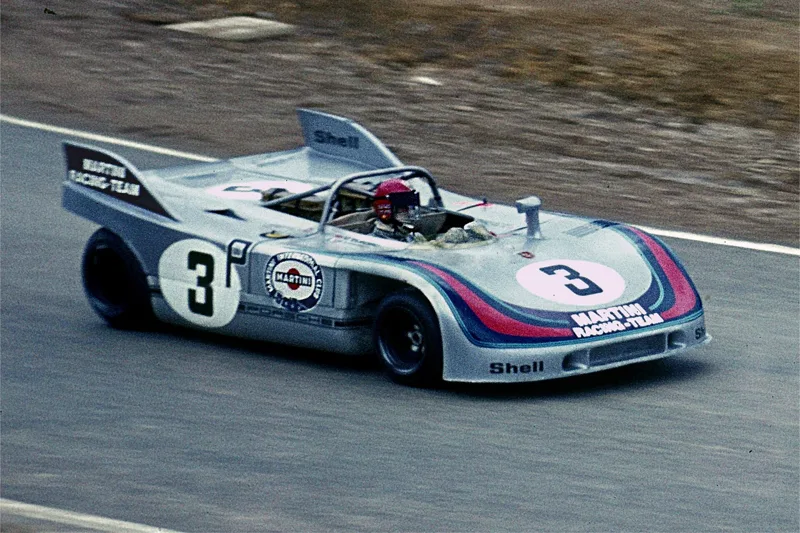
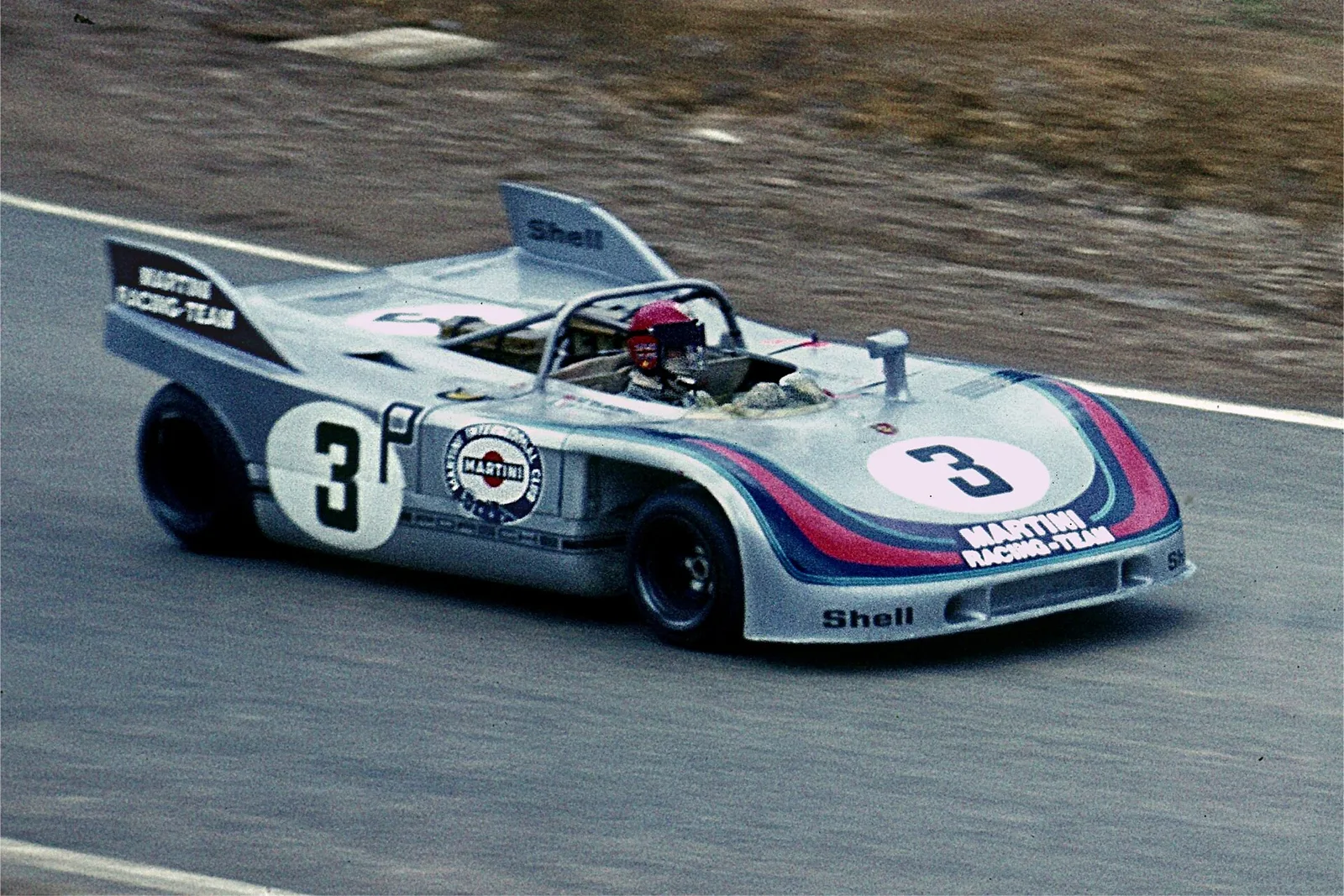
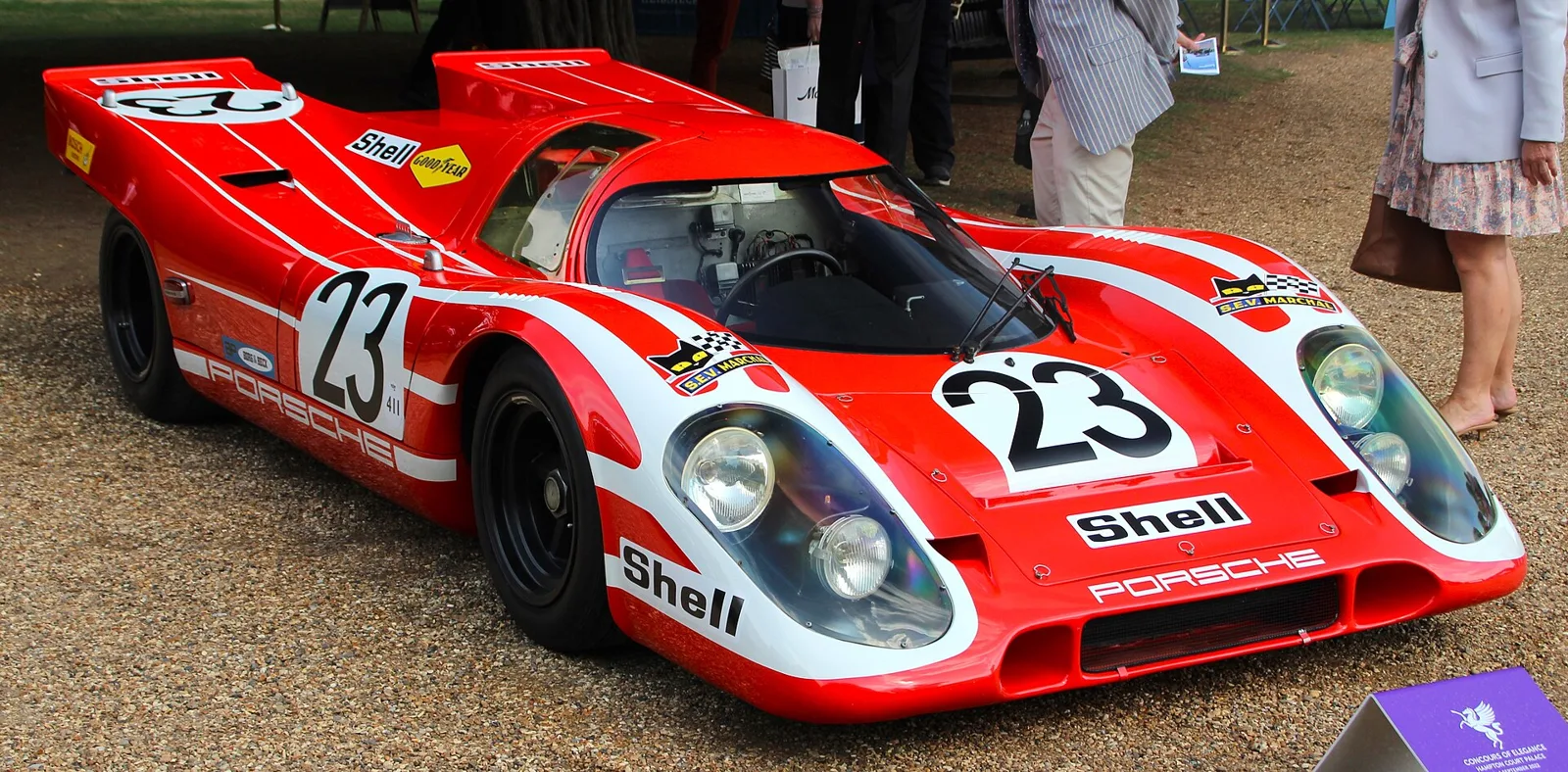
Yes. The Porsche Salzburg 917K of Hans Herrmann and Richard Attwood won the 1970 race, with the Martini 917LH second. It was Porsche's first overall Le Mans victory, achieved in a wet race that left only seven ranked finishers. Porsche's Le Mans effort relied on several teams.
The Gulf-backed JW Automotive team lined up three 917Ks, while Porsche Salzburg was effectively a works team under members of the Porsche family. Martini Racing also received Porsche support, so the company was backing more than one team to win the race.
The long-tail 917L was built for the straights. Vic Elford qualified a Salzburg 917L on pole, but it retired with engine failure after 18 hours. The 917L was 25 mph faster down the straights than the 917K and the Ferrari 512S, although its handling in the braking and cornering sections was still questioned.
The race itself turned on the rain and attrition. Most of the Ferrari 512s eliminated one another early on, and the Gulf-Wyer cars were all out after 12 hours. The red and white Salzburg 917K of Herrmann and Attwood worked carefully through the downpour to take the win. The Martini 917LH came second, five laps behind.
What were the main 917 variants?
The 917 family included at least eleven versions, from the 1969 long-tail coupe to the 1973 917/30 Can-Am car. The table summarises the principal variants and what each one achieved. Each row shows the engine used and what that variant achieved in racing.
| Variant | Years | Engine | Notable result |
|---|---|---|---|
| 917 long tail (Langheck) | 1969 | 4.5 litre flat-12 | Fast on the straights but unstable; flaps allowed at Le Mans only |
| 917K short tail (Kurzheck) | 1970 | 4.5 to 5-litre flat-12 | Won seven of ten championship races |
| 917L and 917LH | 1970 to 1971 | 4.9 to 5-litre flat-12 | Le Mans long-tail cars; Martini second in 1970 |
| 917K with fins | 1971 | 5-litre flat-12 | Won seven of eleven World Sportscar Championship races |
| 917K magnesium frame | 1971 | 5-litre flat-12 | Won Le Mans in 1971 with Marko and van Lennep |
| 917/10K | 1971 to 1972 | Turbocharged, 850 hp (630 kW) | Won the 1972 Can-Am title |
| 917/30 | 1973 | 5.4 litre twin turbo, around 1,100 bhp (820 kW) | Won all races but two in the 1973 Can-Am series |
How did the 917 perform in Can-Am?
Porsche turned the 917 towards North America in the early 1970s, when the series needed bigger engines. A 16-cylinder prototype with about 750 hp was tested, but a turbocharged 12-cylinder was used instead. The longer chassis handled less well, and drivers said so.
A 917/10K won the 1972 Can-Am title for Penske with George Follmer after a testing accident sidelined Mark Donohue. That ended McLaren's five-year grip on the series. The 917/30 went further, with a longer wheelbase, revised aerodynamics and a 5.4 litre twin-turbocharged engine, and Donohue won most of the 1973 races.
Racing rules then turned against the car. The oil crisis and a fuel consumption limit set by the SCCA, of 3 mpg-US (78 L/100 km) for 1974, ended the 917/30's racing. The Penske car competed in only one race that year, and some customers fitted naturally aspirated engines to their 917/10Ks.
The car's last official outing came on 9 August 1975, when Porsche and Penske took a 917/30 to Talladega. Donohue averaged 221.160 mph (355.923 km/h) to set a record that stood for years. He died in practice for the Austrian Grand Prix a week later.
How many 917s were built?
Porsche built 59 917s between 1969 and 1971 by one count, 43 naturally aspirated cars and 16 turbocharged ones. Other accounts put the original series at 25 and the total at more than 50 chassis, so the exact figure depends on how the cars are counted.
The naturally aspirated cars were 36 K models, five LH cars and two Spyders. The turbocharged group comprised 13 917/10s and three 917/30s. Porsche had planned an original series of 25, but customer demand meant the number grew well beyond that.
What became of the 917?
Some 917s were registered for the road, and many surviving cars have appeared in films and replicas. Chassis 030 was road-registered in Alabama, and chassis 037 was registered in Monaco in 2016. Replica builders have produced high-end copies using the 911 flat-6.
Count Gregorio Rossi di Montelera of Martini bought chassis 030, raced it once at the Zeltweg 1000 km on 27 June 1971, and later had it fitted with road equipment and painted silver. European authorities would not certify it, so Rossi obtained an Alabama plate. Joachim Grossmann's car was painted white and registered in Germany as CW-K 917 after he rebuilt it.
The 917 also raced in Europe's Interserie until the mid-1970s, and many leftover parts went into the Porsche 936 of 1976. In 1981 Kremer Racing ran a home-built update, the 917 K-81, which qualified in the top 10 at Le Mans before retiring after seven hours. A Laser 917, a rebodied Volkswagen Beetle, appeared in Herbie Goes to Monte Carlo.