Seven decades of engine formulas, from big naturally aspirated Grand Prix motors and turbo boom years to the 1.6-litre hybrids and the sustainable-fuel rules of 2026.
Formula One engines have been reshaped by many rule changes since the championship began in 1947. The current units are 1.6-litre turbocharged V6 hybrids, and the 2026 rules shifted more of their output to electric power and sustainable fuel, with a greater reliance on electricity.
Formula One engines have gone through many regulation eras since the championship began in 1947. The current power units are 1.6-litre turbocharged V6 hybrids, introduced in 2014, and they were redesigned for 2026 with a greater reliance on electric power. Across the decades, the formula has ranged from large atmospheric engines to small turbos and back again.
How did Grand Prix racing begin?
Car racing grew up in Europe before 1900, and the Grand Prix name began with a 1901 race at Pau. By 1914 the French Grand Prix used limits of 1,500 cc with supercharging or 4,500 cc without, and the sport was governed by a series of national and international bodies.
The Pau race of 1900 was won by Rene de Knyff. In 1901 the event became the Semaine de Pau, and its prizes were named Grand Prix awards, the first use of the name for such prizes. The Commission Sportive Internationale was established in 1922 by the Automobile Club de France.
The Automobile World Championship ran from 1925 to 1930 and the European Drivers' Championship from 1931 to 1939. The FIA succeeded the AIACR in 1946, and Formula One was defined for 1947, with Formula Two set at 500 cc supercharged or 2,000 cc unsupercharged. The World Championship for Drivers began for 1950, and the constructors' title followed in 1958.
From 4.5-litre atmospheric giants to 1.6-litre hybrids, the Formula One engine has been reshaped by rev limits, turbos, cost caps and sustainable fuel.
What engines does Formula One use today?
The present formula calls for a 1.6-litre turbocharged V6 with a 90-degree bank angle, double overhead camshafts and four-stroke operation. These units arrived in 2014, and the specification, including the control software and a maximum price of EUR 15,000,000 per engine to a team, was frozen from the 2023 season until the end of 2025. Specifications, including the control software and a maximum price of EUR 15,000,000 per engine to a team, were frozen from the 2023 season until the end of 2025.
The 2026 formula keeps the 1.6-litre V6 turbo configuration, but the power units now produce over 1,000 bhp (750 kW) with roughly half of that coming from electric power. The fuel is a fully sustainable fuel developed by the FIA.
Why do Formula One engines rev so high?
Power comes largely from speed. An engine would theoretically produce twice the power if it ran twice as fast with the same efficiency, so the sport raced to higher revs. Engines passed 20,000 rpm during the 2004 and 2005 seasons, far above the 6,000 rpm at which road engines of similar size typically run.
The high-revving era was then reined in. The maximum was limited to 19,000 rpm in 2007 and to 18,000 rpm in 2009, and it was set at 15,000 rpm for the 2014 to 2021 seasons. Costs and the poor relevance of such engines to road cars were the main reasons for the limits.
How did engineers manage vibration and valve bounce?
High speeds produced a secondary vibration problem that is inherent in piston engines. Tony Rudd found on BRM's 1.5-litre P56 V8, which had an 11,000 rpm redline in 1961 and 1962, that a long connecting rod was key to reducing it. Coventry Climax's FWMV Mk.III used a much longer rod in the same block and proved the concept in 1963.
Valve control was another limit. Until the mid-1980s engines were held to around 12,000 rpm by metal springs, which grew stiffer and absorbed more power as revs rose. Renault introduced pneumatic valve springs in 1986, and every Formula One manufacturer had adopted them by the 1990s.
Piston speed also set limits. The average piston speed is about 40 m/s, and peak acceleration near top dead centre reaches about 9,700 G. To keep those loads down, teams used short-stroke, multi-cylinder engines, and the number of cylinders peaked at sixteen before the rules cut it.
| Era | Engine formula | Typical output |
|---|---|---|
| 1947 to 1953 | 4.5-litre atmospheric or 1.5-litre supercharged | Up to 425 hp (317 kW) |
| 1954 to 1960 | 2.5-litre naturally aspirated | Up to 290 hp (216 kW) |
| 1961 to 1965 | 1.5-litre naturally aspirated | 150 to 225 hp (112 to 168 kW) |
| 1966 to 1985 | 3.0-litre naturally aspirated, then turbo | 285 to 500 hp (210 to 370 kW) |
| 1989 to 1994 | 3.5-litre naturally aspirated | Around 685 hp at 13,500 rpm for Honda's V10 |
| 1995 to 2005 | 3.0-litre V10 and V8 | 600 to 1,000 hp |
| 2006 to 2013 | 2.4-litre V8 | Around 720 to 800 hp at 19,000 rpm |
| 2014 to 2025 | 1.6-litre turbo V6 hybrid | Up to about 1,000 hp in qualifying |
How did engine formulas change between 1947 and 1966?
From 1947 to 1953 cars ran 4.5-litre atmospheric or 1.5-litre supercharged engines, and from 1954 the rules allowed 2.5-litre naturally aspirated units, with supercharged cars limited to 750 cc. In 1961 the limit fell to 1.5 litres, and in 1966 it returned to 3.0 litres.
Power grew across these eras. Engines of the early period reached up to 425 hp (317 kW), and the BRM Type 15 of 1953 reportedly made 600 hp from its 1.5-litre supercharged engine. The 1.5-litre formula of 1961 to 1965 gave 150 to 225 hp (112 to 168 kW), and lap times still improved as the cars became mid-engined.
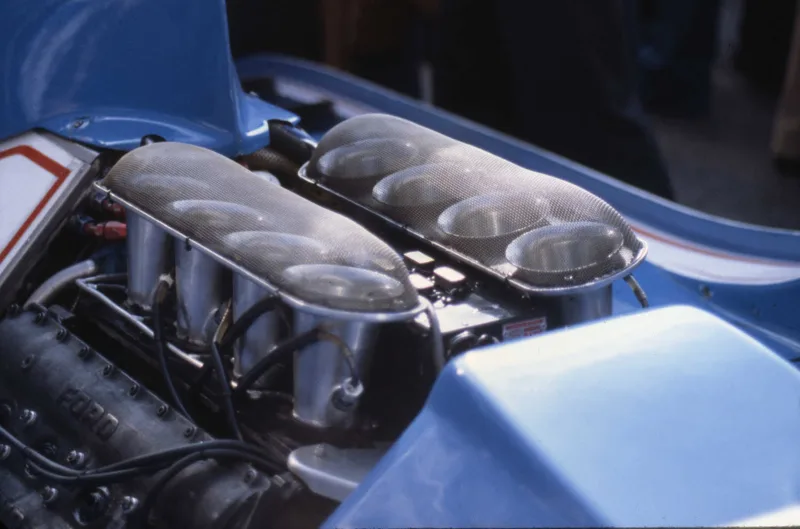
For 1966 Brabham developed the 3.0-litre Repco-Brabham V8, while BRM built a 3.0-litre P75 H16 from two flat-eight engines. The Cosworth DFV V8 of 1967 made the engine a structural part of the chassis, and that design became the standard for Grand Prix cars.
How did turbocharging change Formula One?
The early 1960s saw the 1.5-litre formula take over, and by 1966 the rules had moved to 3.0-litre atmospheric engines and 1.5-litre compressed units. The Cosworth DFV 3.0-litre V8 of 1967 became the standard engine, and its design, with the engine bolted to the monocoque, became the template for the modern car.
Compression devices were allowed again after 1960, but it was not until the Renault V6 turbo debuted at the 1977 British Grand Prix at Silverstone that a manufacturer had the money to use them. Renault proved that turbocharging was the way forward, especially at high-altitude venues such as Kyalami and Interlagos.
By mid-1985 every car on the grid had a turbo engine. The 1986 engines reached over 1,000 hp in qualifying, and the BMW M12/13 made around 1,400 to 1,500 bhp at 5.5 bar in that trim. The engines were unreliable, and the FIA then restricted boost and fuel tanks to keep them in check.
How did the naturally aspirated era return?
Turbochargers were banned from the 1989 season, leaving a 3.5-litre naturally aspirated formula. Honda's RA109E V10 gave 685 hp at 13,500 rpm and powered McLaren to the championship, with the Renault and Ferrari engines close behind.
By 1994 Ferrari's Tipo 043 V12 was producing around 850 hp at 15,800 rpm, the most powerful naturally aspirated V12 ever used in Formula One. The 3.5-litre formula was then replaced by a 3.0-litre formula in 1995, which produced between 600 and 1,000 hp depending on the tune.
Ferrari's first V10, introduced in 1996, produced 715 hp, and the team gradually traded power for reliability. The 3.0-litre V10 became the only permitted layout from 2000. BMW's P82 reached 19,050 rpm in 2002, and its P83 made about 940 bhp at 19,200 rpm in 2003.
The 2005 rules limited engines to five valves per cylinder and to one engine per two race weekends, which put the emphasis on reliability. Power still rose, and Toyota's engines were thought to have exceeded 1,000 bhp.
What were the 2006 to 2013 V8 engines like?
From 2006 the formula called for 90-degree V8s of 2.4 litres maximum with a 98 mm bore, and engines had to be naturally aspirated with two inlet and two exhaust valves per cylinder. The rules were designed to reduce development cost and, with them, the power of the cars.
The rev limit was cut to 18,000 rpm in 2009, and each driver could use only eight engines per season. Taking an extra engine cost a driver ten grid places for the first race in which it was used. The limit made reliability far more important in the closing races.
Honda left Formula One in 2009, and its team became Brawn GP, which kept the Mercedes engine and won both titles that year. KERS returned in 2009 with a maximum power of 60 kW (81 hp) for a little over six seconds per lap. Cosworth came back in 2010 for the new teams Lotus Racing, HRT and Virgin Racing.
What was the hybrid era like from 2014 to 2025?
The 2014 formula replaced the 2.4-litre V8 with a 1.6-litre V6 hybrid. Forced induction was allowed, and every constructor used a turbocharger. Instead of limiting boost, the rules set a fuel flow limit of 100 kg of petrol per hour, and each race was limited to 110 kg of fuel.
Energy recovery came from the Motor Generator Unit-Kinetic, which produced up to 120 kW (160 bhp) and recovered up to 2 MJ per lap, and the Motor Generator Unit-Heat, which recovered energy from the exhaust turbine. The 1.6-litre engine used a bore of 80 mm and a stroke of 53 mm, with a mechanical compression limit of 18:1.
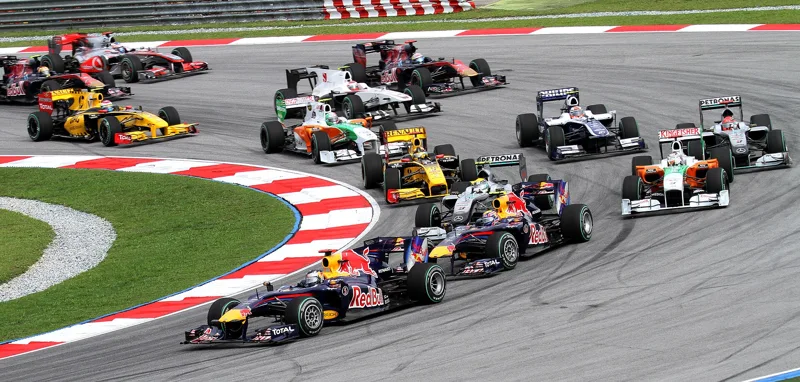
The Mercedes engine produced 870 hp in 2015, and Renault's engine was claimed to reach 1,000 hp in qualifying in 2019. The era was costly, and the FIA introduced a cost cap in the 2021 season to level the field. Honda withdrew at the end of 2021, and Red Bull took the project in-house.
What changes came with the 2026 regulations?
The 2026 formula retains the 1.6-litre V6 turbo but removes the costly MGU-H. Output from the MGU-K rose to 470 bhp (350 kW) from 160 bhp (120 kW), while the combustion engine fell to 540 bhp (400 kW) from 850 bhp (630 kW). Fuel flow was limited by a unified composition rather than by the mass of different fuels.
Early criticism focused on over-reliance on energy management, with cars losing speed on long straights through super-clipping. The super-clipping limit was raised from 340 bhp (250 kW) to 470 bhp (350 kW) before the Miami race. A provisional 60/40 split between combustion and electric power was then set for 2027, with the combustion engine gaining 67 bhp (50 kW).
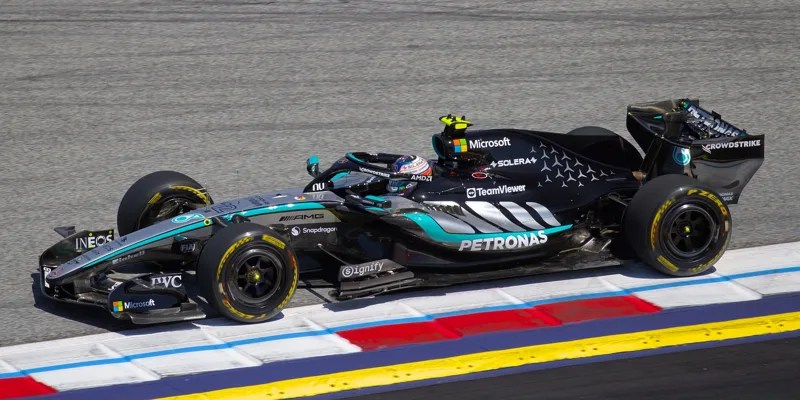
The line-up has changed too. Audi became a supplier in 2026 with its own team, Ford partnered with Red Bull Powertrains, and Honda returned as a manufacturer. Renault ended its engine programme after 2025, and General Motors' Cadillac brand will become a power unit supplier from 2029.