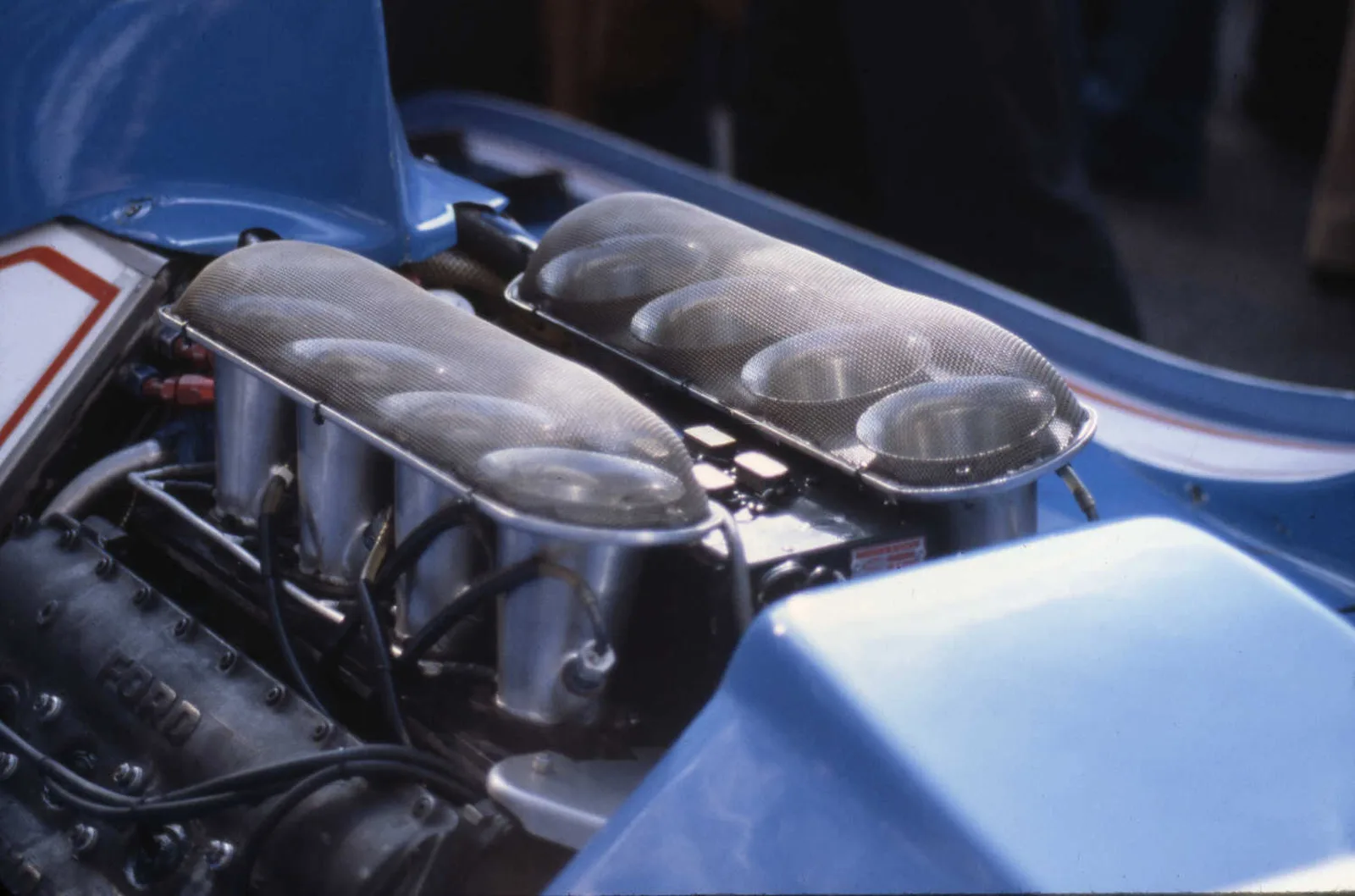
Built for the 1967 three-litre rules, the DFV won 155 grands prix and gave private teams a competitive engine until the turbo era and beyond.
The Cosworth DFV was a 3.0-litre V8 built for Formula One from 1967 and funded by Ford. It won 155 grands prix and gave private teams a competitive engine, and its variants raced in sportscars, Formula 3000 and American Indy cars.
The Cosworth DFV was a 3.0-litre V8 that Cosworth built for Formula One and that Ford funded. Its name stands for Double Four Valve, and it went on to win 155 grands prix between 1967 and 1985, becoming the engine of choice for private teams across the sport.
What was the Cosworth DFV?
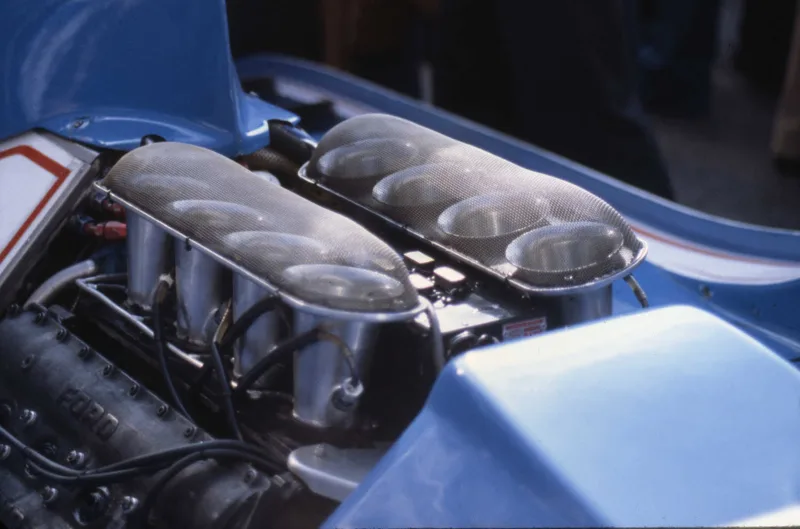
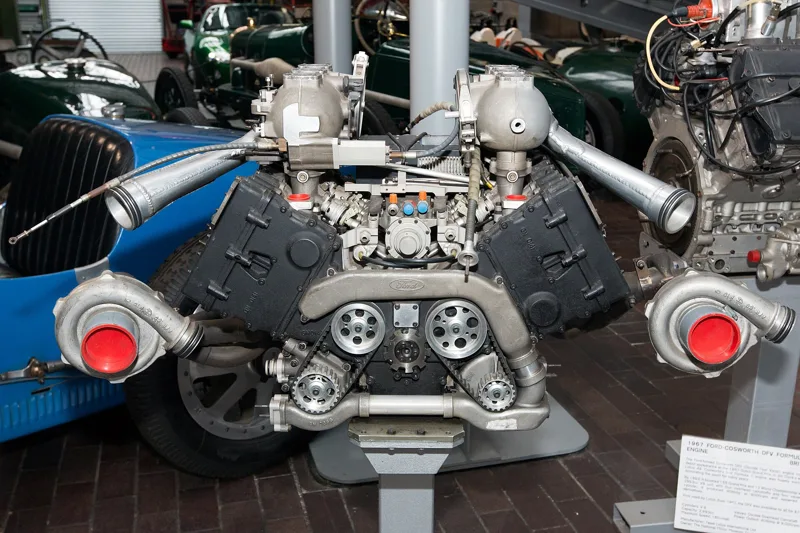
Cosworth first made the DFV as a racing engine for Formula One. It grew out of the earlier four-cylinder FVA, adding two cylinders. Its 90 degree, 2,993 cc layout made it compact and light.
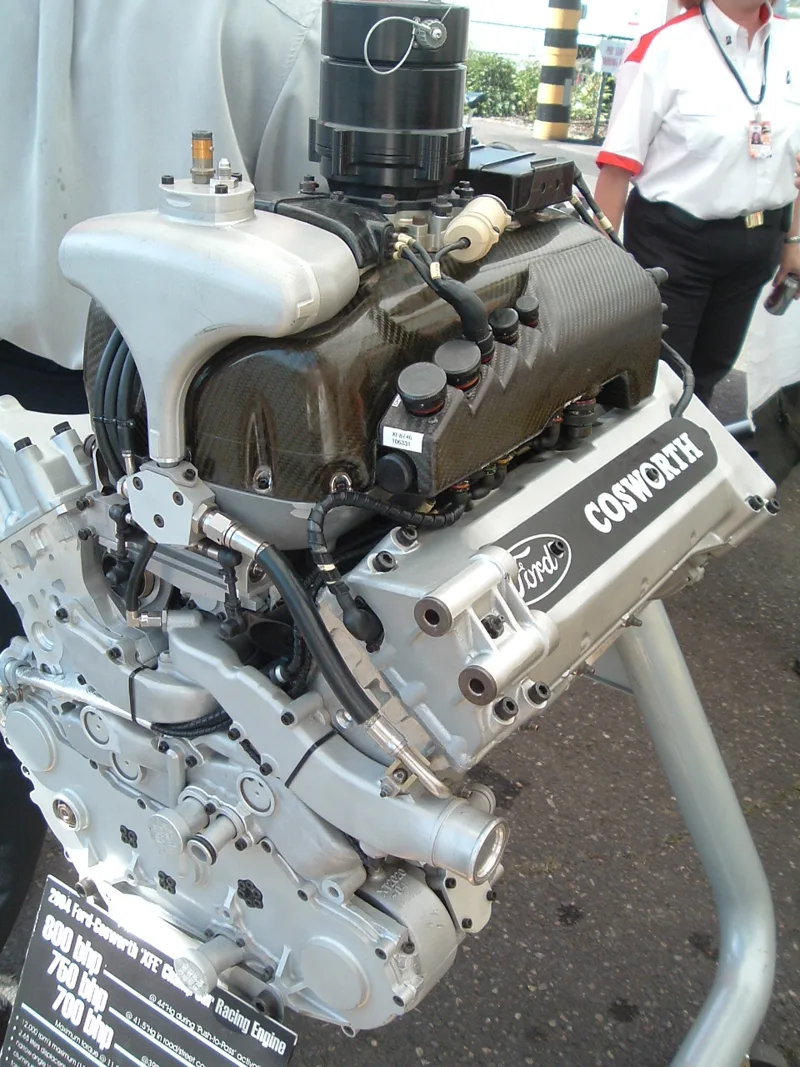
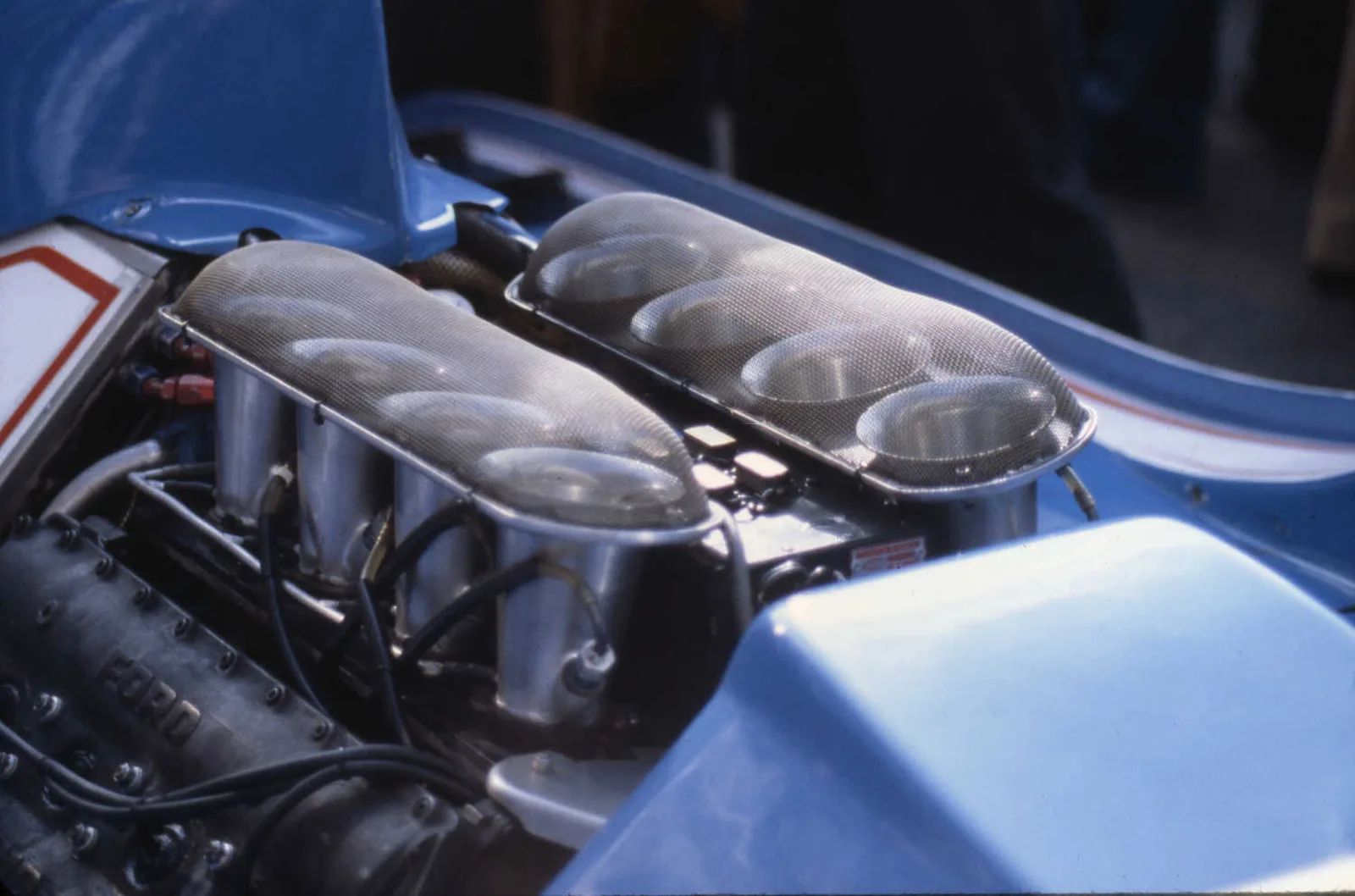
The engine was developed in 1967 for Colin Chapman's Team Lotus with Ford's money, and Ford's European division funded the whole programme. Its engines were badged as Ford for Formula One races, and variants later appeared in CART, Formula 3000 and sportscar racing.
An engine built for the three-litre rules that gave private teams a competitive V8 and won 155 grands prix.
How did Ford and Cosworth come together?
In 1965 the FIA agreed to raise Formula One's maximum engine capacity from 1.5 litres to 3.0 litres from 1966. Team Lotus had relied on fast-revving Coventry Climax engines, but Coventry Climax decided for business reasons not to develop a large-capacity unit.
Chapman approached Keith Duckworth, who ran the young Cosworth company with Mike Costin. Duckworth said he could produce a competitive three-litre engine on a development budget of 100,000 pounds. Ford and David Brown of Aston Martin were approached for funding, and only Ford eventually agreed.
The deal came through Walter Hayes, Ford of Britain's public relations chief, who had worked with Chapman since the Lotus Cortina of 1963. Hayes arranged a dinner with Harley Copp, a British-based American engineer who had engineered Ford's NASCAR entry in the 1950s. Together they drew up a business plan that Ford UK's chairman Stanley Gillen backed.
The plan had two stages. The first would produce a four-cylinder FVA twin-cam for Formula Two, and the second a V8 for Formula One by May 1967. Ford's Detroit head office approved it, and the project was revealed in a PR launch in Detroit at the end of 1965.
How did the DFV debut in 1967?
The engine was ready only for the third race of 1967, at Zandvoort on 4 June. Its debut went well. Graham Hill, who was in the team at Ford's request, put his DFV-powered Lotus 49 on pole by half a second and led for the first 10 laps before a broken gear in the camshaft drive ended his race.
Team-mate Jim Clark moved up through the field in an identical car and came home to win. Clark won three more races that season, yet reliability troubles left him third in the championship, 10 points behind champion Denny Hulme. The engine's early progress was documented in a film by Ford's film section, called 9 Days in Summer.
Why did Ford open the DFV to other teams?
Ford originally planned exclusive use with Lotus, but Hayes saw that the rival engines were flawed. Ferrari was underpowered, BRM was heavy, Maserati unreliable and Honda overweight. Only Brabham's Repco V8 offered a usable mix of power and reliability, and its design left little room for improvement.
Hayes concluded that Lotus winning against weak opposition could damage Ford's name, and that the engine should be shared more widely. By August 1967 the power unit was offered for sale through Cosworth Engineering to racing teams around the world, and the first customer was Matra International, run by Ken Tyrrell with Jackie Stewart driving. That decision turned a single works advantage into an open market for the whole grid.
The result was a golden age for private teams. A competitive, light and relatively cheap engine, priced at 7,500 pounds at 1967 prices, replaced Coventry Climax as the standard powerplant for the mostly British private teams. Lotus, McLaren, Brabham, March, Surtees, Tyrrell, Williams and Ligier were among those that used it.
The engine's dominance was overwhelming. In 1969 and 1973 every world championship race was won by a DFV-powered car, and DFV-powered cars also took the constructors' title in each year from 1968 to 1974, while Ferrari won from 1975 to 1977 and in 1979.
How did ground effect extend its life?
Ground effect aerodynamics arrived in 1977, and it gave the decade-old engine a new lease of life. The principle used Venturi tunnels under the car to create low-pressure regions and extra downforce. The wide flat-12 engines of Ferrari and Alfa Romeo, which had once offered a handling advantage, were a poor fit because their cylinder heads intruded into the tunnel area.
Its V-configuration tilted the cylinders upwards, leaving room under the car for the underbody profile. British ground-effect cars and the DFV effectively ended the era of the flat-12 and V12 engines that many had expected to dominate into the mid-1980s.
Which drivers and constructors won with the DFV?
Andretti, Jones, Piquet and Rosberg each claimed the drivers' crown in a British ground-effect chassis with a DFV, in 1978, 1980, 1981 and 1982 respectively.
The turbo era then began. Renault debuted its turbo engine in 1977, and the early turbos were powerful but heavy and unreliable. For a few years a competitive equilibrium held, until teams running the DFV began looking for turbo engines of their own from 1982.
Alboreto's Tyrrell win at the 1983 Detroit Grand Prix was the final Formula One victory for the DFV. Martin Brundle was the last driver to race an F1 DFV, in a Tyrrell at the 1985 Austrian Grand Prix, which closed the engine's F1 career.
How did the DFV perform in sportscars?
The DFV was used in sportscar racing with modest success, although its crankshaft caused vibrations that hurt endurance reliability. The 1968 Ford P68 failed to finish a race in two seasons, and a DFV-powered Ligier JS3 finished first and second in two short events in 1971.
The engine's best Le Mans result came in 1975, when fuel rules pushed the field into low-power tuning. The Mirage of Jacky Ickx and Derek Bell won, with DFV-powered cars filling the top three places. After that, Porsche's turbo 936 won in 1976 and 1981, and the 1981 distance of 340 laps was the best ever achieved with the DFV at Le Mans, while a DFV-powered Rondeau won the 1980 race with Jean Rondeau and Jean-Pierre Jaussaud.
In Australia Bap Romano used an ex-McLaren DFV in his Kaditcha sports car in 1983 and 1984. The Romano WE84 then won four of five rounds in the 1984 Australian Sports Car Championship, before the DFV was replaced by the Cosworth DFL.
Which variants followed the original DFV?
The first variant was the DFW, a 2,491 cc version for the Tasman Series of 1968 and 1969. Jim Clark took four race wins in 1968 with the Lotus 49 powered by a DFW, although the smaller engine lacked the top-end power of the DFV.
The DFY came in the late 1970s to recover some of the deficit to turbo cars, with a revised cylinder aspect ratio and produced around 520 bhp. It lasted until the end of 1985. The DFZ, a 3.5-litre naturally aspirated version, produced 575 bhp for the 1987 season, when Tyrrell's Jonathan Palmer won the Jim Clark Cup.
The DFR of 1988 was a Benetton engine that was almost entirely new, keeping only the 90 degree V8 layout. Benetton finished third in the constructors' championship that season, and Thierry Boutsen recorded five podiums. The DFR was last used at the 1991 Australian Grand Prix.
The DFL was a Group C engine from 1981, in 3.3 and 3.9 litre versions. The 3.3 litre powered the Rondeau to second in the 1982 World Sportscar Championship, and it later won the C2 class at Le Mans, with five class wins between 1985 and 1990.
How did the DFX and DFS dominate American racing?
In 1976 a turbocharged 2.65-litre version was developed privately by the Vels Parnelli Jones team for USAC IndyCar racing. Al Unser won the 1976 Pocono 500 in a Parnelli-Cosworth, and Cosworth then poached two key engineers and set up its own operation in Torrance, California, to develop the engine.
The resulting DFX was the Indy engine of its era. It won the Indianapolis 500 ten times from 1978 to 1987 and powered 81 consecutive Indy car victories between 1981 and 1986, 153 in total. By the time it was replaced it was developing over 840 bhp.
The DFS came in 1989 as a short-stroke version, and Bobby Rahal won the only race it ever took, at the Meadowlands, before it was retired after the Ford Cosworth XB arrived.
What were the major successes?
The DFV's results span Formula One, Le Mans, Formula 3000 and Indy racing. The table below lists the headline results by year and series.
| Series | Result | Year |
|---|---|---|
| Formula One | Drivers' title, Graham Hill (Lotus) | 1968 |
| Formula One | Constructors' title, Lotus | 1968 |
| Formula One | Drivers' title, Jackie Stewart (Tyrrell) | 1971 |
| Formula One | Drivers' title, Mario Andretti (Lotus) | 1978 |
| Formula One | Drivers' title, Alan Jones (Williams) | 1980 |
| Formula One | Drivers' title, Nelson Piquet (Brabham) | 1981 |
| Formula One | Drivers' title, Keke Rosberg (Williams) | 1982 |
| Le Mans 24 Hours | Win, Jacky Ickx and Derek Bell (Mirage) | 1975 |
| Le Mans 24 Hours | Win, Jean Rondeau and Jean-Pierre Jaussaud (Rondeau) | 1980 |
| Formula 3000 | Champion, Christian Danner (March) | 1985 |
| Indianapolis 500 | Win, Al Unser (Lola), DFX | 1978 |
| CART | Champion, Rick Mears (Penske), DFX | 1979 |
What is the legacy of the Cosworth DFV?
The DFV's legacy is an engine that changed how Formula One worked. It made a competitive V8 available to small teams at a sensible cost, and it helped build the British ground-effect cars that ended the flat-12 era.
Its record of 155 wins from 262 races is one of the clearest measures of how far one engine could carry a sport. Its family of variants kept racing in sportscars, Formula 3000 and American open-wheel racing for decades. Few engines have been so closely tied to a single regulation change, and the DFV remains the reference point for the private-team era. Its later Indy car life showed that the basic design could be reworked for very different formulae.