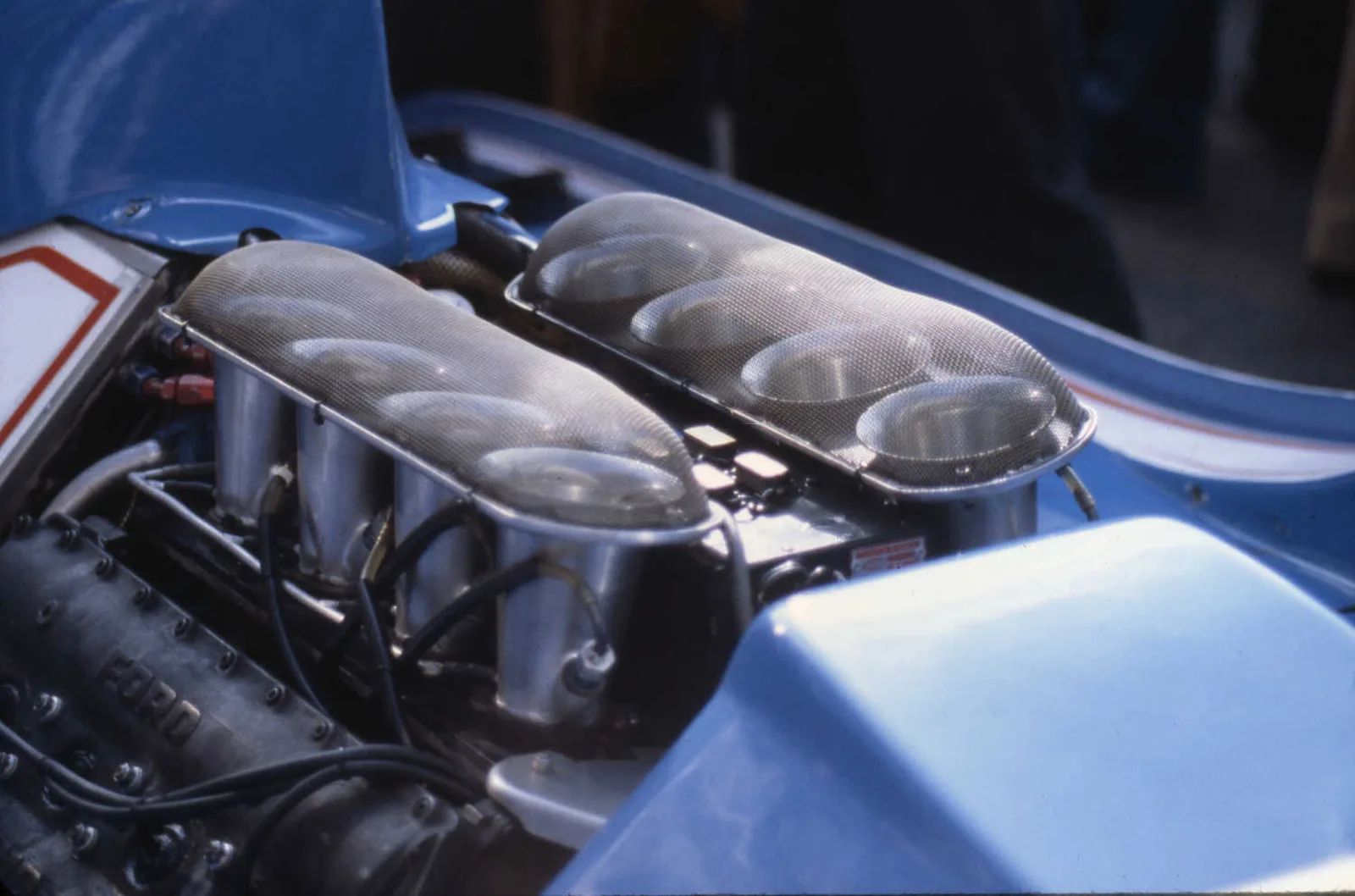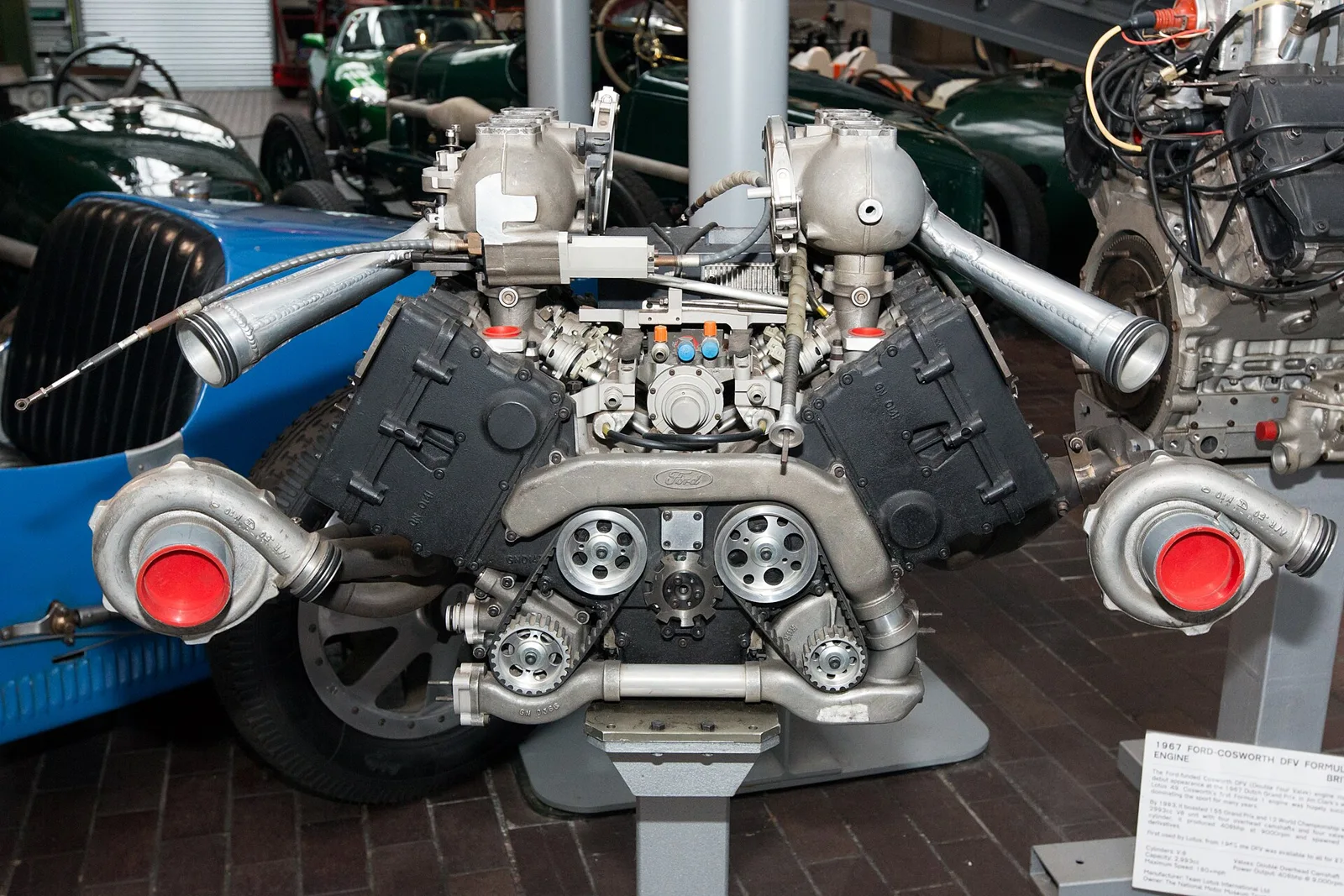
Ford and Cosworth's 1986 turbo engine, built after the naturally aspirated DFV era ended, powered Haas and Benetton before Formula One's turbo rules were withdrawn.
The Ford Cosworth GBA was a turbo V6 built for Formula One use in 1986 and 1987, raced by Team Haas and Benetton without a race win before the turbo rules changed.
The Ford Cosworth GBA was a turbocharged V6 racing engine, designed by Cosworth in partnership with Ford, for Formula One use in 1986 and 1987. Its customers were Lola and Benetton, and it did not score a win in a world championship round. It was the last new turbo design before turbo engines were banned in 1989.
What was the GBA?
The engine was known to the public as the Ford TEC, TEC-Turbo or TEC-F1, and it appeared under those names in the entry lists. The TEC name stood for Turbo Engine Cosworth. Internally it was the Cosworth GBA, a name that echoed the earlier Cosworth GA, the company's first V6 from 1973.
The GBA was the only turbocharged Formula One engine that Cosworth and Ford produced in the turbo era. It was available only to selected teams, which meant that Ford chose who could run it.
A turbo V6 built in nine months, raced by two teams and retired when Formula One turned its back on turbos.
How did the DFV era set the scene?
Cosworth was founded in 1958 by Keith Duckworth and Mike Costin. In partnership with Ford it began a Formula One programme in 1967 with the naturally aspirated 3.0-litre DFV, which was freely available to all teams. Its winning debut came with Jim Clark and Lotus at the 1967 Dutch Grand Prix.
The DFV won 155 world championship races, 12 drivers' titles and 10 constructors' titles, which makes it the most successful engine in Formula One history. Ford remains the third most successful engine maker in the sport's history, behind Mercedes and Ferrari.
Why did the turbo wave overtake the DFV?
Turbo engines became powerful and reliable from 1981, and they began to win regularly. The top teams and then the midfield switched to turbo power in the early 1980s. From 1983 to 1988 every drivers' and constructors' title went to turbo teams.
Cosworth was slow to react. Duckworth and Ford's Walter Hayes considered turbos a distortion of the rules, and Hayes did not believe a 1.5-litre turbo was equal to a 3.0-litre normally aspirated engine. The supercharged DFX was built only for US series, and the DFV gradually fell behind.
The DFY was the last development of the DFV. It won its final three Formula One races in 1983, but by early 1985 it produced only around 570 bhp, well below the turbos. By the 1985 Dutch Grand Prix the engine was all but gone from Formula One.
How did Cosworth start the turbo project?
Ford had been pushing for a Formula One turbo engine since 1981. Duckworth was hesitant, and Ford briefly considered working with the German team Zakspeed, which had long experience with turbo Ford racing engines. In the summer of 1984 Duckworth proposed starting again, and Ford's motorsport chief Mike Kranefuss agreed to continue with Cosworth.
Ford set a deadline of November 1985 for a race-ready engine. Cosworth's first plan was an inline four-cylinder turbo derived from the BDA series, but the crankshaft kept failing under boost. Ford then agreed to a full development budget, and the team chose a completely new design: a 120-degree V6.
How was the GBA designed and tested?
The design was led by Geoff Goddard, with Duckworth helping, and Duckworth was publicly credited with the design. The first drawings were made in December 1984, and the first prototype ran on the test bench on August 1, 1985.
Cosworth designed and built the new 1.5-litre turbo V6 in nine months. The first test drives took place in February 1986 at Boreham in freezing conditions, with Alan Jones and Patrick Tambay at the wheel. The engine was smooth but short of power, and it reached its operating temperature only after about ten laps.
The GBA made its Formula One debut at the 1986 San Marino Grand Prix with Jones at the wheel. He qualified 21st but retired with overheating caused by a holed radiator.
What were the GBA's specifications?
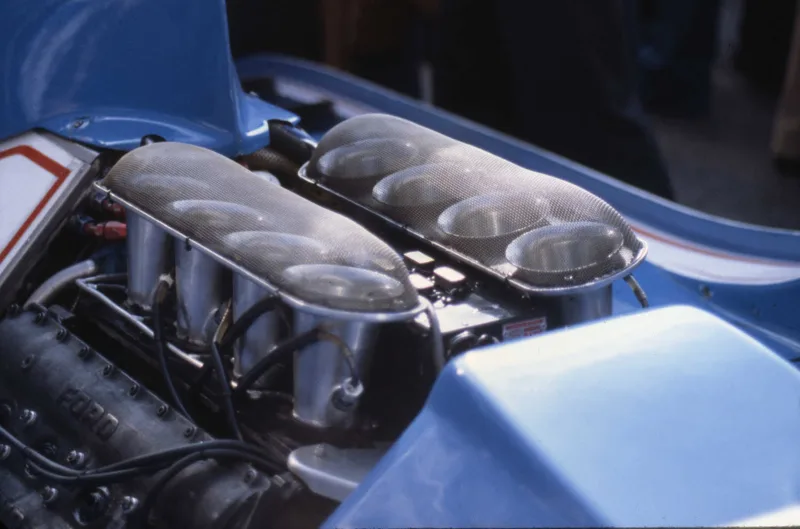
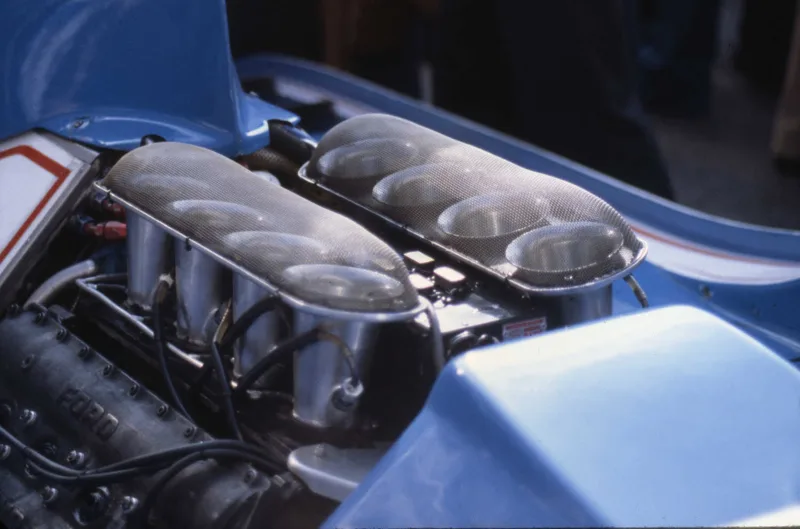
The engine displaced 1498 cc and had a 120-degree V6 layout, with aluminium alloy block and heads. It had two overhead camshafts per bank, driven by chains, and two intakes and two exhausts per cylinder. Twin turbochargers designed by Garrett fed the engine in a single stage.
Pistons were made by Mahle, and the ignition came from Magneti Marelli. The engine electronics were a Ford-Cosworth system, developed with Motorola. The first engines ran a compression ratio of 6.5 to 1, which Cosworth raised over the season to 8.0 to 1.
Power began at around 700 bhp in qualifying and rose to about 900 bhp by the end of 1986. In the second half of 1987 that figure was reached in races, and Cosworth built 25 engine blocks in total.
How did Team Haas use the engine?
Ford awarded the GBA exclusively to Team Haas from 1986 to 1988, and it was a decision Cosworth criticised. Haas had a strong CART history but its Formula One debut came only late in the 1985 season. The team's sponsor, Beatrice, pulled out midway through 1986.
The TEC made its debut with Haas at Imola in 1986, when the team had only one engine available. Jones and Tambay drove the Lolas. Jones retired ten times in 14 races, while Tambay was similarly unlucky, and the team scored six championship points.
Jones finished fourth at the Austrian Grand Prix, helped by a slipping clutch, and sixth in Italy. Tambay took fifth in Austria, but he was injured in a crash during the warm-up for the Canadian Grand Prix. Haas shut down its racing team in October 1986, and both Jones and Tambay retired from Formula One after that season.
Why did Benetton get the GBA in 1987?
Carl Haas sold his team's company and equipment to Bernie Ecclestone at the end of 1986, and Ecclestone wanted the engines for Brabham. Ford, however, terminated the contract with Haas, so neither Haas nor Ecclestone gained access to the turbos.
The GBA went to Benetton in 1987, which used it in two cars. Thierry Boutsen and Teo Fabi qualified on the first five rows almost every time, and Boutsen's best start was third in the penultimate race in Japan.
Boutsen finished nine times and Fabi seven, with both drivers finishing third once. Fabi finished third in Austria, and Boutsen took third in Japan after Ayrton Senna was disqualified. Benetton finished fifth in the constructors' championship with 28 points.
Why did the GBA programme end?
FISA imposed strict turbo rules for 1988, cutting boost from 4.0 bar to 2.5 bar and fuel from 195 litres to 150. Ford judged that the changes would need extensive work on the engine and its management system, and turbo engines were to be banned completely from 1989, so the programme was dropped.
Cosworth returned to naturally aspirated 3.5-litre engines, with the DFZ for customer teams and an upgraded DFR for Benetton in 1988. By mid-1989 the new HB V8 gave Benetton about 640 bhp, against roughly 620 bhp for the DFR and 590 bhp for the DFZ.
How fast were the turbos compared with the DFY?
The speed gap between the two eras was dramatic. During qualifying for the 1985 French Grand Prix at the Circuit Paul Ricard, Marc Surer took a turbo Brabham-BMW to 335 km/h on the 1.8 km Mistral Straight, the highest speed recorded by a Formula One car at that point.
The lone naturally aspirated car in that race was the Tyrrell Ford-Cosworth DFY of Stefan Bellof, which managed only 277 km/h. The difference showed why the turbo teams had moved on, and why the DFV family could no longer keep pace in qualifying.
How did the electronics team work?
The engine electronics were a Ford-Cosworth development, known as EEC-IV, built with the American firm Motorola. The team was led by Steve Taylor, a British electronics engineer at Cosworth, with Ford America software expert Jim Coats and Motorola electrical engineer Frank Rayo.
Ford USA's head of electronic engine development, Bob Stelmaszak, oversaw the programme. The modules were designed in the UK and manufactured in the US, while most of the software work took place in the UK or at race circuits around the world.
What was Benetton's situation before the GBA?
Alex Hawkridge sold the Toleman team to its major sponsor, the Italian fashion house Benetton, in early 1986, and the team was renamed Benetton Formula. Toleman had used Hart engines for six years, but Benetton started its first season with customer BMW engines and scored a win.
For 1987 Benetton received the GBA exclusively, and the car was the Rory Byrne-designed B187, a development of the previous year's BMW-powered B186. Cosworth judged that Benetton was structurally better placed than Haas, which made further turbo development more worthwhile.
What are the key results at a glance?
| Year | Team or driver | Event | Result |
|---|---|---|---|
| 1985 | Cosworth | First prototype on the test bench | Run on August 1, 1985 |
| 1986 | Alan Jones | San Marino Grand Prix | Debut, 21st in qualifying, retired |
| 1986 | Alan Jones | Austrian Grand Prix | Fourth place |
| 1986 | Team Haas | Season | Six championship points, eighth in constructors' |
| 1986 | Haas | October | Racing team shut down |
| 1987 | Benetton | Season | Fifth in constructors' with 28 points |
| 1987 | Thierry Boutsen | Japanese Grand Prix | Third after Senna's disqualification |
| 1987 | Teo Fabi | Austrian Grand Prix | Third place |
Why does the Cosworth GBA matter?
The GBA matters because it shows the cost of changing an engine era. Cosworth had built the DFV, the sport's most decorated engine, and the turbo wave forced it to design a new V6 in a compressed schedule, with mixed results.
Its short life also shows how regulation can end a programme quickly. The GBA was built for two seasons, and the FISA changes and the turbo ban meant that Ford chose to move on rather than invest in another round of development.