A clothing family's racing team: a 1985 Toleman takeover, Michael Schumacher's first two world titles, a 1995 constructors' crown and a 2002 rebrand as Renault.
Benetton Formula was the Formula One team of the Benetton family, which bought Toleman in 1985 and raced from 1986 to 2001. It won the constructors' title in 1995 with Michael Schumacher, and it became the Renault F1 Team in 2002.
Benetton was the Formula One team owned by the family behind the clothing chain, and it raced from 1986 to 2001. It began life as Toleman, won the constructors' championship for the first time in 1995 and gave Michael Schumacher his first two world titles. In 2002 it became the Renault F1 Team.
Where did Benetton come from?
The Benetton Group first entered Formula One as a sponsor, backing Tyrrell in 1983 and Alfa Romeo in 1984 and 1985. It then took control of Toleman in 1985, and Benetton Formula Limited was formed when the family bought the team. Toleman had struggled badly, missing the first three races of 1985 after a dispute with its tyre supplier.
The change of ownership did not improve the season straight away. Toleman was reduced to one car for the following six races, and its poor reliability meant it finished only twice from 20 entries. Alessandro Benetton went on to chair the team from 1988 to 1998.
A clothing family's racing team that changed passports, won Schumacher's first two titles and then became Renault.
How did the 1986 and 1987 seasons go?
The first Benetton, the B186, was developed from Toleman's planned TG186 chassis. Its engines changed from Hart to the powerful BMW M12, and Gerhard Berger joined from Arrows. The car showed real pace, and Berger took the team's first podium at Imola before winning the Mexican Grand Prix, the team's first victory.
Reliability was the problem. The B186 recorded 19 retirements in the season, eight of them for Fabi, who had nonetheless taken two consecutive poles in Austria and Italy. Benetton finished sixth in the championship with 19 points.
The B187 suffered engine trouble early on, but it became more consistent after the turbocharger's effect was reduced. It produced a run of fourth and fifth place finishes and two third places, in Austria and Australia. Benetton finished fifth in 1987 with 28 points.
How did Benetton rise to podium contention?
Alessandro Nannini replaced Fabi for 1988, and the B188 became the team's first naturally aspirated car. It suffered almost half as many retirements as its predecessor and claimed seven podium finishes, all of them third places. Benetton finished third in the championship with 39 points, a result that was later undermined when both cars were disqualified for fuel irregularities after the season.
For 1989 the new Ford engine for the B189 was not ready, so the team ran the B188 again. Johnny Herbert arrived as a rookie, but he had broken both legs in a Formula 3000 crash before his debut. After failing to qualify for the Canadian Grand Prix, he was dropped, and Emanuele Pirro took over. Nannini then won the Japanese Grand Prix after Ayrton Senna was disqualified, Benetton's first win since 1986. The team finished fourth in 1989 with 39 points.
The peak of this period came in 1990, when Nelson Piquet, a three-time world champion, joined from the struggling Lotus team. He won the final two races of the season, and the team took six other podium finishes. Tragedy then struck when Nannini lost his right forearm in a helicopter crash, and Roberto Moreno took his seat. Japan produced the first 1-2 finish in Benetton's history, and Benetton finished third with 71 points.
How did Michael Schumacher arrive at Benetton?
Michael Schumacher was hired by Benetton in 1991, after he impressed in his debut for Jordan at the Belgian Grand Prix. He replaced Moreno for the next race, and his arrival gave the team the young driver it wanted for the future. Camel had become the title sponsor for the same season, and Piquet won in Canada after Nigel Mansell retired on the final lap.
For 1992 Tom Walkinshaw Racing bought a 35% stake in Benetton, and Walkinshaw and Ross Brawn took charge of the engineering operation. The team moved from Witney to a new factory at Enstone in 1992, a site it still uses today. Martin Brundle replaced Piquet, and the B192 brought eleven more podium finishes, including Schumacher's first career win at Spa-Francorchamps. The team ended the year third overall, on 91 points.
The 1993 season was similar. Riccardo Patrese replaced Brundle, and the B193 gave Schumacher a single victory at the Portuguese Grand Prix. Benetton finished third in the championship for the fourth time in its history, but it could not give Schumacher a car to challenge for the title, and it was outclassed by Williams.
Why was the 1994 season so controversial?
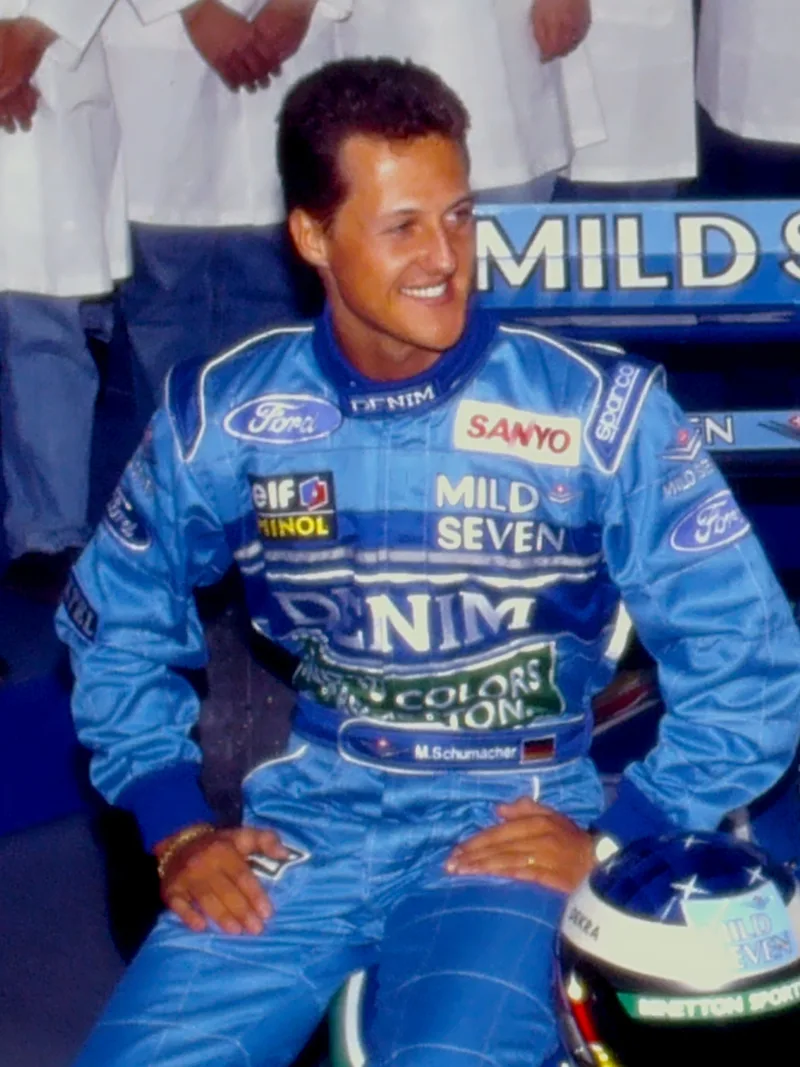
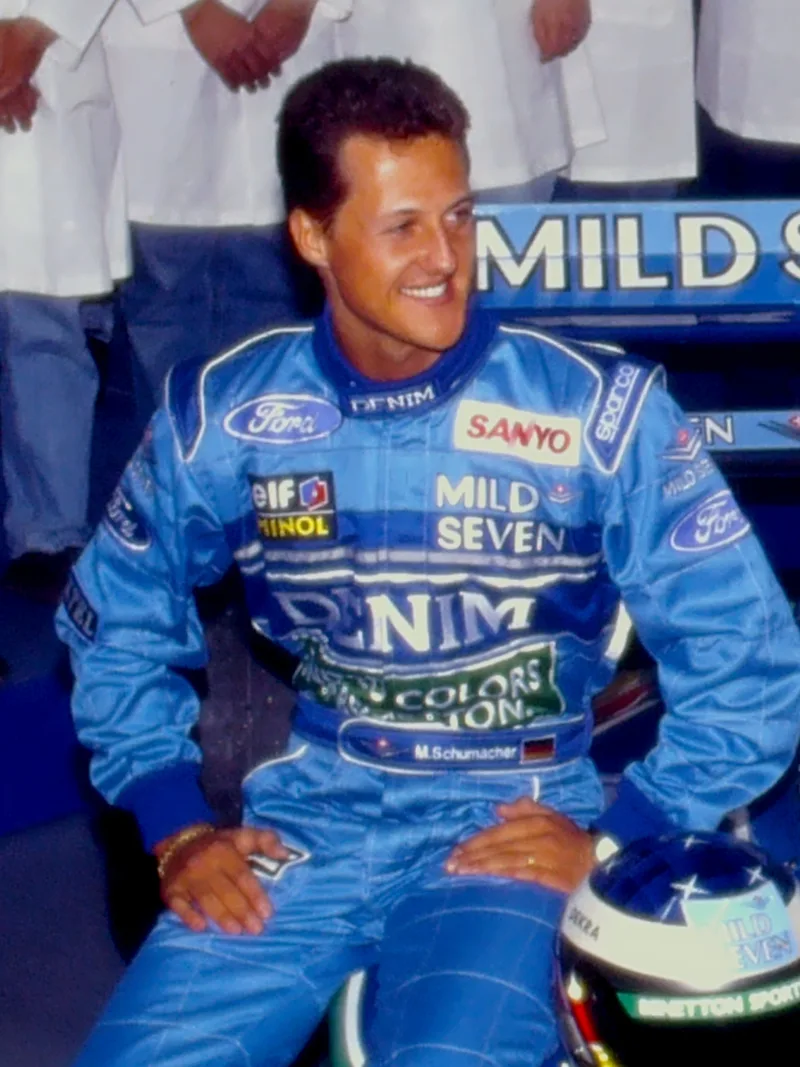
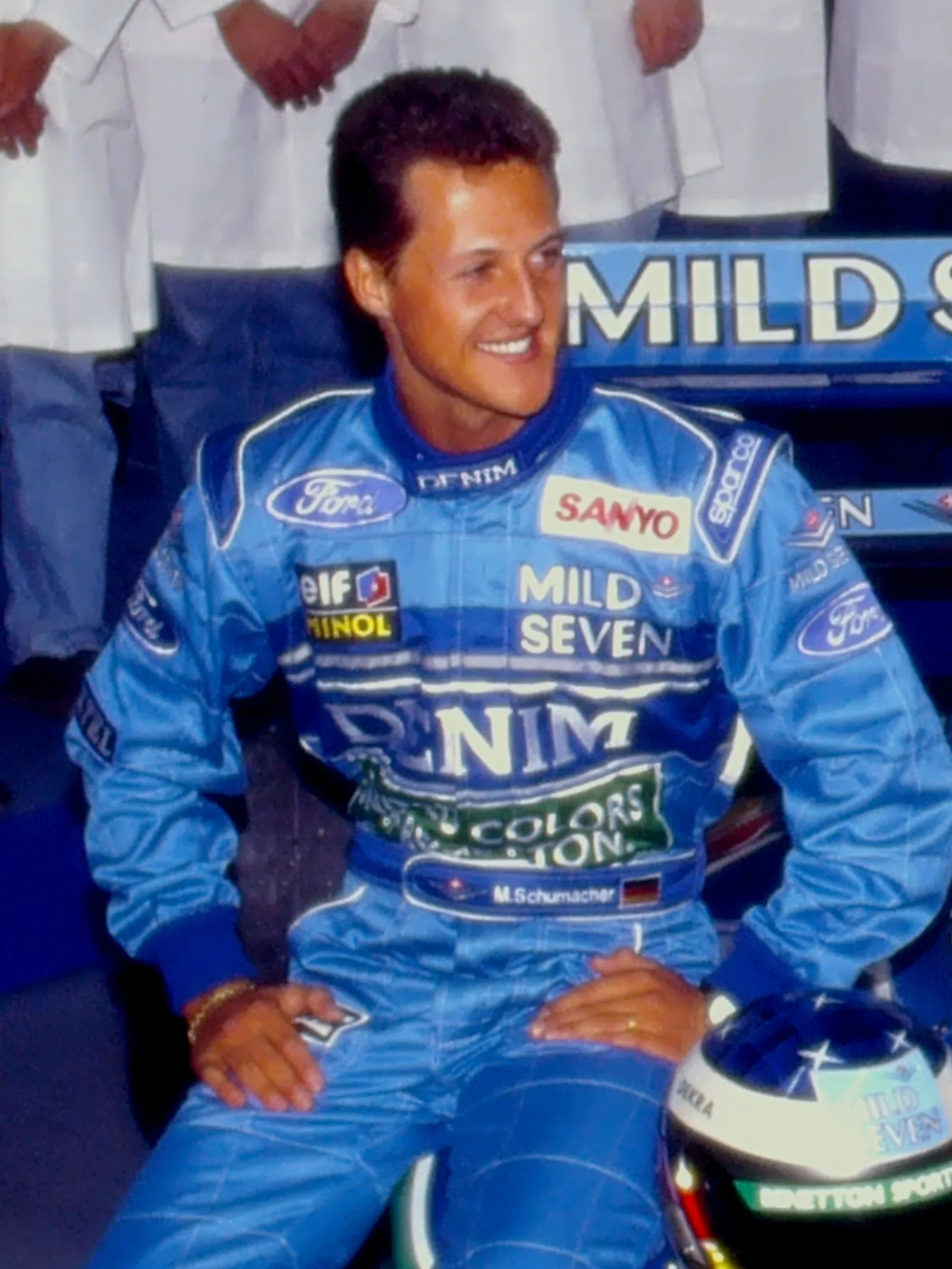
Mild Seven replaced Camel as title sponsor for 1994, and the team adopted sky blue as its main car colour. Schumacher won six of the first seven races, and the B194 delivered Benetton's first pole positions since 1986. The season was also overshadowed by the tragedy at the San Marino Grand Prix, where Ayrton Senna was killed.
Schumacher's season was full of penalties. He finished second at the British Grand Prix but was disqualified after the race, then served a two-race ban. At Belgium he won, but his car was measured as having illegal wear on its skid block, which led to another disqualification. Jos Verstappen replaced the injured JJ Lehto, and Herbert returned for the final two races.
Benetton lost the constructors' title to Williams, but Schumacher won his first world championship after colliding with his rival Damon Hill in the final race in Australia, taking both drivers out. That was not the end of the controversy. The FIA found start sequence software in the B194 cars, and rival teams had also found similar material in their own cars, so punishments were light.
How did Benetton win its first constructors' title in 1995?
Benetton switched to full works Renault V10 engines for 1995, and Ford moved its support to Sauber. Herbert was retained alongside Schumacher, while Verstappen was loaned to Simtek. The new B195 was difficult to control at first, and Schumacher crashed out from pole position at Imola. Setup changes at the next race in Spain improved the car, and Schumacher went on to win nine of the seventeen races.
Herbert took his first podium in Spain and then won the British and Italian Grands Prix. Together they gave Benetton its first constructors' championship and ended Williams' run of three years at the top. Herbert later claimed the team had given him unequal equipment and had favoured Schumacher.
What caused the decline after 1995?
Schumacher left early to join Ferrari in 1996, and Benetton had to find new drivers. Jean Alesi and Gerhard Berger came in, with Herbert moving to Sauber. The B196 took ten podium finishes but no race win, the first season without a victory since 1988. The team finished third with 68 points, far fewer than in 1995.
By 1997 technical director Ross Brawn and chief designer Rory Byrne, along with numerous other staff, had left to join Schumacher at Ferrari. The B197 struggled to compete with Williams and Ferrari, but it still produced a number of podiums. Alexander Wurz scored a podium in Britain, and Berger won the German Grand Prix from pole position. That was Benetton's last victory in Formula One.
| Season | Car | Highlight | Championship place |
|---|---|---|---|
| 1986 | B186 | Berger's first podium at Imola; Mexican Grand Prix win | 6th, 19 points |
| 1987 | B187 | Two third places, Austria and Australia | 5th, 28 points |
| 1988 | B188 | Seven podiums, all third places | 3rd, 39 points |
| 1989 | B188 and B189 | Nannini wins the Japanese Grand Prix after Senna's disqualification | 4th, 39 points |
| 1990 | B190 | Piquet wins the final two races; first 1-2 finish | 3rd, 71 points |
| 1992 | B192 | Schumacher's first career win at Spa; eleven more podiums | 3rd, 91 points |
| 1994 | B194 | Schumacher wins six of the first seven races; his first title | Constructors' title lost to Williams |
| 1995 | B195 | Schumacher wins nine races; Herbert wins the British and Italian Grands Prix | 1st, first constructors' title |
| 1996 | B196 | Ten podium finishes, no win | 3rd, 68 points |
| 1997 | B197 | Berger wins the German Grand Prix, the team's last win | 3rd, 67 points |
| 1998 | B198 | Fisichella second at Monaco and Canada | 5th, 33 points |
| 1999 | B199 | Fisichella second in Canada | 6th, 16 points |
| 2000 | B200 | Three podiums, all by Fisichella | 4th, 20 points |
Why did Benetton fall back in 1998 and 1999?
In 1998 Renault pulled out of Formula One and left Benetton with a supply of its 1997 engines, built by Mecachrome. Benetton rebranded them as Playlife, a sportswear brand owned by the family. Chief executive Flavio Briatore was removed, and former World Rally Champion David Richards took over.
Fisichella achieved some success with the B198, finishing second at Monaco and Canada and taking pole position in Austria. Benetton became uncompetitive towards the end of the season, however, scoring just one point in the final seven races, and the team partly blamed Bridgestone for favouring McLaren. It finished fifth with 33 points.
The 1999 season was a disappointment. The highlight was Fisichella's second place in Canada, which only came after numerous retirements from other cars. Benetton finished sixth with 16 points, its worst ever championship position.
How did Renault take control of Benetton?
Before the 2000 season the team was sold to Renault, which wanted to return to Formula One, but the team kept the Benetton name. Briatore returned as team manager as part of the restructuring. The B200 was an improvement and claimed three podium finishes, all scored by Fisichella, including second place in Brazil after David Coulthard was disqualified. Benetton finished fourth with 20 points.
The 2001 season started badly. Jenson Button arrived after being dropped by Williams, but the B201 often barely qualified inside the top 20, and only one point was scored in the first eleven races. The fortunes began to change at the German Grand Prix, where Fisichella finished fourth and Button fifth. Fisichella also took a podium in Belgium, and the car's performance lifted before the team left Formula One as Benetton.
What is Benetton's legacy?
Benetton is today best known for Michael Schumacher, who accounts for 19 of the team's 27 race victories and his first two world titles. The team's record also includes the change of nationality, a constructors' title in 1995 and the move to Enstone that became its permanent home.
The Renault F1 Team replaced Benetton for 2002 and went on to win the drivers' and constructors' championships in 2005 and 2006 with Fernando Alonso. The team was sold on and became Lotus F1 Team in 2012. Renault later bought it back and rebranded it, and in 2021 it became Alpine.
Why did Benetton change nationality?
Benetton held a British licence from 1986 to 1995 and an Italian licence from 1996 to 2001. Shadow in 1976 was the only earlier constructor to change nationality, so Benetton became the second. The Benetton family wanted its Formula One team to fly the flag of its own country, even though the team stayed based in the UK throughout.