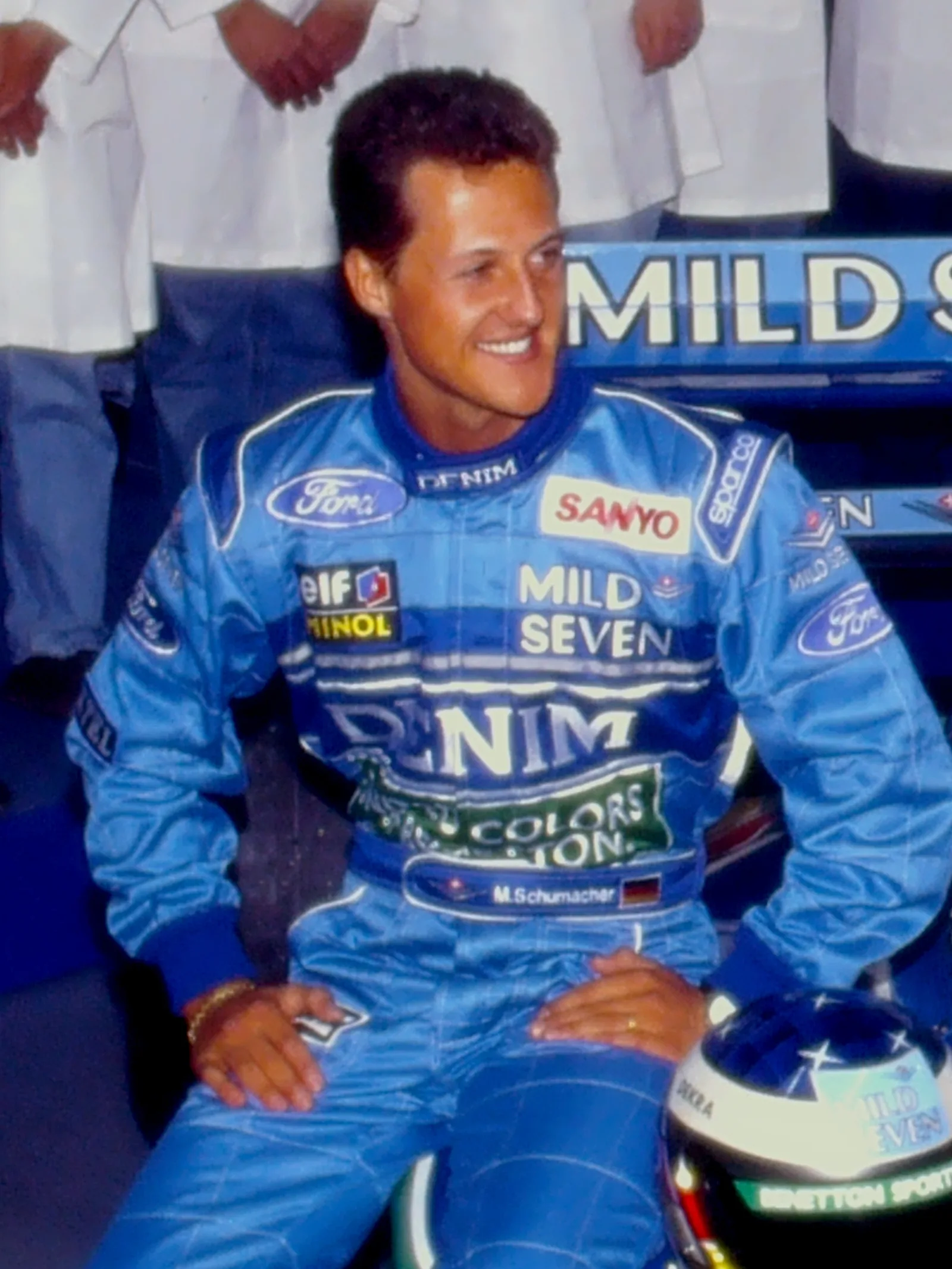
The deaths of two drivers at Imola forced sweeping rule changes, and the title was decided by a single point after a collision at Adelaide.
The 1994 Formula One World Championship was the 48th season of FIA Formula One racing, held over 16 races from March to November. Michael Schumacher won his first Drivers' title for Benetton after a controversial collision with Damon Hill in the final round at Adelaide.
The 1994 season ran from 27 March to 13 November and included 16 races. It was overshadowed by the deaths of Roland Ratzenberger and Ayrton Senna at Imola, and it ended with Michael Schumacher winning his first championship by a single point over Damon Hill.
How did the first two races go?
Schumacher won the opening round in Brazil from second on the grid, and he won again at the Pacific round in Japan, where Senna and Larini were out early. Senna had taken pole in both races, but neither ended well for him.
Senna took pole in Brazil ahead of Schumacher, Alesi, Hill and Frentzen. Schumacher took second from Alesi on lap 2, and the pair soon pulled clear of the rest. Verstappen was sent into a series of barrel rolls after contact with Irvine, and no one was hurt. Irvine received a one-race ban that the FIA later extended to three races when his appeal failed. Senna spun out on lap 56 while pushing too hard to close on Schumacher.
At the Pacific round Jean Alesi was absent with a back injury from a test crash at Mugello, and Nicola Larini took his place. Larini caused a stir by telling the Italian press he had used traction control in practice, an aid that was now banned, although the team and driver later denied it. At the start Hakkinen ran into the back of Senna, and Senna was then struck by Larini, leaving both out. Schumacher went on to win ahead of Berger, Barrichello and Christian Fittipaldi, making it two wins from two.
Two deaths at Imola reshaped the rules, and a single point decided a title fought to the final race.
What happened at Imola?
Rubens Barrichello crashed heavily during practice when his car went over a kerb at the Variante Bassa, struck a tyre wall and landed upside down. He had swallowed his tongue and needed quick medical treatment, but he returned on the Saturday with a broken nose and a bandaged arm.
In qualifying a front wing flap came off Roland Ratzenberger's Simtek, and on the next lap the wing broke away completely and jammed under the car. He lost control at the Villeneuve kink at very high speed and hit the wall. He suffered a basal skull fracture and was pronounced dead at Bologna's Maggiore Hospital.
At the drivers' meeting on race morning the field talked about little else, and the drivers agreed to press for better safety. Senna offered to lead that effort, as the most senior driver present.
At the start Pedro Lamy's Lotus hit Lehto's stalled Benetton. Debris, including one of Lamy's front tyres, flew into the grandstand and injured four spectators and a policeman. Lehto suffered a light arm injury, and the safety car came out with Senna leading Schumacher, Berger, Hill, Frentzen and Hakkinen.
The race restarted at the end of lap 5. On lap 7 Senna left the track at Tamburello and went straight on into an unprotected concrete wall, for reasons that remain debated. Telemetry suggests he left the circuit at 310 km/h (190 mph) and had braked to 218 km/h (135 mph) before impact. The suspension broke on impact, and a loose tyre struck his head. Doctor Sid Watkins reached the scene in less than two minutes, but Senna died in hospital that evening.
An Austrian flag was later found in his cockpit, which suggested he had planned a tribute to Ratzenberger after the race. The race was stopped immediately. Schumacher went on to win it, but there were no celebrations on the podium, and the talk afterwards centred on the two dead drivers.
Monaco brought another serious accident. Karl Wendlinger crashed heavily into the Nouvelle Chicane wall at high speed in the first practice session. Marshals acted quickly to save his life, but he spent three weeks in a coma and was ruled out for the rest of the season. Sauber withdrew Frentzen's car as a mark of respect.
What safety changes followed Imola?
After Imola the FIA moved quickly to slow the cars. Front wing endplates and diffusers were reduced, a 10 mm wooden skid block was added under every car, and the rear wing was restricted. Pit lane speeds were lowered, and 15 of 27 high-risk corners were bypassed or slowed.
The first moves came in Spain, where the front wing endplates and rear diffusers shrank. Canada brought holes cut into the engine cover to reduce the effect of the airbox. From Germany the skid block could wear by no more than 1 mm (0.039 in), and the front wing had to sit at least 40 mm (1.6 in) above the reference plane, up from 25 mm (0.98 in).
Monocoque strength testing rose from 20 kN to 30 kN, and headrests had to be at least 75 mm (3.0 in) thick. Pit lane speed caps were set at 80 km/h (50 mph) for practice and 120 km/h (75 mph) for races after a Minardi wheel that came loose at Imola injured a member of Ferrari's pit crew. Pit crews also had to wait inside their garages until they were needed.
The drivers used the aftermath to organise. At Monaco the Grand Prix Drivers' Association was reformed, with Niki Lauda, Michael Schumacher, Gerhard Berger and Christian Fittipaldi as its representatives. Their demands led to changes for Canada: taller cockpit sides, strengthened front wishbones, a longer cockpit, pump petrol and a minimum weight increase that was later cut from 25 kg to 15 kg.
Which driver aids were banned in 1994?
Active suspension, anti-lock brakes and traction control went for 1994, as did launch control and four-wheel steering. The aim was to return the driving to the driver, which had been a central criticism of the technology race.
The rules were introduced to counter criticism that over-reliance on technology reduced drivers to a secondary role. Gearboxes were limited to between four and seven ratios, and the cars had to be driven without electronic help.
Refuelling returned during races for the first time since 1983, a change that brought fresh fire risk to the pit lane. The Benetton pit fire at Germany showed how serious that risk could be, which is why the fire shield was made compulsory.
Senna had supported the ban but warned that, without a cap on speeds, the season would bring many accidents. By the third race of the season the sport had lost Ratzenberger and Senna, and the warning felt urgent rather than theoretical.
Who replaced Senna at Williams?
Williams used two drivers for Senna's seat: David Coulthard, who drove 8 races, and Nigel Mansell, who drove 4 races while he was committed to IndyCar racing.
Coulthard, the team's test driver, made his race debut in Spain. Damon Hill became the team's leading driver, and his results made him Schumacher's main rival for the title. Hill's form through the second half of the year kept the championship open until the final round.
Mansell finished his Formula One career on a high. He drove the final 3 rounds of the season and won the Australian finale at Adelaide, his 31st and final career victory, after the title rivals had collided and retired.
How did the Schumacher and Hill title fight unfold?
Schumacher led the championship at halfway with 66 points to Hill's 39. Hill's win at Silverstone came after Schumacher was disqualified for ignoring a black flag, and the German was banned for two races. At three-quarter distance Schumacher still led, 76 points to 65.
The swing continued at Belgium. Schumacher had won, but a wooden skid block worn beyond the 10% allowance led to his disqualification, and Hill was reclassified as the winner. Schumacher then missed Italy and Portugal through his ban, and Hill won both races while he was out.
Schumacher's eight wins came in Brazil, at the Pacific round, at San Marino, Monaco, Canada, France, Hungary and at Jerez. Hill's six came in Spain, Britain, Belgium after the reclassification, Italy, Portugal and Japan. Berger won in Germany, and Mansell took the finale at Adelaide.
Adelaide decided the title. Schumacher ran wide at East Terrace on lap 35 and brushed the wall. Hill moved to the inside into the next corner, the two cars touched, and both retired. Hill's front-left wishbone was broken. Whether Schumacher had turned in on purpose remains a matter of debate, and the FIA took no action because Williams did not protest. Schumacher finished on 92 points to Hill's 91.
How did the calendar change in 1994?
Three changes defined the 1994 schedule: the South African race was dropped, Donington's European round was replaced by a Japanese event, and Jerez returned for a late European Grand Prix in October. Spain and Monaco also changed places.
The South African Grand Prix was dropped after the Kyalami circuit changed hands and its new owner judged a Formula One event too expensive to stage. The European Grand Prix planned for Donington Park on 17 April was cancelled and replaced by the Pacific Grand Prix at the TI Circuit in Japan. The Argentine race was cancelled on 1 June, and a European Grand Prix returned at Jerez on 16 October, the first Formula One race there since 1990.
Spain and Monaco swapped places, so the Spanish round followed Monaco. Mercedes-Benz returned to Formula One for the first time since 1955 as engine supplier to Sauber. Lotus used Mugen-Honda engines, its first Honda power since 1988, and McLaren settled on works Peugeot V10 engines.
Simtek entered with David Brabham and Roland Ratzenberger, while Pacific hired Paul Belmondo and Bertrand Gachot. Both were new names on the grid, and their cars were among the least competitive of the season.
Race results and standings
| Race | Winner | Notable point |
|---|---|---|
| Brazil | Michael Schumacher | Senna spun out late in the race |
| Pacific (Japan) | Michael Schumacher | Senna out at the first corner after contact |
| San Marino | Michael Schumacher | Ratzenberger and Senna died during the weekend |
| Monaco | Michael Schumacher | First Monaco pole; Wendlinger injured in practice |
| Spain | Damon Hill | Schumacher second despite gear problems |
| Canada | Michael Schumacher | Hill second for Williams |
| France | Michael Schumacher | Hill second, Berger third |
| Britain | Damon Hill | Schumacher disqualified for ignoring a black flag |
| Germany | Gerhard Berger | Win dedicated to Senna |
| Hungary | Michael Schumacher | Hill second, Verstappen third |
| Belgium | Damon Hill | Schumacher disqualified over a worn skid block |
| Italy | Damon Hill | Schumacher banned from this race |
| Portugal | Damon Hill | Williams one-two with Coulthard second |
| Europe (Jerez) | Michael Schumacher | Hill second; Mansell retired |
| Japan (Suzuka) | Damon Hill | Won by more than three seconds |
| Australia (Adelaide) | Nigel Mansell | Hill and Schumacher collided; Mansell's final win |
Schumacher won eight races and Hill won six, while Berger took Germany and Mansell took the finale. The final drivers' standings read Schumacher 92, Hill 91, Berger 41, Hakkinen 26 and Alesi 24.
The constructors' title went to Williams on 118 points, ahead of Benetton on 103, Ferrari on 71 and McLaren on 42. Benetton had led the constructors at halfway, but Williams took over in the second half of the season.
Why does 1994 still matter?
The 1994 season was the last to see a fatal accident until 2014, when Jules Bianchi died after his crash at the Japanese Grand Prix. The deaths at Imola changed how the sport approached safety, from car design and pit lane procedures to the drivers' own voice in the paddock.
McLaren endured its first winless season since 1980 after Senna moved to Williams. As of 2026, 1994 remains the last season in which no Mercedes-engined car scored a podium.
It was the last year of 3.5-litre engines. For 1995 the capacity dropped to 3 litres for safety reasons, and the original Team Lotus, among the most decorated names the sport has known, had already gone.