From Citroen's hydraulic cars to electromagnetic and in-wheel designs, how active suspension moves each corner, the Skyhook idea behind it and the production cars that used it.
Active suspension uses an onboard control system and actuators to move each wheel relative to the chassis, keeping the body level and steady. Adaptive or semi-active systems only vary shock absorber firmness. Citroen's 1954 hydraulic system was an early example, and electronic and electromagnetic designs have followed.
Active suspension is a car suspension design in which an onboard control system governs the up-and-down motion of each wheel and axle relative to the chassis. A conventional passive suspension relies on large springs to support the car and to damp the motion that comes from the road. Active designs add actuators that can raise and lower the body at each corner, and they can change the car's behaviour in real time.
How do active and passive suspensions differ?
A passive suspension is a fixed arrangement of springs and dampers that does the same job whatever the road or the driving. Its stiffness is a compromise between comfort and control. An active suspension sidesteps that compromise by sensing body motion and applying counter-force, so it can hold the car steady in braking and cornering.
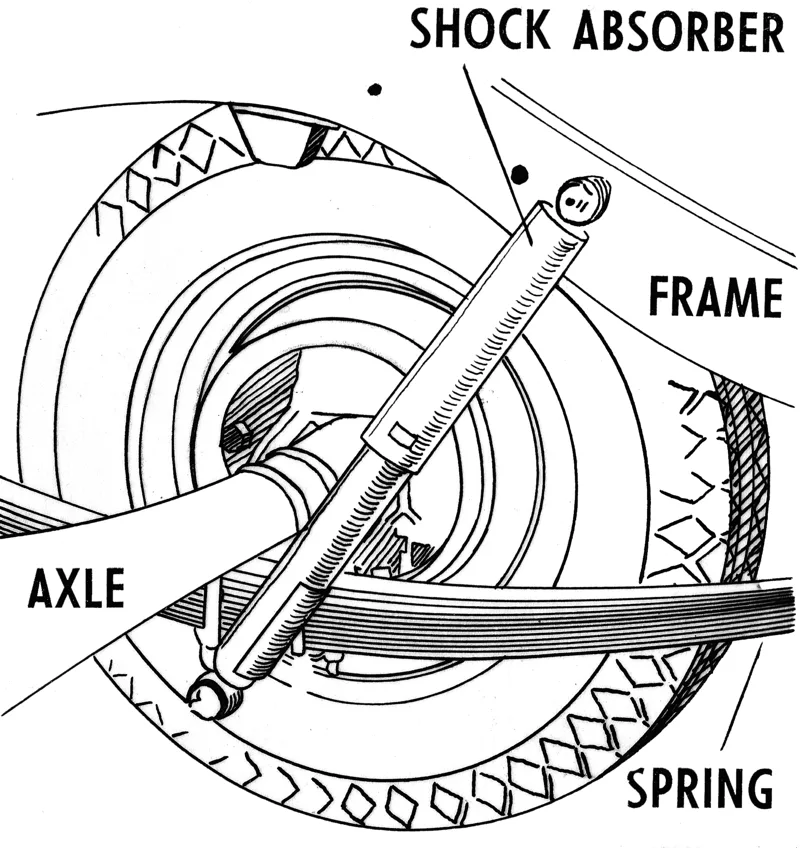
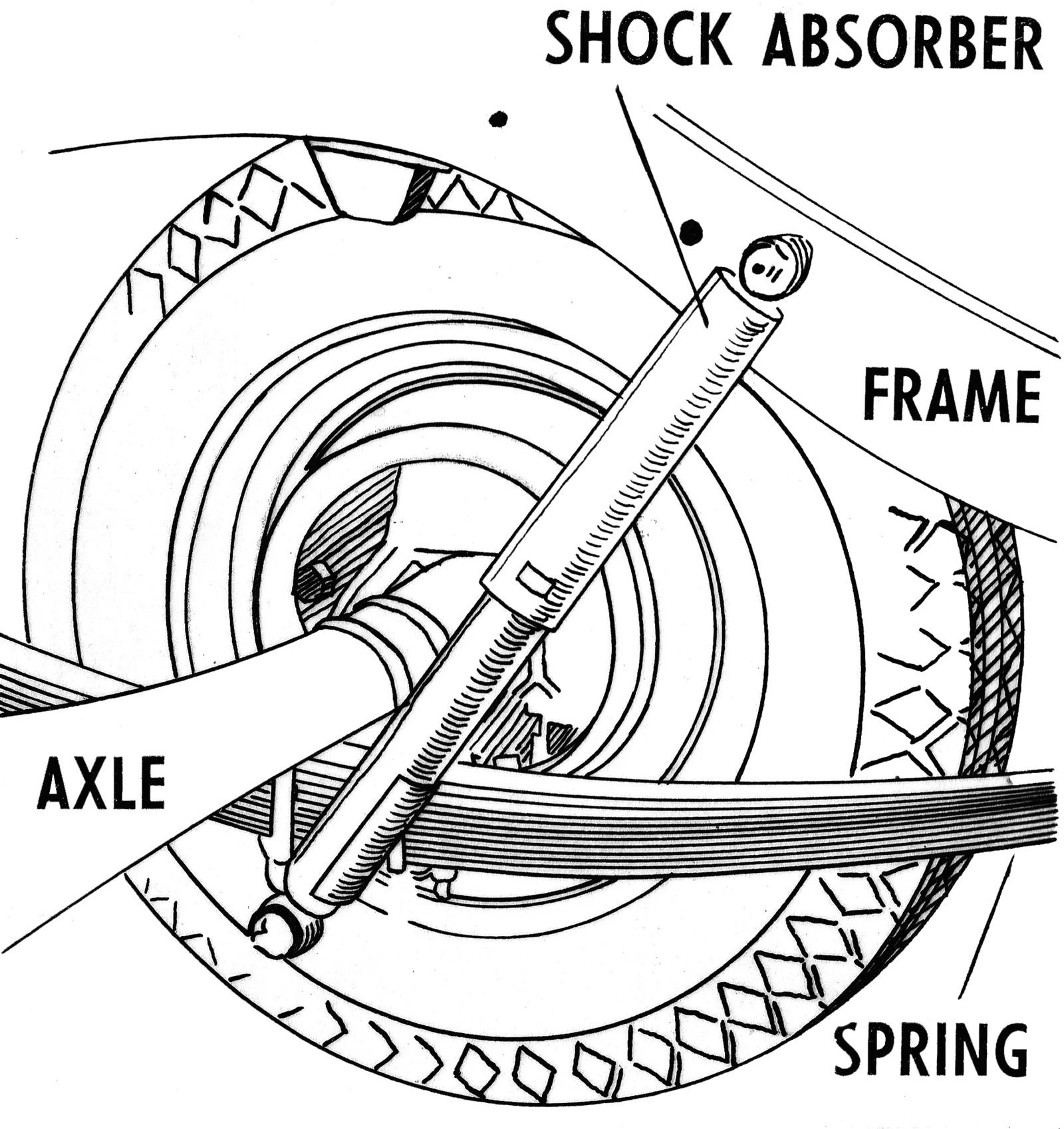
Active suspensions are divided into two classes. True active systems use actuators to move each corner independently. Adaptive, or semi-active, systems simply vary the firmness of the shock absorbers to suit changing road and driving conditions. The distinction matters because the first class adds energy to the system while the second only controls how it dissipates it.
The benefits claimed for active systems are a better balance of ride quality and handling. By keeping the chassis parallel to the road in corners, they reduce unwanted contact between the frame and the ground, especially over a dip, and they can improve traction and steering control. In many situations they virtually eliminate body roll and pitch.
Active suspension does not just absorb the road; it decides, wheel by wheel, how the car should sit on it.
What is the Skyhook principle?
Skyhook theory describes an ideal suspension that keeps the vehicle stable, unaffected by weight transfer or road irregularities, as if it were hung from an imaginary hook in the sky. The hook holds the body at a constant height above sea level, so the body does not move with the road.
An actual hook is impractical, so real systems rely on actuators guided by an acceleration sensor on the body. The sensor provides the imaginary line of zero vertical acceleration, and the dynamic elements can remain a simple spring and damper, so the control calculations stay manageable. In a conventional suspension, the car touches the ground through a spring and a damper. The Skyhook ideal instead connects the body to the imaginary line through the damper.
In theory, if the damping coefficient were infinite, the vehicle would be fixed to the imaginary line and would not shake at all. Real systems fall far short of that, but the principle explains why sensing the body's motion is so central to the design.
How do hydraulic active suspensions work?
Hydraulically actuated suspensions appeared first in 1954, with the hydropneumatic suspension developed by Paul Mages at Citroen. Pressure comes from a high-pressure radial piston pump. Sensors monitor body movement and ride level, and they feed the hydraulic height correctors, which can generate counter-forces to raise or lower the body within milliseconds.
The nitrogen in the system compresses instantly during manoeuvres, offering six times the compressibility of the steel springs used on vehicles up to that point. The system always included self-levelling and height adjustment. Height is now often tied to road speed, so the car lowers itself at high speed for better aerodynamics.
The arrangement performed well in straight-line driving, including over uneven surfaces, but it offered little control over roll stiffness. Millions of production cars have used variations on the basic design,.
When did electronic control reach racing and road cars?
Colin Chapman developed the original concept of computer management for hydraulic suspension in the 1980s, with the aim of improving cornering in racing cars. Lotus fitted and developed a prototype electro-hydraulic active suspension to a 1985 Excel, but it never offered the system for sale, although many demonstration cars were built for other manufacturers.
Sensors read body motion and ride height, and a computer then drives hydraulic servos mounted beside each wheel. The servos generate counter-forces to body lean, dive and squat almost at once, which is what gives the system its fast reactions.
| Year | Car | System |
|---|---|---|
| 1990 | Infiniti Q45 and Nissan President | Full-Active Suspension |
| 1991 | Toyota Soarer (UZZ32) | Hydraulic struts with four-wheel steering |
| 1992 | Williams Formula 1 cars | Active suspension later banned by the FIA |
| 1999 | Mercedes-Benz CL-Class (C215) | Active Body Control with high pressure hydraulic servos |
| 2013 | Mercedes-Benz W222 | Magic Body Control with road surface scanning |
Nissan's Full-Active Suspension, which debuted in 1990 on the Q45 and President, used a hydraulic oil pump, a hydraulic cylinder and an accumulator with two independent circuits, one for the front struts and one for the rear. The system could recover motion energy to keep the car balanced. Nissan later revised it as the Hydraulic Body Motion Control System, which appeared on the Patrol and the Infiniti QX80.
The 1991 Toyota Soarer variant used hydraulic struts and four-wheel steering to combine handling and comfort, with almost no body roll. Numerous accelerometers detected acceleration, cornering and braking forces, and the system varied the steering and suspension pressure at each wheel in real time. The car cost considerably more than other versions of the model, and fewer than 900 were sold during its five-year production run.
Why were active suspensions banned in Formula 1?
Williams Grand Prix Engineering prepared an active suspension devised by designer and aerodynamicist Frank Dernie for its Formula 1 cars in 1992. The cars were so successful that the FIA, motor racing's governing body, decided to ban the technology in order to narrow the gap between Williams and its rivals.
Computer Active Technology Suspension, or CATS, is a later refinement. It weighs ride quality against handling by reading road conditions, then adjusting its electronically controlled dampers up to 3,000 times each second.
How do active anti-roll bars work?
An active anti-roll bar stiffens when the driver or the suspension electronic control unit commands it, typically during hard cornering. The first production car with the technology was the Mitsubishi Mirage Cyborg in 1988. Citroen later used the same logic on the Xantia Activa, where hydraulic anti-roll bars were controlled to eliminate much of the body roll in corners.
Land Rover's Discovery Series 2 had a similar electronically controlled hydraulic anti-roll bar system on some versions, which reduced cornering roll.
What are electromagnetic and in-wheel systems?
In fully active production cars, electric servos and motors combined with electronic computing allow flat cornering and instant responses to road conditions. The approach avoids the slow response times and high power consumption that can affect hydraulics, because linear electromagnetic motors attached to each wheel respond quickly and can regenerate power by acting as generators.
The Electronically Controlled Active Suspension System, or ECASS, was patented by the University of Texas Center for Electromechanics in the 1990s and developed by L-3 Electronic Systems for military vehicles. An ECASS-equipped Humvee exceeded every performance specification in absorbed power to the operator, stability and handling. Bose Corporation also developed a proof-of-concept model, based on work its founder Amar Bose had carried out as an MIT professor.
Michelin's Active Wheel, introduced in 2004, placed an electric suspension motor inside each wheel that controlled torque distribution, traction, turning, pitch, roll and damping for that wheel, alongside an in-wheel traction motor. Audi's active electromechanical suspension, introduced in 2017, drives each wheel individually. Each wheel has an electric motor powered by the 48-volt system, and gears, a rotary tube and an internal titanium torsion bar exert up to 1,100 N m (810 ft lb) on the suspension through a coupling rod.
Audi's system uses a front camera to detect bumps early, and a preview function sends the right amount of travel to the actuators before the wheel reaches the bump. The motors on the outside of a corner can push the suspension up or pull it down, which produces a flatter drive and less body roll.
How do adaptive and semi-active suspensions differ?
Adaptive and semi-active systems can change only the viscous damping of the shock absorber, and they do not add energy to the suspension. Adaptive designs usually have slow response times and a few damping settings, so they tend to offer comfort, normal and sport modes. Semi-active designs respond within a few milliseconds and offer a wider range of damping values.
Semi-active systems are less expensive to design and consume far less energy than fully active ones. Their control force cannot always act in the direction of the suspension's motion, but research has continued to narrow the gap between semi-active and fully active systems.
The simplest semi-active type uses a solenoid valve to alter the flow of hydraulic fluid inside the shock absorber. The Toyota Soarer introduced its Electronic Modulated Suspension in 1983, and Cadillac's Computer Command Ride system used the same basic approach. In 1985 Nissan introduced Super Sonic Suspension, which added an ultrasonic sensor to inform a microcomputer that adjusted the shock absorbers.
Nissan and Bilstein jointly developed DampTronic for the 2008 GT-R, offering three selectable settings that also interact with Vehicle Dynamics Control.
How does MagneRide work?
MagneRide uses magnetorheological dampers, a technology initially developed by Delphi Corporation for General Motors. It was standard on the Cadillac STS from 2002 and was offered on some other GM models from 2003. The system was in development for 25 years and extends the earlier semi-active systems that GM had used on upscale models for decades.
The damper fluid contains metallic particles. An electromagnet controls their alignment: more current increases the magnetic flux, which makes the particles align and raises the fluid's viscosity, while less current lets them align the other way and softens the damper. Wheel sensors, steering and acceleration data feed the calculation of the best stiffness at each moment, and the system reacts within milliseconds.
Sensors can also scan the road ahead to predict conditions, so the suspension can adjust before the car arrives at a bump or a corner.
Which production cars used active suspension?
Production history stretches back to the 1950s. The Citroen Traction Avant of 1954 had self-levelling hydropneumatic suspension on its rear wheels, and the 1955 Citroen DS applied it to all four wheels. Cadillac's 1957 Eldorado Brougham introduced self-levelling GM air suspension, and Rolls-Royce's 1967 Silver Shadow used partial load-bearing hydropneumatic suspension.
Through the 1980s and 1990s, the list grew to include the Toyota Soarer, the Nissan Q45, the Citroen XM and Xantia, and the Mercedes-Benz S-Class and CL-Class. From the 2000s, Volvo, Alfa Romeo, Jaguar and Mercedes-Benz offered semi-active or self-levelling systems, and newer examples include the 2023 Ferrari Purosangue and the 2025 Nio ET9, which uses the SkyRide fully active suspension.