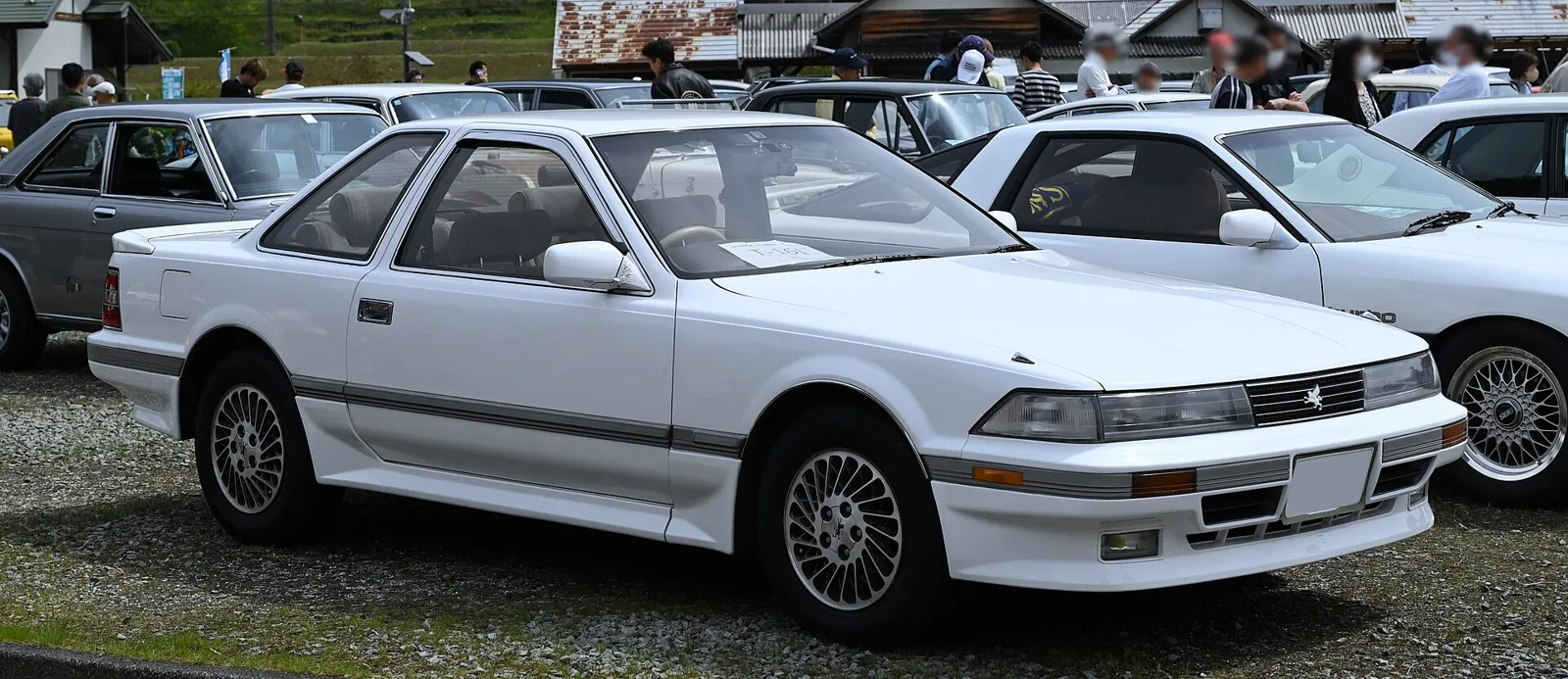
Toyota's personal luxury coupe, from a tax-friendly 1981 compact to the Lexus-linked Z40 that ended the badge in 2005.
The Toyota Soarer was a Japanese personal luxury grand touring coupe built from 1981 to 2005 with straight-six and V8 engines across four generations. It was Toyota's showcase car in Japan, while the United States sold the same design as the Lexus SC.
The Toyota Soarer is a personal luxury grand touring coupe that Toyota sold in Japan between 1981 and 2005. Across four generations it moved from a tax-friendly compact to a V8 grand tourer, and it acted as Toyota's showcase car in Japan for most of that time.
What was the Toyota Soarer?
The Soarer was a personal luxury GT coupe built by Toyota and sold through Toyota Store and Toyopet Store dealers in Japan. It debuted as the Z10 series in 1981, replacing the Mark II, Chaser, Crown and Carina coupes in the lineup, and it was positioned as the brand's halo car.
Toyota marketed the car as a grand tourer with a powerful straight-six, a luxurious cabin and a modern, aerodynamic shape. Personal luxury cars were popular in Western markets, and Toyota wanted Japanese buyers to have a similar option. Rivals included the Nissan Skyline, Nissan Leopard and Mazda Cosmo coupes.
Every version carried a winged lion emblem, which people sometimes mistake for a griffin. In the United States the same design was sold as the Lexus SC, because the Soarer nameplate was not available there.
Toyota's winged-lion grand tourer, from a tax-friendly compact in 1981 to a Lexus-linked V8 coupe.
How did the first generation reach the market?
The first Soarer was shown as the EX-8 at the 1980 Osaka International Motor Show. It went on sale in 1981 and won the Car of the Year Japan Award that year. Production of the Z10 series ran from February 1981 to December 1985 with 2.0, 2.8 and 3.0-litre straight-six engines.
The car used a rear-wheel-drive layout based on the A60 Supra. MacPherson struts were used at the front, with a semi-trailing arm and coil springs at the rear. Ventilated disc brakes went on all four wheels, and self-diagnosis maintenance reminders were standard.
Trim names of the period included 2800GT-Extra, 2800GT, 2000VX, 2000VR and 2000V II, with the 2000V I as the entry level. The top and mid-level packages added cruise control, a seven-way adjustable driver's seat, digital automatic climate control and LED digital gauges.
Why was the first generation classed as a compact?
Toyota shaped the first Soarer to fit Japanese external dimension rules, so it counted as a compact car. That gave Japanese buyers a tax advantage, and engine displacement between 2 and 3 litres let them choose how much annual road tax to pay.
Engines were kept above 2 litres and below 3 litres, which defined the tax band for each buyer. That allowed the car to be sold as a grand tourer without moving into the heavier tax category that larger engines brought.
Toyota saw an opportunity to bring the personal luxury coupe style, already popular in the West, to Japanese buyers. The Soarer was therefore designed around the Japanese rules from the start rather than adapted afterwards.
What did the mid-model refresh add?
The mid-model refresh added Electro MultiVision, a six-inch CRT display in the instrument cluster that showed engine speed, gear selection and fuel consumption trends. The Soarer was also the first Toyota with Toyota Electronic Modulated Suspension, and its front and rear double wishbones were labelled PEGASUS.
The screen was fitted on the 3.0 GT-Limited with automatic transmission. It was not touch-sensitive, and buttons changed the displayed information instead. When the car was parked with the parking brake applied, broadcast television could be watched.
Mirrors were relocated to the doors after 1983, which identifies refresh cars. The trims were renamed, and the 2.8 engine was upgraded to 3.0 litres for 1984.
How did the second generation Z20 change the car?
The Z20 Soarer arrived in January 1986 and was built until April 1991, sharing its platform with the newly introduced A70 Supra. Its styling resembled the X80 Cressida, Mark II, Chaser and Cresta, which gave the car a family look within Toyota's range.
The display moved from the instrument cluster to a position below the automatic climate control, where it could be upgraded to a touch-sensitive interface. Navigation information arrived first on cassette tape and later on CD-ROM, and the digital speedometer gave more at a glance.
Cloth upholstery varied by trim, and the sport bucket seats from the Supra were offered on GT trims in cloth or leather. The electronically controlled shock absorbers carried over, and the double wishbone suspension was shared with the Supra. An airbag suspension was available on the GT Limited model.
What special editions did the Z20 get?
TOM'S released its C5 package for 7M-GTE cars in 1988, with a remapped engine computer and bespoke wheels sized 16x8 inches. The Aerocabin followed in April 1989 as a limited run of 500 two-seat cars with an electric folding roof, a rare variant in the range.
The C5 could be specified with a revised engine computer, a bigger compressor for the turbo and a fibre intake pipe, along with KYB dampers on lowered springs. Its badges went on the rear of the car, and the wheels were made by Ray's Engineering.
The Aerocabin carried the GT-Limited's specification but was offered only with the 7M-GTE engine and a four-speed automatic. It came with a tan leather interior and pearlescent paint.
What changed in the 1988 facelift?
The 1988 facelift redesigned the grille and rear lamps and tweaked the interior, including the climate controls and dashboard. Engines also gained power, with the 1G-GTEU rising from 180 PS to 200 PS (132 to 147 kW) and the 7M-GTEU from 230 PS to 240 PS (169 to 177 kW).
The 2.5-litre twin-turbo 1JZ-GTE that powered the A70 Supra was not offered in the Z20. All models built from May 1989, including the Aerocabin, received a revised crossmember, which was the main structural change in the late run.
Why did the third generation look to Lexus?
Toyota's California design studio Calty was commissioned in 1987 to develop a new luxury coupe, following the design freeze of the Lexus LS 400 sedan. The result debuted in the United States in mid-1991 as the Lexus SC 300 and SC 400, and the Z30 Soarer arrived in Japan that same year.
The Z30 series shared its body and key components with the Lexus SC, but it had different interior features, powertrain choices and performance tuning. The line-up covered two engine classes, with the 4.0 GT-Limited and 4.0 GT alongside the 2.5 GT-TwinTurbo-L and 2.5 GT-TwinTurbo.
Japanese buyers found the car large. It was longer and wider than the Crown and did not fit the government's external dimension rules, so owners paid higher yearly taxes. Its larger engines also raised annual road tax, while the rear seats offered only modest space.
Some technology carried over from earlier cars, including the digital dashboard and the in-dash EMV touchscreen. Factory GPS navigation on CD-ROM, with VICS traffic information for Japanese roads, was among its features.
A notable feature was the articulating door hinge. Opening the doors pushed the hinges out and forward, which helped people get in and out of tight spaces.
How did the Z30 series change through its run?
Styling changed little over the nine-year run, and the Z30 went through three series. Series 1 ran from May 1991 to December 1993, Series 2 from January 1994 to August 1996, and Series 3 from August 1996 to December 2000, with each step bringing new lamps, bumpers and fog lights.
Series 1 received heated seats and an exterior temperature display from May 1992. Series 2 added a new front bumper with a one-piece lower grille, fog lights in place of cornering lights, and new tail lights. Series 3 brought an upper grille, oval fog lamps, a longer rear bumper, standard side skirts, an elevated rear spoiler and a body stripe.
From 1997 several Japanese prefectures used the Soarer as a high-speed patrol car, fitting it with the 2.5GT trim and a five-speed manual.
How powerful was the JZZ30 turbo?
The JZZ30 was the sportiest model in the range and the only one sold continuously from 1991 until production ended in 2001. It used the 2.5-litre 1JZ-GTE twin-turbo rated at 208 kW (283 PS; 279 hp) and 363 Nm (268 lb ft) of torque, in line with the Japanese manufacturers' agreed power limit.
The turbos initially ran as two identical small units working together rather than as a sequential pair. From August 1996 the engine adopted VVTi and a single, more efficient turbocharger, which improved mid-range torque and fuel economy. Official output stayed at 280 PS, while torque rose to 378 Nm (279 lb ft) at 2,400 rpm.
The GT-TL grade added electric seats, wood trim, cruise control and TEMS electronic damper adjustment, while the base GT-T did without them. The JZZ30 was also the only Z30 offered with a five-speed R154 manual transmission, which suited its sporting character.
What V8 options did buyers have?
Toyota offered three V8 Soarers built around the 4.0-litre 1UZ-FE quad-cam engine: the UZZ30, UZZ31 and UZZ32. They were introduced in 1991 alongside the six-cylinder models, and V8 production ended before the engine received VVTi. The UZZ30 was the base model, while the UZZ31 and UZZ32 were the luxury GT versions of the range.
The UZZ30 was the lightest and most basic of the three. It used a standard Tokico coilover suspension, a simpler stereo, a manual steering column and few electronic aids. Its velour seats had no heating or memory, and it lacked a sunroof and rear wiper. Being lighter, it felt sharp to drive, with strong power, handling and braking.
The UZZ30 also served as the base for the Lexus SC400 sold in the United States, which received extra luxury options to meet local requirements. Right-hand drive UZZ30 cars were built only from 1991 to 1993, while left-hand drive cars were made throughout the nine-year run.
The UZZ31 offered an air suspension with two settings for ride height and damper stiffness, a touch-screen TV, satellite navigation, a 12-disc CD stacker and optional heated memory seats. Its air pump sat at the front of the car, and it could be ordered without the EMV system with the UZZ30's radio and separate climate control.
What made the UZZ32 different?
The UZZ32 was the top-of-the-line 30 series car, with every UZZ31 option plus Toyota Active Control Suspension and four-wheel steering. It used self-levelling hydropneumatic struts instead of conventional springs or anti-roll bars, so the car had no traditional springs at all. Only 873 were built, making it the most sought-after model in right-hand drive markets.
Sensors measured suspension height, wheel speed, steering angle and the forces of cornering, acceleration and braking. The result was a controlled and smooth ride with no body roll, but the 110 kg (243 lb) of extra hydraulic equipment reduced performance and fuel economy.
The car was costly to produce, and at over 7,600,000 yen in 1995 it was expensive to buy.
What colours and interiors were offered?
Japanese Soarers came in many colours, and some were limited runs or one-offs that did not match the Lexus SC palette. Interiors were grey, spruce, tan or black, and the choice depended on the exterior paint code. From 1994 black became the common interior, and it dominated by 1998.
Baltic Blue Metallic was a limited 1995 paint shared with the 1993 to 1996 Supra and the 1994 to 1999 Celica. Roughly 199 SC300s were imported into the United States with that paint and a tan-only interior, as well as 256 SC400s.
Paint 6P2 took over from 6M2 in 1996, and 8L5 took over from 8J5. Spruce interiors ended in 1998, and cars that had used them switched to black.
What was the fourth generation Z40?
The fourth generation, the Z40, arrived in 2001 as a convertible-only model in Japan, called the 430SCV. It was largely identical to the Lexus SC 430 and was the first Soarer to share one design configuration with its Lexus counterpart.
The hardtop folded into the boot in the manner of the Mercedes-Benz SL. The 4.3-litre 3UZ-FE V8 from the Lexus LS 430 produced 280 PS (206 kW; 276 hp) and 430 Nm (317 lb ft) of torque, enough for 0 to 100 km/h (62 mph) in 6 seconds.
Some observers considered the fourth generation a step back in style, because the car looked more compact and top heavy than the Z30. Its design was developed by Toyota designers at studios in France and Japan.
Lexus arrived in Japan on 26 July 2005 with the SC 430 in its line-up, which ended Soarer production. In total 6,486 examples were sold with Soarer badging.
Specifications at a glance
| Specification | Detail |
|---|---|
| Production span | 1981 to 2005 in Japan |
| Generations | Z10 (1981 to 1985), Z20 (1986 to 1991), Z30 (1991 to 2001), Z40 (2001 to 2005) |
| Z10 engines | 2.0, 2.8 or 3.0-litre DOHC straight-six, electronic fuel injection |
| Z30 turbo | 2.5-litre 1JZ-GTE, 208 kW (283 PS; 279 hp), 363 Nm (268 lb ft) |
| Z30 V8 | 4.0-litre 1UZ-FE, 191 kW (260 PS; 256 hp) |
| JZZ31 six-cylinder | 3.0-litre 2JZ-GE, 225 PS (165 kW; 222 hp) at launch |
| Z40 V8 | 4.3-litre 3UZ-FE, 280 PS (206 kW; 276 hp), 430 Nm (317 lb ft) |
| Z40 acceleration | 0 to 100 km/h (62 mph) in 6 seconds |
| Rarest model | UZZ32, 873 built, with hydropneumatic suspension |
| Total sold with badge | 6,486 examples |