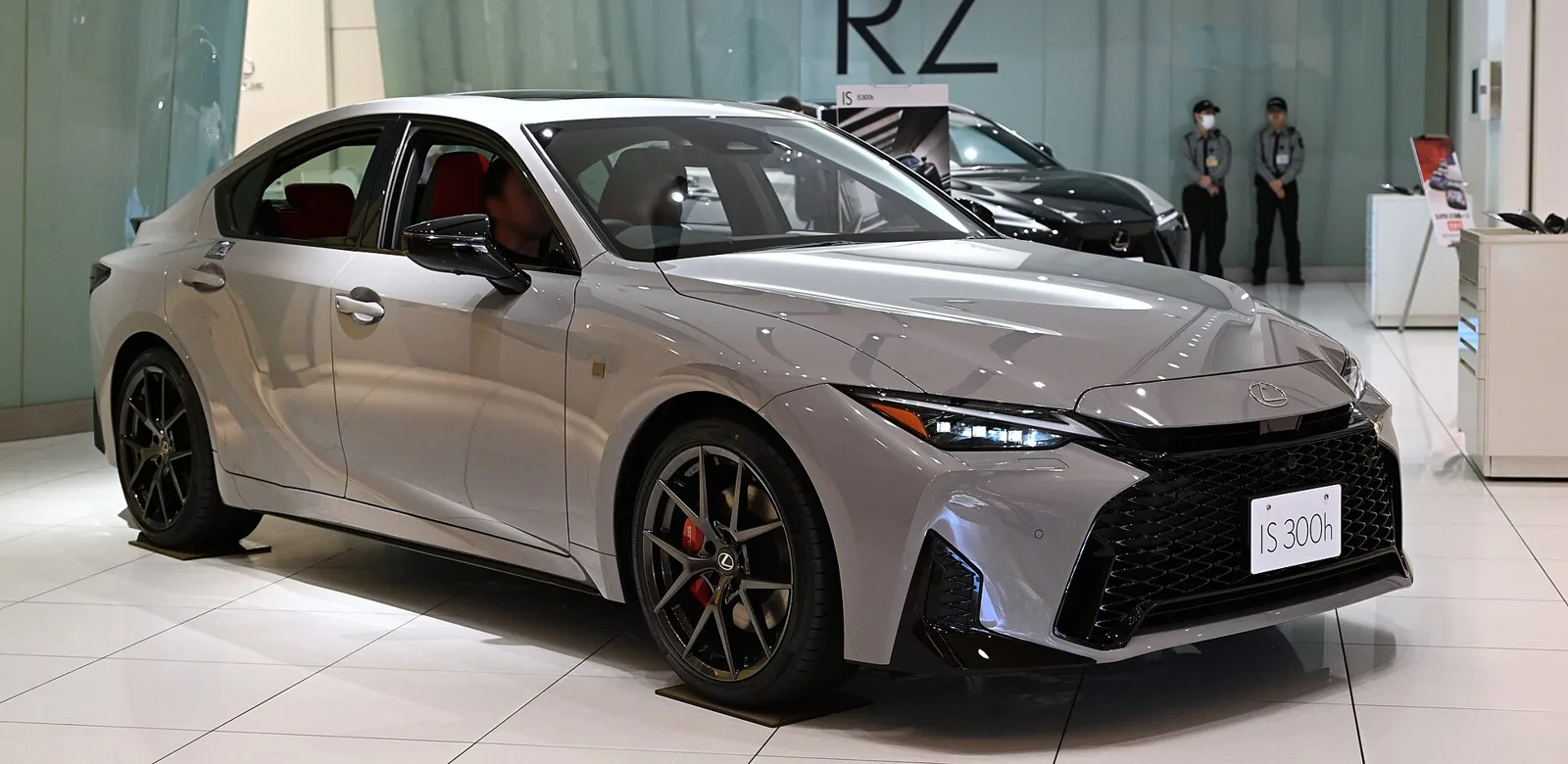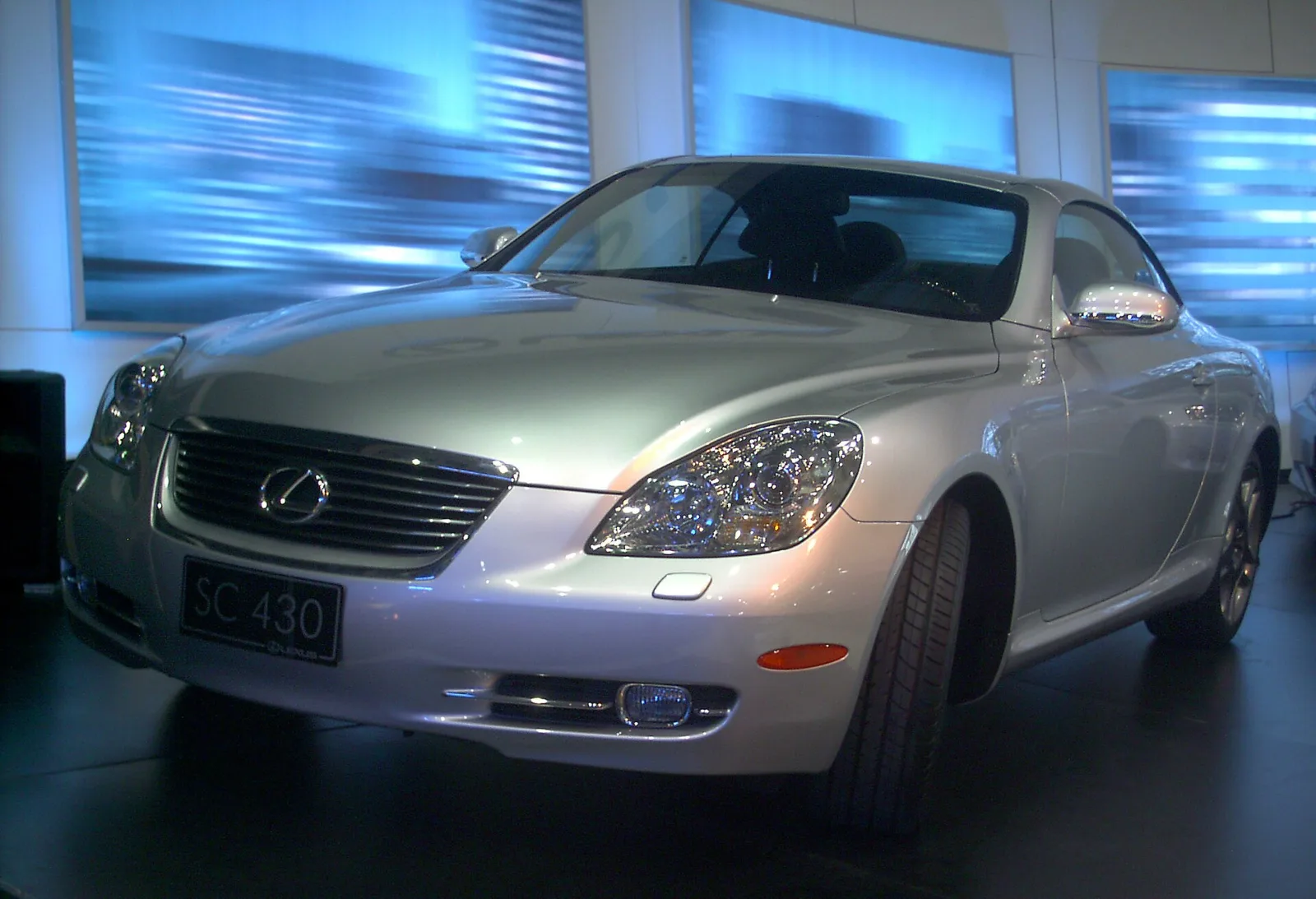
A Calty-styled grand tourer that moved from a fixed-roof V8 coupe to a retractable-hardtop convertible, then into Super GT racing.
The Lexus SC was a two-door grand touring coupe built by Toyota and sold by Lexus from 1991 to 2010. The first generation was a fixed-roof coupe with V8 and inline-six engines, and the second was a retractable-hardtop convertible with a 4.3-litre V8. It was replaced by the LC in 2017.
Lexus built its SC as a grand touring coupe for buyers who wanted a V8 or six-cylinder car with real presence. Production covered model years 1991 to 2010 and two generations, starting with a fixed-roof car and ending with a folding hardtop. The LC took its place in 2017.
Where did the Lexus SC come from?
The SC was Lexus's answer to the large luxury coupes of the early 1990s, and it was aimed mainly at American buyers. Calty Design Research in California handled the exterior, and the first generation shared early body design and parts with Toyota's Soarer, which sold in Japan.
The SC 400 debuted in the United States on 1 June 1991 as a 1992 model. Toyota began building the Soarer in April 1991 at Motomachi in Toyota, Aichi, and the SC was assembled alongside it at a second plant in Susono, Shizuoka.
The coupe was planned to complement the LS 400, Lexus's V8 flagship sedan. Automotive press reports at the time named rivals such as the Mercedes-Benz CL, the Jaguar XJS and the BMW 8 Series.
A grand touring coupe that began with a fixed roof and ended as a retractable hardtop, built from 1991 to 2010.
How was the first-generation SC styled?
Calty's designers modelled the body in plaster and worked in full three-dimensional form rather than on flat drawings, which produced a shape with few straight edges. The drag coefficient was 0.31, and the articulating door hinges swung outward and forward to ease entry in tight spaces.
Design chiefs Dennis Campbell and Erwin Lui described the result as based on emotion and feeling rather than straight-line aesthetics. Lui's production design was approved at the start of 1989, after which he spent four months in Japan helping to finish it. The automotive journalist Bill Russ later considered the design influential among cars of its time.
How much power did the SC 400 and SC 300 make?
The SC 400 used a 4.0-litre V8, the 1UZ-FE, shared with the LS 400 sedan. It made 250 hp (186 kW) and 260 lb-ft (353 N-m) from 1992 to 1995, and 260 hp (194 kW) after a 1996 upgrade. Lexus reportedly spent over US$400,000,000 developing that engine.
The smaller-engined SC 300 used a 3.0-litre 2JZ-GE inline-six rated at 225 hp (168 kW) and 210 lb-ft (285 N-m) in its early years. Lexus offered its TRAC traction control as an option, and a five-speed manual was available until 1997. Automatics made up the vast majority of sales for both models.
What changed for the 1998 model year?
For the 1998 model year, both engines gained VVT-i. The SC 400 rose to 290 hp (216 kW) and 300 lb-ft (407 N-m), and the SC 300 reached 225 hp (168 kW) with 220 lb-ft (298 N-m). A five-speed automatic also replaced the four-speed on the SC 400 in 1997.
Acceleration tests recorded 0-60 mph in 6.9 seconds for the SC 400 from 1992 to 1995, 6.7 seconds for 1996 and 1997, and 6.1 seconds from 1998 to 2000. The SC 300 managed 6.8 seconds with the manual and 7.2 seconds with the automatic. A 3.27 final drive improved fuel economy and top speed on the upgraded cars.
What was the second-generation SC 430?
The SC 430 was a convertible from the outset, unlike its predecessor. It used a 4.3-litre 3UZ-FE V8 with VVT-i, the same engine as the UCF30 Lexus LS, and a five-speed automatic, producing 317 lb-ft (430 N-m) of torque alongside 288 hp (215 kW).
Production of the SC 430 began in 2001, following its April 2000 premiere in New York. Lexus marketed it as the jewel of the range and as the marque's first convertible. Chief engineer Yasushi Nakagawa led development from 1996 to 2000, and Teams based in Europe and in Japan both shaped the body.
Chief designer Sotiris Kovos led a 1997 design theme, and his team travelled to the Cote d'Azur to study its architecture, lifestyle and harbours. The character lines echoed the region's yachts rather than traditional waveform styling. Wind tunnel testing shaped the side profile so that air flowed over the cabin at speed with the roof down.
How did the SC 430 drive and what did it offer inside?
The SC 430 used double-wishbone suspension at both ends and variable-assist rack-and-pinion steering shared with the GS 430. The hardtop retracted in 25 seconds, and the cabin offered an all-leather interior, brushed aluminium accents and a Mark Levinson sound system as standard.
Safety equipment ran from traction control to vehicle stability control, and the convertible earned a ULEV emissions rating. Run-flat tyres were available as an option for extra trunk space. Only four seat belts were fitted, and although four adults could technically squeeze in, the back seat was cramped.
Chrome Lexus emblems sat on the front seat headrests, and the navigation screen hid a folding wood panel. Burl Walnut or Bird's Eye Maple trim was standard, and 18-inch aluminium wheels completed the look.
Where was the Lexus SC sold?
The first-generation car never went on sale through official British channels, so enthusiasts imported examples privately. Markets for the SC 430 included North America, Europe, Oceania and Asia, and it was officially imported to the British Isles, unlike its predecessor.
The second generation was manufactured at the Kanji assembly site in Japan. It premiered in Japan in late 2005 alongside the Lexus marque there. In 2010 a final Eternal Jewel edition, limited to 200 units, was produced for Japan. The 2010 model was also the last car from any major US manufacturer to ship with a cassette tape deck.
What were the Pebble Beach and other special editions?
The Pebble Beach Edition was a limited-production SC 430 for the US market, offered from the 2004 to 2009 model years. Each year brought a new colour pairing, with 'Lone Cypress' badges on the fenders, console and mats.
A 2006 update brought a rear spoiler and spider alloy wheels to the Pebble Beach cars. In June 2004 the Madrid Motor Show showed a Carolina Herrera SC 430 CH, finished in a Testa di Moro body colour, with designer branding on the wheels and sills.
How did critics and buyers rate the SC?
Reviewers were largely positive about the second generation. Car and Driver called the 2002 SC 430 an unqualified success, J.D. Power ranked it top of the premium luxury class in its 2004 and 2005 Initial Quality Surveys, and Kelley Blue Book gave it a Best to Hold Value award in 2002.
The first generation also earned praise. Motor Trend gave the SC 400 its import award for 1992, and Car and Driver placed it on its Ten Best list from 1992 to 1996.
Not every verdict was kind. In a 2012 Top Gear film about the worst cars of all time, presenters Jeremy Clarkson and James May picked the SC 430 as their pick for the worst car ever made. May called the ride absolutely diabolical, and both criticised its handling and style.
Did the Lexus SC race in Super GT?
Yes. From 2006 Toyota entered an SC 430 in the GT500 class of Super GT, which is built around cars with roughly 500 horsepower. The car used a heavily modified 3UZ-FE V8 derived from the Supra racer. The team won the 2006 and 2009 GT500 championships, and the car was competitive from its first race.
The SC 430 won on its debut at Suzuka in 2006. In 2007 the SC replaced the Supra on the Toyota side of the grid, and a Zent Cerumo car won the Fuji 500 in 2008. Race SC 430s used Toyota's RV8KG V8 from 2009 to 2013, and five SC 430s were entered that season.
The SC also appeared outside circuit racing. In 2012 Daigo Saito drove a 2JZ-powered SC430 in Formula Drift.
Lexus's efforts carried on in 2010, when SC 430s from the MJ Kraft and Lexus Team Kraft squads won races at Fuji Speedway. Lexus kept using the SC 430 in Super GT until the 2013 season ended.
What replaced the Lexus SC?
The second generation finished in July 2010, nine years after it started. Lexus showed the LF-LC concept in January 2012, and the production LC 500 went on sale in early 2017 on Toyota's GA-L rear-wheel-drive platform, taking over the SC's role in the Lexus line-up.
Edmunds InsideLine reported in July 2008 that Lexus had cancelled the next SC because of slowing sales. The company did not confirm this and called the report unfounded speculation, and it kept building the SC 430 for 2009 and 2010.
The LF-LC was a design study for a driver-focused car. Work on it started in May 2010, and the Lexus Center in Japan steered the project. Calty in Newport Beach, California, styled its exterior, the same design studio that had drawn the first SC. A preview of a February 2012 Road & Track issue, which put the LF-LC on its cover, appeared on YouTube weeks before the show.
Lexus SC specifications at a glance
| Feature | First generation (Z30) | Second generation (Z40) |
|---|---|---|
| Years built | 1991-2000 production | 2001-2010 production |
| Engines | 4.0 L 1UZ-FE V8 (SC 400); 3.0 L 2JZ-GE inline-six (SC 300) | 4.3 L 3UZ-FE V8 with VVT-i |
| Power | 250 hp (186 kW) SC 400 from 1992 to 1995; 225 hp (168 kW) SC 300 | 288 hp (215 kW) |
| Torque | 260 lb-ft (353 N-m) SC 400; 210 lb-ft (285 N-m) SC 300 | 430 N-m (317 lb-ft) |
| 0-60 mph | 6.9 seconds SC 400 (1992-1995); 6.8 seconds SC 300 manual | 6.2 seconds |
| Transmission | Four-speed, then five-speed automatic; five-speed manual on SC 300 until 1997 | Five-speed automatic |
| Roof | Fixed-roof coupe body | Retractable aluminium hardtop, 25 seconds |
| Production ended | 7 July 2000 | July 2010 |