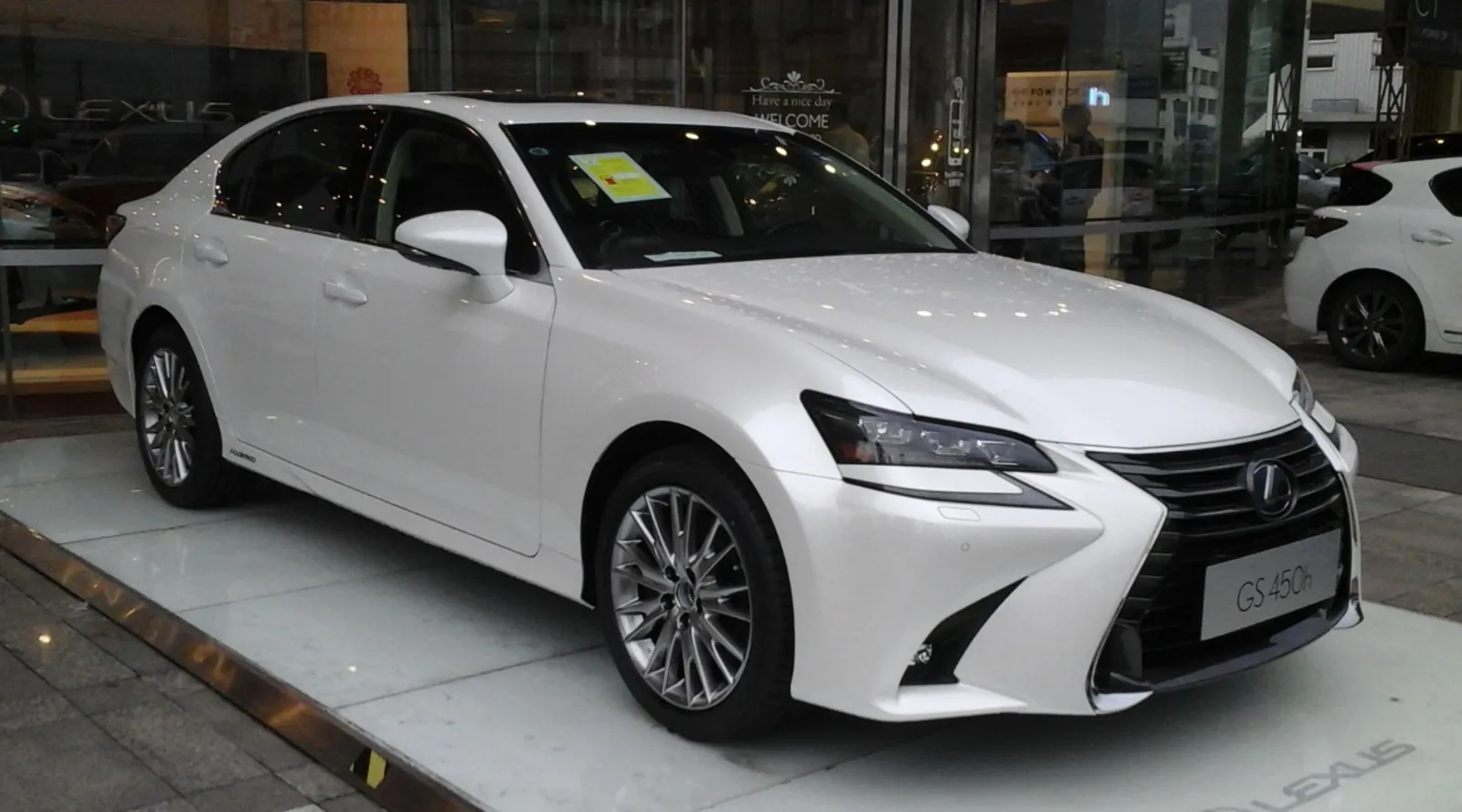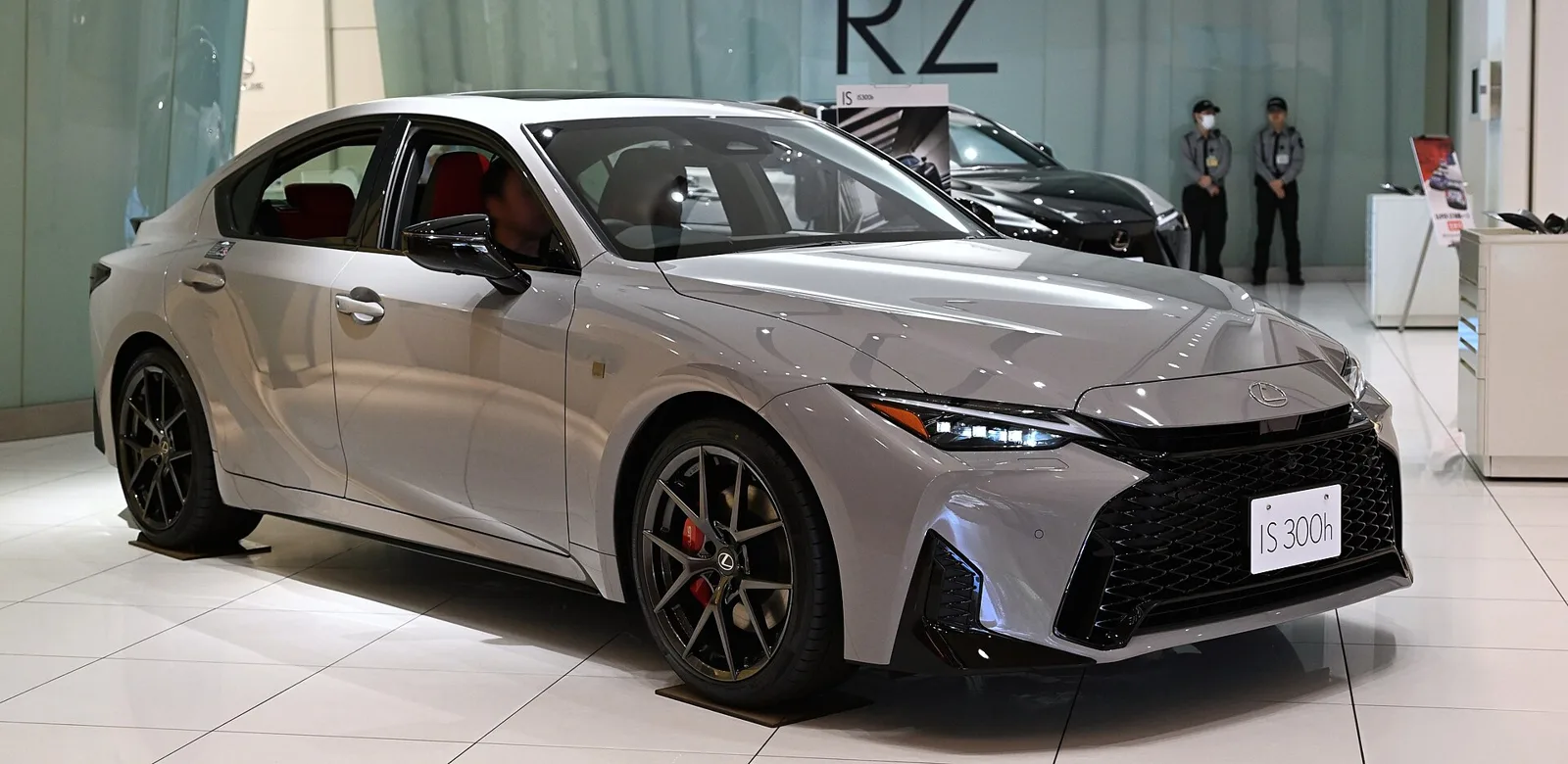
Lexus's entry-level sport sedan, sold as the Toyota Altezza in Japan, carried a sporting image through three generations and a run of F models.
The Lexus IS is a compact executive sport sedan sold since 1998, first as the Toyota Altezza in Japan. It has had three generations, V6, turbo and V8 engines, and the F and F Sport models that gave it a performance identity.
The Lexus IS is a compact executive car that Lexus has sold since 1998, first under the Toyota Altezza name in Japan. It was positioned as the sporting entry point in the Lexus range, below the ES, and it stayed the smallest Lexus until the CT arrived in 2011. Three generations followed, along with a run of F Sport and F models.
A compact sport sedan has to balance a small footprint with enough room for four adults, which is a difficult brief for any designer.
Where did the Lexus IS come from?
The IS was sold in Japan as the Toyota Altezza from 1998 until 2005. Altezza is Italian for height or highness, and the first-generation car, codenamed XE10, launched in Japan in October 1998. The IS name stands for Intelligent Sport, which describes the car's intended character.
Nobuaki Katayama led the engineering work between 1994 and 1998. The design patent was filed on 5 December 1996 at the Japan Patent Office, which put the concept on paper well before the car reached showrooms.
Lexus described the IS as an entry-level sport model positioned below the ES. Until the CT arrived in 2011, it was the smallest car in the Lexus lineup,.
A compact sport sedan that began as the Altezza in Japan and carried Lexus's performance image into the F era.
How did the first-generation IS perform?
The AS200 used a 2.0-litre 1G-FE straight-six with a four-speed automatic as standard. The RS200 used a 2.0-litre 3S-GE straight-four with a six-speed manual, while a five-speed automatic was optional. The Japanese models were built on a shortened midsize platform.
The IS 200 sold in Europe was rated at 153 hp (114 kW), and it could go from 0 to 100 km/h in 9.3 seconds. That made it a useful performance car for buyers who wanted more than a standard compact saloon offered at the time.
The AS300 arrived in July 2001 with a 3.0-litre 2JZ-GE straight-six. It was offered as a hatchback-station wagon with rear-wheel or all-wheel drive, and it was only available with an automatic gearbox at first.
Rear-wheel drive and all-wheel drive versions gave buyers a choice of character, with the all-wheel drive cars offering more grip in poor weather.
In Europe a supercharged option appeared in 2000. An Eaton supercharger at 0.3-bar pressure lifted the IS 200 to 153 kW (205 hp) without sacrificing fuel consumption, although the kit was later dropped once the IS 300 arrived in Europe.
How many first-generation IS models sold?
North American sales peaked at 22,486 units in 2001, the first full year of the IS 300 there. Later years came in below forecast, and sales fell below 10,000 units in 2004, which was short of the company's targets. The early years set the tone for what followed.
The IS 200 did better relative to its targets in Europe and Asia, although it still lagged behind the Mercedes-Benz C-Class and other German rivals. Lexus had built a strong position in North America, but its sales in Europe were smaller than those of its German competitors.
Sales patterns like these are common for premium brands entering a market where established German names already hold strong positions.
How did the second generation change the IS?
The second generation went into production in September 2005 at the Miyata plant, supplemented later that year by Tahara. It marked the next use of Lexus's L-finesse design philosophy on a production car, with a fastback silhouette, and an arrowhead shape repeated across the nose and the side glass.
The car had a drag coefficient of Cd=0.28, and its line-up included the IS 250 and IS 350 V6 sedans. The IS 200d and 220d diesels were offered in Europe, and the sales boost that followed was dramatic.
Sales rebounded strongly. The introduction of the second generation brought a 332% increase overall in 2006 compared with the previous year. In its first year in the US, the IS sold over 49,000 units, and it went on to become one of the best-selling luxury cars in the country.
A rise of that size usually reflects new styling and a sharper image arriving at the same time, and the second generation delivered both.
What was the IS F?
The IS F was the performance version of the second generation, and it became the launch product of Lexus's F marque. Lexus officially confirmed it in December 2006, and the sedan premiered at the North American International Auto Show in January 2007.
The IS F covered 0-97 km/h in 4.2 seconds, and electronic limiting held its top speed to 274 km/h (170 mph). Production began in December 2007 at the Tahara plant, and the car went on sale in North America and Europe several months after its debut.
Adding a V8 to a compact sedan created a demanding package, with heavier brakes and a stiffer chassis needed to keep the car composed at speed.
The F was more than a faster IS. It carried a V8 and distinctive styling, and it set the template for later F models, including the IS 500 F Sport Performance, which carried the same family of engines into the 2020s.
Did the IS get a convertible?
Yes. A coupe convertible version arrived in 2008 as the IS 250 C, with a more powerful IS 350 C also available. The model went on sale in Europe in 2009 and in North America in May 2009, which gave the range a fourth body style.
The convertible joined a range that had offered only one body style for three years.
How did the third-generation IS differ?
The third-generation IS was produced at the Tahara plant in Japan from 25 April 2013. Sales had reached 1,919 units by June 2013, and the order books for the sedan grew to about 7,600 units between 16 May and 16 June 2013.
The line-up included V6 IS 250 and IS 350 models, turbocharged IS 200t and IS 300 models, and the hybrid IS 300h. F Sport variants added sharper handling and styling, and the Adaptive Variable Suspension and Variable Gear Ratio Steering were offered on the IS 350.
All-wheel drive versions used a full-time system with a planetary gearset centre differential. It gave a 30:70 front to rear torque split under normal conditions, and it could move up to a 50:50 split to control wheel slip when needed.
A full-time system keeps all four wheels driven at all times, which is different from a part-time set-up that only engages the rear wheels when slip is detected.
What were the Lexus IS specifications?
The IS went from a 2.0-litre straight-six and a 3.0-litre straight-six in the first generation to V6, turbo and V8 options later on. Output rose steadily, with the IS F and the IS 500 F Sport Performance at the top of the range. The table below lists the main figures.
| Specification | Detail |
|---|---|
| Launch | Japan, October 1998, as the Altezza XE10 |
| First-generation engines | 2.0-litre 1G-FE straight-six; 2.0-litre 3S-GE straight-four; 3.0-litre 2JZ-GE straight-six |
| IS 200 in Europe | 153 hp (114 kW), 0-100 km/h in 9.3 seconds |
| Second-generation drag | Cd=0.28 |
| IS F | 0-97 km/h in 4.2 seconds, top speed 274 km/h (170 mph) |
| IS 350 F Sport | 3.5-litre V6, 232 kW (311 hp) |
| IS 500 F Sport Performance | 5.0 L V8, 472 horsepower |
The figures show the range widening over time, from modest straight-sixes to V8 performance, which mirrors the brand's broader push into performance.
Did the Lexus IS race?
Yes. The first-generation IS 200 was raced in the British Touring Car Championship, and the IS 300 raced in the United States through the Motorola Cup series with Team Lexus. Several Japanese teams also used the RS200 and IS 200 in touring car series across Asia.
In 2001 Team Lexus entered three IS 300s in the Grand-Am Cup, and it won its first IS 300 race that year. In 2002 the team won both the Drivers' and Team titles in the Grand-Am Cup ST1 class.
Touring car racing rewards durable, well-balanced cars, so a compact sedan that could be tuned for it made a sensible base for a team.
The second-generation IS 350 entered Super GT in the GT300 class in 2008, and the Project Bandoh WedsSport IS 350 won the GT300 driver and team titles in 2009. An IS F also won the SP8 class at the DMV Grenzlandrennen in August 2009.
Drifting took the IS into another world. In 2012 Daigo Saito entered an IS 250 C in Formula Drift Asia, a car that had survived the 2011 earthquake and tsunami and was rebuilt for drift competition.
How did the IS fare in awards and reviews?
The second-generation IS earned J.D. Power's entry luxury honours for 2006, and Top Gear named it Executive Car of the Year in the same year. Ward's placed the IS 350 V6 among its 10 Best Engines in 2006, and that engine returned to the list in 2007, 2008 and 2009.
In Australia the IS 250 won Best Prestige Car in Australia's Best Cars awards in 2006 and 2007. Earlier, the first-generation IS 300 had won Kelley Blue Book's Best to Hold Value Award in 2001.
What happened to the IS in its later years?
The IS was updated several times. The 2017 update gave the V6 engines a 5 hp boost, and the 2020 facelift for the 2021 model year brought a larger spindle grille and a revised interior. Android Auto and Apple CarPlay were added at the same time.
Lexus dropped the IS from European showrooms in 2020, citing poor sales, fierce competition and a shift toward crossover SUVs. It was withdrawn from the Australian market in November 2021, when stricter crash safety rules came in.
In North America the IS 500 F Sport Performance arrived for the 2022 model year with a V8 rated at 472 horsepower. That car was the first V8 IS since the IS F, and the 2025 facelift later brought a redesigned front fascia and a larger central display.
What is the Lexus IS's legacy?
The IS gave Lexus a sporting compact sedan, and it carried the marque's performance story through the F models and the sporting F Sport trims. It also bridged the brand's entry models and its high-performance F cars, and that role made it the sporting heart of the range for much of its life.
From the Altezza in Japan to the IS 500 in North America, the car stayed true to its sporting intent. Its engines, its F badge and its racing record all show a model built to be driven as well as admired.