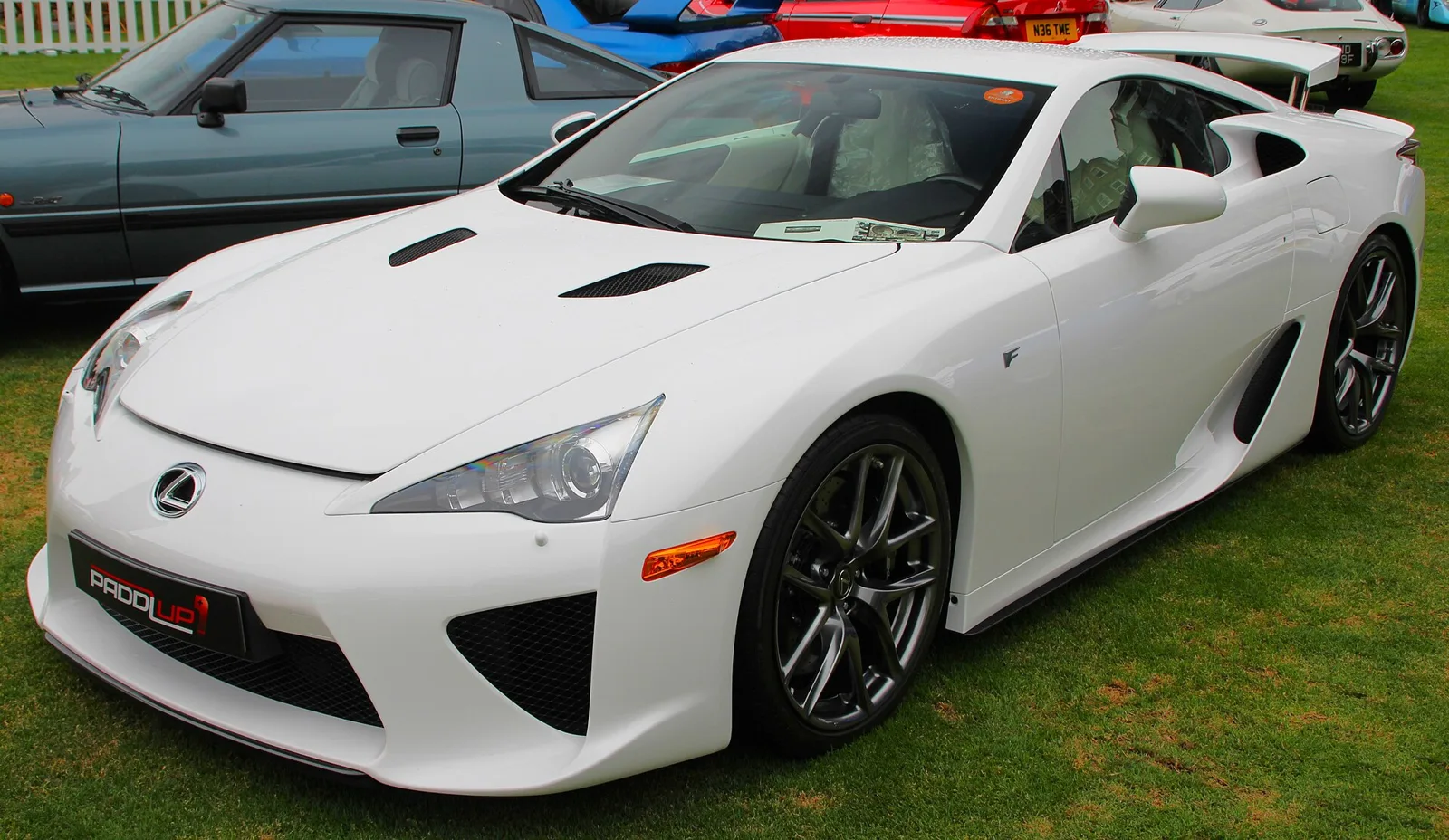
Built from 2010 to 2012 with a 4.8-litre V10, a carbon fibre body and a racing pedigree, the LFA remains Lexus's most extreme road car.
The Lexus LFA was a two-door sports car built by Lexus from 2010 to 2012, with 500 units made. Its 4.8-litre V10, developed with Yamaha, produced 412 kW (560 PS; 553 hp), and its body was mostly carbon fibre. Its Nurburgring Package set road-car lap records in 2011.
Toyota's luxury marque, Lexus, built the LFA as a two-door sports car between 2010 and 2012. Lexus made 500 units, each one hand-built with a 4,805 cc V10 engine and a body that was around two-thirds carbon fibre. It was the marque's flagship performance car, and its engine, lap records and limited run have made it a collector's car.
The project started as a prestige exercise rather than a profit centre. Analysts did not expect the car to make money, but it gave Lexus a testbed for carbon fibre mass production and for the performance models that followed it.
How did the LFA project begin?
Development started in early 2000 under the codename TXS, with the aim of showing what Toyota Motor Corporation and its Lexus marque could achieve in a sports car. The first prototype was completed in June 2003, and prototypes were seen testing at the Nurburgring from October 2004.
The first LF-A concept appeared at the January 2005 Detroit show as a design study. Its design was a collaboration between Toyota and the Italian designer Leonardo Fioravanti. Reports in 2006 suggested that production was approved, although that was never confirmed officially.
A more aerodynamic second concept arrived in January 2007, alongside the first F marque car, the IS F sports sedan. A roadster version followed in January 2008, and a trademark filing in December 2008 showed the name had dropped its hyphen to become LFA for a possible production model.
A 500-car V10 supercar with a carbon fibre body, built by hand and raced at the Nurburgring.
When was the production LFA confirmed?
Toyota's chief executive, Akio Toyoda, publicly confirmed production on 5 August 2009. The production car was then unveiled at the Tokyo Motor Show on 21 October 2009, with the announcement that only 500 copies would be made. The timing marked the 20th anniversary of the Lexus brand.
The production car kept the concept's name but without the hyphen. Chief Engineer Haruhiko Tanahashi dismissed claims that the letters stood for a particular phrase, and the car was shown as the last vehicle in a press conference that also included a hybrid concept.
How was the LFA sold and built?
Lexus opened orders on 23 October 2009 and selected its buyers in the second quarter of 2010. Production began on 15 December 2010 at the Motomachi plant in Aichi. The output was limited to 20 cars per month, and each one was ordered to the customer's specification. European orders went through one London dealership, where buyers bought the car outright.
A website configurator let buyers choose exterior and interior colours, brake calipers, seats and steering wheel leather. Lexus said the combinations ran past 30 billion. Each LFA was hand-built by a dedicated team of engineers and specialists, and each V10 carried the signature of the technician who assembled it.
The price was $375,000 (340,000 pounds sterling). In North America, 150 cars were first sold on a two-year lease. The lease was designed to stop owners reselling the car at a profit, and later Lexus allowed outright purchases on condition that the dealer had first right of refusal within two years.
Each car also received a numbered plaque showing its place in the production run. Production ran from December 2010 until December 2012, and no successor was planned when it ended. Lexus later sold the final car in Australia, where a dealer bought its own display vehicle in June 2023.
What makes the LFA's V10 engine special?
The LFA uses a 4,805 cc V10 with a 72 degree bank angle and Dual VVT-i. Lexus developed it in partnership with Yamaha, which co-developed the whole engine rather than only the cylinder heads. The unit produces 412 kW (560 PS; 553 hp) at 8,700 rpm, with torque of 480 Nm (354 lb ft) at 6,800 rpm.
The engine redlines at 9,000 rpm, with a fuel cutoff at 9,500 rpm, and it uses forged aluminium pistons, forged titanium connecting rods and solid titanium valves. Air reaches ten individual throttle bodies through a dual-stage variable intake manifold, and the exhaust exits through a dual-stage titanium muffler.
The V10 was picked because it revved higher than a V8 and carried less reciprocating mass than a V12. Lexus said the engine could rise from idle to its redline in 0.6 seconds. The result was a digital tachometer, because an analogue needle could not keep up with the rapid changes in engine speed.
The weight-to-power ratio of 2.67 kg/hp helped the car reach a top speed of about 325 km/h (202 mph). The engine is mounted at the front in a mid-engine layout, and chief engineer Tanahashi said the front engine position was chosen because it was more forgiving for less experienced drivers.
How is the LFA's body and chassis built?
The LFA's frame is a carbon fibre reinforced polymer centre monocoque with aluminium front and rear subframes. The subframes can be removed and replaced, which limits repair costs. Overall, 65% of the body mass is carbon fibre, with the remaining 35% in aluminium, and the carbon structure saves 100 kg (220 lb) against an aluminium equivalent.
The suspension uses double wishbones at the front and a multi-link arrangement at the rear. Brembo monobloc calipers grip carbon ceramic discs, with six pistons at the front and four at the rear, and forged 20-inch BBS wheels are standard. Tyres are 265 mm at the front and 305 mm at the rear.
A transaxle at the rear helps the car keep its weight balance. Overall, 48% of the mass sits over the front wheels and 52% over the rear, and the fuel tank sits ahead of the rear axle. The exhaust runs beneath a carbon torque tube, which keeps the centre tunnel narrow enough for central seating.
How does the LFA look and handle at speed?
The exterior was shaped by Lexus Design under general manager Kengo Matsumoto, with aerodynamics ahead of decoration. The car is 4,506 mm (177.4 in) long, with a wheelbase of 2,606 mm (102.6 in), a height of 1,219 mm (48 in) and a width of 1,895 mm (74.6 in).
The rear wing is speed-sensitive. It deploys above 80 km/h (50 mph) and generates 237 kg (522 lb) of downforce at top speed, while the wing retracted gives a drag coefficient of Cd 0.31. Air scoops above the rear fenders feed the radiators, and the design used a choice of 28 standard exterior colours.
The interior combined carbon fibre, leather, Alcantara and metal finishes. Its instrument display is a thin-film transistor speedometer that changes appearance with the drive mode, and engine sound reaches the cabin through twin ducts linked to the intake manifold.
How did the LFA perform on track?
Independent tests showed strong acceleration and braking, with Car and Driver recording 0-97 km/h (0-60 mph) in 3.6 seconds using launch control. Insideline measured a quarter-mile of 11.6 seconds at 200 km/h (124 mph) and a dyno output of 383 kW (521 PS; 514 hp) at the wheels.
Lap times at tracks across Europe were quick, and the car set a fast hot lap at the Circuit de Nevers Magny-Cours. At Top Gear's test track in Surrey, the LFA set the quickest wet lap ever recorded there.
What was the Nurburgring Package?
Lexus detailed the circuit-tuned variant on 15 March 2010. It added 7.4 kW (10 PS) from the engine, bringing output to 420 kW (571 PS; 563 hp), and it used stiffer, more adjustable suspension, magnesium BBS wheels and a large fixed rear wing that increased downforce by 33%.
Lexus said it would be limited to 50 cars, but 64 were built. Buyers received training sessions on the Nordschleife with chief instructors, along with a one-night stay and a one-year pass to the circuit. The package was offered in four colours: glossy black, matte black, race yellow and whitest white.
In June 2011 Akira Iida drove the car to a time of 7:22.85, and a lap in September 2011 was timed at 7:14.64. The car reached 298 km/h (185 mph) on the uphill Dottinger section, making it the fastest road-legal production car to lap the circuit at that time.
How did the LFA do in motorsport?
An LF-A prototype entered the VLN endurance series in 2008, and it won the over 4,000 cc SP8 class in the race where all other class entrants failed to finish. Lexus also entered the 24 Hours of Nurburgring that year, with a car that finished 7th in its class.
In 2009, two LF-As and an IS F ran in the 24 Hours, and the No. 15 LF-A set a best time of 8:50.458. In 2010 Lexus took the SP8 class win with a car that finished 18th overall. Chief test driver Hiromu Naruse died in a crash on 23 June 2010 while testing a Nurburgring Edition prototype.
What do critics say about the LFA?
Critics were consistently impressed by the engine and the car's performance, even when they questioned its value. Evo UK named the V10 the best engine of the year in 2011, praising its noise and its wall of torque. Car and Driver called it hugely expensive but hugely competent, and it placed the LFA ahead of a Ferrari 599 in a comparison test. Motor Trend praised the driving dynamics and the engine note.
Not every review was positive. Motor Trend placed the LFA ninth of eleven in its 2011 Best Driver's Car contest, and Autocar said the car struggled on uneven roads. Top Gear criticised its price against rival sports cars, although Jeremy Clarkson later said it was the best car he had ever driven.
Jay Leno called it one of the greatest supercars ever built, praising its engineering, its quality of construction and its city manners.
How did the LFA end and what came after?
Production ended in December 2012, and by 2020 Lexus still had unsold cars. A convertible version was planned but cancelled, and the LFA stayed a limited run of 500 cars that had cost far more to develop than it earned.
The LFA nameplate returned in December 2025 for a battery electric concept sports car, a renamed version of a concept shown earlier that year. The original car remains the benchmark for Lexus's most extreme road model.