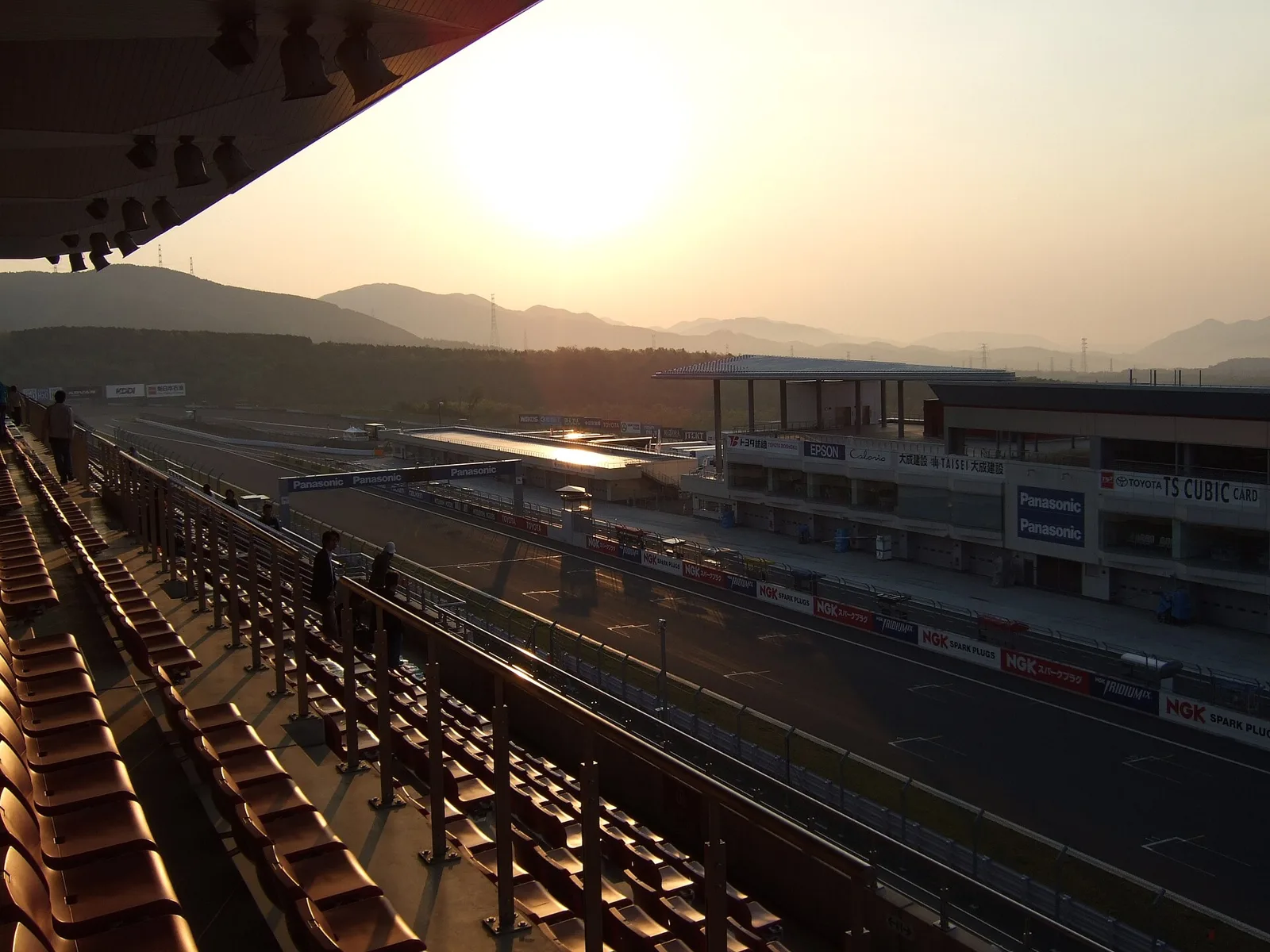
A Mount Fuji circuit that began as a superspeedway plan, hosted Formula One in 1976 and still anchors Japanese racing.
Fuji Speedway is a motorsport circuit in Oyama, Shizuoka Prefecture, at the foot of Mount Fuji in Japan. It opened in January 1966, hosted Japan's first Formula One race in 1976 and returned for the 2007 and 2008 Japanese Grands Prix. Its 1.475 km (0.917 mi) straight is one of the longest in motorsport.
Fuji Speedway sits on the eastern side of Mount Fuji in Shizuoka Prefecture, Japan. It was first conceived as an American-style superspeedway, finished as a European-style road course and opened in January 1966. Its long straight and its place in Japanese motorsport history have kept it central to the country's racing calendar.
Why was Fuji Speedway first planned as a superspeedway?
The project began with the Japan NASCAR Company, which was formed in December 1963 and secured exclusive Far East rights to NASCAR-style racing from NASCAR founder Bill France in January 1964. The plan called for a 4.0 km (2.5 mile) high-banked superspeedway, and Oyama-cho, at the foot of Mount Fuji, was chosen as the site.
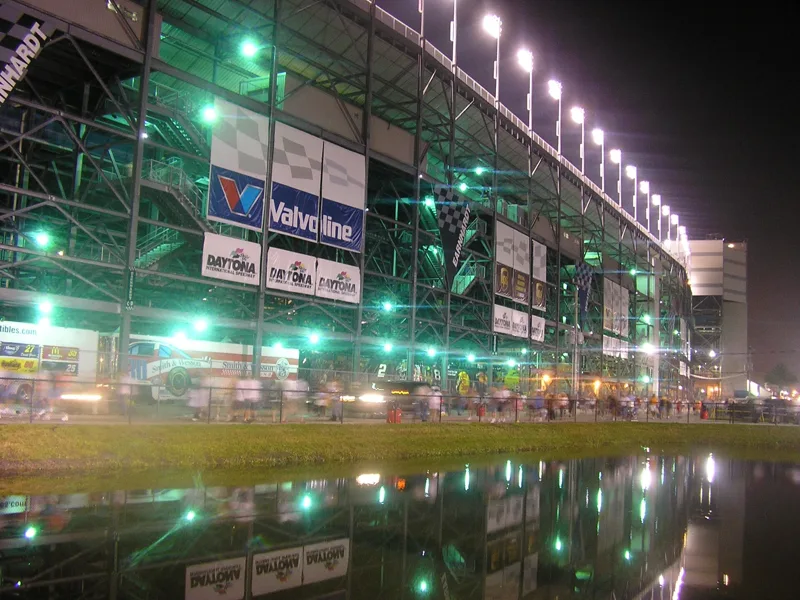
Charles Moneypenny, who had designed Daytona International Speedway, was brought over in July 1964 to plan the track. He found the site's steep terrain unsuitable for an oval, so he brought in retired Formula One driver Stirling Moss as a consultant. Moss inspected the land in August 1964, dismissed the Daytona-style idea and argued for a European road course with several possible layouts.
A superspeedway dream that became a road course and a lasting home for Japanese motorsport.
How did the superspeedway become a road course?
Funding problems forced a management overhaul in January 1965. The new team ended the NASCAR agreement, renamed the company Fuji International Speedway Corporation and restarted the project as a road course. One feature of the original plan survived: a 30-degree banked first turn.
Mitsubishi Estate took over management in October 1965 as construction neared completion. The circuit was finished in December 1965 and opened the following January, although its wide banked turn was soon to cause serious trouble.
Why was the banked first turn so dangerous?
The banking was the root of the problem. Cars reached a blind crest at the end of the straight at very high speed and then dropped into the bank, the reverse of the climb drivers faced at tracks such as Daytona. Vic Elford, who spent two months in Japan in 1969 on a Toyota test contract, said the corner produced major accidents and a horrendous death toll.
Elford's Toyota 7 test ran with the track in its clockwise direction. He also recalled that the big Group 7 cars were later banned in Japan, which meant neither Nissan nor Toyota ever raced them in Can-Am. A 6.3-litre Nissan V-12 had been among the cars destined for that series.
The danger persisted into the 1970s. In 1974 Hiroshi Kazato and Seiichi Suzuki were killed on the Daiichi banking in a fiery accident that injured six other people. The response was a 4.359 km (2.709 mi) course section that removed five fast corners, and it proved far more successful.
When did Formula One first race at Fuji?
Formula One first raced at Fuji for the Japanese Grand Prix at the end of the 1976 season. James Hunt won the world championship on a rainy day, while Mario Andretti won the race after Niki Lauda withdrew because the conditions were too dangerous. The race came with a dramatic title battle between Hunt and Lauda.
The following year brought tragedy. Gilles Villeneuve crashed in 1977 and two spectators beside the track were killed, after which Formula One left the speedway. Japan's next Grand Prix went to Suzuka ten years later, and the sport did not return to Fuji until 2007.
How was the modern Fuji layout created?
The circuit closed in 2003 for a major reprofiling to a new design by Hermann Tilke. It reopened on April 10, 2005, and most of the old banked section had been demolished during the work, leaving only a small remnant. The 1.475 km (0.917 mi) straight remains one of the longest in motorsport.
The first Formula One championship event at the circuit in 29 years took place on September 30, 2007. Heavy rain and mist marked the race, and the safety car led the first 19 laps before Lewis Hamilton took the win.
What were the most serious accidents at Fuji Speedway?
The most serious incident of the modern era came on May 3, 1998, when a multi-car crash broke out during the parade lap ahead of a JGTC race. The safety car had slowed in torrential rain, and Ferrari driver Tetsuya Ota was badly burned across his body after being held inside his car for nearly 90 seconds. Porsche driver Tomohiko Sunako broke his right leg.
Earlier accidents had already shaped the circuit. The Daiichi banking crash of 1974 and the 1977 spectator deaths both forced changes, and most of the old banked section was demolished in the 2003 reprofiling. Only a small piece of that banking still stands, a reminder of how the original design came to be abandoned.
What were the problems at the 2007 Japanese Grand Prix?
The 2007 weekend ran into trouble with transport, facilities and prices. The shuttle bus network stopped working, some reserved seats had no view, and simple lunch boxes sold for 10,000 yen (US$87). Newspapers also reported that only the Toyota F1 team was allowed to display flags and banners, which left the event with far fewer displays than other Grands Prix.
Organisers responded in 2008 by cutting the Sunday allowance from 140,000 people to 110,000, and they improved walkways and spectator facilities. Rain disrupted the race again. After weak ticket sales and poor weather, FOM agreed that Fuji and Suzuka would share the Japanese Grand Prix in alternate years, and the next race was held at Suzuka on October 4, 2009. Toyota stopped hosting the race from 2010, citing the Great Recession and its own operating deficit.
Which racing series have used Fuji Speedway?
Fuji has hosted an unusually wide range of racing, from sports prototypes and touring cars to motorcycles and Formula One. The FIA World Sportscar Championship visited between 1982 and 1988, while the All-Japan Sports Prototype Championship ran from 1983 to 1992. The All Japan Grand Touring Car Championship followed from 1993 to 2003, and the Japanese Touring Car Championship ran from 1985 to 1998.
Motorcycle racing has a long history at the circuit. The Japanese motorcycle Grand Prix, the closing round of the FIM road racing championship, was held in 1966 and 1967. The 1966 race used the full banked track, so the Honda works team stayed away for safety reasons, while the 1967 event ran on a 4.3 km track without the banking. A USAC Indy Car non-championship race in 1966 was won by Jackie Stewart.
Other series with long runs at the circuit include the Fuji Grand Champion Series from 1971 to 1989 and the Fuji Long Distance Series from 1977 to 1992. Formula Challenge Japan ran from 2006 to 2013, and the TCR Japan Touring Car Series from 2019 to 2023.
What is the Fuji Speedway layout like?
The current layout has 12 corners and has been in use since 2005. Some corners carry sponsor names, such as the TGR Corner, Coca-Cola Corner and Panasonic Corner, while others take their names from their radius in metres, such as 300R. The 300R is a wide, fast corner, and the drift course begins from it.
The Dunlop Corner changes with the configuration. In the full layout it is a tight right-hand hairpin followed by a left-right flick, while on the GT course it becomes a medium-speed right-hander that bypasses turns 11 and 12.
What are Fuji Speedway's key figures?
| Feature | Detail |
|---|---|
| Location | Oyama, Shizuoka Prefecture, Japan |
| Opened | January 1966 |
| Current layout | 12 corners, in use since 2005 |
| Main straight | 1.475 km (0.917 mi) |
| Owner | Toyota Motor, majority interest since autumn 2000 |
| Japanese Grand Prix | 1976, 1977, 2007 and 2008 |
| Super GT | Fuji 500 km, held during Golden Week in May |
| Olympic cycling | Road race finish, 2020 Summer Olympics, held July 2021 |
Who won the Olympic cycling races held at Fuji?
Fuji Speedway served as the venue and finish for the road cycling events at the 2020 Summer Olympics, which were held in July 2021 after the COVID-19 postponement. Richard Carapaz took the men's road race, Anna Kiesenhofer won the women's road race, Annemiek van Vleuten claimed the women's time trial and Primoz Roglic won the men's time trial.
The medal positions in the four events were as follows.
- Men's road race: Wout van Aert (silver), Tadej Pogacar (bronze)
- Women's road race: Annemiek van Vleuten (silver), Elisa Longo Borghini (bronze)
- Women's time trial: Marlen Reusser (silver), Anna van der Breggen (bronze)
- Men's time trial: Tom Dumoulin (silver), Rohan Dennis (bronze)
Is Fuji Speedway more than a racetrack?
Yes. Fuji is also a motorsport complex with a drift course, a safety education centre run by Toyota and a mini circuit. The Nismo Festival for historic Nissan racers has been held there since the 2003 refurbishment, and Toyota runs its own historic event a week before it.
A drifting course built during the refurbishment lies close to the circuit and was supervised by Keiichi Tsuchiya and Masanori Sekiya. Fuji also hosts the Udo Music Festival. In April 2022 Toyota announced the Fuji Motorsports Forest, a regional project that its real-estate arm, Toyota Fudosan, had been pushing forward as the Motorsports Village plan. The Fuji Speedway Hotel, operated by Hyatt, and the Fuji Motorsports Museum opened on the west side of the circuit in October 2022.
How has Fuji Speedway appeared in games and television?
Fuji has a strong presence in motorsport media. The arcade racing game Pole Position featured the circuit, and it was one of four tracks you could pick in Pole Position II. The Gran Turismo series and Project CARS 2 both include it, and it is also available as paid content for iRacing.
On television, the Japanese drama Engine used Fuji for its racing scenes, with the fictional Regulus Cup held there. An episode from the 11th season of Top Gear saw Jeremy Clarkson drive a Nissan GT-R on the circuit, and the anime Overtake! is set at Fuji Speedway.