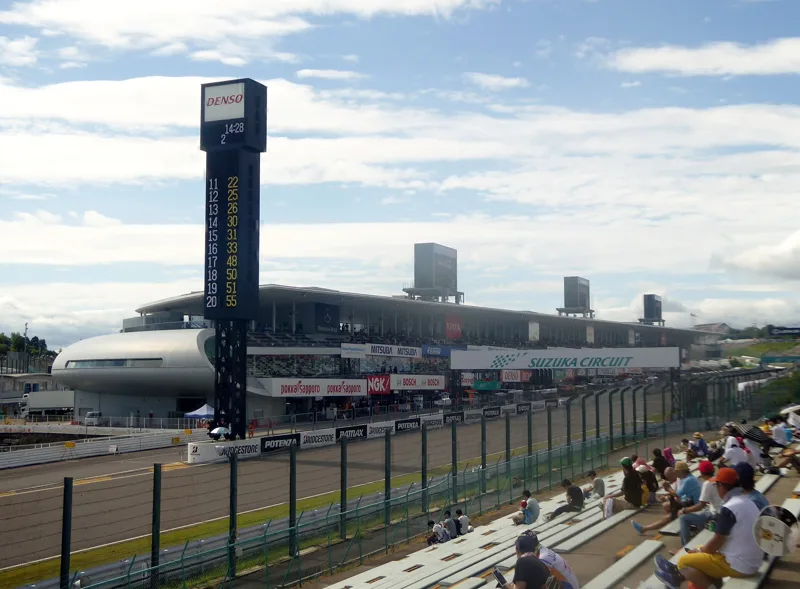
A home-grown championship that once lapped Suzuka within 4.49 seconds of Formula One pole, and a world championship round that has settled titles since 1976.
Super Formula is Japan's top single-seater championship, run by Japan Race Promotion since 1996 and renamed in 2013. The Japanese Grand Prix is a separate Formula One round, held at Suzuka every year since 2009 bar 2020 and 2021, and due there until at least 2029.
In 2014, a driver in Japan's own top single-seater series lapped Suzuka only 4.49 seconds slower than the pole time set for that year's Formula One Japanese Grand Prix. Andre Lotterer's lap would have placed him 21st on the F1 grid, ahead of a Caterham and a Marussia. It was the closest the two series have ever come on lap times.
What is Super Formula?
Super Formula is a formula racing championship held mainly in Japan and widely regarded as the pinnacle of single-seater racing in the country, and arguably across Asia. The Japan Automobile Federation sanctions it and Japan Race Promotion manages it. As of 2025 it ranks among the quickest championships anywhere.
The two are easy to confuse. The Grand Prix is a single round of the FIA world championship that visits Japan once a year. Super Formula is a full domestic season, with its own teams, its own rules and, since 2013, its own name.
At Suzuka in 2014, Japan's own championship was only 4.49 seconds off Formula One pole.
How did Japan's top formula series get its name?
The current title is the fifth in a line that runs back to 1973.
| Series name | Years | What defined it |
|---|---|---|
| All-Japan Formula 2000 | 1973 to 1977 | Modelled on European Formula Two, but open to purpose-built racing engines |
| All-Japan Formula Two | 1978 to 1986 | Renamed after the FIA changed its own Formula Two rules |
| All-Japan Formula 3000 | 1987 to 1995 | Official start in 1988; rode the late-1980s boom |
| Formula Nippon | 1996 to 2012 | First seasons under Japan Race Promotion, with open chassis and engine competition |
| Super Formula | 2013 to present | Renamed to claim equal footing with Formula One and IndyCar |
The early years leaned heavily on British hardware. March cars dominated the first Formula 2000 seasons, and local firm Nova built its own machine inspired by the March. Kojima Engineering joined the fray in 1977 with a design based on Formula One thinking. Underneath the senior class sat two feeder categories, one using kei car engines and the other close to European Formula Three.
A strange footnote sits in 1987. The Formula Two championship scheduled for that year was cancelled because every entrant turned up with a Formula 3000 car. The new formula started officially the following season.
Why did the 1980s boom matter?
Honda-powered Formula One teams were winning titles, the Japanese Grand Prix returned to the calendar in 1987, and Satoru Nakajima began racing full-time in F1 the same year. Fuji Television broadcast Formula One, and viewers who tuned in for the grands prix started following the home series too. Add the asset-fuelled bubble economy and the All-Japan Formula 3000 Championship drew entrants and investors in numbers it had not seen before.
The grid filled with names that would later matter abroad. Aguri Suzuki won the 1988 title and Ukyo Katayama the 1991 crown, and both went on to long Formula One careers. Europeans who raced there included Eddie Irvine, Heinz-Harald Frentzen, Johnny Herbert and Jean Alesi. Michael Schumacher appeared once, at Sportsland Sugo in 1991.
Then the bubble burst, and popularity sagged through the early and middle 1990s. International Formula 3000 became a one-make series in 1996 to cut costs, so Japan's organisers chose a different road: Fuji Television established Japan Race Promotion in 1995, and the series carried on with open chassis and engine rules as Formula Nippon.
What are Super Formula cars like?
Until 2002 Formula Nippon was a genuine open formula. Lola, Reynard and G-Force built chassis, Mugen-Honda supplied most of the engines alongside Cosworth and Judd, and Bridgestone, Yokohama and Dunlop all sold tyres. Costs pushed the series towards control parts. Bridgestone became sole tyre supplier in 1997, Mugen-Honda sole engine supplier in 1998, and once Reynard went bankrupt and G-Force withdrew, the Lola B03/51 became the spec chassis from 2003.
Big rewrites followed. In 2006 the Lola FN06 chassis arrived with 3.0-litre V8 engines from Toyota and Honda, built on the same blocks the two firms had used in the 2005 IndyCar Series. The Swift FN09 chassis came in 2009, along with a 3.4-litre V8 shared with the GT500 class of Super GT and a push-to-pass system that survives to this day.
The Dallara era
The Dallara SF14 ran from 2014 to 2018 with 2.0-litre single-turbocharged engines from Honda and Toyota, built to the Nippon Race Engine formula, and with at least 30 percent of its components made in Japan. Yokohama replaced Bridgestone as sole tyre supplier in 2016.
The SF19 followed for the 2019 to 2022 seasons. It was unveiled at Suzuka in October 2017, weighs 670 kilograms including the driver and carries a halo. The SF23, unveiled on 13 December 2022 and used since 2023, is a slightly modified SF19 with upgraded aerodynamics aimed at closer, wheel-to-wheel racing.
Push to pass
Think of the overtaking system as a sprint button. For up to 200 seconds over a race distance, a driver can burn an extra 5 kg of fuel per hour. The engines are detuned compared with their Super GT cousins, but they keep the facility.
How does Super Formula score points?
Since 2020 the series has used a top-ten system modelled on Super GT, with 20 points for a win. Qualifying carries its own reward: three points for pole, two for second and one for third at every round.
Earlier systems tracked Formula One. The All-Japan F3000 and Formula Nippon fields were paid on a top-six scale between 1988 and 2006, a top-eight scale started in 2007, and a pole-position bonus appeared in 2008. For a time the series paid ten places with 15 points to the winner, before reverting to a top-eight format from 2009 to 2019.
How close is Super Formula to Formula One?
Regulation changes in 2014 in both Super Formula and Formula One produced the closest gap ever recorded between their lap times. At the season-opening round at Suzuka, Andre Lotterer set 1:36.996 in the second qualifying session. Nico Rosberg's pole time for that year's Japanese Grand Prix was 1:32.506, so the difference was 4.49 seconds.
Lotterer's lap sat inside the 107 percent qualifying threshold used in Formula One, and it would have put him 21st on the grid. Kamui Kobayashi's Caterham (1:37.015) and Max Chilton's Marussia (1:37.481) were slower.
Who has used Super Formula as a stepping stone?
Formula Nippon was once a route into Formula One for drivers such as Ralph Firman, Toranosuke Takagi, Shinji Nakano, Ralf Schumacher and Pedro de la Rosa. By the late 2000s that status had faded, and the 2008 financial crisis hit hard: the grid shrank from 20 cars in 2008 to 13 in 2009.
The rebrand to Super Formula came with a stated ambition to stand level with Formula One and the IndyCar Series, and international interest returned. Stoffel Vandoorne, the 2015 GP2 champion, raced a full season in 2016 for Docomo Team Dandelion Racing, won twice and stepped up to McLaren in 2017. Pierre Gasly, the 2016 GP2 champion, joined Team Mugen in 2017 with Red Bull backing, won twice and was Rookie of the Year, losing the title by half a point.
Felix Rosenqvist, Alex Palou and Patricio O'Ward all raced in Super Formula before winning IndyCar races. Palou, the 2019 Rookie of the Year, won the IndyCar championship in 2021, 2023, 2024, 2025 and 2026. Liam Lawson, the 2023 runner-up, drove for AlphaTauri and RB in 2023 and 2024, then for Red Bull Racing in two races in 2025 before returning to Racing Bulls.
Off the track, the figures are also moving. Masahiko Kondo became chairman of Japan Race Promotion in 2023, succeeding Satoru Nakajima, and attendance rose 64 percent in his first season compared with the year before. Princess Yoko of Mikasa became special honorary president in 2025, and the champion now receives the Princess Yoko Cup.
Where did the Japanese Grand Prix come from?
The first Japanese Grand Prix was a sports car race at Suzuka in May 1963, about 80 kilometres south west of Nagoya. Suzuka hosted again in 1964, then the race moved to Fuji Speedway for the next eight editions. Fuji lies 64 km west of Yokohama and 106 km west of Tokyo, and in those days it had an incomplete layout with a banked opening turn, Daiichi, that was the scene of fatal accidents until it was removed in 1974.
Touring and sports car racing was hugely popular in 1960s Japan, and the Grand Prix was the largest event in the country between 1963 and 1969. Single-seaters struggled for attention. The 1969 JAF Grand Prix at Fuji was the country's first big single-seater race. In 1971 the Grand Prix itself switched to a formula-car format. Neither event drew crowds like the old sports car race.
When did Formula One come to Japan?
Formula One's first Japanese Grand Prix was in 1976, on a version of Fuji without the banking. It became famous at once. James Hunt and Niki Lauda arrived fighting for the title in monsoon conditions, and Lauda, who had nearly died in a crash at the German Grand Prix earlier that season, withdrew, saying his life mattered more than the championship. Emerson Fittipaldi and Carlos Pace also pulled out. After a slow pit stop dropped him to fifth, Hunt climbed to third, collected the four points he needed and took the title by one point. Mario Andretti won for Lotus ahead of Patrick Depailler's Tyrrell P34.
The 1977 race was marred when Gilles Villeneuve's Ferrari collided with Ronnie Peterson, somersaulted into a restricted area and killed two spectators. Japan then left the calendar. A 1978 date was cancelled, and the sport did not come back for a decade.
Why is Suzuka so central to the Japanese Grand Prix?
A 1985 race planned for Suzuka was cancelled because rebuilding parts of the track took too long. When Formula One returned in 1987, the circuit was redesigned and revamped. Dutchman John Hugenholtz had laid it out inside a funfair, Honda owned it and used it as a test track, and it remains the only figure-eight circuit to appear on the Formula One calendar.
The first event settled a title. Nigel Mansell's Williams-Honda hit the barriers hard in practice at the Snake Esses, and he could not start because the crash aggravated an old back injury, which effectively handed the championship to his team-mate Nelson Piquet. Gerhard Berger won for Ferrari, the team's first victory since 1985.
Senna against Prost
Suzuka became the stage for the feud between Ayrton Senna and Alain Prost. In 1988, as McLaren team-mates, Senna stalled on the grid, bump-started down the sloping pit straight and dropped to 14th. Rain arrived, and Senna caught and passed Prost, winning the race and his first title even though Prost scored more points over the year; only the best 11 results counted in those days.
The 1989 meeting was worse. McLaren had won 10 of the 14 races, Prost led Senna by 16 points, and Senna needed a win. He qualified on pole 1.5 seconds clear of Prost. On lap 47, at the Casio chicane, Senna tried to pass on the inside and Prost turned in. The cars locked together and stalled. Marshals pushed Senna's car back onto the track, he bump-started it, pitted for a new nose cone and then caught and passed Alessandro Nannini to take the chequered flag.
He was disqualified for bypassing the chicane, Nannini was given the victory, and McLaren's appeal failed. Senna was also fined $100,000 and handed a six-month ban; both penalties were later withdrawn. Prost was champion for the third time.
The 1990 round opened with the roles reversed. Prost, now with Ferrari, needed to win both remaining races to retain the title. Senna took pole three-tenths clear, asked to move pole to the cleaner side of the track and was granted it, only for the FIA president to put the grid positions back where they had been.
How are the series linked today?
They share a venue and a rivalry. Every year since 2009 the Japanese Grand Prix has been run at Suzuka, apart from 2020 and 2021, when the pandemic cancelled it, and the Super Formula season opener there in 2014 supplied the lap-time comparison above. In 2007 and 2008 the Grand Prix visited Fuji, after which an alternating agreement between the circuit owners, rivals Toyota and Honda, pointed back to Suzuka. Toyota said in July 2009 that Fuji would not stage the race from 2010.
The Grand Prix itself has crowned 13 World Drivers' Champions across the 40 world championship editions staged in Japan, and Japan is one of only nine countries to have hosted more than one Grand Prix in a single season, thanks to the Pacific Grand Prix, run at the TI Circuit in 1994 and 1995.
Where does this go next?
The Japanese Grand Prix is due to take place at Suzuka until at least 2029. Super Formula has run the Dallara SF23 since 2023, and from 2025 its champion receives the Princess Yoko Cup.