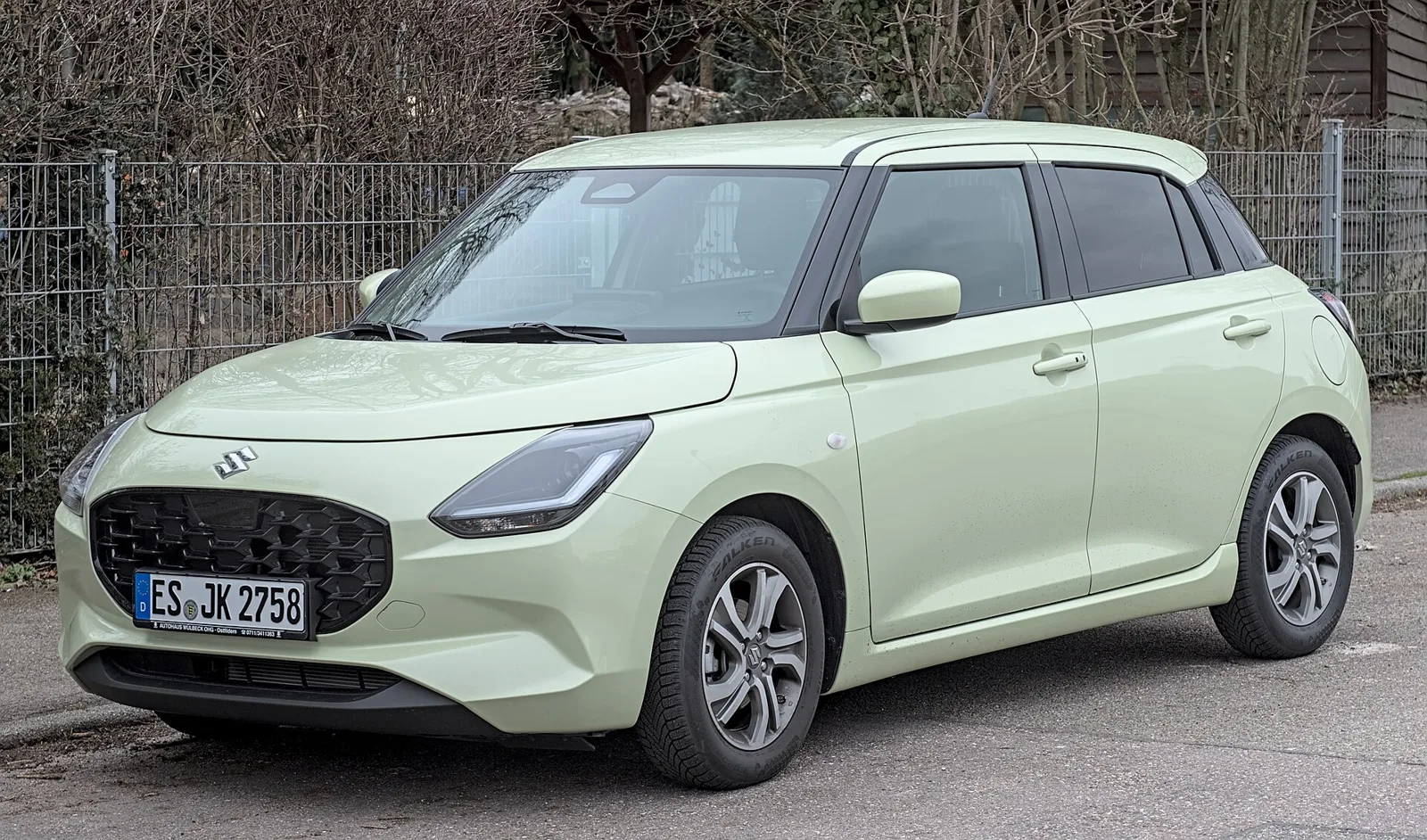
From a 1909 loom works to Maruti Suzuki and MotoGP, the Japanese maker's cars, motorcycles and racing record in one guide.
Suzuki is a Japanese maker of cars, motorcycles and marine engines, headquartered in Hamamatsu. It began in 1909 as a loom works and became a major automaker through small cars, motorcycle racing and joint ventures in India and Pakistan. The company's range also includes ATVs, outboard engines and wheelchairs.
Suzuki Motor Corporation is a Japanese mobility manufacturer based in Hamamatsu, Shizuoka, that builds cars, motorcycles, all-terrain vehicles, outboard marine engines and wheelchairs. It started in 1909 as a loom maker and grew into one of the world's largest automakers, with a motorcycle and racing record that shaped its reputation for small, practical machines. The brand matters because it shows how a compact-vehicle specialist became a worldwide name through partnerships and persistent engineering.
How did a loom maker become a carmaker?
Michio Suzuki founded the Suzuki Loom Works in 1909 to make weaving looms for Japan's silk industry. Looms remained the core business for the first 30 years, but he saw small cars as a practical new venture and began a project in 1937.
Within two years of starting that project, Suzuki had several compact prototypes running. They used a liquid-cooled, four-stroke, four-cylinder engine with a cast aluminium crankcase and gearbox, producing 9.7 kW (13 hp) from under 800 cc.
Wartime rules ended the plan. The government declared civilian passenger cars a non-essential commodity, so the prototypes never reached production. After the war the company returned to looms, but the cotton market collapsed in 1951 and it needed a new direction.
The answer was a simpler kind of motorised transport. In 1952 Suzuki launched the Power Free, a motorised bicycle with a 36 cc, one horsepower, two-stroke engine. Its double-sprocket gearing let riders pedal with engine assistance, pedal alone or run on the engine alone.
By 1954 the company was building 6,000 motorcycles per month and had changed its name to Suzuki Motor Co., Ltd. Following the success of those motorcycles, it turned back to cars and launched the Suzulight in 1955.
From silk looms to racing motorcycles, Suzuki built its name on small, practical machines that travelled far.
What was the Suzulight and why did it matter?
The Suzulight was a 360 cc two-stroke car launched in 1955 as Japan's minivehicle age began. It used front-wheel drive, four-wheel independent suspension and rack-and-pinion steering, features that were uncommon on cars until three decades later. The company's car business was still young, since it did not set up a separate automobile division until 1961.
The next steps came quickly. The Fronte 800, a two-stroke subcompact, arrived in 1965, and an automobile plant was built in Iwata, Shizuoka, in 1967 alongside the Fronte 360.
The Alto of 1979 changed the company's standing. It was a massive success that propelled Suzuki to seventh place among Japanese car and truck makers, which strengthened its hand in later talks with Isuzu and General Motors.
How did Suzuki's India business begin?
Suzuki helped create Maruti Udyog, a joint venture with the Government of India, in the early 1980s. It started as a minority partner, later acquired a majority, and today Suzuki Motor Corporation owns 54.2% of Maruti Suzuki, with the rest held by Indian public and financial institutions.
The first model was the Maruti 800, launched in 1983. The Alto arrived in September 2000, and it reached one million units in seven years and five months, a milestone Maruti announced in February 2011.
Output at Maruti Suzuki reached 1,133,695 units across the period from 1 April 2011 to 30 March 2012, and its shares are listed on the Bombay Stock Exchange and the National Stock Exchange of India.
The Pakistan business followed a similar path. Suzuki's equity in Pak Suzuki rose to 73.09% by 31 December 2001, and its Bin Qasim plant was expanded to 50,000 vehicles per year in July 1994.
How did Suzuki become a motorcycle racing force?
Suzuki built its early racing success on two-stroke machines after Ernst Degner, an East German rider, defected to the West in 1961 and brought his expertise with him. His RM62 won the first 50 cc Grand Prix title in 1962, and Suzuki added further titles in the years that followed.
Degner's know-how covered three key ideas: the boost port, the expansion chamber and the rotary valve. Walter Kaaden, an engineer at MZ, was the first to bring all three together, and they went on to shape Suzuki's two-stroke success.
In 1963 Mitsuo Itoh became the first Japanese rider to win the Isle of Man TT, and Suzuki secured rider and manufacturer titles in the 50 cc and 125 cc classes. In 1970 Joel Robert won the 250 cc motocross title, and Suzuki became the first Japanese manufacturer to win a motocross world championship.
Road racing brought more success. Barry Sheene won the 500 cc World Championship for Suzuki in 1976 and again in 1977, while Marco Lucchinelli took the 500 cc class title in 1981 and Franco Uncini won it in 1982. Roger De Coster also won the 500 cc motocross title in 1971 on the RN71 machine.
Suzuki also took 94 victories at the Isle of Man TT. In 1976 Pops Yoshimura's GS750 won at Laguna Seca, and in 1978 a Yoshimura GS1000 won the first Suzuka 8 Hours.
Rizla sponsored the MotoGP team from 2006 to 2011. On 18 November 2011 Suzuki announced a suspension of its GP racing until 2014, but it returned to MotoGP in 2015. The modern high point came in 2020, when Joan Mir won the MotoGP title, Suzuki's first since 2000.
Which landmark models defined Suzuki's range?
Suzuki's most cited models span motorcycles and cars, from the Katana and GSX-R750 to the Hayabusa, the Alto, the Swift and the Jimny. Several of them carried awards or held performance records when they launched.
- Katana (GSX1100S, 1980): styled by Hans A. Muth around a samurai sword motif, and said to have revolutionised sportbike styling.
- GSX-R750 (1984): an oil-cooled four-cylinder DOHC engine that began the modern race replica era.
- Hayabusa (1998): a 1299 cc flagship sport bike and the fastest production motorcycle in the 1999-2000 models.
- Alto (1979): a two-stroke minivehicle that became a massive success.
- Swift (second generation, 2004): debuted at the Paris Motor Show and won the 2006 RJC Car of the Year.
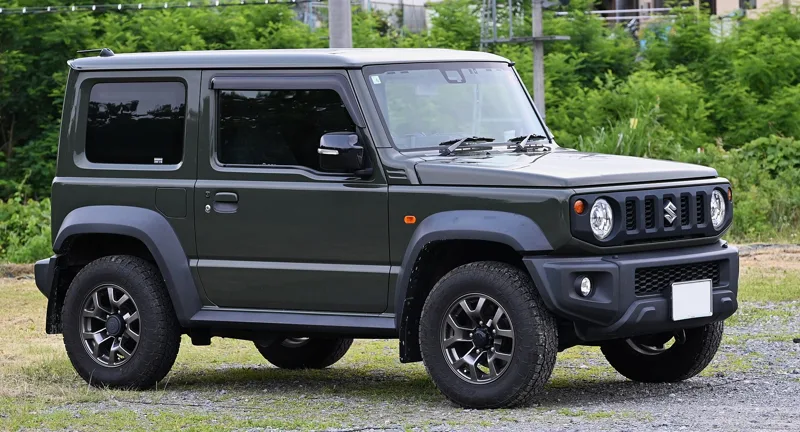
- Jimny (LJ50, 1975): a 4x4 released in Australia with an export-only 550 cc engine.
Suzuki has also shown concept cars to test ideas. The Hayabusa Sport, unveiled at the 2002 Tokyo Auto Salon, used a 1,300 cc four-cylinder engine in an unusually light body. Only one prototype was built, and it never ran on public roads.
Why did Suzuki leave the American and Canadian car markets?
Suzuki's American arm filed for Chapter 11 bankruptcy protection in November 2012. Reasons given included a strong yen, the company's focus on small cars and stringent US safety regulations. It ended operations on 31 March 2013 and sold its assets to Suzuki Motor of America, Inc., a wholly owned subsidiary of the parent company.
The American market had once been significant. The Samurai 4x4 arrived in 1985 for the 1986 model year, and in 1988 Consumers Union claimed it was prone to rolling over. Annual sales in the years that followed dropped to below 20,000 units.
The rollover dispute ran for years. American Suzuki accused Consumers Union of rigging the 1988 test results in 1997, and the lawsuit was settled out of court in 2004, after eight years.
In 2006 American Suzuki sold more than 100,000 vehicles, the first year it had done so. US sales peaked in 2007 and fell to a quarter of that level by 2011, and American Suzuki sold only 21,188 automobiles in ten months of 2012.
Canada followed the same path. Suzuki Canada began automotive sales in 1980 with the four-wheel-drive LJ80, and in 2013 it announced it would stop selling cars after the 2014 model year. It continues to sell motorcycles, ATVs and outboard motors, and to service vehicles through its dealers.
Who has held stakes in Suzuki?
General Motors, Volkswagen and Toyota have all held or agreed stakes in Suzuki. GM's holding ran from 1981 until 2008, Volkswagen completed a 19.9% stake in January 2010 before arbitration ordered it sold back, and Toyota agreed a 4.9% stake in 2019.
General Motors and Isuzu announced cooperation on mini-cars in 1981, and GM bought a 5.3% stake that year. GM's share rose to 10% in 1998 and reached 20% in 2000, before GM sold down to 3% in 2006 and divested its remaining 3% in 2008.
The Volkswagen partnership was announced in 2009, when the group planned to buy a 20% stake. It completed its purchase of 19.9% in January 2010. Suzuki later accused Volkswagen of not sharing promised technology, and an international arbitration court ordered the stake sold back. Suzuki paid $3.8bn to complete the buy-back in September 2015.
Toyota's entry came in August 2019, when it agreed a 4.9% holding in Suzuki, and Suzuki in turn took a 0.2% holding in Toyota.
Who has led Suzuki?
Michio Suzuki founded the company, and Osamu Suzuki, the fourth adopted son-in-law in a row to run it, became president in 1978. He built the company into its present form, retired as chairman in June 2021 and died in December 2024.
Toshihiro Suzuki has led the company since 2015. Earlier, Rick Suzuki, a grandson of Michio, became president of American Suzuki in 1998 and stepped down as its chairman in 2008.
What are the key Suzuki figures?
Suzuki employs over 45,000 people across 35 production facilities in 23 countries, and it sells through 133 distributors in 192 countries. It ranked eleventh among automakers by production in 2016. The table below sets out the core figures for the company, its earliest milestones and its most recent footprint.
| Figure | Detail |
|---|---|
| Founded | 1909 as Suzuki Loom Works, Hamamatsu |
| Headquarters | Hamamatsu, Shizuoka, Japan |
| Employees | Over 45,000 |
| Production facilities | 35 in 23 countries |
| Distributors | 133 in 192 countries |
| Production rank (2016) | Eleventh biggest automaker worldwide |
| First car | Suzulight, 1955, 360 cc two-stroke |
| Automobile division | Formed 1961 |
| Maruti Suzuki stake | 54.2% |
| Worldwide car sales rank | Tenth largest |
| Domestic sales rank | Third largest in Japan |
Domestic demand is significant. Suzuki's domestic automobile sales volume is the third largest in Japan, and its domestic motorcycle sales are also third largest there. Its worldwide car sales volume ranks tenth among the world's largest.
What controversies and recalls affected Suzuki?
Suzuki has faced regulatory and legal challenges in several markets, including a US emissions penalty, a large motorcycle recall and the long-running Samurai rollover dispute. The cases below range from emissions reporting and product safety to disputes over test results in the courts.
The US Environmental Protection Agency fined Suzuki $2,054,924 for falsifying NOx emission levels in its vehicles. The penalty falls in the company's history from 2016 onwards.
In October 2013 Suzuki recalled 210,228 motorcycles in the US because the front brakes might not work properly. In 1988 the National Highway Traffic Safety Administration (NHTSA) rejected demands for a Samurai recall, and in September 2018 Suzuki withdrew from China.
Which sports has Suzuki sponsored?
Suzuki is a major sponsor of luge, biathlon and cross-country skiing events. It has also been the title sponsor of the ASEAN Football Championship, known as the AFF Suzuki Cup, from 2008 to 2020, and has backed clubs in England, Italy and Poland.
The club deals are with Milton Keynes Dons in England, Torino in Italy and Korona Kielce in Poland. Together with its motorsport history, they give the brand a presence in road racing, MotoGP, luge, biathlon and football.
Frequently asked questions
When did Suzuki start making cars?
Suzuki began a small car project in 1937, and the Suzulight of 1955 was the first car it produced. A separate automobile division only arrived in 1961, so the car business grew out of a company better known for looms and motorcycles.
Who owns Maruti Suzuki?
Suzuki Motor Corporation holds 54.2% of Maruti Suzuki. Indian public and financial institutions own the balance, and the shares are listed on Bombay and National Stock Exchanges of India.
Did Suzuki stop selling cars in the United States?
Yes. American Suzuki filed for Chapter 11 in November 2012, stopped selling automobiles and ended operations on 31 March 2013. Suzuki continues to sell motorcycles, ATVs and marine products in the US.
Who is Suzuki's current chief executive?
Toshihiro Suzuki has been chief executive since 2015, succeeding his father Osamu. Osamu retired as chairman in June 2021, handing over to Toshihiro, and died in December 2024.
_hybrid_DSC_7922.jpg)