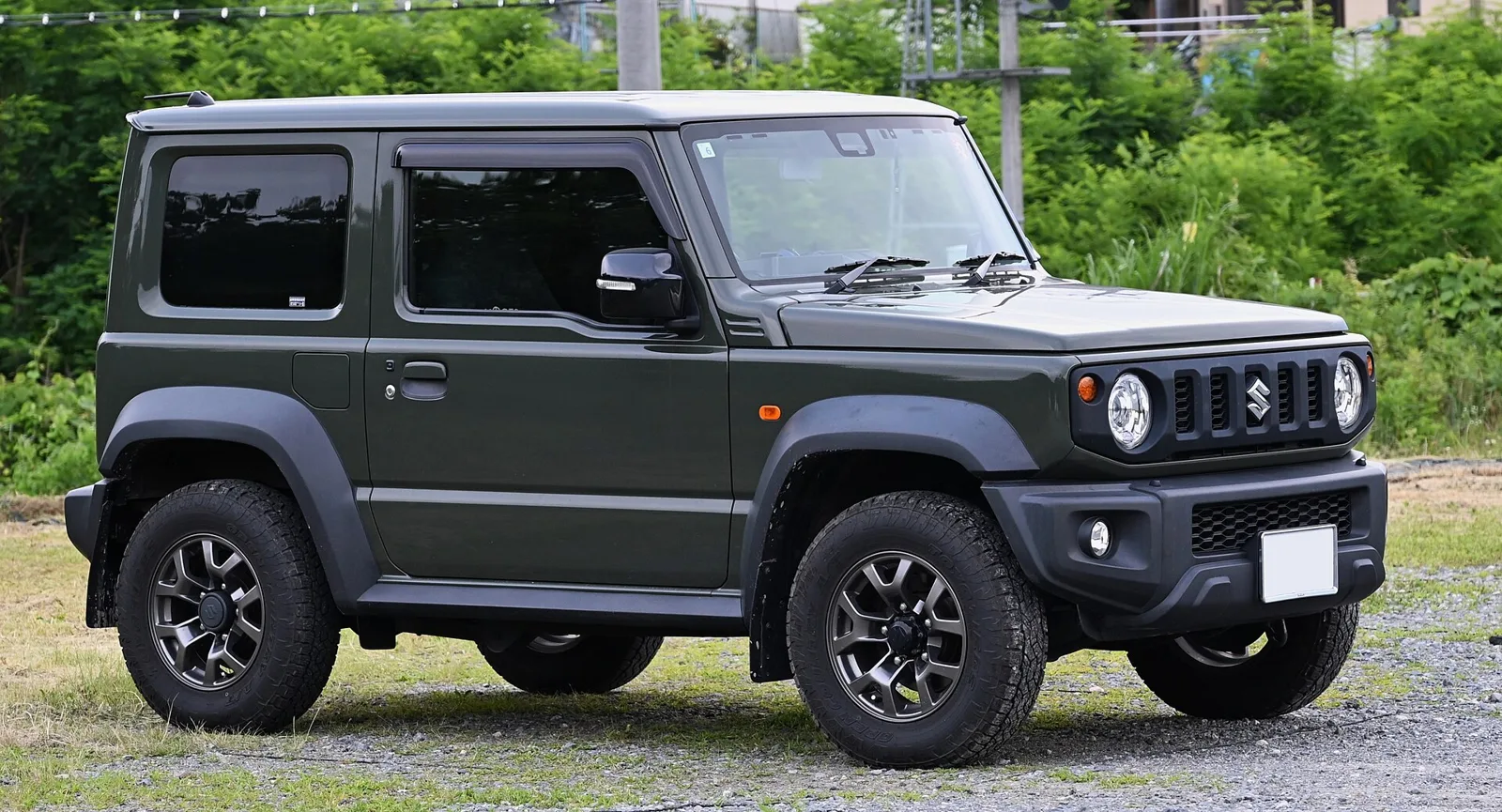
From the 1970 LJ10 to the 2018 fourth generation, the Jimny stayed a four-wheel drive kei-class off-roader with a ladder frame, part-time 4WD and a low range.
The Suzuki Jimny is a four-wheel drive off-road mini SUV that Suzuki has built since 1970, beginning in the kei class. It has used a ladder frame, solid axles and a dual-range transfer case through four generations, with 2.85 million sold by September 2018.
The Suzuki Jimny is a series of four-wheel drive off-road mini SUVs that Suzuki has built since 1970. It began in the kei class, Japan's light automobile category, and the company has since sold 2.85 million units in 194 countries. It has kept a ladder frame, solid axles and a low-range transfer case through four generations.
When did the Suzuki Jimny go on sale?
The first Suzuki-branded four-wheel drive, the LJ10, which stood for Light Jeep 10, arrived in 1970. Its 359 cc air-cooled two-stroke twin was paired with a design that made it the first four-wheel drive kei car put into series production. The LJ10 Jimnys ran 16-inch wheels and weighed 590 kg (1,301 lb).
Its roots go back to the late 1960s. Suzuki bought a Steyr-Puch Haflinger to study the kei off-roader idea, and in 1968 it acquired the bankrupt Hope Motor Company. Hope had built a small off-road vehicle called the HopeStar ON360, but only about 45 were made.
A kei-class four-wheel drive that began in 1970, sold 2.85 million units and still uses a ladder frame, solid axles and a low range.
What was the HopeStar ON360?
The HopeStar ON360 was developed by Hope Motor Company and available from April 1968. It used a Mitsubishi 359 cc air-cooled two-stroke engine producing 21 PS (15.4 kW; 20.7 bhp), and it was a very basic two-seater with no doors. A sturdy four-wheel drive system still let it go off-road.
Hope sold very few of them, just 15 in the domestic market and another 30 exported to Southeast Asia. Mitsubishi declined to take over production, so Hope sold the design to Suzuki in 1968. Suzuki then rebodied the car and replaced the Mitsubishi engine with its own 359 cc unit.
Why was the LJ10 classed as a kei car?
Suzuki kept the new engine under 360 cc and placed the spare tyre inside the truck, which made it a three-seater. That kept its length under 3 m, so it qualified as a kei car. The kei class conferred certain tax privileges and other benefits.
Demand was immediate. The original Jimny sold nearly 5,000 units in its home market in the first year, outselling the Mitsubishi Jeep that had led the off-road market. Over 6,000 were sold in 1971, and Suzuki soon moved production into a dedicated assembly line.
How did the LJ series develop?
The LJ was updated in May 1972 and renamed the LJ20. Its engine became the water-cooled L50, which produced 28 PS (21 kW) and let the car reach 80 km/h (50 mph). With production in house, Suzuki could build 2,000 cars a month.
In 1975 Suzuki introduced the LJ50, which had a larger 539 cc three-cylinder two-stroke engine and bigger differentials. It was first aimed at Australia, but exports soon followed. The four-stroke LJ80 with an 800 cc engine ended the original series.
Specifications at a glance
The table below sets out figures for the early models through to the fourth generation. Each row names the model it covers, so the kei cars are not mixed up with the later 1.3-litre and 1.5-litre cars.
| Specification | Detail |
|---|---|
| LJ10 (1970) engine | 359 cc air-cooled two-stroke, 25 PS (18 kW) |
| LJ10 weight | 590 kg (1,301 lb); top speed 75 km/h (47 mph) |
| LJ20 (1972) engine | Water-cooled L50, 28 PS (21 kW); 80 km/h (50 mph) |
| LJ50 (1975) engine | 539 cc three-cylinder two-stroke, 33 PS (24 kW) for export |
| SJ20 (1977) engine | 797 cc four-stroke F8A, 41 PS (30 kW); 770 kg (1,698 lb) |
| Jimny 1300 (SJ413) | G13A 1.3 litre; five-speed manual; disc brakes at the front |
| Samurai (US, 1986) | 1.3-litre, 63 hp (47 kW; 64 PS); priced at $6,200 |
| Third generation (1998) | 1.3 litre, 80 PS (59 kW) G13BB; part-time 4WD |
| Fourth generation (2018) base | 658 cc R06A turbo three-cylinder, Japanese kei version |
| Fourth generation Sierra | K15B 1.5 litre, 75 kW (102 PS); 138 N m (102 lb ft) |
| Total sales | 2.85 million through September 2018 |
How did the second generation differ from the original?
The second generation, the Jimny 1000 and SJ410, arrived in Japan in August 1982 to replace the older LJ80 range. Export markets had the SJ410 from the summer of 1981, and it used the F10A four-cylinder engine producing 45 PS (33 kW; 44 hp) on the export spec.
The Jimny 550 kei car, meanwhile, was the last two-stroke automobile built in Japan by a sizable margin. Its LJ50 engine stayed in place until the four-stroke JA71 arrived in January 1986, with a turbocharged 543 cc three-cylinder.
What did the 1990s kei Jimnys bring?
The JA11 replaced the JA71 in March 1990 under new kei category rules, with a 657 cc engine that initially made 55 PS (40 kW; 54 hp). Power rose to 58 PS (43 kW; 57 hp) in June 1991, and a year later power steering and a three-speed automatic became available for the first time.
In November 1995 the update called the Coily arrived with coil springs, though both axles stayed live. The JA12 kept the 657 cc F6A engine, while the JA22 received the more powerful DOHC K6A. Both were limited to 64 PS (47 kW; 63 hp) to stay within kei rules.
How did the Samurai sell in North America?
The SJ413 reached the United States in 1985 for the 1986 model year as the Samurai, with a wider track already fitted. The SJ410 had already been sold in Canada and Puerto Rico before that. The US car was priced at $6,200 and 47,000 were sold in its first year.
The Samurai became intensely popular with serious four-wheel drivers. It had a transfer case, switchable 4WD and low range, and it outsold the Jeep Wrangler (YJ) by two to one in 1987. Its lightness made it a nimble off-roader that sank less easily into soft ground than heavier vehicles.
Why did the Samurai face a lawsuit?
Consumer Reports ran a critical piece in 1988, arguing that the Samurai was unsafe and prone to rollovers. In 1996 Suzuki of North America sued the magazine's publisher, Consumers Union, for libel. The suit ended in an inconclusive settlement, and the two sides issued statements that disagreed over the validity of the tests.
The 1988.5 Samurai had been retuned for on-road use, with softer suspension and a larger anti-roll bar. Even so, low sales and stricter safety rules led to the withdrawal of the Samurai from Canada and the United States after 1995.
Where else was the Jimny built?
Santana Motor in Spain built SJs from March 1985, a version that was sold as a domestic vehicle in Europe because its native parts content exceeded 60 per cent. Santana also exported a version to Taiwan as the Santana 1000.
In Indonesia the SJ410 was assembled by Suzuki Indomobil from late 1982 until 2006, with a 2WD version sold as the Katana from September 1986. In India the SJ410 and SJ413 were built as the Maruti Gypsy until late 2018, and the last Indian version was the Samurai-based Gypsy King with an 80 PS (59 kW; 79 hp) sixteen-valve engine.
Did a Jimny set a height record?
Yes. On 21 April 2007 the Chilean pair Gonzalo Bravo and Eduardo Canales drove a modified Samurai up Ojos del Salado to 6,688 m (21,942 ft), beating the 6,646 m (21,804 ft) set by a Jeep. The car had wheel, tyre and suspension changes and a supercharged G16A four-cylinder engine. It was the team's third attempt, after bad weather on the first and an engine fire on the second.
Guinness World Records certified the result in July 2007. Matthias Jeschke reclaimed the altitude record for four-wheeled vehicles on 13 December 2019, in a Mercedes-Benz Unimog.
What was the third generation like?
Suzuki revealed the third-generation Jimny at the 1997 Tokyo Motor Show. It kept the ladder chassis and a dual-ratio transfer case, unlike many compact 4WDs that lacked a low range. Its European introduction came at the Paris show in 1998, and the car replaced the Sierra and Samurai in most markets.
The third generation was sold with three dashboard buttons for 2WD, 4WD and 4WD-L. The default was two-wheel drive, while 4WD engaged the front wheels in high gear. Since there was no centre differential, the system worked well only on loose surfaces, and 2WD suited dry pavement.
Vacuum-locking hubs allowed shifts from 2WD to 4WD at up to 100 km/h (62 mph). Newer cars had electronic push-button selection, which needed the vehicle to be stopped with the clutch down and the transmission in neutral to select low range.
What is the fourth-generation Jimny?
Suzuki launched the fourth generation in Japan on 5 July 2018, with styling that recalled the earlier LJ and SJ models. Production began in Japan on 29 May 2018 at Suzuki's Kosai plant. For the first time the power output could exceed 100 PS (74 kW).
The body-on-chassis design keeps a ladder frame, a three-link rigid axle with coil springs and part-time four-wheel drive with low range, marketed as ALLGRIP PRO. Its approach angle is 37 degrees, and its departure angle is 49 degrees. Suzuki Safety Support includes Dual Sensor Brake Support, which can apply automatic braking.
A long-wheelbase five-door version, based on the Sierra, arrived in January 2023 with the larger 1.5-litre K15B engine. The five-door adds 34 cm (13.4 in) of wheelbase over the standard car.
Where is the Jimny sold today?
The Jimny has been launched across Asia, Oceania, Latin America and the Middle East. Indonesia took the three-door in July 2019 and the five-door in February 2024, while Thailand launched in March 2019 and Malaysia in September 2021. Mexico followed in November 2020 with a sole GLX trim, and the 2021 model year sold out in three days after the first 1,000 reserved units.
In Europe the Jimny was discontinued in 2020 over its carbon dioxide emissions, then returned in mid-2021 as a commercial vehicle with the rear seats removed. Australia launched the three-door in January 2019 and the five-door as the Jimny XL in December 2023.
Is an electric Jimny planned?
An electric version was confirmed and scheduled to arrive around 2030. The company president later seemed to rule out an electric version, saying it would ruin the best part of four-wheel driving.
Frequently asked questions
Was the Jimny always a kei car?
Suzuki still sells a kei-compliant version as the Jimny. Other versions exceed the kei limits, and the five-door and export cars are larger.
How many Jimnys have been sold?
Suzuki has sold 2.85 million units of the Jimny in 194 countries through September 2018. The Samurai alone sold 47,000 cars in the United States in its first year.
Does the Jimny have a centre differential?
No. Jimnys have no centre differential, so 4WD should be used only on slippery surfaces such as snow, ice, mud, loose gravel and sand. Wet asphalt and hard-packed gravel do not count as slippery enough.
When was the Samurai withdrawn from the US?
The Samurai left the Canadian and US markets after 1995, and the Sidekick had replaced it in 1995.