Honda's one-box small car has sold almost 5 million units since 2001, with a Magic Seat, hybrid variants and a fourth generation that went hybrid-only in Europe.
Sold as the Jazz in most markets, the Honda Fit has been a five-door small hatchback since its 2001 debut. Four generations later it is best known for the Magic Seat, its hybrid versions and sales that passed almost 5 million by mid-2013.
The Honda Fit, sold as the Jazz in most markets, is a small five-door hatchback that Honda has built since 2001 across four generations. Its forward-placed fuel tank and folding Magic Seat gave it unusually roomy interior space for its size. Sales had reached almost 5 million by mid-2013, and the fourth generation went hybrid-only in Europe.
Why is it the Fit in some markets and the Jazz in others?
Honda used the Jazz name in most markets and Fit in Japan and the Americas. The name Fitta had been planned for the Japanese launch, but it was dropped because the word is slang in Scandinavian languages. The change left one car with two names across regions.
Whatever the label, the car was built on the same global small car approach, so buyers in different markets were getting essentially the same vehicle. The shared design also made it easier for Honda to move engines, trims and safety kit between regions.
Naming was only part of the picture. Honda's choice to keep one body and one layout across most of the world was a deliberate way to build scale, and it explains why the Fit looks so similar in Tokyo, London and Mexico City.
A one-box hatchback with a folding Magic Seat became one of Honda's biggest small-car successes across four generations.
What was the first generation like?
Japan saw the first Fit in June 2001, Europe followed in early 2002 and Australia in late 2002. It sat on Honda's Global Small Car platform, which also underpinned the City, Airwave, Mobilio and Freed family, and it came with a range of L-series petrol engines.
Japanese sales beat the original monthly target of 8,000 units on debut, and the car sold 250,790 units in Japan during 2002. The car became a headline success in its home market almost at once, and the strong start set the tone for everything that followed.
A North American production model arrived in January 2006, when Honda debuted it at the Detroit show. Its arrival there followed years of strong growth in Japan and Europe, and it gave the Fit a second big market to conquer.
How did the second generation build on the first?
The second generation made its debut at the 40th Tokyo Motor Show in October 2007. It won Japan's Car of the Year prize for a second time, and its 1.2-litre i-VTEC produced 74 kW (99 hp; 100 PS) at 6,000 rpm.
At 6,600 rpm the 1.5-litre i-VTEC produced 120 PS (118 hp; 88 kW), giving buyers a stronger option. Honda also showed an electric concept on the same platform, and the Fit EV was built in limited numbers from 2013 to 2015.
A hybrid arrived in Japan in October 2010 with a 1.3-litre engine and an electric motor. Its estimated economy was 3.3 litres per 100 kilometres (86 mpg-imp; 71 mpg-US) on the Japanese test cycle, and a Fit Shuttle wagon was sold only in Japan.
What made the third generation different?
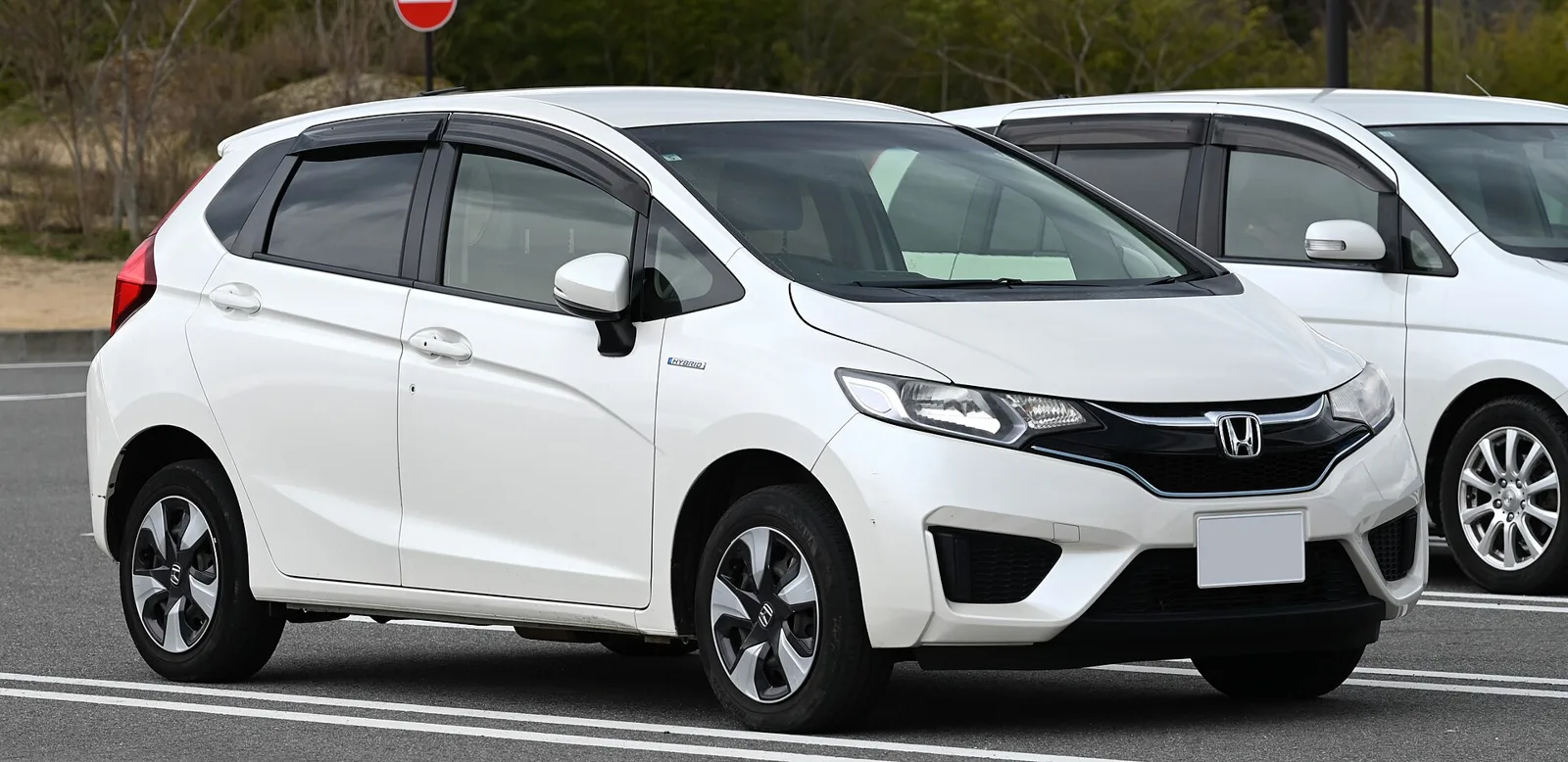
Japan received the third generation on 5 September 2013. The car kept the centre-located fuel tank and Magic Seat, and 780 MPa high-strength steel went into 27 percent of the structure, while rear legroom grew by 12.2 cm (4.8 in).
Overall length fell by 4 cm (1.6 in) while the wheelbase grew by 3 cm (1.2 in). The cabin gained 136 L (4.8 cu ft) of passenger volume, and a more compact rear suspension freed up interior and boot space.
The Japanese hybrid relied on Honda's i-DCD setup. Its 1.5-litre Atkinson-cycle petrol engine, producing 130 hp (132 PS; 97 kW), worked alongside a 30 hp (22 kW) motor. On the Japanese cycle its rating worked out to 86 mpg-US, or 36.4 km/L, a 35 percent gain over its predecessor that came with a 470-litre boot.
What are the key Honda Fit specifications?
The table lists the headline figures for each generation so the changes are easy to follow. Each row names the generation or market it describes, which keeps the Japanese, European and Chinese figures apart. Where a number belongs to one engine or market, the table says so.
| Specification | Detail |
|---|---|
| First generation debut | June 2001, Japan |
| Second generation debut | 17 October 2007, 40th Tokyo Motor Show |
| Gen two 1.2 i-VTEC | 99 hp (100 PS; 74 kW) at 6,000 rpm |
| Gen two 1.5 i-VTEC | 118 hp (120 PS; 88 kW) at 6,600 rpm |
| Gen three hybrid engine | 1.5-litre Atkinson cycle, 130 hp (132 PS; 97 kW) |
| Gen three hybrid motor | 22 kW (30 PS; 30 hp) |
| Gen three boot (hybrid) | 470 litres |
| Gen four e:HEV system | 108 hp (109 PS; 80 kW), 253 Nm |
| Gen four Europe economy | 62.8 mpg-imp on WLTP; 102 g/km CO2 (base model) |
| China Fit length | 4,110 mm (161.8 in) |
How did the fourth generation change the formula?
The fourth generation was unveiled on 23 October 2019 at the Tokyo Motor Show and went on sale in Japan on 13 February 2020. Its hybrid, marketed as e:HEV, uses a dual-motor i-MMD system in place of the earlier i-DCD setup, with a 1.5-litre petrol engine driving a motor that can spin to 13,300 rpm.
The hybrid-only Jazz reached Europe in June 2020. It was rated at 62.8 mpg-imp on the WLTP cycle, with CO2 output of 102 g/km in the base form. Honda was phasing out conventional engines across the region, which left the hybrid as the sole option.
China gets its own version. The GAC Honda-built Fit launched on 10 June 2020 at 4,110 mm (161.8 in) long, and a facelift arrived on 16 January 2026 limited to 3,000 units.
How many Fits and Jazzes have been sold?
Global cumulative sales passed 1 million in December 2004 and 2 million by June 2007, a pace that made the Fit one of Honda's most successful small cars. Worldwide sales reached 3 million in July 2009 and 3.5 million by July 2010, with Japan the largest market at 962,000 units.
Europe followed with 417,000 units, and the United States accounted for 77,000 cars after its 2006 introduction. Honda built the car at ten plants in eight countries, and sales reached almost 5 million by mid-2013.
Japanese sales of the first generation passed 500,000 by September 2003, and the second generation became the top-selling car in Japan from November 2007. That sustained demand is why the model kept a place in Honda's line-up across so many markets.
Did the Fit win awards and race?
Yes. It won Japan's Car of the Year for 2001-02 and 2007-08, and Top Gear's 2006 survey named it the best small car. Car and Driver placed it on its 10 Best lists for 2007 to 2013, and Consumer Reports awarded it best overall value in 2010.
The model's motorsport presence was modest but steady. It was eligible for SCCA World Challenge's touring car B-spec class from the 2012 season, Fit engines powered the SCCA F1600 Championship Series, and the car raced in Japan's Super Taikyu Series.
What did the Magic Seat actually do?
The Magic Seat is the Fit's signature feature. Its rear seats fold and tumble in several ways, so the cabin can carry tall items or a flat load area that a conventional hatchback would struggle to swallow. Honda kept the fuel tank forward to free up that space.
Each arrangement changes the shape of the boot, so owners could choose between passengers, bulky shopping or long items. The approach suited people who used a small car for many jobs, from school runs to weekend trips with awkward loads.
The seat system carried through all four generations, although each new model reworked the details. Keeping the feature alive was a clear sign that Honda treated versatility as the core of the car's identity rather than an optional extra.
How did the Fit's hybrid systems evolve?
The third-generation Fit used the i-DCD system, which paired a 1.5-litre Atkinson-cycle engine with a motor and a dual-clutch gearbox. The fourth generation switched to the e:HEV, a dual-motor layout with a single fixed gear ratio and a lock-up clutch.
In electric mode the third-generation hybrid could drive on its motor alone, matching the Toyota Prius in that respect. The same system also served the first-generation Vezel and Grace Hybrid, which spread the development cost.
The e:HEV motor spins up to 13,300 rpm and handles low-speed acceleration, while the single gear ratio keeps the drivetrain simple. Honda said the arrangement was more compact and refined than the planetary eCVT used in many rival hybrids.
Which trims and grades were offered?
Trim levels changed with each market. The third-generation car came in LX, EX, EX-L and EX-L with Navigation in North America, while Japan sold 13G, 15X and RS grades. A Sport trim was added in the 2018 facelift for North America.
Equipment rose with the trim. Leather seating first appeared on North American Fits in the EX-L, every trim had a multi-angle rear-view camera, and higher grades added dynamic guidelines. Honda's LaneWatch passenger-side camera was an optional extra.
That spread of trims let one body serve budget buyers and families who wanted leather and navigation, and it showed how far the basic car could stretch.
How did the Fit's safety and equipment develop?
The Fit's equipment list grew over its life, and buyers could tick several options that made each car unique. North American cars carried a multi-angle rear-view camera from the outset, and the third generation offered a driver assistance package that included lane departure warning among its features.
Crash testing was part of the story as well. The third-generation North American car was assessed with its vehicle structure rated Acceptable, and the strength-to-weight figure of 6.13 showed how much effort went into a light but protective body.
Those changes reflected a broader shift, as small cars were asked to carry the same safety kit as larger models while keeping their running costs low.
What did owners say about the Fit day to day?
Owners praised the Fit for its space, easy driving manners and fuel economy, particularly in the hybrid versions. Its tall cabin and clever seats made it practical for shopping, family life and longer trips alike. Many owners also mentioned the easy parking that a compact footprint allows.
Reviewers repeatedly highlighted how much usable space the Fit packed into a small footprint. The Magic Seat and the forward fuel tank were the two features most often cited when people explained why they chose the car.
Over time the Fit earned a reputation as a sensible, honest small car rather than a flashy one, which helped it hold a steady place in the market for years. Its consistent sales across four generations reflected that reputation.
Frequently asked questions
How many Honda Fits have been sold?
Sales reached almost 5 million by mid-2013. Global sales passed 3.5 million by July 2010, and Japan was the largest market with 962,000 units.
How much boot space does the hybrid have?
The hybrid's boot holds 470 litres. Passenger volume rose by 136 L (4.8 cu ft) on the previous generation.
Was there an electric Fit?
Yes. Honda built a small run of EV versions of the second-generation car between 2013 and 2015.
Did the fourth generation reach North America?
No. Honda dropped the Fit in North America because of falling sales, and the earlier generation's Mexican Final Edition launched on 1 December 2020.