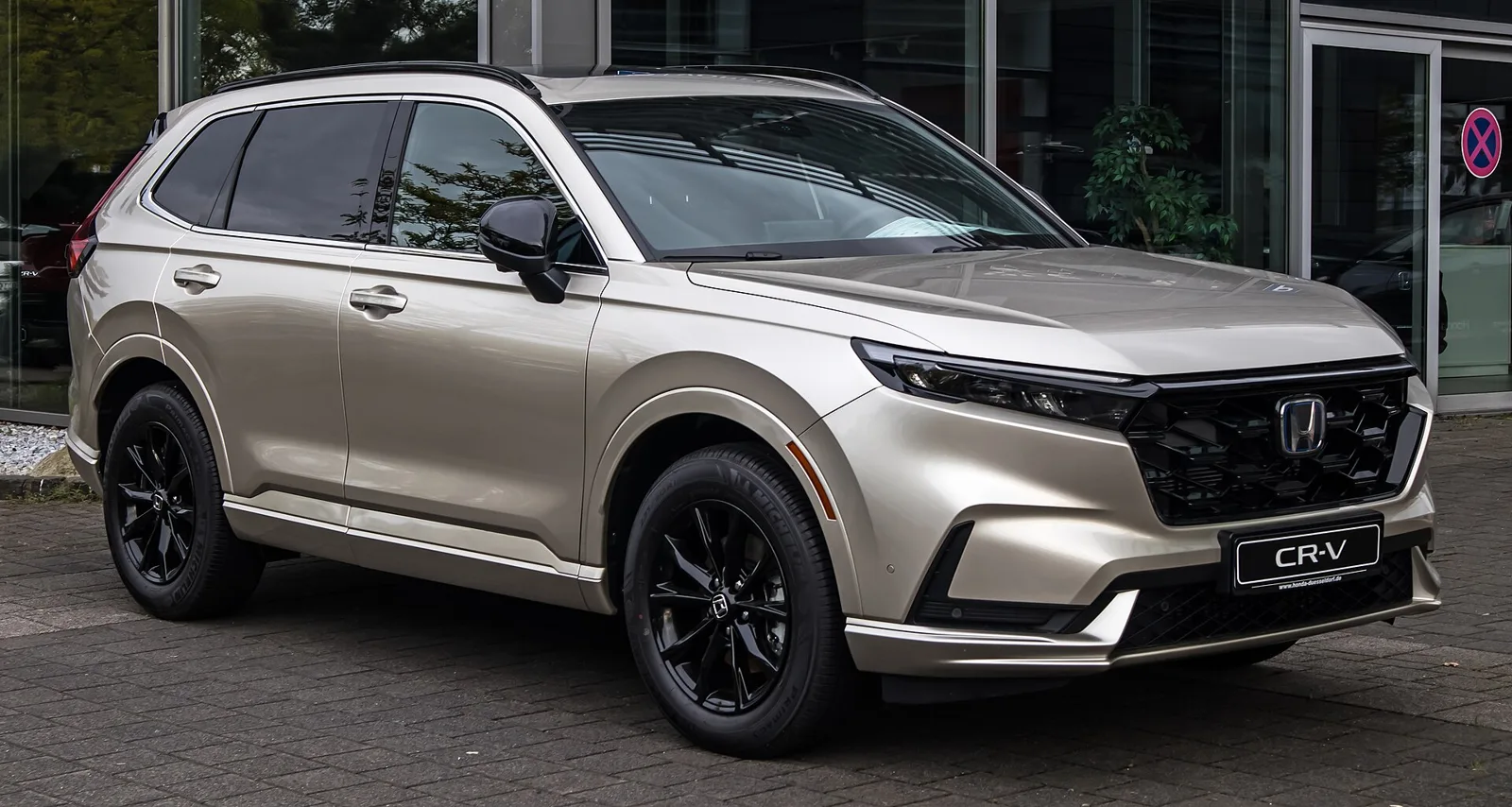
Three decades of Civic-derived crossovers, from the RD1 that Honda designed in-house to the sixth generation that now leads US sales.
Launched in Japan in October 1995, the CR-V is a Civic-based crossover that Honda built as its first in-house SUV. It later became a global model with production in several countries, and by the first half of 2026 it had become the best-selling vehicle in the US.
The Honda CR-V is a compact crossover that Honda has built since 1995, positioned between the smaller ZR-V and the larger Passport and Pilot in North America. Honda says the name stands for Comfortable Runabout Vehicle, and the model moved to the top of US sales in the first half of 2026.
Where did the CR-V come from?
Hiroyuki Kawase led the first CR-V, code RD1, the first sport utility vehicle Honda had designed internally. It shared its platform with the Civic and went on sale in Japan in October 1995, sold only through Honda Verno and Honda Primo dealerships.
Japanese rules set a width limit of 1,700 mm (66.9 in), and the new model went past it, which put it into a more expensive annual road tax band. Honda showed the car at the 1996 Chicago Auto Show, and North American sales began in February 1997.
The original line-up was a single trim, which later became known as the LX. The EX added anti-lock brakes and 15-inch alloy wheels, and buyers could choose front-wheel drive or Honda's Real Time all-wheel drive.
A Civic-based crossover from 1995 that is now the top seller on the US market.
What was under the first CR-V's bonnet?
The original car used a 2.0-litre B20B inline-four with an 84 mm bore, larger than the 81 mm bore of the Integra's 1.8-litre engine. Its one-piece cylinder sleeve was unique within the B-series, and the chassis combined double wishbones at the front with a trailing-arm multilink at the rear.
The rear seats folded flat to meet the front seats and form a bed-sized space, and a picnic table was stowed in the floor. Plastic cladding covered the bumpers and wheel arches, and in North America the grille was black plastic to match.
How well did the first generation sell?
Through 2001 the model outsold every other vehicle in its class in North America, although the Ford Escape and its Mazda Tribute sibling overtook it that year. In Australia it claimed the top SUV sales spot in 2000, ahead of the Land Cruiser for the first time.
Australian sales of the first generation passed 40,000 units between 1997 and 2001. The Sport specification added ABS, cruise control, a sunroof, 15-inch alloy wheels and front fog lights above the base car.
What did the 2000 facelift add?
The B20Z engine lifted output to 147 hp (110 kW) at 6,200 rpm, and torque to 133 lb ft (180 N m) at 4,500 rpm. A higher compression ratio of 9.6:1, up from 8.8:1, and a new intake manifold delivered a 16 percent gain in power.
Fuel economy and pricing stayed unchanged despite the extra power, and the five-speed manual four-wheel-drive car reached 60 mph in 8.6 seconds. The update also brought a new front bumper, a smoother rear bumper and a smaller roof antenna.
How did the second generation build on the Civic?
Honda launched the second generation on 13 November 2001, rebuilding the car on the seventh-generation Civic. It used the K24A1 engine, or the K20A4 in Southeast Asia, and its chassis added torsional and bending rigidity along with a rear reactive-link double wishbone layout.
Southeast Asian models produced 150 hp (112 kW) and 190 N m (140 lbf ft). The North American K24A1 was first rated at 160 hp (119 kW), with torque of 219 N m (162 lbf ft), before newer SAE rules gave it 156 hp (116 kW), with 160 lb ft (217 N m) of torque.
The cargo area grew to 72 cu ft (2,000 L), and Car and Driver named the car its Best Small SUV for 2002 and 2003. The Honda FR-V, a related model, was also based on the second generation.
Where were seven and ten-seat versions sold?
Indonesia received a locally assembled CR-V in 1999, reconfigured with face-to-face third-row seating to make it a seven-seater. The Philippines went further with a ten-seat layout that qualified for a tax exemption as a mass transport van. Both changes reflected local tax rules and show how one platform was adapted for different markets.
In the Philippines the second generation seated three in front, four in the second row and three in the third row. It was produced locally at Santa Rosa, Laguna, with 63 percent local content, and Honda sold 20,886 units in a four-year run.
Five- and eight-seat versions were also offered there, which let the car compete with Asian utility vehicles. In Indonesia the rear foglamp was reconfigured as a fourth and fifth brake light.
How did the third and fourth generations differ?
The third generation reached the US market in late September 2006 for the 2007 model year. It kept parts of the earlier structure but gained a rear liftgate in place of the side-opening door, and North American cars used a K-series 2.4 L inline-four.
In North America the engine produced 166 hp (124 kW) at 5,800 rpm, with peak torque of 161 lb ft (218 N m) at 4,200 rpm. European cars used a 2.0 L R20A borrowed from the Civic, while diesel versions used a 2.2 L i-CTDI in Europe and Asia.
The fourth generation was previewed at the Orange County show in September 2011, and the production car debuted at the Los Angeles show that year. Its US launch followed on 15 December 2011, with a 2.4-litre i-VTEC inline-four making 185 hp.
A Real-Time all-wheel-drive system with intelligent control was paired with the engine, and every North American car came with a five-speed automatic transmission.
What did the 2015 refresh bring?
The facelifted 2015 model year went on sale in October 2014, and it combined direct-injected Earth Dreams engines with a continuously variable transmission. Fuel economy improved by +4/+3/+3 mpg for city, highway and combined driving, and the change was a mid-cycle refresh rather than a new generation.
Honda reworked the structure to improve crash performance in the small offset test, and it revised the dampers, springs, stabiliser bars and lower control arms. A 15.6:1 steering ratio and a larger brake booster gave the car a sportier feel.
How did the fifth generation arrive?
The fifth generation was unveiled in Detroit on 13 October 2016, and North American sales opened on 21 December 2016 for the 2017 model year. It used the Honda compact global platform first introduced on the tenth-generation Civic, and it was offered with a seven-seat option in markets outside North America.
Production began at East Liberty, Ohio, in November 2016 and at Greensburg, Indiana, in February 2017, so North American output came from two plants.
The 2020 model year refresh was unveiled in September 2019 and brought advanced safety features onto every trim level. Adaptive cruise control came standard even on the cheapest version, and the refreshed model offered a hybrid powertrain as an option in North America for the first time.
Why is the Breeze badge used in China?
In October 2019 Guangqi Honda began marketing the fifth-generation model in China as the Breeze, with styling different from the international car built by Dongfeng Honda. The two versions sold side by side, so Honda's Chinese partners offered two looks for one generation.
GAC Honda continued the Breeze name in December 2022 for the sixth generation, giving it different front and rear fascias. The plant building the sixth generation for Dongfeng Honda also supplied European models from June 2023.
What is the sixth-generation CR-V?
The sixth generation was unveiled on 12 July 2022 in Los Angeles, and US sales started in September 2022 as a 2023 model. It rides on the Honda Architecture platform that underpins the eleventh-generation Civic, with five- or seven-seat layouts depending on the market.
European sales began in June 2023, several months after the US launch, which shows how the car was rolled out market by market. The same generation carries the CR-V name in North America and Europe and the Breeze name in China.
How did the CR-V reach the top of US sales?
The CR-V overtook the Ford F-Series pickup and the Toyota RAV4 during the first half of 2026, taking the top spot among all US vehicles. Its earlier record includes second place among SUVs worldwide in 2020, and the car has been refined across six generations.
The CR-V shares its platform with the smaller ZR-V, and the Breeze shows that one body design can carry different names in different markets.
How did safety ratings evolve?
The first generation was tested by the Insurance Institute for Highway Safety, which gave its overall result a marginal rating, mainly because the dummy's left leg would have been broken in the test. Later models did better, and by 2005 North American CR-Vs had anti-lock brakes, traction control and Vehicle Stability Assist as standard.
Automatic models gained an override that held the first three gears for passing and climbing, with hill assist when the car was stationary. The 2005 model year also brought a drive-by-wire throttle to every CR-V and changed the all-wheel-drive engagement threshold for quicker response.
In Australia the 2005 facelift went on sale in late 2004. Base cars kept dual airbags and ABS, while the Sport gained side airbags for the first time, and curtain airbags did not arrive on any Australian model until the next generation.
What special editions did Australia receive?
Australia received several special editions from 2003, starting with the Winter Classic and Sport Winter Classic. Later versions included an SE with rear parking sensors and 16-inch alloy wheels, and an Extra model in 2006 with 16-inch wheels and side airbags.
The Winter Classic came with alloy wheels, side steps and a tow bar. The Sport Winter Classic dropped the tow bar and instead carried roof racks, a nudge bar and foglights. The SE was sold between October and November 2005.
Where is the CR-V built?
Production first ran in Japan and Britain, serving customers around the world. North American assembly followed, starting in the US and Mexico in 2007 and extending to Canada in 2012. Dongfeng Honda builds it in Wuhan for China, while Guangqi Honda makes the Breeze version in Guangzhou.
East Liberty, Ohio, and Greensburg, Indiana, built the fifth generation from late 2016 and early 2017, adding to Honda's North American output in the years that followed.
How do the generations compare?
The table lists the launch point of each generation and the engine or platform that defined it. Figures are North American ratings where they apply, so some values differ from the Japanese and Southeast Asian numbers given earlier in the article.
| Generation | Launch | Engine or platform |
|---|---|---|
| First (RD1) | October 1995 (Japan) | 2.0 L B20B, later B20Z at 147 hp (110 kW) |
| Second | 13 November 2001 | K24A1 inline-four, 156 hp (116 kW) US rating |
| Third | Late September 2006 (US) | 2.4 L K-series, 166 hp (124 kW) |
| Fourth | 15 December 2011 (US) | 2.4 L i-VTEC, 185 hp, Real-Time AWD |
| Fifth | 21 December 2016 (US) | Honda compact global platform from the tenth-generation Civic |
| Sixth | September 2022 (US) | Honda Architecture platform from the eleventh-generation Civic |
_%E2%80%93_f_05052024.jpg)