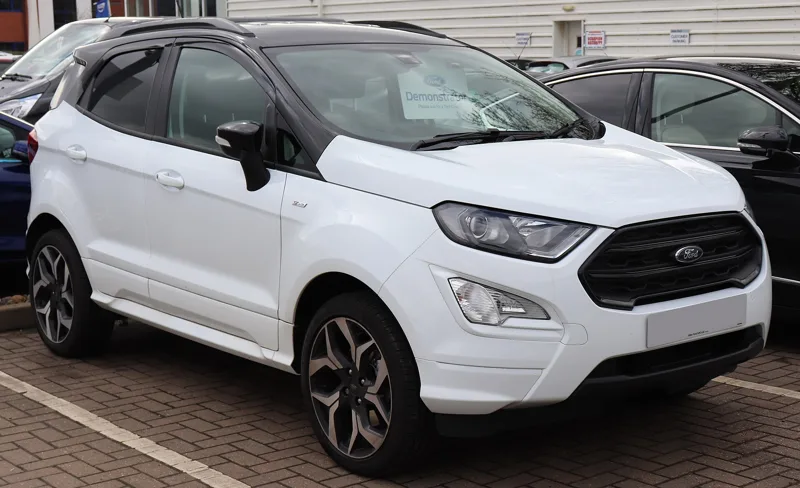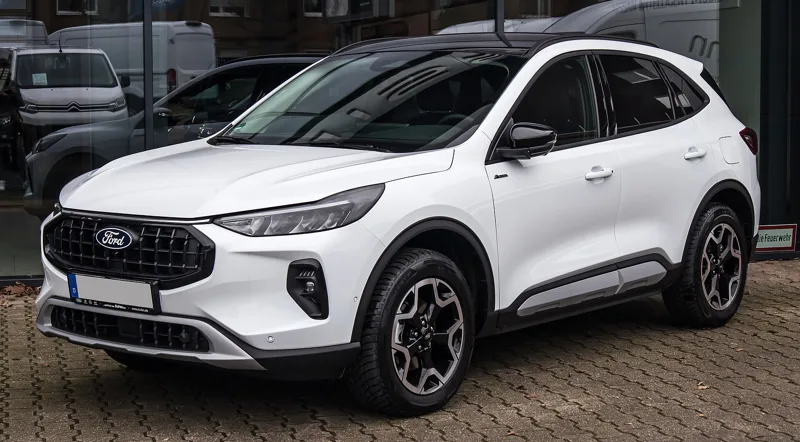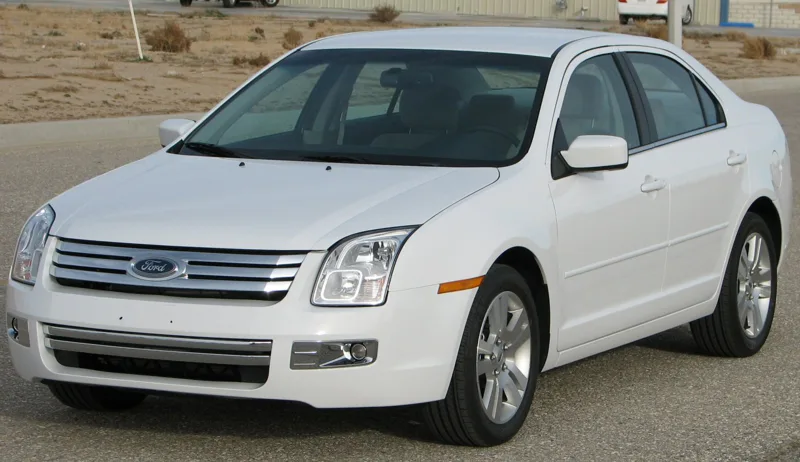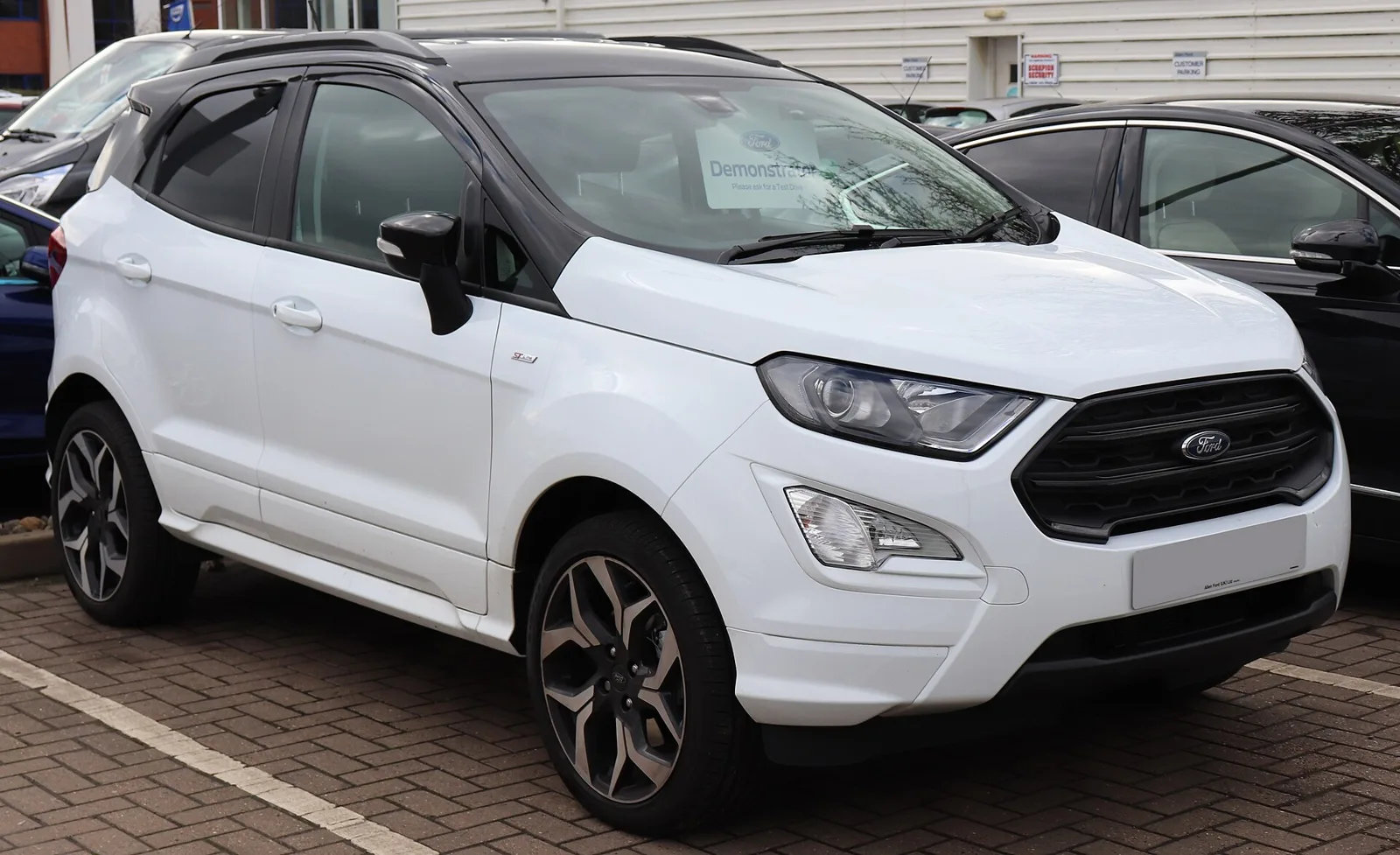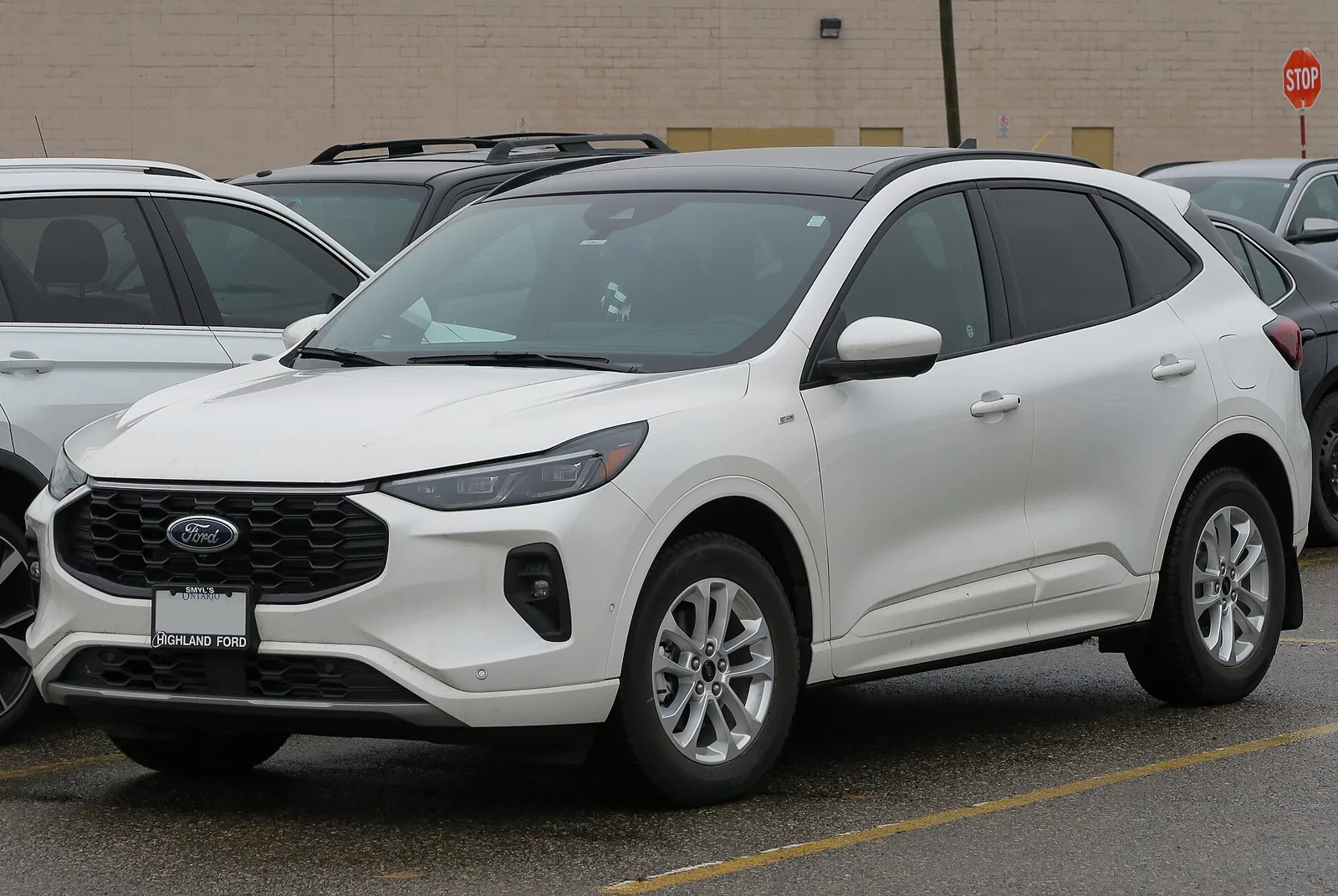
Ford's first SUV built on a car platform, the first hybrid SUV sold in the US, and a 25-year run that ended at the Louisville plant in 2025.
The Ford Escape was a compact SUV built from 2001 to 2026 across four generations, starting as a Mazda-developed car-platform crossover. Its 2005 hybrid was the first hybrid SUV sold in the US, and production ended at Louisville in December 2025.
The Ford Escape was a compact crossover SUV that Ford sold from the 2001 to the 2026 model years across four generations. It was Ford's first SUV built on a car platform, and in 2005 the hybrid version became the first hybrid SUV sold in the United States by any manufacturer.
This guide covers the Escape's origins with Mazda, the early trims and safety record, the hybrid and its plug-in tests, the Mercury Mariner and Mazda Tribute siblings, the second and third generations, the recalls, the 2020 fourth generation and the end of production. A specification table and frequently asked questions close the piece.
Where did the Ford Escape come from?
The Escape was Ford's first SUV derived from a car platform, and it was developed jointly with Mazda, in which Ford held a controlling interest. The first generation arrived in 2000 as a 2001 model. It sat between the Ford EcoSport and Ford Edge in size, and it was marketed as a compact SUV for American buyers.
The first two generations used the Ford CD2 platform, which was based on Mazda GF underpinnings. The Escape was released at the same time as the Mazda Tribute, and the Mercury Mariner was a later rebadged version. Engines and automatic gearboxes came from Ford, while Mazda supplied the manual gearboxes.
Ford's first car-platform SUV, which carried the first hybrid SUV sold in America and ended at Louisville in 2025.
How did the first Escape differ from rival SUVs?
Larger SUVs at the time mostly used pickup-based, body-on-frame designs, while smaller rivals such as the Jeep Cherokee XJ, Toyota RAV4 and Honda CR-V used unibody construction. The Escape followed the unibody route, with independent suspension at each corner and a rack-and-pinion steering setup that echoed the RAV4 and CR-V.
Buyers could order a Dana-supplied, full-time all-wheel drive setup, which had a locking centre differential run from a dashboard switch. The system normally sent most of the power to the front wheels and shifted power to the rear when slip was detected. The Control Trac II system allowed four-wheel drive without a centre differential.
The Escape was not meant for serious off-roading, and Ford positioned it for on-road use. The braking system was built by Continental Teves, which also supplied the ABS and related suspension parts. Mazda's Tribute had a firmer ride than the Escape.
Why was the Escape sold as the Maverick in Europe?
Ford sold the first generation as the Maverick in Europe and China, replacing an earlier Nissan-sourced model. From 2001 to 2004 the Maverick was offered in Europe with two petrol engines, a 2.0 L Zetec four and a 3.0 L Duratec V6, and it was dropped in late 2003 before returning in 2005 with the V6 only.
The European Maverick had no diesel option, which hurt its sales. It was primarily a road car with normal road tyres and front-wheel drive for most of the time. As of 2006 it was no longer sold in Europe, and Ford had no compact SUV there until the 2008 Ford Kuga arrived.
Which trims did the early Escape offer?
In North America every early Escape had power windows, power door locks, ABS, keyless entry, a folding rear bench, 16-inch wheels and air conditioning. The base XLS used a 2.0 L Zetec and later a 2.3 L Duratec, with a five-speed manual, 15-inch steel wheels and a cassette and CD stereo.
The XLT was the most popular trim throughout the first generation, with 16-inch alloy wheels, a security alarm and an enhanced interior. The XLT Sport added V6 power, an automatic and sport trim from 2002 to 2007. The Limited arrived in 2003 with leather, heated front seats and a unique grille, and the Hybrid appeared in 2005 based on the mid-range XLT.
How safe was the early Escape?
Crash results were mixed. In the US New Car Assessment Program the car earned five stars for driver protection and four for passenger protection in a 35 mph (56 km/h) frontal impact, and five stars for side impact driver and rear passenger protection. The Insurance Institute for Highway Safety rated the 2001 to 2004 cars Marginal in its 40 mph (64 km/h) frontal offset test.
The side impact result depended on the optional side airbags. Cars with them scored Good at 31 mph (50 km/h), while cars without them scored Poor. Every Escape also had SecuriLock, a passive immobiliser that used an RFID chip in the key, and the car would not run without a valid signal.
When did the Escape become a hybrid?
The Escape Hybrid launched in the US in 2004 as a 2005 model, assembled in Kansas City, Missouri. It was the first hybrid SUV for sale and the first hybrid from an American manufacturer. Ford built 17,000 Escape Hybrids in the second half of 2004, four times the original plan.
The hybrid used a 2.3 L Atkinson-cycle engine, with 133 hp (99 kW), plus an electric motor. Together they made 155 hp (116 kW), close to the 200 hp (150 kW) V6 Escape. Its battery was a 330-volt nickel metal hydride pack built by Sanyo, and the continuously variable transmission was supplied by Aisin.
Ford signed a 2004 patent-sharing accord with Toyota, licensing some Toyota hybrid technology in exchange for Ford diesel and direct-injection technology. Ford said it received no technical help from Toyota, but some of its own hybrid engine ideas matched Toyota patents, so licences were obtained.
Taxi fleets adopted the hybrid from 2005. San Francisco and Luxor Cab ran Escape Hybrids, and New York later placed 13,237 in cab service, after 1,438 went into San Francisco service. Ford said the car could claim a 70% efficiency gain over the regular Escape according to EPA figures.
How did the plug-in Escape work?
Ford's research team produced a plug-in test car, and the first car of a 20-vehicle fleet went to Southern California Edison in December 2007. The test cars were run in customer settings to see how they interacted with the home and the utility grid. Ford also delivered a flexible-fuel plug-in hybrid SUV to the US Department of Energy in June 2008.
The plug-in used a 10 kWh lithium-ion battery that allowed a 30-mile (48 km) range at up to 40 mph (64 km/h). Once the charge fell to 30%, the car ran as a conventional hybrid. In hybrid mode, Ford rated fuel economy at 88 mpg-US in the city and 50 mpg-US on the highway.
In August 2009 Ford delivered a plug-in with vehicle-to-grid communications to American Electric Power in Columbus, Ohio. The system let the owner set when to recharge, for how long and at what utility rate, using smart meters over wireless networks.
What were the Mercury Mariner and Mazda Tribute?
Ford's Mercury division sold the Mariner from 2004, its first car-based SUV and the first Mercury with a four-cylinder since the Cougar was dropped in 2002. The Mariner had a two-tone interior and Mercury's waterfall grille, and it had no manual option. A Mariner Hybrid was added for 2006.
The Mariner Hybrid used the same powertrain as the Escape Hybrid and sold a total of 12,300 units. Mercury ended with the 2010 model year, and the last Mariner rolled off the line on 5 October 2010.
The Mazda Tribute was revamped for the 2008 model year, and it kept the CD2 platform with the 2.3 L and 3.0 L engines. In 2009 it gained a 2.5 L four-cylinder and a 240 hp (180 kW) V6, and it was discontinued in November 2011, replaced by the Mazda CX-5.
What changed in the second generation?
The second-generation Escape debuted at the 2006 Los Angeles International Auto Show and went on sale as a 2008 model. It was redesigned to stay competitive with newer compact SUVs, but most of its internals carried over, and it still used the CD2 platform. The new car had styling cues from the Explorer, Edge and Expedition.
The 2008 model added electronic stability control and the first pull-drift steering mode, which was made possible by software control of the electric power steering. For 2009 the 2.5 L Duratec 25 replaced the 2.3 L, with 171 hp (128 kW) and 171 lb-ft (232 Nm), and the 3.0 L V6 rose to 240 hp (180 kW) with 223 lb-ft (302 Nm).
The 2009 model also brought Ford's 6F35 six-speed automatic and an Easy-Fuel capless filler. Sync became standard on the hybrids and some other trims, and the 2010 update added active park assist, a backup camera option and flex-fuel capability for the V6.
Second-generation production moved to the Louisville Assembly Plant in Kentucky, and the car was replaced in 2012 by a model based on the European Ford Kuga. Sales in 2009 were helped by the Cash for Clunkers programme, which lifted sales 49 percent by August 2009.
Why were there Escape recalls?
In April 2014 Ford recalled 386,000 Escapes and Mazda Tributes from the 2001 to 2004 model years, built in the Canadian and northern salt-belt climate. Subframe rust could cause the lower control arm mount to break, which risked a loss of steering control. Dealers fitted a crossbrace to affected vehicles.
Fire recalls followed for the third generation. In December 2012 more than 70,000 cars with 1.6 L engines were recalled after 12 fire reports. In November 2013 over 160,000 1.6 L EcoBoost cars were recalled for oil and fuel leaks that had caused 13 fires.
In March 2017 Ford recalled 2014 Escapes with 1.6 L EcoBoost engines over a risk of engine fires from a lack of coolant circulation. Another March 2017 recall covered 692,700 2014 Escapes for faulty door latches. The coolant recall contributed to a US$300 million charge by Ford.
What did the third-generation Escape bring?
The third generation was first shown at the 2011 Los Angeles Auto Show. Ford of Europe designed it alongside the largely identical European Ford Kuga, and it reached North America in 2012 as a 2013 model. Production began on 11 April 2012, and the old car ended on 28 April 2012.
The base car used a naturally aspirated 2.5 L Duratec four with 168 hp (125 kW; 170 PS) and 167 lb-ft (226 Nm), and it was exclusive to the S trim. Higher trims had two EcoBoost turbo fours, a 2.0 L with 237 hp (177 kW; 240 PS) and 250 lb-ft (340 Nm), and a 1.6 L with 173 hp (129 kW; 175 PS). Transmissions were a six-speed automatic or a dual-clutch automatic.
Ford said the 1.6 L EcoBoost would match the earlier hybrid's economy, though the hybrid was rated 32 mpg-US combined by the EPA. The 1.6 L was rated 26 mpg-US combined, but it compared better on the highway at 32 mpg-US against the hybrid's 30. The V6 was dropped, and the hybrid was replaced by the C-Max Hybrid.
New for the 2013 model year were the MyFord Touch entertainment system and an optional hands-free liftgate. The 2017 refresh added an Edge-inspired front end, a new 1.5 L turbo three-cylinder with 179 hp (133 kW), Sync 3 and the Sync Connect app. The 2023 refresh replaced the S, SE and Titanium trims with Base, Active and Platinum, and it added a digital gauge cluster.
What did the fourth generation change?
Ford unveiled the fourth generation on 2 April 2019, and sales started in the third quarter of 2019 as a 2020 model. Louisville Assembly Plant built it, and it shared its underpinnings with the third-generation Ford Kuga. It was over 200 pounds (91 kg) lighter than its predecessor, with a wider track and longer body.
The base engine was a turbocharged 1.5 L three-cylinder with 181 hp (184 PS; 135 kW) and 190 lb-ft (258 Nm). A 2.0 L turbo four with 250 hp (253 PS; 186 kW) and 280 lb-ft (380 Nm) was all-wheel drive only. The hybrid and plug-in hybrid used a 2.5 L Atkinson four with an eCVT, and the plug-in had a 14.4 kWh battery with 10.7 kWh usable.
The 2020 Escape won the Top Safety Pick award from the Insurance Institute for Highway Safety. The Escape was also sold in Mexico from 2019 and Australia from the third quarter of 2020, where it used Kuga exterior styling. Australia dropped the Escape in 2023 because of poor sales.
How did the Escape end?
Last US-built cars left the Louisville plant in December 2025. The 2026 model year was sold from remaining stock, and Ford said it would retool the site for electric vehicles, including the Ford Fathom. Production for New Zealand, built in Valencia, Spain, ended in early 2026.
What are the Ford Escape specifications?
The table covers the main figures across the four generations. Power is shown metric first, with hp in brackets, and each row names the generation or model it describes.
| Specification | Detail |
|---|---|
| Production | 2001 to 2026 model years, four generations |
| Platform | Ford CD2, developed with Mazda |
| First generation base engine | 2.0 L Zetec, 127 hp (95 kW) |
| 2005 base engine | 2.3 L Duratec |
| Early V6 | 3.0 L Duratec, 200 hp (150 kW) |
| 2009 four-cylinder | 2.5 L Duratec 25, 171 hp (128 kW), 171 lb-ft (232 Nm) |
| 2009 V6 | 3.0 L Duratec 30, 240 hp (180 kW), 223 lb-ft (302 Nm) |
| Hybrid | 2.5 L Atkinson four, 156 hp (116 kW) combined |
| Third generation base | 2.5 L Duratec, 168 hp (125 kW; 170 PS), 167 lb-ft (226 Nm) |
| Third generation EcoBoost | 2.0 L, 237 hp (177 kW; 240 PS); 1.6 L, 173 hp (129 kW; 175 PS) |
| Fourth generation base | 1.5 L turbo three, 181 hp (184 PS; 135 kW), 190 lb-ft (258 Nm) |
| Fourth generation 2.0 L | 250 hp (253 PS; 186 kW), 280 lb-ft (380 Nm), AWD only |
| Plug-in hybrid | 209 hp (212 PS; 156 kW) combined; 14.4 kWh battery |
| Hybrids built | 122,850 Escape Hybrids since 2005 |
| Cargo space (2020) | 37.5 cubic feet (1,062 L) |
Frequently asked questions
Was the Escape the first hybrid SUV?
Yes. The Escape Hybrid, sold in the US for the 2005 model year, was the first hybrid SUV on the market, and it was the first hybrid from an American manufacturer.
What was the Escape called in Europe?
It was sold as the Ford Maverick in Europe from 2001 to 2008, with petrol engines only. The Maverick was replaced in Europe by the Ford Kuga from 2008.
How many Escape Hybrids were built?
A total of 122,850 Escape Hybrids were built from 2005, along with 12,300 Mariner Hybrids from the Mercury sibling, which was discontinued in 2010.
When did Escape production end?
Production of the car for American showrooms stopped in December 2025, and a few markets such as New Zealand kept building it into early 2026.