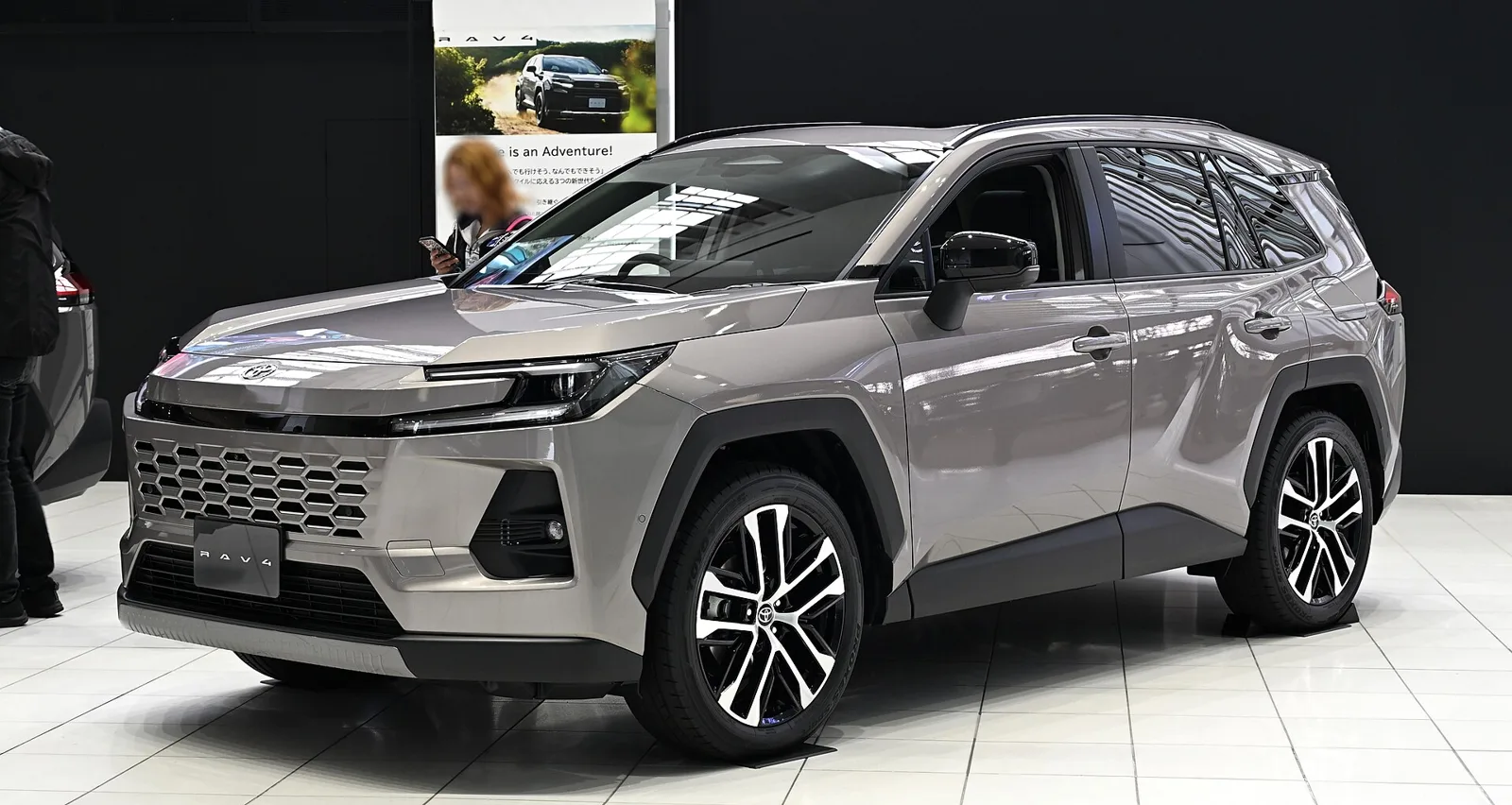
Launched in 1994 with most of an SUV's benefits and a mid-size car's handling, the RAV4 has sold more than 15 million units and is now in its sixth generation.
The Toyota RAV4 is a compact crossover SUV from Toyota that launched in Japan and Europe in 1994. It has sold more than 15 million units worldwide and is credited with popularising the compact crossover, which made it one of the best-selling SUVs ever.
Few cars have done more to define a segment than the RAV4. Its blend of SUV practicality and mid-size car handling struck a chord with buyers who wanted high seating and cargo room without the bulk of a truck.
Where did the RAV4 come from?
The RAV4 was designed for buyers who wanted most of the benefits of an SUV, such as cargo room, a higher view of the road and the option of full-time four-wheel drive, alongside the handling of a mid-size car. Its name abbreviates Recreational Active Vehicle with 4-wheel drive, although not every model came with four-wheel drive.
Development began in 1989 under an internal code name, and the first-generation XA10 shared elements with the Carina and Corolla. Design approval came in the second half of 1991 for the three-door car, with the five-door following later.
The car launched in Japan in May 1994. The five-door version followed in March 1995 and reached the United States in January 1996 with standard dual airbags.
Toyota of Japan also sold a longer-wheelbase version as the Vanguard from 2005 to 2016 through the Toyopet Store chain, which kept the model alive in its home market for longer than many expected.
A compact crossover that made the SUV practical for everyday buyers and then kept reinventing itself for six generations.
How did the first generation perform?
The XA10 was offered as a three-door and a five-door, with a 2.0-litre engine producing 89 kW (121 PS; 119 hp) in the United States. Front-wheel drive and four-wheel drive were both available, and the car was named 1997 Automobile of the Year by Automobile Magazine.
Japanese cars could also be fitted with the more potent 3S-GE BEAMS unit, rated at 132 kW (179 PS; 177 hp). Some Japanese examples were badged SXA11, and owners sometimes called them RAV 4.1 to tell them apart.
The 1996 model was rated between 21 and 23 mpg for combined city and highway driving, which was typical for a compact vehicle with four-wheel drive of its era.
The facelift for 1998 restyled the front and rear fascias, added a soft-top three-door and raised power slightly to 95 kW (129 PS; 127 hp).
What was the RAV4 EV?
The RAV4 EV was a plug-in all-electric variant built from 1997 to 2003 for fleet lease. It was offered for public sale for seven months in 2002, and only in small quantities in California.
It used a 27 kWh nickel-metal hydride battery pack and could cover up to 193 km (120 miles) between charges. The battery carried a 97,000 km (60,000-mile) warranty, which was generous for a car of its type.
A total of 1,484 units were leased or sold in California, and by mid-2012 almost 500 were still in use. That small volume reflected the limited scope of the zero-emission programme.
How did the second generation change?
The XA20 arrived in July 2000 and was offered as a three-door in some markets and a five-door in North America. Styling came from Calty Design Research, and Australia received a 2.0-litre VVT engine with permanent four-wheel drive.
Australia proved an important market, where the RAV4 became the best-selling SUV in 2001 and overtook the Honda CR-V for the first time. That success helped establish the model as a serious volume seller.
The 2003 facelift brought a redesigned interior, improved equipment and a 2AZ-FE 2.4-litre unit, in the US and Australia, rated at 120 kW (163 PS; 161 hp). Vehicle Stability Control became standard in the US.
The second generation also had the highest proportion of female drivers in the United States, apart from the Volkswagen New Beetle, according to 2003 and 2004 registration data.
What did the third generation bring?
The third generation was unveiled at the 2005 Frankfurt Motor Show and was built on an all-new platform for the 2006 model year. It was offered in short- and long-wheelbase versions, with the long wheelbase sold in Australia and North America.
The short wheelbase was 70 mm (2.8 in) longer than before, while the exterior was 145 mm (5.7 in) longer and 80 mm (3.1 in) wider. The extended-length version gained 21% more interior volume and an optional third row in North America and Japan.
Front-wheel drive could be specified in North America and Japan, while most other markets received only the four-wheel drive version. Japanese four-wheel drive cars sent 97 to 98 percent of power to the front wheels until traction was lost.
A 3.5-litre V6 became available in some markets, rated at 201 kW (273 PS; 270 hp) and able to reach 0-60 mph in around six seconds.
How did the third generation change in its later years?
A 2008 refresh for the 2009 model year redesigned the front end and replaced the 2.4-litre engine with a 2.5-litre unit. Canadian buyers received a front-wheel drive model in 2009 to lower the entry price.
The 2.5-litre 2AR-FE engine resolved the excessive oil consumption seen with the earlier unit, and it gave more power and better fuel economy in the same package.
A 2010 facelift for some markets borrowed the styling of the Vanguard, and the Chinese market received its own version with a black strip in the front grille and parking sensors as standard.
How did the fourth generation differ?
The fourth-generation RAV4 was revealed at the November 2012 Los Angeles Auto Show. It dropped the side-opening rear door for a liftgate, and it lost the V6 engine in favour of four-cylinder engines only.
The full hybrid combined a 2.5-litre Atkinson-cycle petrol engine with an electric motor and a 204-cell nickel-metal hydride battery under the rear seats. The four-wheel-drive hybrid added a 50 kW rear motor and a 1,750-pound (790 kg) towing capacity.
US sales began in early January 2013 with the LE, XLE and Limited trims. The fourth generation reached Australia in February 2013, where it came with diesel options alongside petrol engines.
How did the RAV4 score in safety testing?
The 2013 and 2014 models earned a poor rating in the IIHS small overlap test, but changes from the 2015 model year lifted the car to good. Latin NCAP gave the Japan-made model five stars for adult occupants in 2015.
The small overlap test simulates a frontal impact on 25 percent of the driver's side. A passenger-side version found the RAV4 faring worst, with 330 mm (13 in) more intrusion than on the driver's side.
The 2019 model year earned Top Safety Pick+ from the IIHS, although the standard reflector LED headlights received a poor rating in the headlight tests.
In September 2019 the Swedish magazine Teknikens Varld ran both petrol and hybrid versions through its moose test, and both failed. Toyota issued a software update, and a January 2020 retest gave the model a passing mark.
How did the fifth generation redefine the RAV4?
The fifth generation was unveiled at the March 2018 New York International Auto Show. It used the TNGA-K platform shared with the Camry and was 57 percent more rigid than the previous generation.
Dynamic Torque Vectoring AWD sends torque independently to the left and right rear wheels, which Toyota marketed as a world first. A Rear Driveline Disconnect sends power only to the front wheels when all-wheel drive is not needed.
The hybrid's E-Four system raised rear torque by 30 percent over the previous AWD system. A new control arrangement could vary the front-to-rear split from 100:0 to 20:80, which gave the car far more adjustable traction.
The fifth generation launched in Australia on 8 May 2019 in GX, GXL, Cruiser and Edge trims. The GX, GXL and Cruiser came with a choice of petrol or 2.5-litre hybrid power, while the Edge had only the petrol engine.
What is the sixth-generation RAV4?
The sixth-generation RAV4, codenamed XA60, was revealed on 20 and 21 May 2025 in Japan, Canada and the United States. It is the first RAV4 with a fully electrified line-up of hybrid and plug-in hybrid drivetrains.
Development began in early 2022 under chief engineer Yoshinori Futonagane, with full development starting in October of that year. The result was a development period of roughly three years.
Toyota kept the outgoing model's length and width, so the car grew in height only in Cruiser specification, from 1,605 mm (63.2 in) to 1,685 mm (66.3 in).
Toyota reorganised the trim strategy into three emotional grades, Core, Rugged and Sport. The Chinese version, sold as the Wildlander by GAC Toyota, shares its basic design with a different look.
Where was the RAV4 built and sold?
Production spread across several continents over the model's life. The North American models were built in two plants at Woodstock, Ontario, while the hybrid was also produced at Georgetown, Kentucky, and the plug-in version came from Toyota's Nagakusa plant in Japan.
China production began in April 2009 at a joint-venture plant in Tianjin, and the third-generation car became one of Toyota's most important models there. Russian production followed in August 2016, which underlined how far the model's reach had grown.
In Japan the fifth generation was launched with a monthly sales target of 3,000 units, a demanding figure that reflected the model's status there. Until 2020 the car was sold only through the Corolla Store and Netz dealership chains.
The third-generation RAV4 also topped Toyota's SUV sales in the United States for the first time, a sign of how central the model had become to the brand's American business.
The mix of plants reflected the car's global demand, which grew with each new generation and pushed the company to build closer to its key markets.
What are the RAV4 specifications?
The table covers the main engines, towing and fuel figures across the generations. Metric values come first, with imperial figures in brackets, and each row names the generation or drivetrain where a figure applies to one model only.
| Specification | Detail |
|---|---|
| Segment | Compact crossover SUV |
| First-generation US engine | 2.0-litre, 89 kW (121 PS; 119 hp) |
| Third-generation V6 | 3.5-litre, 201 kW (273 PS; 270 hp) |
| Fourth-generation hybrid | 2.5-litre Atkinson-cycle petrol with electric motor, 204-cell battery |
| Hybrid towing | 1,750 lb (790 kg) |
| Hybrid EPA combined | 6.0 L/100 km (47 mpg-imp; 39 mpg-US) |
| Plug-in hybrid | 225 kW (302 hp), 0-100 km/h in 6.2 seconds |
| Plug-in 0-60 mph | 5.8 seconds |
| Sixth-generation AWD towing | 3,500 lb (1,588 kg) |
| Touchscreen | 10.5-inch standard, 12.9-inch on upper grades |
| Cruiser height | 1,685 mm (66.3 in) |
| All-electric range after 2021 facelift | 75 km (47 miles) |
Frequently asked questions
Did the RAV4 ever use a diesel engine?
Diesel options were offered in Australia during the fourth generation, with 2.0-litre and 2.2-litre turbo-diesels. The fifth generation dropped diesel entirely, and no diesel option has been offered since.
Was the Vanguard sold under the RAV4 name elsewhere?
No. The Vanguard badge was used only in Japan, and Toyota discontinued it in November 2013 in favour of the Harrier, which replaced the longer-wheelbase model there.
Did the RAV4 keep its V6 engine?
No. The fourth-generation car offered only inline-four engines, and the V6 was not revived in later generations.
What is the RAV4 Prime?
The plug-in hybrid sold in North America as the RAV4 Prime was renamed the RAV4 Plug-in Hybrid in 2024, for the 2025 model year.