Built since 2016 on the Corolla's TNGA-C platform, the C-HR went from Japan and Thailand to Turkey, with hybrid, plug-in and electric versions along the way.
Built by Toyota from 2016, the C-HR is a subcompact crossover that sits between the Yaris Cross and Corolla Cross. Production began in November 2016 on the TNGA-C platform, and its 2023 second generation is hybrid-only and built in Turkey.
The Toyota C-HR is a subcompact crossover SUV that Toyota has built since 2016. It sits between the Yaris Cross and the Corolla Cross in the company's crossover range, and it shares its platform with the E210 Corolla. Its later generations moved to hybrid and electric power.
When did the Toyota C-HR go on sale?
The production car made its debut at the Geneva Motor Show in March 2016, and manufacturing began that November. The Japanese launch came on 14 December 2016. Europe, Australia, South Africa and North America followed in early 2017, with Southeast Asia, China and Taiwan joining in 2018.
The development of the car began in 2013 under chief engineer Hiroyuki Koba. Before the production model, Toyota previewed the car as the Scion C-HR Concept and then the Toyota C-HR Concept.
A coupe-styled subcompact crossover on the Corolla's platform that moved from Japan and Thailand to Turkey and then to electric power.
What does the name C-HR stand for?
The letters have been read as Coupe High Rider, Compact High Rider or Cross Hatch Run-about, and the car kept the same name in every major market where it was sold.
Where was the first-generation C-HR built?
Initial production was in Japan and Turkey. The first generation reached buyers across Japan, China, North America, Europe, Southeast Asia and Australasia, and it was built in four countries in total. The North American C-HR for the 2018 to 2020 model years was imported from Turkey.
The car shared the TNGA-C platform, known as GA-C, with the E210 series Corolla.
What engines did the C-HR offer in Japan?
In Japan the C-HR was sold through all of Toyota's dealership channels, including Toyota Store, Toyopet Store, Toyota Corolla Store and Netz Store. The S-T and G-T grades carried the 1.8-litre hybrid, which made them the hybrid choice in the Japanese range. The market offered either a 1.2-litre turbocharged petrol engine or a 1.8-litre hybrid, and front-wheel-drive models could take either unit.
Japanese grades were S, S-LED, G, S-T and G-T. The S, S-LED and G grades used the 1.2-litre turbo, while the other grades carried the 1.8-litre hybrid. The LED package was exclusive to the G and S-LED grades.
How was the C-HR sold across Asia?
The Thai-built C-HR, fitted with a 1.8-litre engine, found buyers in Thailand, Indonesia, Malaysia and Brunei. Its ASEAN-market version debuted on 30 November 2017 at the 34th Thailand International Motor Expo.
The Indonesian car launched on 10 April 2018 with a 1.8-litre petrol engine, and a hybrid joined on 22 April 2019. The petrol variant was discontinued in March 2022, and the last hybrid sold until May 2023. Brunei received the car in early 2018 and dropped it in 2022.
Taiwan offered the C-HR only with a 1.2-litre petrol engine, in front-wheel and all-wheel-drive versions. In Singapore the front-wheel-drive model came in Active and Luxury grades with the 1.2-litre engine, while hybrid models reached buyers through parallel importers.
How did China handle the C-HR and the IZOA?
In China the C-HR is sold by GAC Toyota, while its twin, sold by FAW Toyota, is called the IZOA. The IZOA has a horizontal-line grille in place of the C-HR's mesh. Both cars were revealed at the Auto Guangzhou show in November 2017 and went on sale in April 2018.
An electric version of both cars appeared at the 18th Auto Shanghai on 16 April 2019. Toyota presented it as the first battery electric car in its planned line-up, and it reached Chinese showrooms in April 2020.
What was the C-HR EV like?
The China EV's motor is rated at 150 kW (201 hp; 204 PS) with 300 N m (220 lb ft) of torque. Its 54.3 kWh lithium-ion battery is quoted at up to 400 km (250 miles) of range on the NEDC test cycle.
Toyota C-HR specifications at a glance
The table below sets out the headline figures across the first and second generations and the electric models. Each row names the generation or version it covers, so the EV and plug-in figures are not mixed up with the standard hybrids.
| Specification | Detail |
|---|---|
| Platform | TNGA-C (GA-C), shared with the E210 Corolla |
| First generation launch | 14 December 2016 in Japan |
| First generation petrol | 1.2-litre turbocharged petrol; 2.0-litre naturally aspirated in North America |
| First generation hybrid | 1.8-litre hybrid; 2.0-litre hybrid in Europe from the facelift |
| China EV motor | 150 kW (201 hp; 204 PS) |
| China EV torque | 300 N m (220 lb ft) |
| China EV battery | 54.3 kWh lithium-ion, up to 400 km (250 miles) NEDC |
| Second generation reveal | 26 June 2023; launched October 2023 |
| Second generation 1.8 L hybrid | 103 kW (138 hp; 140 PS) |
| Second generation 2.0 L hybrid | 145 kW (194 hp; 197 PS) |
| Second generation plug-in hybrid | 164 kW (220 hp; 223 PS) |
| Second generation transmission | eCVT on all models |
What changed in the 2019 facelift?
The facelifted C-HR was unveiled in October 2019 in Japan, Europe, Australia and North America. Europe gained the 2.0-litre M20A-FXS hybrid as an option for the first time.
Smartphone integration arrived as standard, covering both Android Auto and Apple CarPlay, and a GR Sport variant joined the line-up.
How did the first-generation C-HR sell in Australia?
In Australia the car was imported from Japan and offered only with the 1.2-litre 8NR-FTS turbo petrol engine. The base model came with a six-speed manual in front-wheel drive, while automatic versions could be front or all-wheel drive. The high-level Koba was available in both layouts with a CVT only.
The Koba added LED headlights, leather seats, heated front seats and a smart entry and start system. Those features made it the top model in the local range.
How was the C-HR different in North America?
North America received a larger 2.0-litre 3ZR-FAE naturally aspirated petrol engine, matched to a CVT gearbox. The car was originally planned to be marketed under the Scion brand, before Toyota discontinued that marque.
The 2018 model year came in XLE or XLE Premium trims, and from the 2019 model year it was offered as LE, XLE, XLE Premium or Limited. The car was discontinued in North America after the 2022 model year, when Toyota chose not to bring the second generation over and the Corolla Cross continued as the brand's subcompact SUV.
How did Argentina and Malaysia end the C-HR?
The C-HR launched in Argentina in December 2020 with only the hybrid 1.8 engine. Buyers got the HEV grade alone, paired with a CVT. It was discontinued there in December 2023, along with the Camry.
In Malaysia the comparatively expensive C-HR, a fully imported model from Thailand, was discontinued in late 2020 as sales declined. The Corolla Cross replaced it in late March 2021.
What did the second-generation C-HR bring?
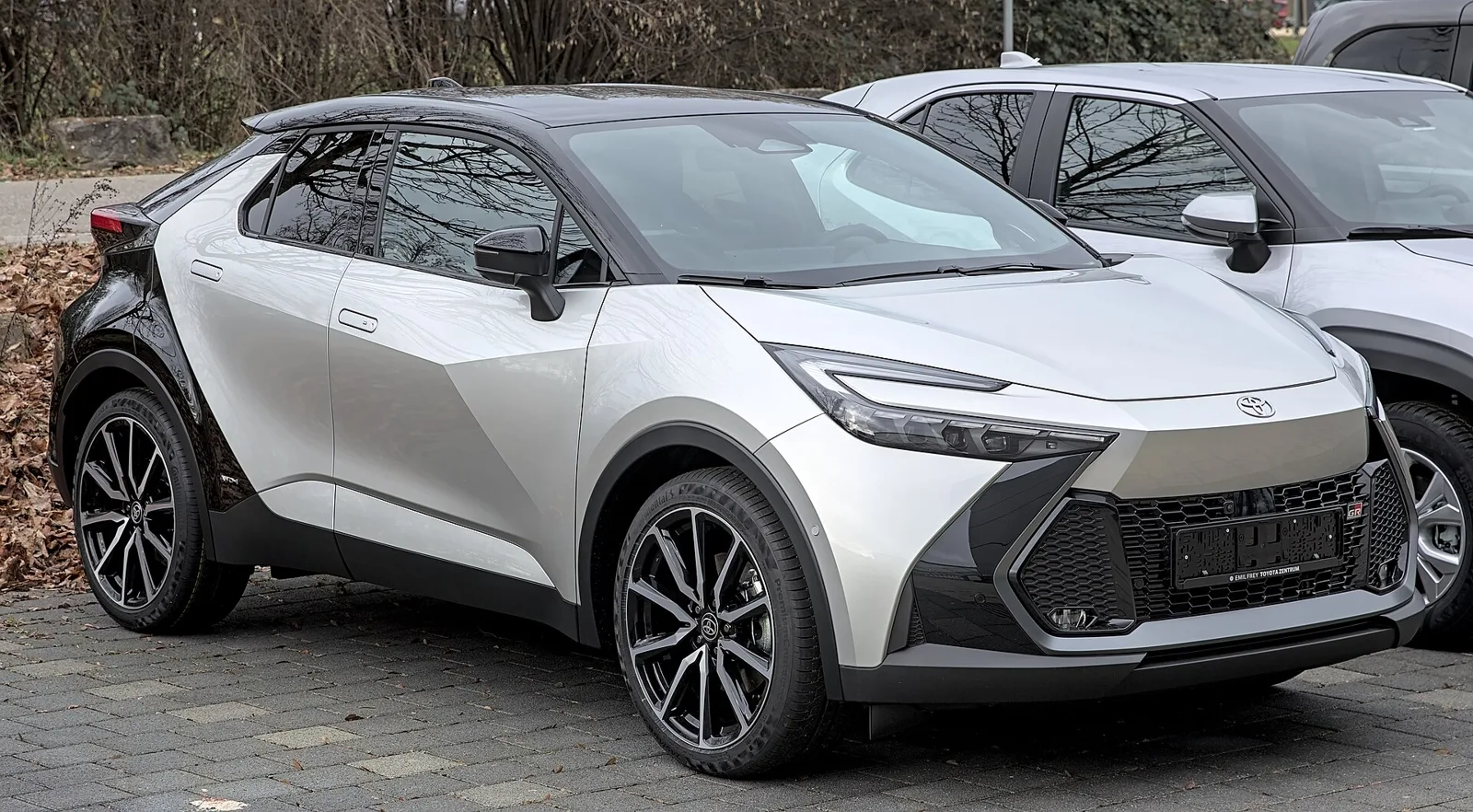
The second generation was previewed by the Toyota C-HR Prologue on 6 December 2022. It was revealed on 26 June 2023 and launched in October 2023 with two-tone paint, a sharper body and C-shaped headlights in the new Toyota design language.
The new car became exclusively hybrid and introduced a plug-in hybrid option for the first time, though the plug-in was not sold in Australia. Equipment highlights included a digital key, a remote parking function and a hands-free system for slow traffic, alongside advanced safety systems.
How did European buyers choose a C-HR?
European buyers could choose a 1.2-litre turbocharged petrol, a 1.8-litre hybrid or a 2.0-litre hybrid. Only the front-wheel-drive 1.2-litre turbo offered a six-speed manual, while the 1.2-litre turbo AWD and the hybrids used a CVT.
Trim levels varied across countries. In the UK they were Icon, Design, Excel and Dynamic, and the names changed again from one market to the next. The car was essentially the same in each market, with different standards or optional equipment.
Across Europe the base car rides on 17-inch alloys, higher grades step up to 18 or 19-inch wheels, and the GR Sport alone gets 20-inch black alloys.
The UK range also included a limited Orange Edition, and plug-in models were offered on every grade except the base Icon.
What engines were offered in the second generation?
The range consisted of the Hybrid 140, Hybrid 200, Hybrid 200 AWD-i and Plug-In Hybrid 220. The AWD versions had a compact electric motor on the rear axle for extra traction and stability. Frequency Sensitive Control, a hydro-mechanical damping system, was used to improve handling and comfort.
The second-generation 1.8-litre hybrid used the 2ZR-FXE engine with a combined output of 103 kW (138 hp; 140 PS). The 2.0-litre hybrid with the M20A-FXS engine made 145 kW (194 hp; 197 PS), and the plug-in variant produced 164 kW (220 hp; 223 PS). All models used the eCVT transmission.
Where is the second-generation C-HR built?
The second generation is no longer built in Japan. It is built exclusively in Turkey, at Toyota's Turkish plant. It is not sold in North America, Japan, China or Southeast Asia, where the Corolla Cross took over the role.
The Corolla Cross is a C-segment vehicle and is about 100 mm (3.9 in) longer than the C-HR. In the markets where the C-HR was dropped, that size difference became the main argument for the newer model.
Which trims does the second-generation C-HR come in?
In Australia and New Zealand the second generation went on sale in the first half of 2023, exclusively as a hybrid. Australian trims were the 1.8 GXL, 1.8 Koba and 2.0 GR Sport, and Toyota Safety Sense was standard on all models.
In Australia the GR Sport runs 19-inch wheels that differ from the Koba's, and a panoramic roof could be added to the Koba and GR Sport.
New Zealand offered GX, GXL, Limited and GR Sport trims. In Germany the trims included Flow (later renamed Active), Business Edition, Team Deutschland, Lounge and GR Sport, with Lounge Premiere and GR Sport Premiere sold at launch.
What is the C-HR+?
Toyota unveiled the battery electric C-HR+ in March 2025. The bZ Compact SUV concept shown in 2022 had previewed its look. Europe was due to receive it in late 2025, with North America following in 2026 under the plain C-HR name.
Frequently asked questions
Was a manual gearbox offered?
Yes, but only in some markets. In Europe the six-speed manual was fitted to the front-wheel-drive 1.2-litre turbo alone, and in Australia the base model could be ordered with one.
Where is the second-generation C-HR sold?
The second generation was limited to Europe and Australia. Its production was centralised in Turkey.
Did the C-HR go electric?
Yes. A China EV version went on sale in April 2020, with a 150 kW motor and a 54.3 kWh battery. A battery electric C-HR+ was unveiled in March 2025.
Could Japanese buyers get an all-wheel-drive hybrid?
No. The all-wheel-drive models there used only the 1.2-litre turbo, while front-wheel-drive cars could take either engine.
What replaced the C-HR in North America?
Production in North America ended with the 2022 model, and the Corolla Cross filled the subcompact slot instead.