From a European-focused hatchback in 1999 to a WRC-homologated hot hatch and a nameplate that conquered the world, the Toyota Yaris story is one of quiet, relentless evolution.
The Toyota Yaris is a supermini produced since 1999, replacing the Starlet and Tercel. It has spanned four generations, sold 8.71 million units worldwide by March 2020, and evolved from a European-focused hatchback into a global nameplate that includes the GR Yaris and Yaris Cross.
The Toyota Yaris is a supermini that has been in production since 1999, replacing the Starlet and Tercel. Over four generations it has become one of the world's most successful small cars, with 8.71 million units sold worldwide as of March 2020.
Where did the Toyota Yaris come from?
Toyota launched the Yaris in 1999 as a replacement for the Starlet and Tercel, aiming to capture the growing European supermini market. The name comes from the Greek Charites, goddesses of charm and beauty.
The first-generation hatchback was developed specifically for Europe and designed by Toyota's ED2 facility in France. In some markets, the car was sold as the Echo through 2005. Up to 2019, the Yaris nameplate served as an export name for Japanese-market models, but from 2020 it replaced the Vitz in Japan.
The GR Yaris is not simply a warmed-over Yaris; it is a rally car for the road, designed to meet WRC homologation requirements.
How did the Yaris evolve across generations?
The first generation (XP10/XP20, 1999-2005) was a significant step for Toyota in Europe. The hatchback and sedan shared only their front doors; the hatchback derived from the Japanese-market Vitz (XP10), while the sedan came from the Platz (XP10). A mini MPV variant, the Yaris Verso, joined the range from 1999 to 2005 on the NBC platform.
The second generation (XP90, 2005-2013) continued the dual-platform strategy: the hatchback was based on the Vitz (XP90) and the sedan on the Belta (XP90). This generation solidified the Yaris as a global player, with production and sales expanding across continents.
The third generation arrived in two waves: the XP130 hatchback in 2011 and the XP150 in 2013. The XP130 hatchback derived from the Vitz (XP130) or Yaris (XP150), while the sedan came from the Vios (XP150) or Yaris (XP150). This generation also saw the introduction of Mazda2-based models (DA/DB/DD) from 2015, which were restyled Mazda2s sold as the Yaris sedan and hatchback in North America.
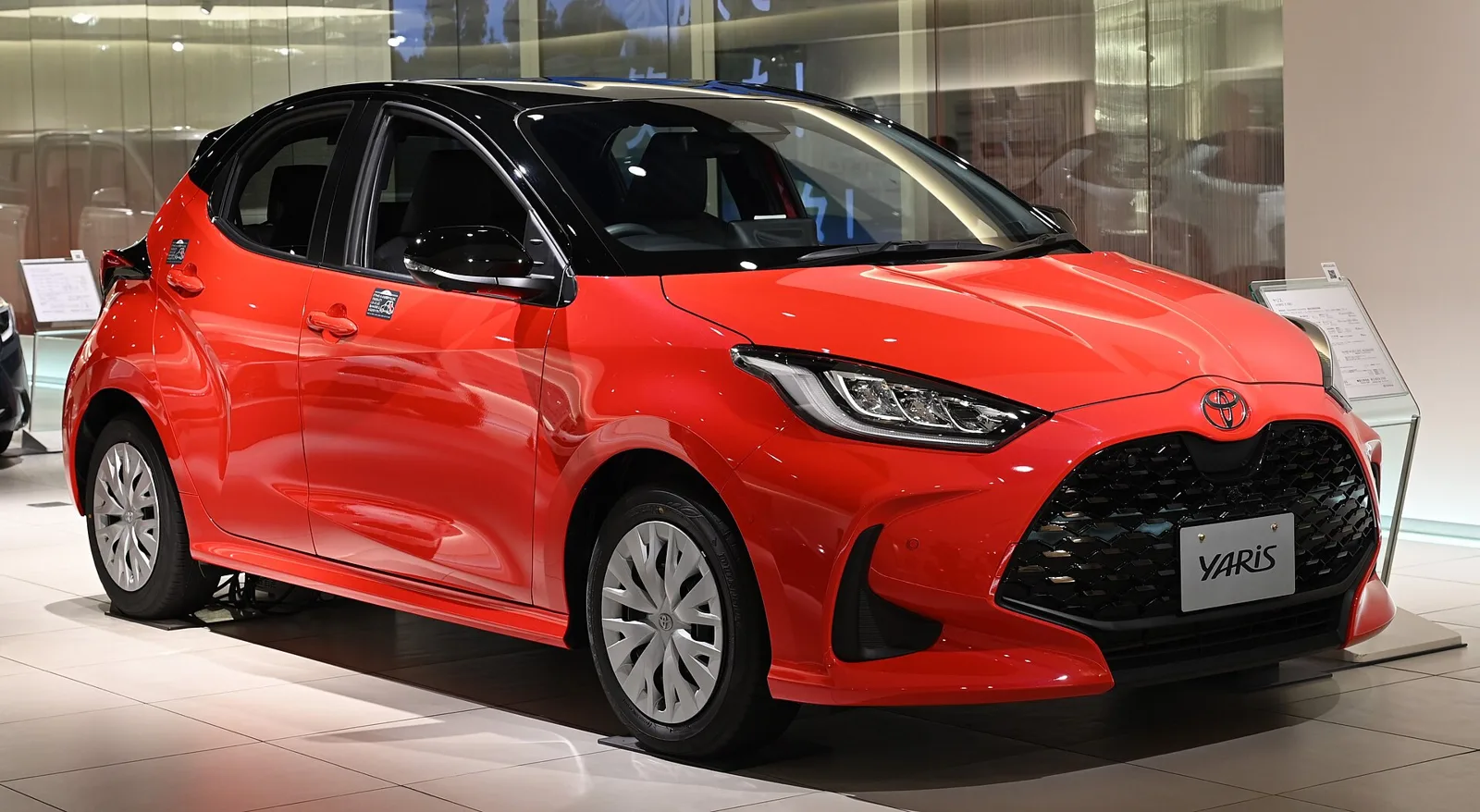
The fourth generation (XP210, 2020; AC100, 2022) marked a major shift. The XP210 hatchback moved to the GA-B platform, part of Toyota's TNGA family, while the AC100 sedan was developed by Daihatsu on the DNGA-B platform. The fourth generation also spawned the Yaris Cross, a subcompact crossover SUV, and the GR Yaris, a three-door performance variant.
What is the Toyota Yaris like to drive and live with?
Across its generations, the Yaris has been praised for its practicality, efficiency, and ease of driving. The first-generation car was nimble and spacious for its class, with a high seating position and a surprisingly roomy interior. The second generation improved refinement and safety, while the third generation added more technology and a hybrid option in many markets.
The fourth-generation XP210, built on the GA-B platform, represented the biggest leap. With a lower centre of gravity and a more rigid body, it offered sharper handling and a more engaging drive. The hybrid powertrain, developed under chief hybrid engineer Takashi Uehara, became the centrepiece of the range in Europe. The Yaris Cross XP210, sharing the TNGA-B platform with the XP210 Yaris, brought the formula to the booming small SUV segment.
What is the GR Yaris and why does it matter?
The GR Yaris is a three-door performance variant of the XP210 Yaris, built as a homologation model for the FIA World Rally Championship. It was unveiled at the 2020 Tokyo Auto Salon, with production beginning in September 2020.
Developed under Gazoo Racing branding, the GR Yaris features a bespoke three-door body, a turbocharged engine, and a sophisticated all-wheel-drive system. It is not simply a warmed-over Yaris; it is a rally car for the road, designed to meet WRC homologation requirements. Its existence underscores how far the Yaris nameplate has come from its humble European hatchback origins.
How did the Yaris perform in motorsport?
The GR Yaris was created specifically to homologate Toyota's rally contender for the FIA WRC. This was a deliberate strategy to bring Toyota's motorsport engineering to a road car that enthusiasts could buy. The GR Yaris quickly gained a reputation as one of the most exciting small performance cars of its era, thanks to its rally-derived chassis and powertrain.
What variants and spin-offs have worn the Yaris badge?
The Yaris nameplate has been applied to a wide range of models. The Yaris Verso was a mini MPV sold from 1999 to 2005, later succeeded by the Ractis and Verso-S. The Yaris Cross, a subcompact crossover SUV, arrived in 2020 on the XP210 platform, with a second version, the AC200, launched in 2023 for emerging markets on the DNGA-B platform shared with the AC100 Vios/Yaris.
In North America, the Yaris sedan and hatchback from 2015 to 2020 were restyled Mazda2s. The sedan was sold as the Scion iA from 2015, then renamed the Toyota Yaris iA from August 2016, and finally the Yaris sedan for 2019. The Mazda2-based Yaris hatchback replaced the XP130 Liftback in the US and Canada for 2020. These models were produced by Mazda for Toyota starting in 2014 at Salamanca, Guanajuato, in Mexico.
Other notable variants include the Yaris Ativ sedan, which debuted in Thailand in August 2022 and is designated AC100. Concept cars have also explored the Yaris theme: the Yaris Cabrio (2000), Five Axis (2008), HSD (2011), Hybrid-R (2013), and Legian (2015).
How did the Yaris sell around the world?
Global sales reached 8.71 million units by March 2020, a remarkable figure for a supermini. In the US and Canada, XP130 production moved to Toyota Motor Manufacturing France in May 2013. The 2019 XP130 Yaris Liftback was not introduced in the US, and US sales of the 2018 XP130 continued into January 2019. The Canadian 2019 model sold into 2020, replaced by the Mazda2-based Yaris.
The XP150 Vios was launched in Latin America and the Caribbean in 2013 as the Yaris Sedan. In early 2018, the Thai-market Yaris ATIV replaced the XP150 in those regions. In Mexico, the Mazda2-based Yaris R was sold alongside other Yaris models until 2020.
North America did not receive the fourth-generation Yaris. Mazda2-based Yaris models were discontinued in the US in June 2020, with Canada ending sales in July 2020 and Mexico in August 2020. The Yaris nameplate was eliminated in North America in 2020, though it continued to thrive elsewhere.
What is the legacy of the Toyota Yaris?
The Yaris replaced both the Starlet and Tercel, and in doing so it became Toyota's global small-car standard-bearer. It has worn many hats: economy hatchback, sedan, mini MPV, crossover SUV, and rally-bred performance car. From 2020, the nameplate replaced the Vitz in Japan, unifying Toyota's small-car naming worldwide.
The Yaris demonstrated that a supermini could be engineered for different regions without losing its identity. It also proved that Toyota could build a genuinely exciting performance car from a humble hatchback, as the GR Yaris shows. With the Yaris Cross and the AC100 sedan, the Yaris family continues to expand into new segments and markets.
Specification comparison: Toyota Yaris generations
| Generation | Production years | Platform/family | Key variants |
|---|---|---|---|
| First (XP10/XP20) | 1999-2005 | Vitz (XP10), Platz (XP10) | Hatchback, sedan, Yaris Verso |
| Second (XP90) | 2005-2013 | Vitz (XP90), Belta (XP90) | Hatchback, sedan |
| Third (XP130/XP150) | 2011/2013-2020 | Vitz (XP130), Vios (XP150) | Hatchback, sedan, Mazda2-based models |
| Fourth (XP210/AC100) | 2020-present | GA-B (XP210), DNGA-B (AC100) | Hatchback, Yaris Cross, GR Yaris |
What should you know before buying a Toyota Yaris?
Buying a Yaris means choosing from a vast pool of generations and regional variations. The fourth-generation XP210 offers the most modern engineering, with the GA-B platform and hybrid power. The GR Yaris is a specialist machine with rally DNA, while the Yaris Cross adds SUV practicality. Earlier generations are affordable and reliable, but each has its own character. The Mazda2-based models from 2015 to 2020 are a distinct breed, with different underpinnings and styling. Understanding which generation and which market-specific version you are looking at is key to finding the right Yaris for you.