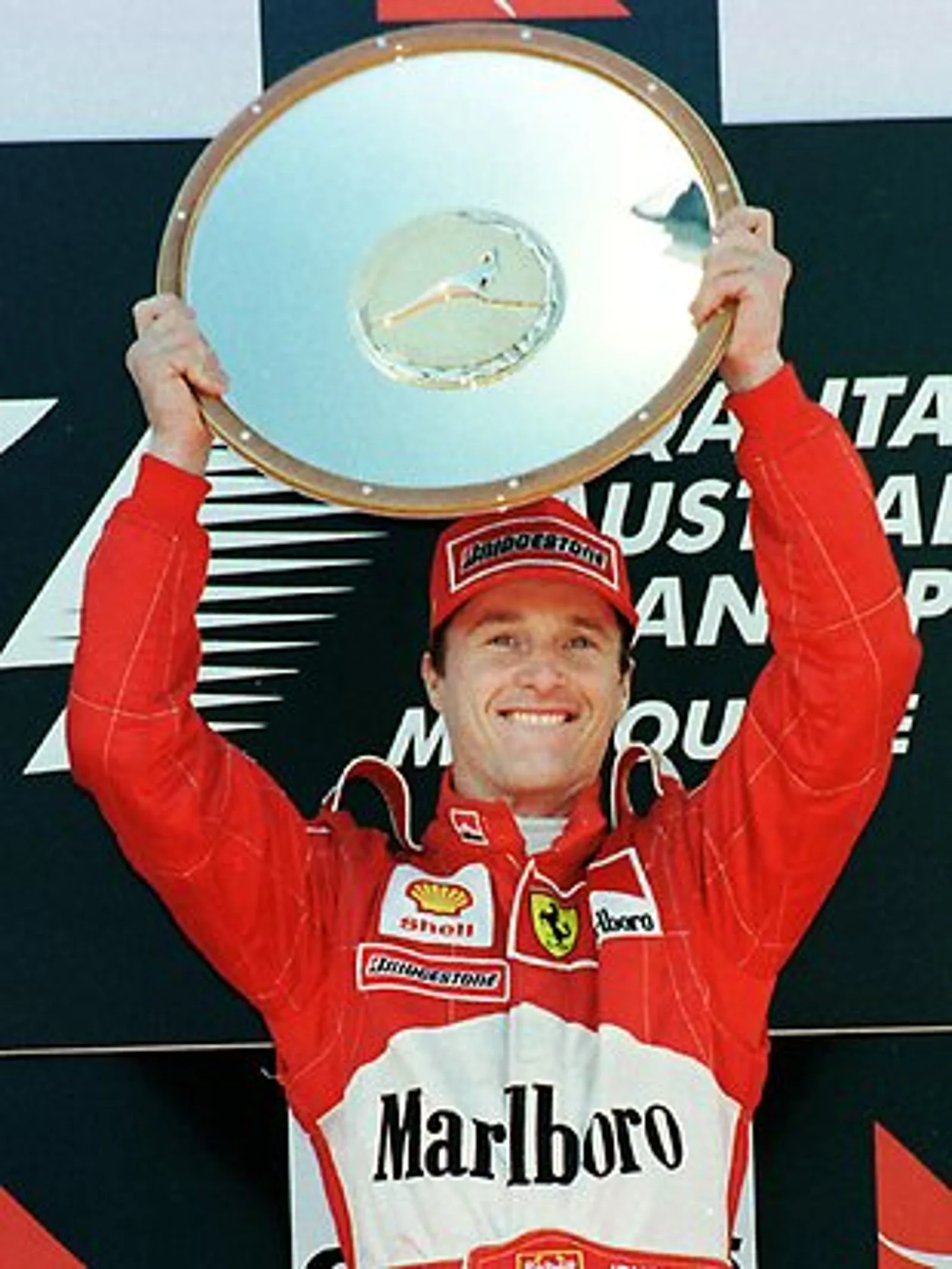
The Northern Irish driver who lost the 1999 world title to Mika Hakkinen by two points, won four Grands Prix with Ferrari and later raced for Jaguar.
Eddie Irvine was a Northern Irish driver who raced in Formula One from 1993 to 2002 for Jordan, Ferrari and Jaguar. He won four Grands Prix in 1999, when he finished second in the championship, two points behind Mika Hakkinen. He retired at the end of 2002.
Eddie Irvine was a racing driver from Northern Ireland who competed in Formula One from 1993 to 2002. He finished runner-up in the 1999 World Drivers' Championship with Ferrari, losing the title to Mika Hakkinen by two points. Across ten seasons he won four Grands Prix, all of them in 1999.
Who was Eddie Irvine?
Edmund 'Eddie' Irvine Jr. was born in Newtownards, County Down, on 10 November 1965. Between 1993 and 2002 he took part in Formula One under the British flag, first with Jordan, then Ferrari and finally Jaguar. He retired from competition at the end of 2002.
Conlig was his childhood village, and he attended Regent House Grammar School in Newtownards. His childhood hero was fellow Northern Irishman John Watson. His father also raced single-seaters for fun.
After retiring, Irvine stayed in the public eye in Britain, working in television and building a property portfolio. His career is remembered mainly for the 1999 season, when he was the closest challenger to Hakkinen and helped Ferrari to the constructors' title.
Two points separated Eddie Irvine from the 1999 title, and his four wins that season kept that gap in the headlines.
How did Irvine reach Formula One?
Irvine began racing in 1983 in Formula Ford, after an early interest in motorcycles was discouraged. He took the Esso and RAC Formula Ford titles and the Formula Ford Festival, and a winter test then earned him a British Formula 3 seat. Formula 3000 and Japanese racing followed.
Irvine's first interest was motorcycle racing, but his parents thought it too dangerous. His father encouraged him into Formula Ford instead, and Irvine did unpaid work in his father's scrapyard, and his father paid for his racing in return.
His first win came at Brands Hatch in 1984, and he also picked up a best-driver award. That year he moved to the Van Diemen team, and his results brought three major Formula Ford titles.
Marlboro organised a winter 1987 shootout in which the quickest driver would win a seat for the next British Formula 3 campaign. He was that driver and signed with West Surrey Racing for 1988. The season brought no wins, and he finished fifth in the championship. At Macau he started from pole but did not finish.
In 1989 he moved into International Formula 3000 with Pacific Racing and finished ninth, ahead of JJ Lehto, who was then seen as a promising young driver. In 1990 he joined the Jordan Formula 3000 team, won in Germany and ended the season third in the standings. He also stood on the podium at Macau and at the Fuji F3 Cup.
He then moved to Japan. Driving for Cerumo Racing in 1991, he won one race, collected 14 points and finished seventh in the Japanese Formula 3000 Drivers' Championship.
How did Irvine's Formula One debut go?
Irvine made his debut at the 1993 Japanese Grand Prix, partnering Rubens Barrichello at Jordan. He scored a point with sixth place. After two races he stood 22nd in the championship with that single point, a modest start that was overshadowed by the Senna incident.
The race itself was his first Grand Prix start, and it was the penultimate round of the season. He made an immediate impression by unlapping himself on Senna, who was leading the race and went on to win it.
After the race Senna confronted Irvine in the Jordan hospitality unit. He believed Irvine had driven in an unprofessional way, and the argument became a fight, with Senna throwing a punch. Senna received a suspended two-race ban for the incident. He stopped in the season finale in Australia after accident damage.
What happened to Irvine in the 1994 season?
1994 was a difficult year for Irvine at Jordan. He was involved in a four-car crash in Brazil, received a ban that was later increased after an appeal, and was warned about his conduct in Portugal. His first points of the year came at Spain, and he finished 16th with six points.
The opening round in Brazil ended in a four-car crash in which Irvine was involved. The stewards handed him a one-race ban plus a $10,000 penalty. An appeal to the FIA was turned down on 6 April, which raised the ban to three races. Aguri Suzuki drove in his place at the Pacific Grand Prix, and Andrea de Cesaris took over for San Marino and Monaco.
Irvine returned at Spain with sixth place, his first points. Five retirements followed, and at Belgium an alternator failure ended his race. He was classified 13th because he had completed over 90 percent of the distance. Engine failure ended his Italian race. An opening-lap clash with Johnny Herbert brought a one-race ban, with a three-race suspension attached.
In Portugal he clipped Damon Hill during qualifying, and Hill's car flipped over, although Hill was unhurt. Irvine was warned that a similar incident could cost him his Super Licence. He bounced back with a fourth at the European Grand Prix, then fifth in Japan, before a spin ended his Australian race. Six points were his total for the year.
Why did Ferrari sign Irvine for 1996?
Ferrari bought out Irvine's Jordan contract and signed him to partner Michael Schumacher from 1996. The move came after a 1995 season that included his first Formula One podium, a third place at the Canadian Grand Prix. He finished 12th in the championship that year with ten points.
The 1995 season began badly. Irvine retired in Brazil with a gearbox actuator problem, and in Argentina he collided with Mika Hakkinen on the first lap before an engine failure ended his race after only six laps. He recovered with eighth at San Marino and fifth in Spain before reaching the podium in Canada.
A fire broke out in his car during a Belgian pitstop, when a fuel valve jammed open. He was uninjured but had to retire. Jordan said, days before the European Grand Prix, that he would stay on a two-year deal, but Ferrari then bought out his contract.
What did Irvine achieve with Ferrari?
Irvine's four years at Ferrari brought his best results, including a career-high second place in 1997 and a string of podiums in 1998. The team's number one driver was Schumacher, and the Irish driver often had to work around that. In 1999 Irvine finally became the team's main challenger.
In 1996 Irvine finished third at the season opener in Australia, where he had qualified, after out-qualifying Schumacher. He took fifth in Argentina and fourth at San Marino, but a run of retirements followed. He finished tenth in the championship with 11 points.
The 1997 season brought his best finish to date. At Argentina he challenged Jacques Villeneuve for the lead, and Villeneuve was suffering from a stomach ailment and had brake trouble, leaving Irvine in second place. Third places at San Marino, Monaco, the French Grand Prix and Japan followed, and he ended the year seventh with 24 points.
In 1998 Irvine finished fourth in the championship with 47 points. He had back trouble early in the year, and a new seat was fitted to help. He took second in France behind Schumacher and two more second places in Italy and Japan. In July that year he signed a two-year contract extension, which kept him in a supporting role to Schumacher.
Did Irvine come close to the 1999 title?
Yes. Irvine won four races in 1999 and led the championship at one stage, before Mika Hakkinen edged him by two points at Suzuka. The season also brought a Ferrari one-two result that was later disqualified and then reinstated on appeal.
The season opened in Australia with Irvine's maiden Grand Prix victory, which put him at the head of the championship for the first time. Brazil was a setback when blocked radiators forced an unscheduled pitstop, and he finished fifth. At San Marino his engine failed on lap 47 while he was running third and comfortable, handing the lead back to Schumacher.
Monaco brought second place and the only fastest lap of his career. Canada followed with third, after a collision with David Coulthard on the way. Schumacher's right leg was broken at Stowe Corner during the British Grand Prix after his rear brakes let go. Irvine became team leader and was partnered by Mika Salo for the next six races.
Irvine won in Austria and then took the German win after Salo handed it to him a week later. He added a podium in Hungary, where oversteer made the car difficult to drive. In Malaysia Schumacher returned to help him win a fourth race and a Ferrari one-two ahead of Hakkinen. Both Ferraris were later disqualified over bargeboard rules, and the Court of Appeal overturned that decision the day after it was heard.
At Suzuka Irvine crashed heavily in qualifying and started fifth. He finished third in the race, behind Schumacher and Hakkinen, and lost the title by two points. Ferrari did win its first Constructors' Championship in 16 years.
What did Irvine achieve at Jaguar?
Irvine moved to Jaguar in 2000, a move announced in September 1999. He scored the team's first points at Monaco in 2000 and its first podium at Monaco in 2001. His final podium came at Italy in 2002, and he finished that season ninth in the championship.
The 2000 season started poorly with retirements at Australia and Brazil after spins. He later finished three races outside the points. He missed the Austrian Grand Prix with appendicitis, and Luciano Burti took his place. He finished the year 13th in the championship with four points.
The 2001 season opened with 11th place in Australia, but he failed to finish four consecutive races. Jaguar's team boss Bobby Rahal backed him early, but tension grew when the team's car underperformed in testing. Pedro de la Rosa became his team-mate after Burti left for Prost. Irvine's third place at Monaco was Jaguar's first podium, and he finished 12th with six points.
Rahal later tried to place Irvine with Jordan, but Irvine turned the deal down, as he preferred to help Jaguar improve. The row led to reports that he had been sacked and that Niki Lauda would replace him, yet Irvine was still at Jaguar for 2002, again partnered by de la Rosa. The 2002 season ended with Irvine's final podium, third at Italy, and a ninth-place finish with eight points.
Did Irvine race at Le Mans?
Yes. Irvine raced at Le Mans three years running, from 1992 to 1994. He finished ninth overall and second in class in 1992, fourth overall in 1993, and second overall in 1994 after stepping in for the late Roland Ratzenberger.
The SARD Toyota Group C car was shared with Roland Ratzenberger and Eje Elgh in 1992, and the crew ended ninth overall and second in the Group C class. In 1993 he drove a Toyota Group C car with Toshio Suzuki and Masanori Sekiya, and the team finished fourth overall.
In 1994 Irvine replaced Ratzenberger, who had died after crashing in qualifying for the San Marino Grand Prix. Partnered by Mauro Martini and Jeff Krosnoff at SARD, the car was leading with 90 minutes left when a gearbox fault made it slow down. They ended second overall and top of the LMP1/C90 class.
How was Irvine's nationality handled in Formula One?
As a Northern Ireland-born citizen he could describe himself as British, Irish or both. He raced under the British flag, but Formula One's nationality rules caused some confusion in the early years of his career, particularly at podium ceremonies, where the flags shown were sometimes wrong.
The FIA's International Sporting Regulations say that drivers in world championships compete under the nationality of their passport, not that of the authority that issued their racing licence. Irvine held an Irish racing licence, and some early official entry lists wrongly showed him as Irish, for instance in 1995 and 1996.
Race organisers also flew an Irish Tricolour at some of his early podiums by mistake, including the 1995 Canadian Grand Prix and the 1996 Australian Grand Prix, along with the 1997 Argentine and Monaco races. After the 1997 Argentine race his family received threatening phone calls. He then asked for a politically neutral shamrock flag at podiums, and for the Londonderry Air to be played after his wins.
What did Irvine do after Formula One?
After retiring, Irvine became a media personality in Britain and expanded his property interests. He won a passing-off case against Talksport in 2002 over a print advert, presented a Sky One programme in 2006, and was linked with the Jordan and Minardi teams in 2005, although no deal followed.
In 2002 Irvine successfully sued Talksport over a print advertisement that suggested he had endorsed the station. The Court of Appeal decided the case in 2003, and it was the first UK ruling in which passing-off succeeded in a false endorsement case.
In late 2006 he fronted a Sky One programme, The Race, that pitted celebrity driving teams against one another. David Coulthard captained the girls' team, and Irvine led the boys' team. In 2005 he had also been linked with a consortium to buy the Jordan team and held talks about the Minardi team with its principal, Paul Stoddart. Neither deal progressed.
What is Irvine's legacy in motorsport?
Irvine's legacy rests on the 1999 season, when he came closest to the world title and helped Ferrari win the Constructors' Championship. The Hawthorn Memorial Trophy honours the leading British or Commonwealth driver of each Formula One season, and Irvine won it for 1999. Autosport also named him British Competition Driver of the Year that year.
His nicknames, 'Irv the Swerve' and later 'Fast Eddie', reflected a driver whose style drew attention on track. He was also known for speaking his mind, which sometimes irritated others in the paddock.
Season by season summary
| Season | Team | Championship place | Highlight |
|---|---|---|---|
| 1993 | Jordan | 22nd | One point from sixth at the Japanese Grand Prix |
| 1994 | Jordan | 16th, six points | Fourth at the European Grand Prix, fifth at the Japanese Grand Prix |
| 1995 | Jordan | 12th, ten points | First podium, third at the Canadian Grand Prix |
| 1996 | Ferrari | 10th, 11 points | Third at the Australian Grand Prix, where he started |
| 1997 | Ferrari | 7th, 24 points | Career-high second place at the Argentine Grand Prix |
| 1998 | Ferrari | 4th, 47 points | Two second places, in Italy and Japan |
| 1999 | Ferrari | 2nd | Four Grand Prix wins; lost the title to Mika Hakkinen by two points |
| 2000 | Jaguar | 13th, four points | First points for the team, fourth at Monaco |
| 2001 | Jaguar | 12th, six points | First Jaguar podium, third at Monaco |
| 2002 | Jaguar | 9th, eight points | Final podium, third at the Italian Grand Prix |