A British driver who raced across sports cars, Grands Prix and speed records, finishing runner-up four times.
Stirling Moss was a British driver who raced from 1948 to 1962, winning 212 of the 529 races he entered. He finished runner-up in the Formula One championship four times, and his 16 Grand Prix wins are a record for a driver who never became champion.
Stirling Moss is one of the best-known British drivers of the twentieth century, and he is often remembered as the greatest driver never to win the Formula One championship. He raced across sports cars, Grands Prix and speed records, and finished runner-up in the championship four times between 1955 and 1958.
Who was Stirling Moss and where did he grow up?
Stirling Moss was a British racing driver born in London on 17 September 1929. He was the son of the amateur racing driver Alfred Moss, who gave him an Austin 7 when he was nine, and he raced in Formula One from 1951 to 1961.
The family home was Long White Cloud, a house beside the Thames on its southern shore. His mother, Aileen, was also involved in motorsport and competed in hillclimbs in a Singer Nine, and his sister Pat later became a rally driver of note.
Moss was educated at several independent schools, including Haileybury and Imperial Service College, and he did not enjoy school.
A driver who won 16 Formula One Grands Prix without ever taking the title, and who never stopped being a racer.
How did Moss start his racing career?
Moss began racing with a Cooper 500 that he bought in 1948, paid for with winnings from horse riding competitions. He won quickly at national and international level, then took his first major victory at the 1950 RAC Tourist Trophy in a Jaguar XK120.
He was one of the first customers of the Cooper Car Company. He had to persuade his father, who opposed his racing and wanted him to become a dentist, before he could buy the car.
Moss was also a capable rally driver. He finished second at the 1952 Monte Carlo Rally in a Sunbeam-Talbot 90, and in 1954 he also took the 12 Hours of Sebring, the first win there by a non-American, co-driving a 1.5-litre machine with Bill Lloyd.
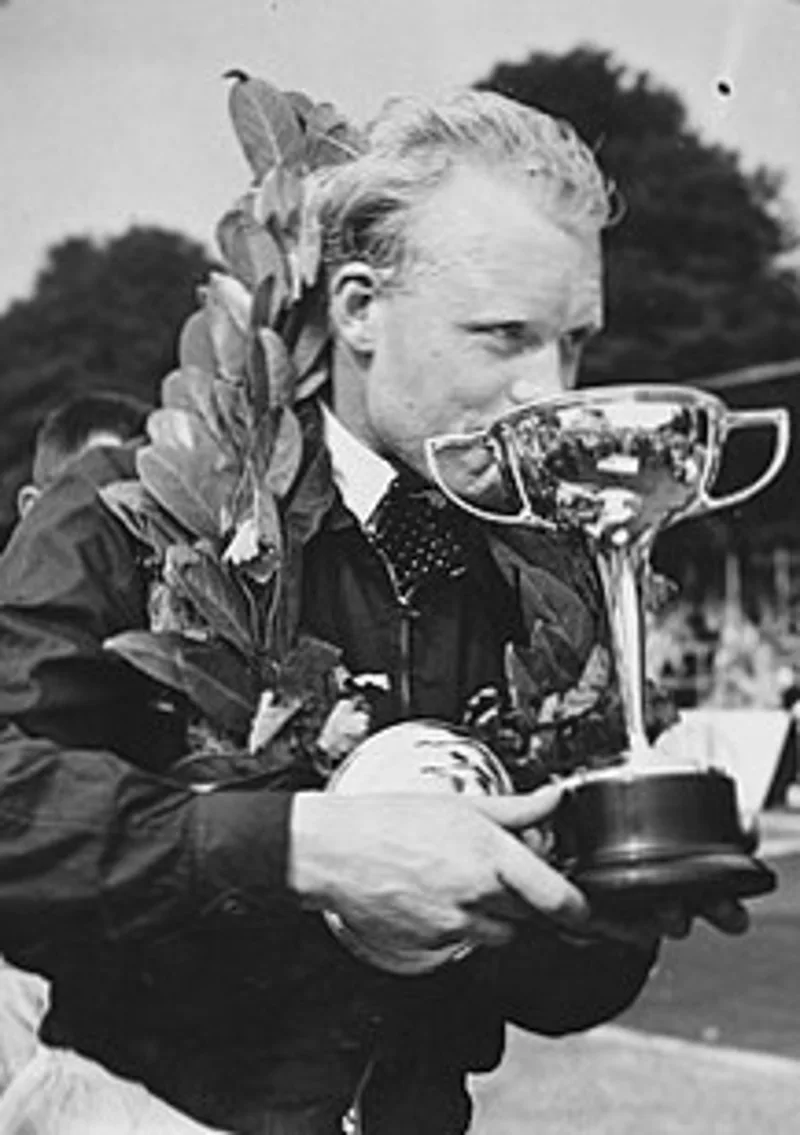
The 1954 season brought his first Formula One victory, at the Oulton Park International Gold Cup, in a Maserati 250F. He had bought that car after Mercedes racing boss Alfred Neubauer suggested he move to a better machine to show what he could do.
How did Moss's Mercedes years begin in 1954 and 1955?
Moss raced a Maserati in 1954 and was signed by Mercedes for 1955 after a strong run. The 1955 British Grand Prix gave him his first World Championship win, with Mercedes finishing 1-2-3-4 behind him.
At the 1954 Italian Grand Prix Moss passed Juan Manuel Fangio and Alberto Ascari to lead the race. His Maserati then suffered an engine failure at lap 68, and Fangio went on to take the victory.
Neubauer had already been impressed when Moss tested a Mercedes-Benz W196 at Hockenheim, and the team signed him for 1955. The British Grand Prix that year was the first time Moss had beaten Fangio, his teammate, rival and mentor.
That season he also took the RAC Tourist Trophy, shared the Targa Florio with Peter Collins, and added the Mille Miglia. It was a remarkably busy year for him, and he finished runner-up to Fangio in the championship.
What made Moss's 1955 Mille Miglia win so famous?
Moss won the 1955 Mille Miglia, a famous road race across Italy, with the journalist Denis Jenkinson as his co-driver. The pair finished in ten hours and seven minutes, a time that still ranks among the most celebrated drives the sport has seen.
Moss also took a pill that Fangio had given him before the race. He later said that such stimulants were common in rallies, where the aim was simply to stay awake.
Jenkinson prepared pace notes for the event, and the two men worked out a set of hand signals so that they could communicate over the noise of the engine.
Why did Moss lose the 1958 title to Mike Hawthorn?
Moss lost the 1958 championship to Mike Hawthorn by a single point, despite collecting four race wins to Hawthorn's one. A misread pit signal and his own decision to defend Hawthorn at the Portuguese Grand Prix both played a part in that outcome.
When Hawthorn faced a possible penalty after the Portuguese race, Moss defended him before the stewards. Hawthorn had been accused of reversing on the track after stalling on an uphill section, and Moss's explanation helped preserve Hawthorn's 6 points for second place.
The signal problem came at a race where the pit crew told Moss that Hawthorn had set the fastest lap. Moss read the signal differently and did not try to take the fastest lap himself, which cost him the point that would have been awarded for it.
Moss's sporting attitude, which he showed in defending Hawthorn, is still cited as a clear example of fair play in the sport.
How did Moss's Walker years and Monaco wins go?
From 1959 to 1961 Moss raced for the Walker team and finished third in the championship three times. He won the 1960 Monaco Grand Prix in a Lotus 18 and the 1961 Monaco race by 3.6 seconds.
His 1960 Monaco victory came in a Coventry-Climax-powered Lotus 18. A serious practice accident at Belgium then kept him out of the next three races, but he returned to win the United States Grand Prix, the final race of the season.
In 1961 the new 1.5-litre rules favoured Enzo Ferrari's V6 Ferrari 156, and Moss's Lotus was underpowered by comparison. Even so, he won the Monaco Grand Prix ahead of three rivals, Ginther, von Trips and Hill, and then took the German Grand Prix.
His sports car record was just as strong. He won three consecutive 1000 km Nurburgring races from 1958 to 1960, and the 1960 race was won with Dan Gurney in a Maserati Tipo 61 after a difficult wet spell.
Away from the Grands Prix he also collected the Nassau Cup in both 1956 and 1957, in the Bahamas. In 1957 he won the Pescara race on a 25 km circuit, beating Fangio by approximately 3 minutes in a race lasting three hours.
What happened in Moss's 1962 crash at Goodwood?
On 23 April 1962 Moss crashed his Lotus during the Glover Trophy at Goodwood. He was 32 at the time. The crash caused a coma lasting a month, and his left side stayed paralysed for six months.
He recovered, but he felt he had not regained the instinctive command of the car that he once had. He retired from professional racing after a 1963 test in a Lotus 19, a session in which his pace fell a little short of his old form.
Across those years his championship finishes were second four times in succession and third three times afterwards.
What speed records did Moss set away from Formula One?
Moss set several land speed and endurance records. In 1950 he and Leslie Johnson averaged 107.46 mph for 24 hours at Montlhery, and in 1957 he broke five International Class F records at Bonneville in the MG EX181.
No production car had managed an average above 100 mph over 24 hours at Montlhery before that run.
In 1952 Moss was one of four drivers who spent 7 days and nights in a Jaguar XK120 at Montlhery. The crew set four World records and five Class C records on that run.
The streamlined, supercharged MG EX181 reached 245.64 mph over the flying kilometre, judged from two runs made in opposite directions.
What did Moss do after his racing career?
From 1962 Moss worked as a colour commentator on ABC's Wide World of Sports, a role he kept until 1980. He returned to competition in 1980 with an Audi in the British Saloon Car Championship and announced his final retirement from racing in 2011.
In 2004 Mercedes-Benz reunited him with the 300 SLR in which he had won the Mille Miglia, a promotional event for a new model.
He co-narrated the 1988 Formula One season review with Tony Jardine, and he also provided the narration for the children's series Roary the Racing Car. His public profile remained high long after he stopped racing regularly.
Honours followed his career. In 1961 the BBC named him Sports Personality of the Year, the International Motorsports Hall of Fame took him in 1990, and he was knighted on 21 March 2000 for services to motor racing.
In 2006 the FIA awarded him its gold medal for his outstanding contribution to motorsport.
He also received the 2005 Segrave Trophy. In 2008 McLaren-Mercedes unveiled a final SLR model named the Mercedes McLaren SLR Stirling Moss.
A 2016 academic paper on the influence of driver and machine placed him 29th among Formula One drivers across history.
How did Moss's championship finishes look season by season?
| Season | Championship position | Key result |
|---|---|---|
| 1955 | 2nd | Mercedes; first World Championship win at the British Grand Prix |
| 1956 | 2nd | Runner-up to Fangio with Maserati and Vanwall |
| 1957 | 2nd | Pescara race win, about 3 minutes ahead of Fangio |
| 1958 | 2nd | Four wins; one point behind Hawthorn |
| 1959 | 3rd | Walker team |
| 1960 | 3rd | Monaco Grand Prix win in a Lotus 18 |
| 1961 | 3rd | Monaco Grand Prix and German Grand Prix wins |
In Formula One he recorded 16 victories, 16 poles, 19 fastest laps and 24 rostrum finishes. The 16 wins remain the record for a driver who never became World Champion.
Stirling Moss's legacy
Together these runs show how far his talent extended beyond Grands Prix.
Moss is remembered as a driver whose versatility stood out across sports cars, rallying, record attempts and Grands Prix. He also helped Vanwall break the German and Italian grip on Formula One, and he preferred to race British cars whenever he could.
On his 80th birthday in 2009, the Goodwood Revival staged a parade of 80 cars on each of its three days, and Moss drove a different car each day.
Moss also appeared on screen in 1964's The Beauty Jungle, and he was among several celebrities who made cameo appearances in the 1967 Casino Royale.
His life after racing kept him in the public eye through commentary and television. After his death the Goodwood Revival renamed its Kinrara Trophy race in his honour.