A Le Mans win for Jaguar, a famous Reims victory and a title won by a single point: the short, intense career of Britain's first Formula One champion.
Mike Hawthorn was Britain's first Formula One champion, taking the 1958 title with Ferrari by a single point over Stirling Moss. He also won the 1955 Le Mans 24 Hours for Jaguar, and he was killed in a road crash only months after retiring.
Mike Hawthorn was the first British driver to win the Formula One world championship, and he did it with Ferrari in 1958. His career was brief and intense, marked by a famous Reims victory and one of motorsport's worst disasters at Le Mans, and it ended in a road accident only months after he won the title.
Who was Mike Hawthorn?
John Michael Hawthorn was a British driver whose Formula One career ran from 1952 until 1958. He won the world title with Ferrari in 1958 by a single point, and he also won the 1955 24 Hours of Le Mans for Jaguar. He died in a road accident in January 1959.
Hawthorn was born on 10 April 1929 in Mexborough, Yorkshire, and was educated at Ardingly College in West Sussex before training at Chelsea technical college. His father ran the Tourist Trophy Garage in Farnham, a franchise that supplied and serviced high-performance brands including Jaguar and Ferrari.
His father raced motorcycles and encouraged his son's racing. When his father died in a road accident in 1954, Hawthorn inherited the garage, which he would keep running alongside his racing career.
A Ferrari title won by a single point, a Le Mans win for Jaguar and a career that burned bright and ended too soon.
How did Hawthorn start racing?
Hawthorn's first competition outing came on 2 September 1950 at the Brighton Speed Trials, where he took the 1,100 cc sports car class in a Riley. In 1951 he won the Motor Sport Brooklands Memorial Trophy by a single point, a season-long contest at Goodwood.
That same season he took the Leinster Trophy at Wicklow, alongside an Ulster Trophy Handicap success at Dundrod, which showed how quickly he was learning to win on different circuits.
He switched to single-seaters in 1952, and his first win came in a Cooper-Bristol T20 Formula Two car at Goodwood that season. Those results caught the eye of Enzo Ferrari, who then made him a works offer.
How did Hawthorn's Formula One career begin?
His first Formula One start came at the 1952 Belgian Grand Prix, where he finished fourth. By the end of that season he had a third place at the British Grand Prix, which gave him his first podium. Joining Ferrari for 1953 gave him the chance he had been looking for, and that year he won the French Grand Prix.
In 1953 he won the French Grand Prix at Reims at his ninth attempt, outmanoeuvring Juan Manuel Fangio in a race later described as the race of the century. The leading four finished inside five seconds of one another after 60 laps.
He finished fourth overall in the championship that year. He also collected the BRDC International Trophy, enjoyed Ulster success, and won the 24 Heures de Spa, sharing that win with Giuseppe Farina, his Ferrari teammate.
How did Hawthorn's 1955 season unfold?
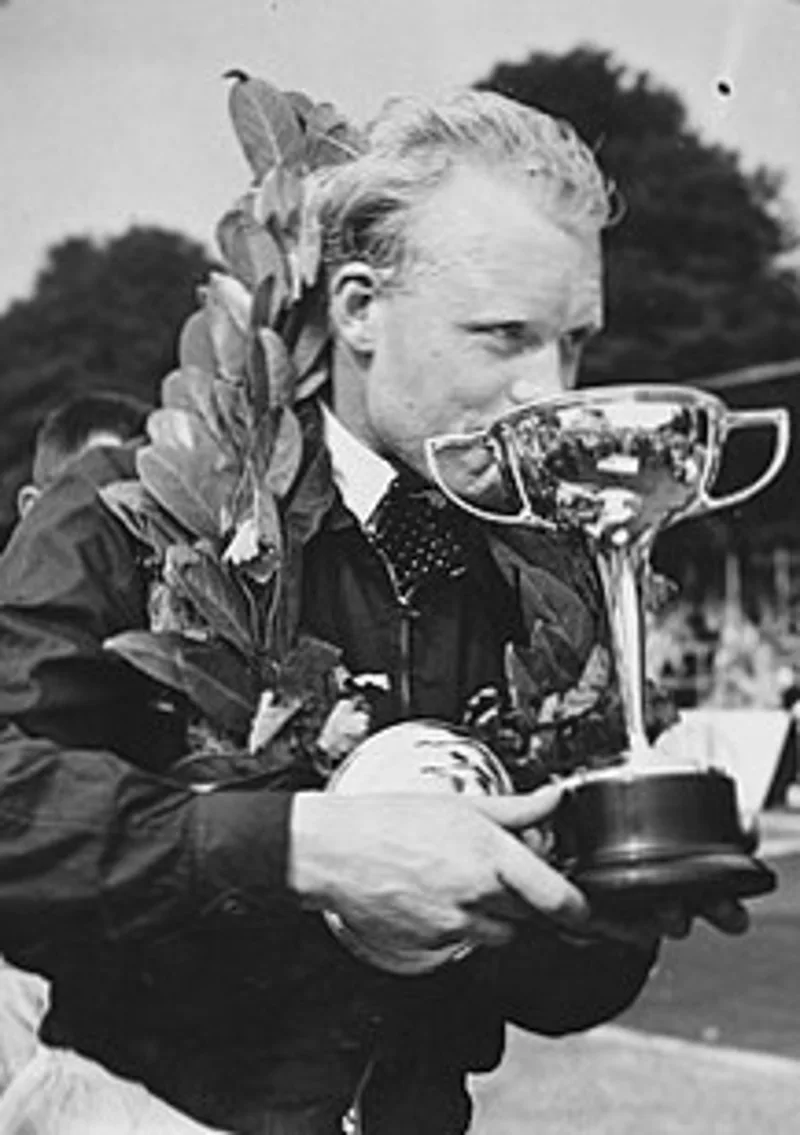
In January 1955 Hawthorn signed for Jaguar in place of Stirling Moss, who had gone to Mercedes. That year he won the 24 Hours of Le Mans, a race that will always be linked with a tragedy in which 83 spectators and the Mercedes driver Pierre Levegh were killed.
He set the lap record for the race, at a little over four minutes, during a three-hour duel with Fangio early on. The race was overshadowed by a crash that is still regarded as the sport's gravest disaster.
The official inquiry ruled that Hawthorn was not responsible and that the accident was a racing incident, although the death toll led to a wider debate about safety. The track had changed little since the first race in 1923, when cars were typically around 100 km/h (60 mph).
By 1955 the quickest cars were approaching 270 km/h (170 mph), and the spectator area was separated from the track by an earthen bank of 4 ft (1.2 m). The disaster led to motorsport bans in several countries while the tracks were brought up to a higher standard.
What happened at Dundrod in 1955?
Hawthorn shared a Jaguar D-Type with Desmond Titterington at the 1955 RAC Tourist Trophy race at Dundrod. He overtook Fangio twice and set the circuit's lap record, but he lost the race on the final lap when the car's engine failed and Stirling Moss went past.
The same year brought a serious crash while he was racing a D-Type in Italy, which left him with severe burns. It was his second bad accident of the year, and it left him disillusioned with racing. He still believed a return to Ferrari could bring him a championship.
Why did the BRM years fail to deliver?
In 1956 Hawthorn moved to BRM, but the team proved a failure. His only podium with BRM came in Argentina, where he guest-drove a Maserati 250F because his own car did not appear. The new 2.5-litre BRM was quick when it ran, but he eventually walked out of the team.
At Silverstone in 1956 he kept Fangio behind him while leading the first 25 laps of the British Grand Prix, but he retired before half distance because of handling and brake problems.
He had grown deeply unhappy with the team's management and car preparation. He rejoined Ferrari in 1957, and there he formed a close bond with Peter Collins, another English Ferrari driver.
How did Hawthorn win the 1958 title?
Hawthorn won the 1958 world championship with only one race victory, against four for Stirling Moss. He took the title by a single point, which made him the first English driver to win the Formula One championship. Moss finished one point behind him.
The title was settled in the season's last race, held in Morocco. Hawthorn drove a cautious race to keep ahead of the Vanwall drivers chasing him, and when second-placed Phil Hill slowed late on, Hawthorn was waved through to take the points he needed.
At Monaco that year he was in front at half distance, until his 246 engine blew, and at Monza he was a minute clear of Tony Brooks before a clutch problem forced him to slow to second.
Moss's sportsmanship at Porto mattered too. Hawthorn was disqualified there for bump starting a stalled car downhill, but Moss spoke up for him and the decision was reversed. Hawthorn then drove back through the field to take an extra point for fastest lap.
His win total is still shared with Keke Rosberg as the fewest wins by a champion in a title-winning season. He retired immediately after winning the title.
What was the rivalry with Luigi Musso and Peter Collins?
Hawthorn and Collins found themselves in a fierce contest with Luigi Musso, the Italian driver who was also in the Ferrari team. Their contest was largely over prize money. Musso was fatally injured at Reims in 1958, and Collins died at the German Grand Prix.
According to Fiamma Breschi, who was in a relationship with Musso when he died, the two Englishmen shared winnings under an agreement that excluded Musso. She described the antagonism as something that pushed all three drivers to take more risks.
How did Hawthorn die?
Hawthorn died on 22 January 1959, about three months after retiring, in a road collision on the A3 bypass at Guildford, near Onslow Village. He was driving a modified 1958 Jaguar 3.4-litre saloon, and the precise cause was never established. The accident was investigated, but no single explanation was ever confirmed.
The stretch of road was notorious, having been the scene of 15 serious accidents, two of them fatal, in the previous two years, and the surface was wet. One witness estimated his speed at 80 m.p.h.
He had been overtaking a Mercedes-Benz 300SL driven by an acquaintance, the team manager Rob Walker, when he clipped a bollard on a right-hand bend. The Jaguar then crossed the carriageway and struck a tree.
In an interview in 1988, Walker admitted that he had indeed been racing Hawthorn, though he had been advised by a police officer not to mention it. Investigators considered driver error, a blackout and a mechanical fault, but the wreck showed no obvious defect.
The coroner's inquest recorded a verdict of accidental death on 26 January. He lies in West Street Cemetery in Farnham, the town where he had lived and run the garage.
What is Hawthorn's legacy?
Hawthorn is remembered as the first British Formula One champion to win the title, and the Hawthorn Memorial Trophy, set up by the RAC in 1959, honours the most successful British or Commonwealth driver each year. Lewis Hamilton has won the trophy eleven times, more than anyone else.
Goodwood has a statue honouring him, recognising his place as the country's first title winner. In Farnham, Mike Hawthorn Drive and the garage that bears his name keep his memory local. Brands Hatch has a hill and corner named after him, and Croft has a corner linked to his name.
In 1958 and 1959 he wrote children's books in which a fictional character, Carlotti, joined a team, and in which real drivers appeared. He wore a bow tie when racing, which earned him the nickname Le Papillon (The Butterfly) in France.
What were Hawthorn's main career results?
Hawthorn's career was short but productive, with one world title, three Grand Prix wins and two major endurance victories. The table gathers his key results, which show a driver whose achievements came in a handful of seasons rather than a long career.
| Measure | Detail |
|---|---|
| Born | 10 April 1929, Mexborough |
| Died | 22 January 1959, A3 Guildford bypass |
| Formula One seasons | 1952 to 1958 |
| Grand Prix wins | 3 across 7 seasons, in 1953, 1954 and 1958 |
| World title | 1958 with Ferrari, by one point |
| 24 Hours of Le Mans | 1955 winner with Jaguar |
| 12 Hours of Sebring | 1955 winner with Jaguar |
| Hawthorn Memorial Trophy | Established by the RAC in 1959 |
| Fatal car | Modified 1958 Jaguar 3.4-litre saloon |