Hawthorn and Bueb won with a Jaguar D-Type, but the race is remembered for the crash that killed Pierre Levegh and spectators in the crowd.
The 1955 24 Hours of Le Mans went to Hawthorn and Bueb in a works Jaguar D-Type, which completed 306 laps. The event is remembered for a catastrophic accident involving Pierre Levegh's Mercedes-Benz, which killed Levegh and spectators in what remains the deadliest accident in motorsport history.
Mike Hawthorn and Ivor Bueb won the 1955 24 Hours of Le Mans in a works Jaguar D-Type after 306 laps. The race is remembered for something else, though. At the end of lap 35 a collision sent Pierre Levegh's Mercedes-Benz into the crowd, and the accident became the deadliest in motorsport history.
Why is the 1955 Le Mans race remembered for disaster?
At 6.20pm on lap 35, Mike Hawthorn braked sharply for his pit entry, and Lance Macklin's Austin-Healey braked and ran onto the dusty edge of the track. Levegh's Mercedes-Benz, running a lap down, ran into the rear corner of the British car and threw it into the spectators. The official report cites 80 spectators killed and 178 injured.
Jaguar won the race, but the crash decided how the sport would be remembered.
Mercedes-Benz returns with the 300 SLR
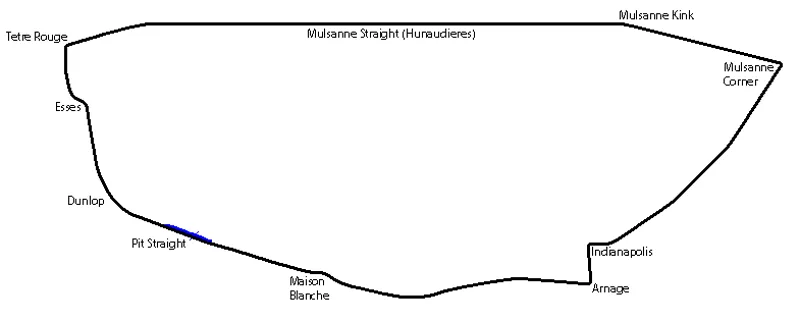
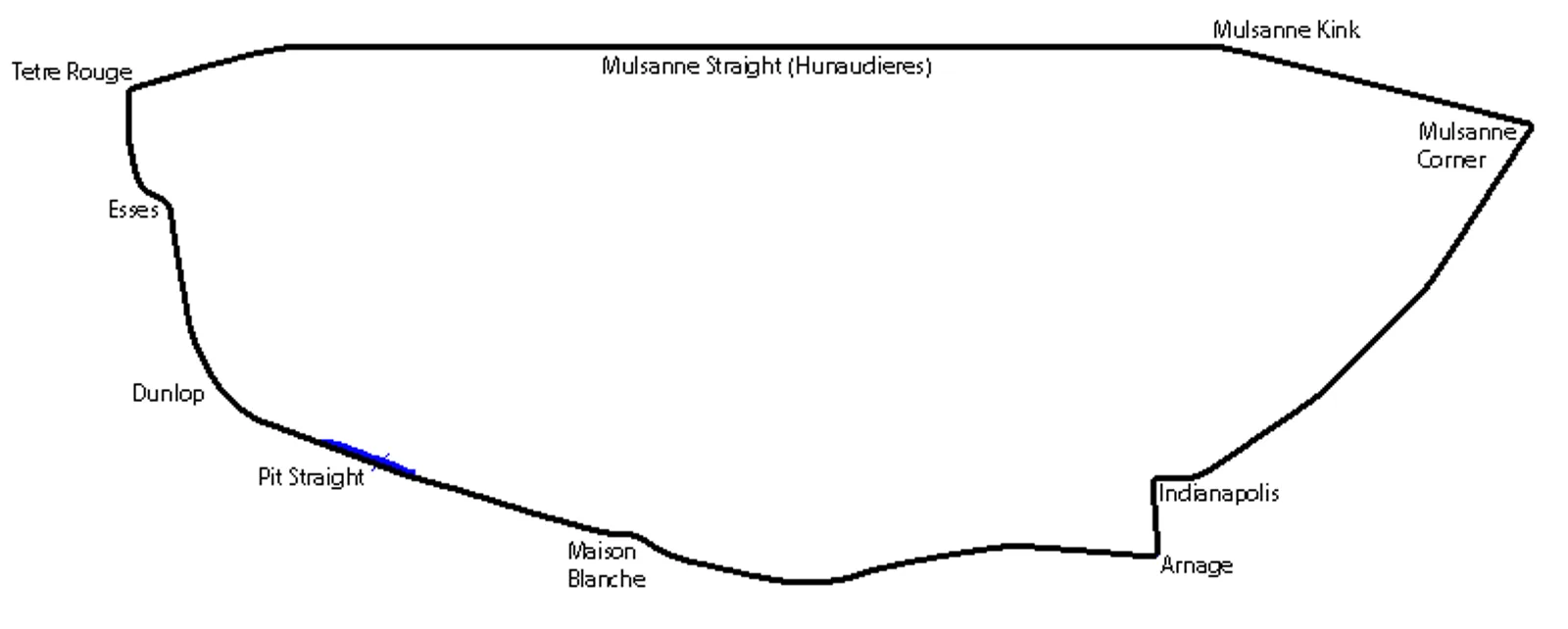
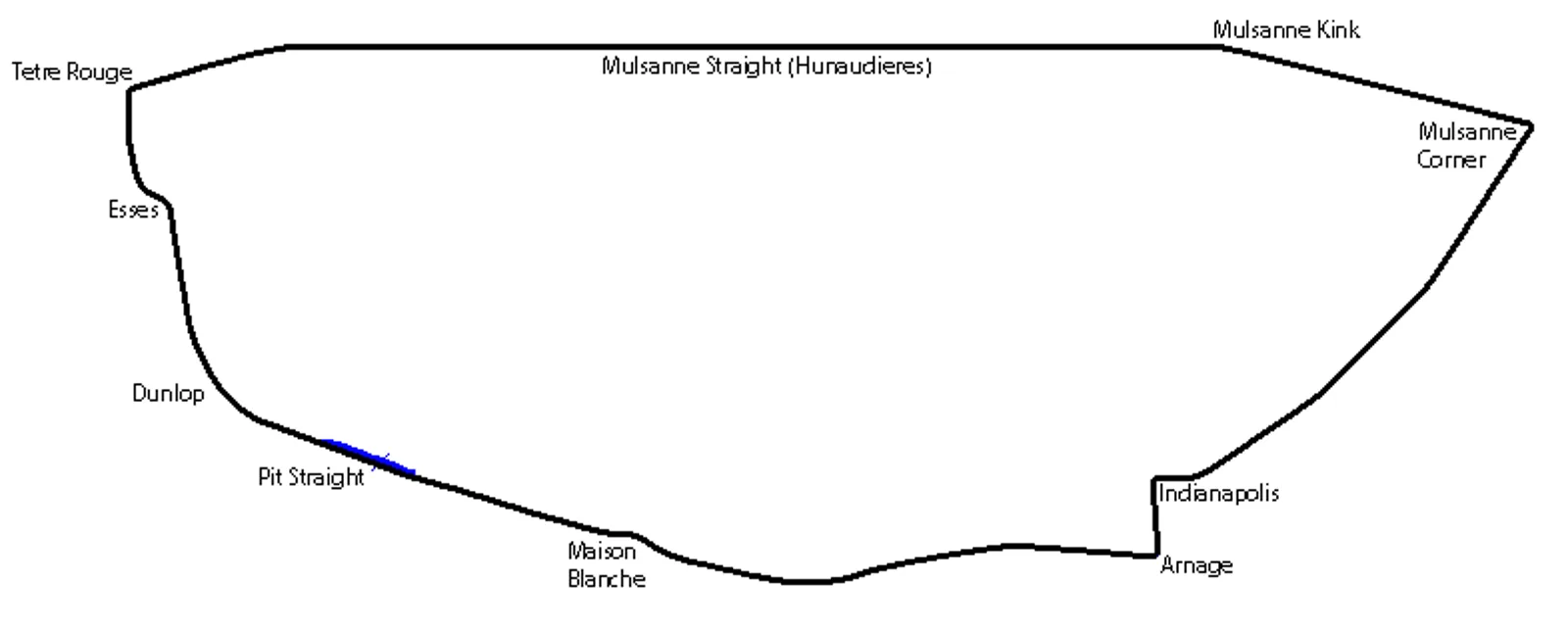
Mercedes-Benz arrived at La Sarthe fresh from a 1-2 debut win in the Mille Miglia with the 300 SLR, and the team knew what it needed to win. The fuel-injected 3.0-litre straight-eight was the most advanced engine in the field, and by the end of the season it was producing 300 bhp. Its weak point was braking from the long Mulsanne straight, where the inboard drum brakes were stretched by the heavier chassis.
To help, the team fitted a larger hand-operated air brake to the rear deck. The ACO allowed it only after glass-covered viewing ports were added. Alfred Neubauer, the team manager, had already guided Mercedes-Benz to victory in 1952 with Hermann Lang, and this time his squad was more international and more experienced. Fangio and Moss ran in the lead car, a deliberate choice that kept the two strongest drivers from racing each other.
Which teams and drivers were entered?
Jaguar brought three works D-Types with 270 bhp, Ferrari fielded the new 735 LM with a 360 bhp straight-six, and Mercedes-Benz ran three 300 SLRs. Aston Martin, Maserati and Gordini made up the mid-field, and 27 British cars started, nearly half the field.
Jaguar's three works cars had their engines lifted from 250 to 270 bhp for the year. Rolt was paired with Hamilton, Hawthorn with Bueb, and Norman Dewis with Don Beauman. Hawthorn had moved across from Ferrari and was an up-and-coming English star.
Ferrari's answer was the 735 LM, a straight-six rather than the V12s the marque usually built. Castellotti shared his car with Marzotto, Trintignant with Harry Schell, and Maglioli with Phil Hill. Maglioli and Hill had been rivals in the Carrera Panamericana the year before.
The smaller teams had their own stories. Aston Martin entered three DB3S cars with disc brakes and a 225 bhp engine, and the Lagonda V12 was the biggest engine in the field. Maserati fielded two 3.0-litre 300S cars, while Gordini ran a 3-litre T24S for Jean Behra and Elie Bayol. Austin-Healey returned with a single 100S prototype after boycotting the previous year's race.
How did the race unfold in its first hours?
Castellotti led the opening lap and held Hawthorn and Fangio back for the first hour, until a late braking error at Mulsanne let the Jaguar and Mercedes past. Hawthorn later set the race lap record on lap 28, and the works cars were running at the front within the first few laps.
Fangio's start was delayed when his trouser leg caught the gear lever, but he worked his way forward quickly. The pace was furious. By the end of the fourth lap the leading group was almost entirely made up of works cars, Trintignant's Ferrari being the exception after a problem in the pits. The leaders soon began lapping the backmarkers.
On lap 5 the tiny Nardi was blown off the road into a ditch by the slipstream of the bigger cars, one of the first casualties of the race. Behind the leaders, the Mercedes and Jaguars circulated with Mieres's Maserati in tenth place.
The crash at the end of lap 35
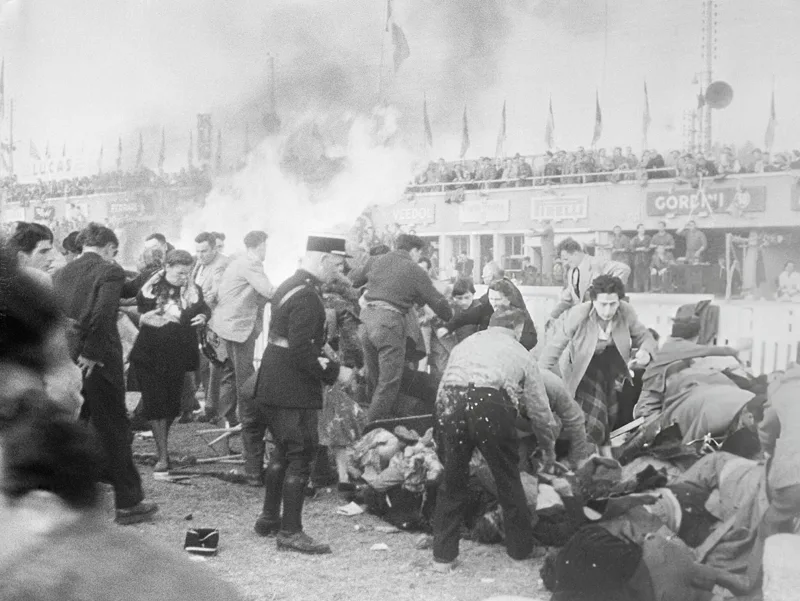
The first pit stops were due at the end of lap 35. Hawthorn had been told to come in by his Jaguar crew, and he braked hard in front of Macklin. Macklin went off the edge of the track and then swung back toward the centre. Levegh's Mercedes, running sixth and a lap down at around 150 mph, had no room to avoid him. Its right-front wheel rode up onto the left-rear corner of the Austin-Healey, launching the British car into the air.
The Austin-Healey rolled end over end for about 80 metres above the spectators. The wreckage then came down on a four-foot earth embankment, the only barrier between the crowd and the circuit, and broke apart. The heaviest components were carried almost 100 metres into the crowd, and the remains on the bank caught fire. Levegh was killed instantly.
Race officials kept the race going. Their reasoning was that a mass exodus from the grandstands would block the roads needed by ambulances and rescue crews. Hawthorn, initially waved through his stop, joined the other leaders at their scheduled pit stops. Thirteen minutes after the first crash, Dick Jacobs' MG overturned at Maison Blanche and burned. Jacobs survived with severe injuries and never raced again.
Ferrari's challenge ended soon afterwards. Castellotti and Marzotto retired just before 8pm after a slipping clutch led to engine failure, and Maglioli and Hill, who had held third place, were stopped around 11pm when a rock pierced their radiator.
Did the race carry on after the crash?
Officials let the race continue, because a mass exodus from the grandstands would have blocked the roads that ambulances and rescue crews needed. Mercedes-Benz withdrew its cars in the early hours, after its directors met in Stuttgart, while Jaguar kept racing and Lofty England declined to follow the German team.
Chief engineer Rudolf Uhlenhaut, who had been born and raised in England, went to the Jaguar pits to ask whether the British team would withdraw out of respect for the victims. Lofty England refused. Mercedes-Benz had been running first and third when Alfred Neubauer waited until many spectators had left, stepped onto the track at 1.45am and quietly called his cars in. The public address system announced their retirement.
John Fitch had urged the German team to pull out early, seeing that a win or a loss would be a public relations disaster either way. Neubauer agreed but lacked the authority to decide alone, so the company directors made the call, approving the withdrawal just before midnight.
How the Jaguars and the back of the field fared through the night
Don Beauman had taken more than an hour to free his works Jaguar from the Arnage sandtrap, and it was only moving again after 10pm when Colin Chapman ran into it. Chapman reversed and rejoined, but officials disqualified him for restarting without a marshal's permission.
The Aston Martins were running to a strict lap-time target set by team manager John Wyer and kept just inside the top ten. Two of them were sidelined by mechanical trouble either side of midnight, and a sister Lagonda ran out of fuel after its filler cap came loose. In the 2-litre class the Maserati and the Gordini fought each other, until the Maserati retired after midnight with ignition failure.
Why did Jaguar take the lead once Mercedes-Benz had gone?
Once Mercedes-Benz had withdrawn and the last Ferrari had retired, Jaguar held a comfortable 1-2 position, although Rolt and Hamilton were having gearbox trouble. Hawthorn had cut the leaders' advantage to a lap and a half by 2am, and the Jaguars kept pressing through the early morning.
Spotters had reported on the Mercedes braking points, and those reports had convinced the Jaguar team that the German brakes were weakening. Rolt and Hamilton's car was having gearbox trouble, but the team held to its plan through the night.
Morning brought rain. By 6am it was falling steadily, and the class-leading Gordini pitted with a holed radiator and had to retire. Around 8am the second Jaguar's gearbox seized. The Maserati of Valenzano and Musso, five laps down, was pushing for second until its transmission seized, and the Cunningham, lapping in 13th, had already lost its lower gears the night before.
Who won the 1955 24 Hours of Le Mans?
Hawthorn and Bueb won in a Jaguar D-Type after 306 laps, finishing five laps ahead of the Aston Martin. It was the first Le Mans win for Hawthorn, who had switched to Jaguar from Ferrari, and it came in a race overshadowed by the crash earlier in the evening.
Bueb handed the leading Jaguar over to Hawthorn for the final 15 minutes, and the pair coasted home through drizzle. Their 306 laps were a record for the race. Ecurie Francorchamps' yellow Jaguar, driven by Claes and Swaters, was third, eleven laps behind.
Hawthorn was relieved to have won his first Le Mans, yet he was devastated by what had happened on the track. A press photograph showed him smiling on the podium with the victor's champagne, and the French press ran it under the headline 'Here's to You, Mr Hawthorn'.
Final classification
| Place | Entry | Result |
|---|---|---|
| 1st | Jaguar D-Type, Hawthorn and Bueb | 306 laps |
| 2nd | Aston Martin DB3S | Five laps behind |
| 3rd | Jaguar D-Type, Ecurie Francorchamps (Claes and Swaters) | Eleven laps behind |
| 4th to 6th | Porsche 550 Spyder | Three cars finished in a row, the S-1500 class going to Polensky and von Frankenberg |
| 7th to 9th | Bristol, three-car team | Finished as a team, at the top of the 2-litre class |
How did the smaller cars fare?
Porsche's three 550 spyders with 1.5L engines were the best of the small cars, finishing fourth, fifth and sixth overall. Helmut Polensky and Richard von Frankenberg won the S1500 class, and the Index of Performance and the Biennial Cup went to the same Porsche effort. The privateer Porsche also won the S1100 class.
Both leading 1.5L Porsches went further than the overall distance covered by the 1952-winning Mercedes-Benz, and five new class records were set. For the first time none of the Cunningham team cars finished.
The previous year had been a setback for OSCA, but this year the one Italian car to reach the flag was its 1.5L entry. Two DB-Panhards were the only French finishers in the small-car classes that are usually the most dependable.
What changed in motor racing safety after 1955?
A French ban on motor racing followed the crash, and it was lifted on 14 September 1955 once new rules were in place. Before the 1956 race the grandstands and pits were demolished, the road was widened and a wide ditch was added between the track and spectators.
The official inquiry found no single driver to blame. It pointed instead to a combination of circumstances, including serious deficiencies in track design and safety. The Ministry of the Interior issued new regulations for racing events, and the ACO announced that Le Mans would return in 1956 with the circuit altered to meet them.
Track safety improved slowly after that. Jackie Stewart campaigned for better measures about ten years later, and his push gained momentum after the deaths of Lorenzo Bandini and Jim Clark. Juan Manuel Fangio never raced at Le Mans again, and John Fitch and Phil Walters left racing after the crash.