More than 80 spectators died, the race kept running, and motorsport was banned in several countries. One pit-lane move became the deadliest crash in racing history.
On 11 June 1955 Pierre Levegh's Mercedes struck Lance Macklin's Austin-Healey at Le Mans, was launched into the crowd and killed an estimated 82 to 84 people. The race continued, Mercedes withdrew, several countries banned motorsport, and the inquiry criticised the old circuit's layout rather than blaming any driver.
The deadliest accident in motorsport history happened at about half past six on a Saturday evening, and the race went on through the night. More than 80 spectators were dead, the race was never stopped, and the winners stood on a podium the next day.
What happened in the 1955 Le Mans disaster?
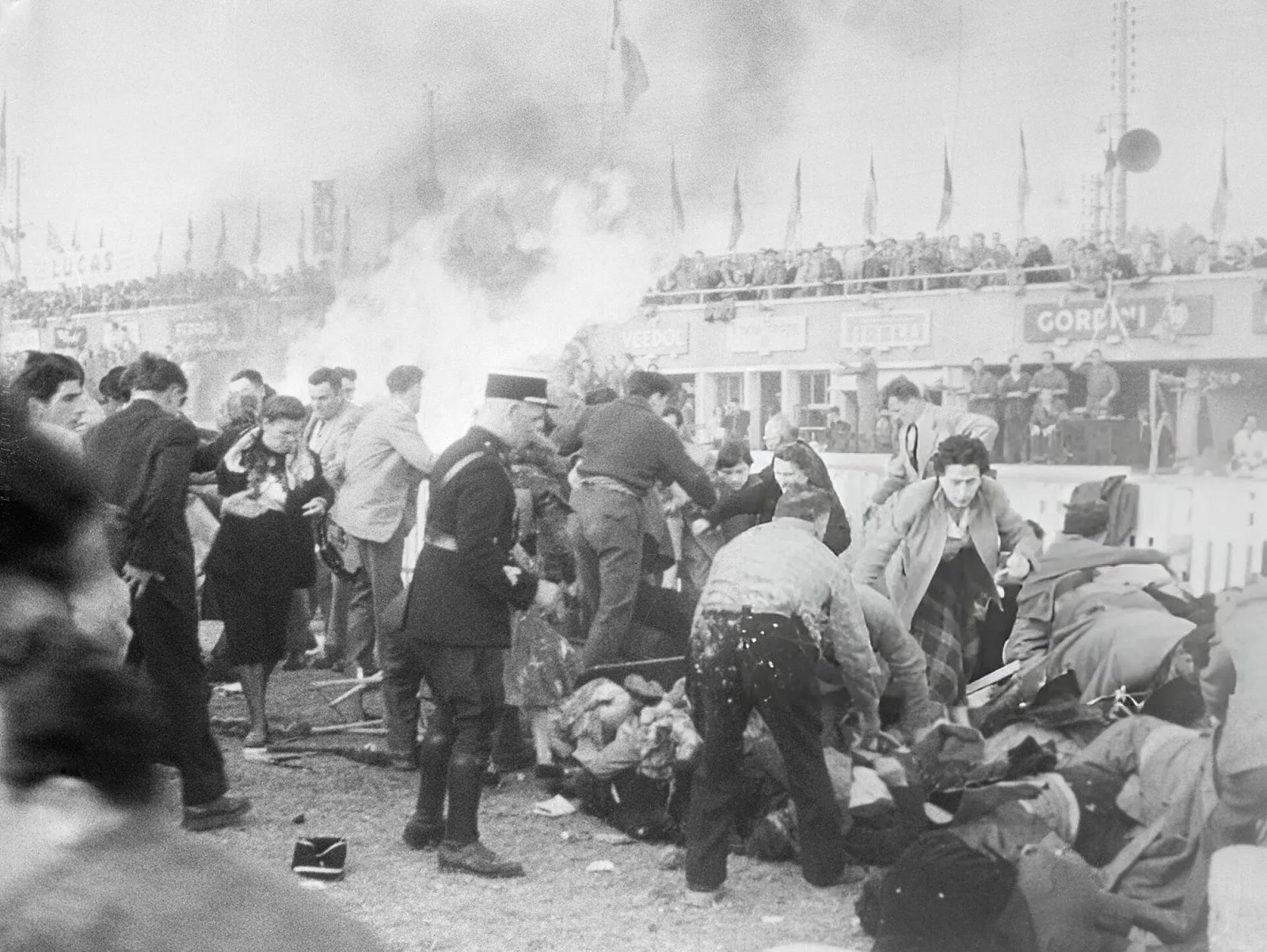
On 11 June 1955, during the 24 Hours of Le Mans at the Circuit de la Sarthe in France, Mercedes driver Pierre Levegh collided with the Austin-Healey of Lance Macklin after a manoeuvre by Jaguar's Mike Hawthorn. Levegh's car was thrown into a spectator area, and the debris killed at least 82 people.
The accident came at 6:26 pm, at the end of lap 35, as the front runners were beginning to make their first calls at the pits. The race had started at 4 pm. Eugenio Castellotti's Ferrari led the first lap, with Hawthorn's Jaguar and Juan Manuel Fangio's Mercedes close behind, and the three works teams filled the top places for much of the opening laps. Fangio's start had been slowed after his trouser leg caught the gearshift. Castellotti kept the others at bay for the first hour, and then Hawthorn and Fangio took over the duel, swapping the lead and lowering the lap record.
The official inquiry held none of the drivers specifically responsible, but criticised the layout of a 30-year-old track.
What was the build-up to the race?
Few Le Mans races had promised so much. Ferrari, Jaguar and Mercedes-Benz had each won the event before, and all three arrived with new or improved cars. The Ferraris, the reigning champions, were known to be fast and fragile. Jaguar concentrated its racing almost entirely on Le Mans and had signed an experienced line-up that included Hawthorn, who also drove for Ferrari in Formula One.
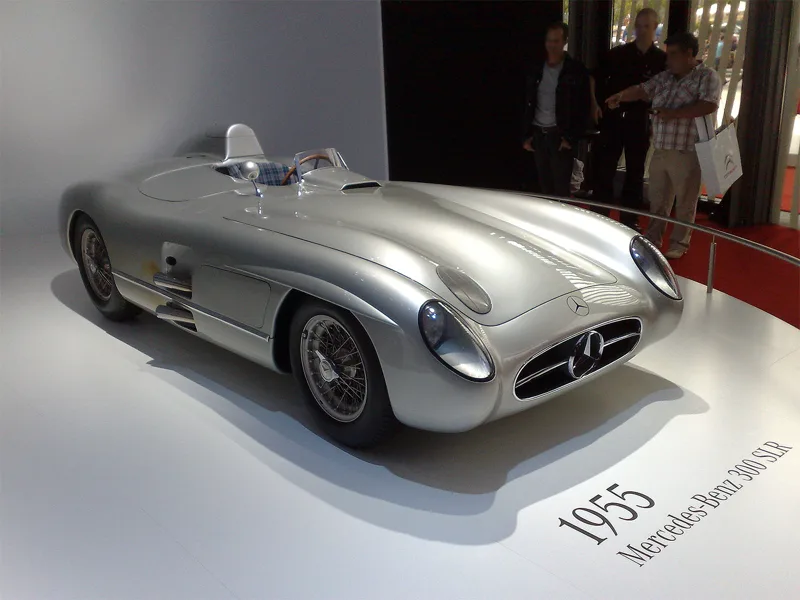
Mercedes had come off success in Formula One with its new 300 SLR, which won the Mille Miglia in record time for Stirling Moss, setting an event record of 157.650 km/h (97.96 mph) averaged across 1,600 km (990 mi). Its body was made of Elektron, an ultra-lightweight magnesium alloy. The car lacked the more effective disc brakes of the rival Jaguar D-Type. Its stopping power came from inboard drum brakes plus a big flap behind the driver's seat that could be flipped up to increase drag and shed speed.
Team manager Alfred Neubauer built a multinational crew: Fangio and Moss together in the lead car, Karl Kling with Andre Simon, and the American John Fitch with Levegh, one of the elder statesmen of French racing. Levegh had been the driver whose unprecedented solo drive in 1952 failed in the final hour and handed Mercedes its first Le Mans victory.
The track was the weak link. Apart from two changes that shortened it, the circuit was largely as it had been when the race began in 1923, when top speeds were typically about 100 km/h (60 mph). By 1955 the fastest cars passed 270 km/h (170 mph). The road had been resurfaced and widened after the war, and the pits and grandstands rebuilt, but nothing separated the pit lane from the racing line and the spectators stood behind only a 1.2 m (4 ft) earthen bank. The cars had no seat belts, since drivers reasoned it was better to be thrown clear than to be trapped in a burning car.
The warnings were there. During practice a series of accidents hurt several drivers, and after a close brush with a Gordini, Levegh remarked that the cars were going too fast and that some sort of signal system was needed. Neubauer asked the organisers for permission to build a little signal tower at the head of the pit line for his team. The request was turned down.
How did Pierre Levegh's crash unfold?
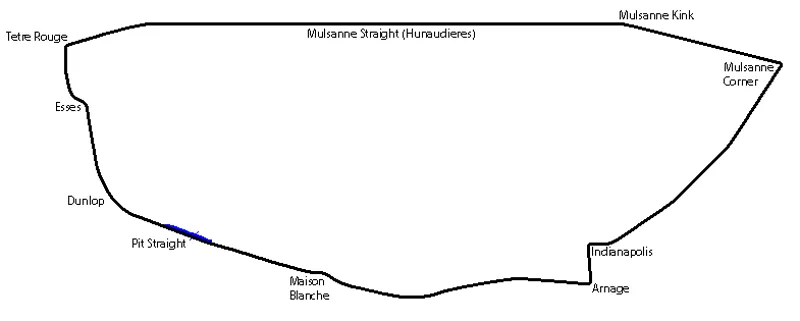
By lap 35 Hawthorn and Fangio were still fighting over first place. Hawthorn's crew had told him the lap before to come in on the next one. He had just passed Levegh, a lap down in sixth, and he was determined to hold off Fangio for as long as possible. Leaving Maison Blanche he caught Lance Macklin, who saw him coming and moved right to let him through.
Approaching the main straight, Hawthorn raised his hand to show he was pitting, pulled across to the right, and braked hard with the Jaguar's disc brakes. His speed fell sharply and Macklin was caught out.
Two features of the layout made things worse. There was no deceleration lane for cars entering the pits, and a very slight right-hand kink sat in the road just before Hawthorn started braking. Macklin also stamped on his brakes, drifted off the right-hand side and threw up dust, then swerved left to avoid the Jaguar. His car veered across towards the middle of the track, briefly out of control.
That put him in front of Levegh's Mercedes, which was closing at over 200 km/h (120 mph) with Fangio waiting to pass. There was no time for Levegh to take avoiding action. As he was about to hit, he raised a hand to warn Fangio, who squeezed through the wreckage and went past Hawthorn's stationary Jaguar in the pits. Fangio later maintained that the signal had been a deliberate warning that saved him from the crash.
Why was the death toll so high?
The mechanism was cruelly simple. The Mercedes's front-right wheel climbed up the left rear of Macklin's car, and the angle worked as a launch ramp. The Mercedes was launched into the air and rolled end over end for 80 m (260 ft). Levegh was thrown out and hit the ground, and the impact crushed his skull and killed him instantly.
The kink in the road had sent the car on a direct line towards the packed terraces. It landed on the earthen embankment, bounced, and struck a concrete stairwell structure, where it disintegrated. The heaviest parts, the engine block, radiator and front suspension, flew into the crowd for almost 100 m (330 ft). Spectators who had climbed ladders and scaffolding for a better view, and those crowding the underpass that led to the pits, were directly in the path of the debris.
Then came the fire. When the rear of the car came to rest on the embankment, its fuel tank exploded. The heat lifted the remaining Elektron bodywork past its ignition point, which is lower than that of other metal alloys because of the high magnesium content. Think of a chip-pan fire: water is the wrong answer, and rescue workers who were unfamiliar with magnesium fires poured water on the blaze and made it far more intense. The car burned for several hours.
Macklin's damaged car, meanwhile, hit the left-side barrier and veered right into the pit lane. It narrowly missed the Mercedes of Kling, the Maserati of Roberto Mieres and the Jaguar of Don Beauman, all stopped for fuel, then struck the unprotected pit wall. It struck a policeman, a photographer and two officials, leaving all four seriously hurt, before rebounding across the track. Macklin escaped without injury and jumped out over the bank.
How many people died?
Between 82 and 84 people died, including Levegh.
About half an hour after the crash, Fitch went to the media centre to telephone his family and tell them he was safe. A reporter nearby was dictating a story that put the confirmed dead at 48.
Why did the race go on, and why did Mercedes withdraw?
Many expected a red flag. Instead, the officials, headed by race director Charles Faroux, let the cars run. In the days afterwards Faroux gave several reasons. If the enormous crowd had tried to leave at once, it would have clogged the main roads and blocked ambulances and medical teams. Participating firms might have sued the organisers for large sums. He cited the "rough law of sport" and pointed to the 1952 Farnborough Airshow crash as precedent. And he said that only the prefect, Pierre Trouille, as the onsite representative of the Ministry of the Interior, had power to stop the race.
Fitch urged Mercedes to pull out. Neubauer had already reached the same view but could not decide it himself. A telephone vote of the company's directors in Stuttgart approved the withdrawal just before midnight. Neubauer waited until 1:45 am, when many spectators had gone home, then walked onto the track and quietly called in his cars, which were running first and third. By morning the Mercedes trucks had left. Chief engineer Rudolf Uhlenhaut went to the Jaguar pits to ask whether the British team would follow out of respect for the victims, but Jaguar team manager "Lofty" England declined.
Jaguar kept racing. With Mercedes gone and the Ferraris all out, its main opposition had disappeared. Hawthorn and Ivor Bueb won by five laps from Aston Martin, in weather that had turned grey on Sunday morning and with no victory celebration. A press photograph still showed Hawthorn smiling on the podium and drinking champagne, and the French magazine L'Auto-Journal printed it with a sarcastic caption. Hawthorn had stopped at his pit after the crash and was told to go out for another lap to get away from the confusion. When he stopped on the next lap he staggered from the car believing he had caused the catastrophe.
The inquiry reached a different judgement. It held none of the drivers specifically responsible, and instead criticised the layout of a track that was 30 years old and not built for cars this fast.
Who was Pierre Levegh?
He was born Pierre Bouillin in Paris on 22 December 1905, and took the racing name Levegh as a tribute to his uncle Alfred Velghe, an early pioneer of the sport who died in 1904. He also played ice hockey and tennis. In Formula One he started six races for Talbot-Lago in 1950 and 1951, retiring from three of them without scoring.
At Le Mans he raced four times for Talbot and finished fourth in 1951. His 1952 drive is the one people remember. He drove alone, held a four-lap lead, and lost it when the engine failed in the final hour. A bolt in the central crankshaft bearing had worked loose many hours earlier, though many fans put it down to tiredness. Levegh would not hand over to his co-driver, convinced that he alone could bring the car home. He was eighth in 1953 and had an accident in the seventh hour in 1954. In 1955 Mercedes tempted him away from Talbot to share its 300 SLR with Fitch. He is buried in the Pere Lachaise Cemetery in Paris.
What changed in racing after 1955?
The immediate reaction was a wave of temporary bans: France, Spain, Switzerland and West Germany, among others, stopped racing pending safety upgrades at their circuits. The 1955 events that followed were hit hard: the next World Sportscar Championship round at the Nurburgring was cancelled, as was the Carrera Panamericana, and the July German Grand Prix fell as well.
| Who | Response |
|---|---|
| France | Lifted its complete ban on 14 September 1955; the Ministry of the Interior issued new racing regulations and codified an approval process for future events |
| Most other countries | Lifted their bans within a year |
| Switzerland | Ban lasted more than 60 years; relaxed in 2015 for electric vehicles only; fully lifted in May 2022, with the change officially effective from July 2026 |
| United States | The American Automobile Association dissolved its Contest Board, sanctioning body for the Indianapolis 500 since 1904; the United States Automobile Club took over |
| Mercedes-Benz | Ended its motorsport programme at the end of 1955 and stayed away from major racing for about three decades |
| Bristol Cars | Abandoned racing and scrapped all but one of its racing cars |
For Swiss promoters the ban meant staging their circuit races abroad, in France, Italy and West Germany among other places. When the Federal Assembly began discussing it in 2003, the debate centred on traffic policy and the environment rather than safety.
The accident also changed attitudes. It was a major contributor to a shift in how much danger motor racing was expected to carry, and to a stronger push for safer courses, for onlookers and competitors. Fitch turned safety campaigner and began researching road-car safety, with some of that work reaching motorsport.
What happened to the Mercedes 300 SLR?
The 300 SLR (the letters stand for Sport, Leicht, Rennen: sport, light, racing) was based on the Mercedes W196 Formula One car rather than on the 1952 Le Mans racer or the Gullwing road car, and it was the work of design chief Rudolf Uhlenhaut. Its direct-injected straight-eight displaced 2,982 cc. Magnesium bodywork, with a relative density of 1.8 against iron's 7.8, helped hold the roadster to 901 kg (1,986 lb). Nine chassis were built, seven roadsters and two coupes.
Across the season the car won five of its six races, two of them outside the championship, and was withdrawn from the sixth while leading. Mercedes took the 1955 World Sportscar Championship even so, with a Tourist Trophy 1-2-3 at Dundrod and a Targa Florio 1-2-4 in Sicily in October, two points clear of Ferrari. The company then terminated its racing programme at the end of the season.
One of its by-products became a legend of its own. Uhlenhaut had set aside two chassis for a road-going hybrid, and after racing stopped he took one of the leftovers for his own use. With a top speed approaching 290 km/h (180 mph), the Uhlenhaut Coupe was the fastest road car of its day. One example stayed in the Mercedes-Benz Museum, while its sibling was sold on 5 May 2022 to a private collector for 135 million euros, the highest price ever paid for a car, and the money funded the creation of the Mercedes-Benz Fund.
Where this goes next
Switzerland's ban is the last chapter. The ban was fully lifted in May 2022, and the change formally began in July 2026.