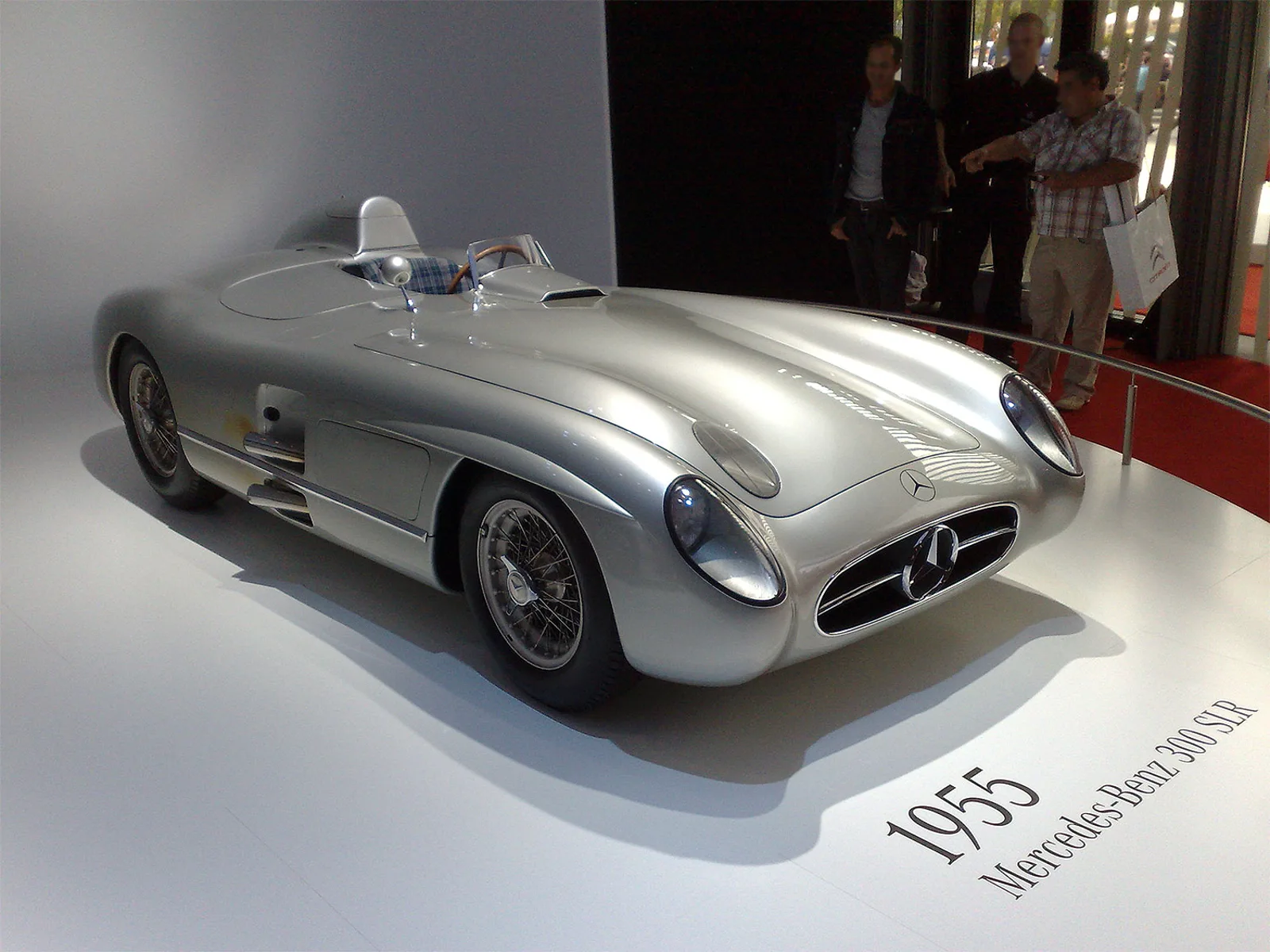
A three-litre straight-eight sports racer that won five of six races in 1955, then ended in the worst accident in motorsport history at Le Mans.
Built from the W 196 Formula One car, the 300 SLR was a 1955 sports racer with a three-litre straight-eight. Its run of five wins in six races ended at Le Mans, and its name later passed to the SLR McLaren.
The Mercedes-Benz 300 SLR was a two-seat sports racing car that competed in the 1955 World Sportscar Championship until a crash and fire at Le Mans ended its run of wins. It was built around the W 196 Formula One car with its engine enlarged to three litres, and it remains one of the most celebrated sports racers of its era.
Where did the 300 SLR name come from?
The name comes from SL-R, shorthand for Sport, Leicht and Rennen, meaning sport, light and racing, and the car was later known simply as the SLR. Despite its strong resemblance to the 1952 W194 Le Mans racer and the 1954 300 SL road car, it was not derived from either. Stirling Moss, a Hall of Fame Formula One driver who raced for the team, later called the 300 SLR the greatest sports racing car ever built.
Mercedes-Benz based the car on the 2.5-litre straight-eight that powered the Formula One champion of 1954 and 1955. The engine was enlarged to three litres for sports car racing, and the design work was led by Daimler-Benz design chief Rudolf Uhlenhaut.
A racer built for one brutal season, which Stirling Moss later called the greatest sports racing car ever built.
How did the 300 SLR engine work?
The M 196 S was a direct-injected straight-eight of 2,982 cc with a 78 mm bore and stroke. It produced a peak of 310 PS (228 kW) at 7,400 rpm and a maximum sustained output of 276 PS (203 kW) at 7,000 rpm. It was canted 53 degrees to the right, which lowered the car's profile and gave it a slicker outline.
Unlike the Formula One engine, the M 196 S was designed to run on commercially available Super 98 RON petrol. Each cylinder had a desmodromic intake valve and a desmodromic exhaust valve, driven by two spur-gear overhead camshafts. A Bosch eight-plunger inline pump handled injection, and the engine used a dry-sump lubrication system with chromium-coated aluminium cylinder sleeves.
Torque peaked at 311 Nm (31.7 kp m) at 5,950 rpm. Power was taken from the centre of the engine through a gear, which reduced stress on the crankshaft. The canted engine pushed out a bulge on the passenger side of the bonnet. For the Mille Miglia the two-seater windscreen was redrawn repeatedly in wind testing, and Denis Jenkinson's famous beard was used to show airflow over the car.
How was the 300 SLR built and braked?
Its engine lay well forward: the long unit sat just behind the front axle, which balanced weight between the two axles. The car used a brazed steel tube spaceframe that carried ultra-light Elektron magnesium-alloy bodywork, which helped keep the roadster to 901 kg (1,986 lb). The coupes weighed 1,117 kg (2,463 lb). The W 196 S was built in a run of nine chassis, seven roadsters and two coupes, which kept the production small.
Suspension was independent on all four wheels. Torsion bars inside the frame tubes supported the double-wishbone front, while the rear used an off-centred low-roll arrangement to stop cornering forces lifting the car. Snap oversteer could still be a serious problem at speed. A passenger could ride in the second seat as a co-driver, mechanic or navigator, and on circuits such as the Targa Florio that seat was covered over.
The brakes were drums so large that they would not fit inside the 16-inch rims, so they were mounted inboard on short half shafts with two universal joints per wheel. For Le Mans 1955 Mercedes also added a rear wind brake, a light-alloy spoiler of 0.7 m2 (7.5 sq ft) that hinged up above the deck. It slowed the car at the end of the long straights, where drivers had to shed speed from close to 290 km/h down to as little as 25 mph. Alfred Neubauer, the motorsport director, had proposed it to protect the brakes and tyres during long races.
How did the 300 SLR race in 1955?
The 1955 World Sportscar Championship counted only the best four results from six races, while most works teams gave the early overseas rounds a miss. Mercedes entered the sports car series alongside its Formula One effort, and its main drivers were Juan Manuel Fangio and Stirling Moss, with Hans Herrmann and Karl Kling also driving.
The season opened in Argentina. Fangio won the Argentine Grand Prix on 16 January for Mercedes, even though he suffered burns to one leg. The 300 SLR's three-litre engine was then fitted to a single-seater W196 for the Buenos Aires Formula Libre race on 30 January, which Fangio also won, ahead of Moss.
The 1955 Mille Miglia went to Moss in a 300 SLR. He averaged 157.650 km/h (97.96 mph), an event record, across the 1,600 km (990 mi) course. He was guided by Denis Jenkinson, a British journalist who used prepared notes that worked much like modern pacenotes. Fangio finished second in a sister car, while the two German drivers both retired, Kling after a crash leaving Rome and Herrmann after a fuel problem in the mountains.
Kling and Herrmann missed the Monaco Grand Prix, and Fangio and Moss shared a dead heat at the Nurburgring Eifelrennen on 29 May 1955.
What happened at Le Mans in 1955?
At the 1955 24 Hours of Le Mans, Mercedes fitted innovative wind brakes to reduce fade from the inboard drums. Fangio and Moss shared the No. 19 car, which kept them from racing each other, while Pierre Levegh drove the No. 20 car. Levegh braked hard for the pits but overshot them, and the Austin-Healey of Lance Macklin swerved to avoid him. Levegh could not avoid rear-ending it, and his car was launched over the barrier into the spectators.
The magnesium-rich Elektron bodywork burned fiercely, and an uninformed fire crew first tried to put the blaze out with water, which made the blaze worse. Eighty-three spectators, along with Levegh, died, and the crash remains the highest-fatality accident in motorsport history. The front-running cars were pulled out overnight.
The rest of the season was disrupted. The German Grand Prix and the late August Nurburgring 1000 km were cancelled or reduced, so Mercedes entered a non-championship race in Sweden, where Fangio and Moss again finished 1-2. In September the cars took a 1-2-3 at the Tourist Trophy at Dundrod, and in October a 1-2-4 at the Targa Florio, which secured the World Sportscar Championship by two points from Ferrari. Mercedes ran the Targa Florio in October instead of its usual May date, four weeks after Dundrod, because that round replaced the cancelled Carrera Panamericana.
Why did Mercedes quit racing after 1955?
Mercedes had already decided to end its motorsport programme at the close of 1955, having proven its point in both world championship categories. The company kept out of major racing for the next three decades, focusing on road cars and its factories.
Across six races the 300 SLR took five wins, and two of those came outside the championship. It was withdrawn from the sixth while leading. An updated design for 1956 was under development when the company announced its withdrawal from motorsport, a decision already in the works before Le Mans.
What were the Uhlenhaut Coupes?
Daimler-Benz built two road-legal 300 SLR coupes, known as Uhlenhaut Coupes after Rudolf Uhlenhaut, who used one as his personal car. Uhlenhaut had set aside two of the nine W196 chassis for conversion into an SLR and SL hybrid before the Le Mans accident.
The coupe had a far more sculpted body than the 300 SL and kept the gull-wing doors that were needed to clear the spaceframe's high sill beams. Its target was the Carrera Panamericana, a race scrapped after the Le Mans accident. When Mercedes announced its withdrawal from competition, the hybrid programme was dropped, and Uhlenhaut took one of the spare mules for his own use, fitted with a large suitcase-sized muffler to tame the exhaust.
Able to approach 290 km/h (180 mph), the coupe was widely regarded as the era's fastest road car. The story goes that Uhlenhaut drove the 220 km from Munich to Stuttgart in a little over an hour, a trip that now takes about two and a half hours. Motor Trend road tested one, and two English journalists from Automobile Revue logged over 2,000 miles (3,200 km) at the wheel. After a high-speed run in the early morning they described 120 mph as little more than walking pace, and their only regret was that the average driver could never afford the car.
How much did a 300 SLR coupe sell for?
In May 2022 the second Uhlenhaut Coupe was sold from the Mercedes-Benz Museum to a private collector through RM Sotheby's for EUR 135 million (GBP 114 million; US$142 million). It is the highest price ever paid for a car, whether in a private sale or at auction, and it surpassed the previous record of US$75 million (EUR 69 million) for a Ferrari 250 GTO.
The proceeds went towards establishing the Mercedes-Benz Fund. The buyer was never named, and the sale took place at the museum itself on 5 May 2022.
What were the key 300 SLR specifications?
| Specification | Detail |
|---|---|
| Engine | M 196 S, 3-litre straight-eight, 2,982 cc |
| Bore and stroke | 78 mm |
| Peak power | 310 PS (228 kW), reached at 7,400 rpm |
| Sustained power | 276 PS (203 kW), held at 7,000 rpm |
| Maximum torque | 311 Nm (31.7 kp m), peaking at 5,950 rpm |
| Fuel system | Direct injection with Bosch eight-plunger pump |
| Roadster weight | 901 kg (1,986 lb) |
| Coupe weight | 1,117 kg (2,463 lb) |
| Chassis | Brazed steel tube spaceframe |
| Bodywork | Elektron magnesium alloy |
| Wheel rims | 16-inch, with inboard drum brakes |
| Uhlenhaut Coupe top speed | Approaching 290 km/h (180 mph) |
What became of the SLR name?
The SLR name returned in 2003 with the SLR McLaren, a grand tourer inspired by the Uhlenhaut Coupe and developed jointly by Mercedes-Benz and McLaren Automotive. It used a hand-built 5.4-litre supercharged V8 making 626 PS (460 kW; 617 hp), and it was offered as a coupe and a roadster with several specialised variants.
Production of the SLR McLaren ran through early 2010,.