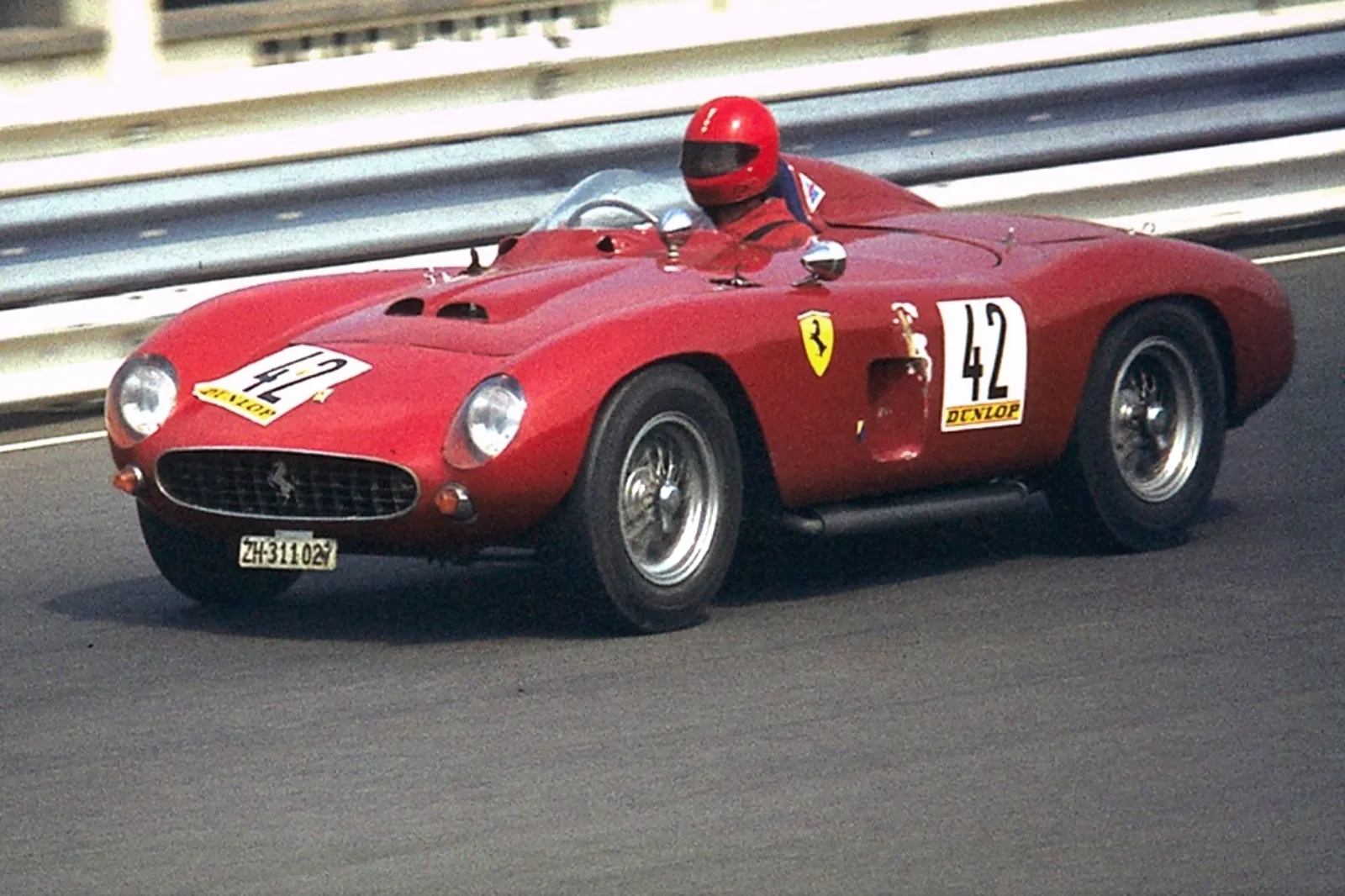
From the 625 TF to the 860 Monza, the four-cylinder and six-cylinder sports racers that carried Ferrari through the World Sportscar Championship.
The Ferrari Monza was a family of four-cylinder sports racers that Ferrari built in the 1950s. The line began with the 625 TF in 1953 and included the 500 Mondial, the 750 Monza and the 500 TRC. The later Monza SP1 and SP2, introduced in 2018, took the name forward as limited production cars.
The Ferrari Monza was a family of race cars that Ferrari built in the 1950s, most of them four-cylinder sports racers named after the Italian circuit. They came from a change of direction when Scuderia Ferrari moved away from its V12 engines for small-capacity racing. The line produced the 500 Mondial, the 750 Monza and the 500 TRC, and it carried Ferrari through its strongest years in the World Sportscar Championship.
Why did Ferrari switch to four-cylinder engines?
Formula Two rules in 1952 and 1953 capped engines at 2000cc, so Scuderia Ferrari swapped the compact Gioacchino Colombo V12 used in its smallest sports racers for four-cylinder engines drawn up by Aurelio Lampredi. The result was the Ferrari Tipo 500, which had 500cc per cylinder. The 1953 version kept the same cylinder size and was called the 553.
When Formula One moved to 2500cc in 1954, Ferrari bored its engine out to 625cc per cylinder, and the four-cylinder sports racers went on to win races through the late 1950s. The cars that followed culminated in the famous 500 Mondial and the 750 Monza.
The inline engines used side-draft carburettors, while Ferrari's V12 models used downdraft units sitting in the valley of the engine. That difference meant the fours did not need the hood scoops seen on the V12 cars.
Four-cylinder sports racers that took Ferrari from a rules change to the 1953 sportscar title and on to the Testa Rossa name.
How did the 1953 season make Ferrari a champion?
Ferrari won the first running of the World Sportscar Championship in 1953. It took three of the seven races, while four rival brands each won one, and only the four best results counted towards the title. The four-cylinder 625 TF and 735 S joined the established V12 250 MM and the new 340 MM and 375 MM.
The season was a breakout year for the company, and its traditional V12 cars still ran alongside the new fours.
What was the 625 TF?
The 625 TF was the first four-cylinder closed-wheel sports racer from Ferrari, launched in 1953. It looked much like the Vignale-designed 250 MM spyder, but its engine was a 2.5-litre straight four, 2498 cc, lifted from the 625 F1 car. The 250's 3.0-litre V12 was replaced by that four.
It was a small car with a 2,250 mm (89 in) wheelbase and a weight of just 730 kg (1,610 lb). The engine made 220 hp (164 kW) at 7,000 rpm, enough to take the little roadster past 240 km/h (150 mph). Mike Hawthorn drove it on debut at Monza on 29 June 1953, and despite struggling on the long straights, he took fourth place.
A single closed 625 TF berlinetta was also built in the spring of 1953. Vignale built it, and a fire destroyed it. There is speculation that Scaglietti rebodied it as a spyder in 1954, but that has not been confirmed.
What was the 735 S?
The 735 S ran on the same day as the 625 TF, driven by Alberto Ascari. It had an enlarged 2.9-litre engine, 2941.66 cc, and it was more capable at Monza, where it led the race until Ascari collided with a 250 MM. The 735 S was a barchetta from Carrozzeria Autodromo, with headlights set into the body, a drooping grille and fender vents.
Pinin Farina and Scaglietti each produced one further body for it, so the 735 S remained a small run of cars.
What was the 500 Mondial?
The 500 Mondial came directly from early experiments with Lampredi's four. Its name marked the world championships won by Alberto Ascari. It used a 2.0-litre version of the four in a small, light body with advanced suspension, including a de Dion tube at the rear.
The car debuted on 20 December 1953 at the 12 Hours of Casablanca. Ascari and Luigi Villoresi drove it to second place behind a 375 MM. In 1954 four 500 Mondials ran in the Mille Miglia, and the best of them finished second overall behind the Lancia D24.
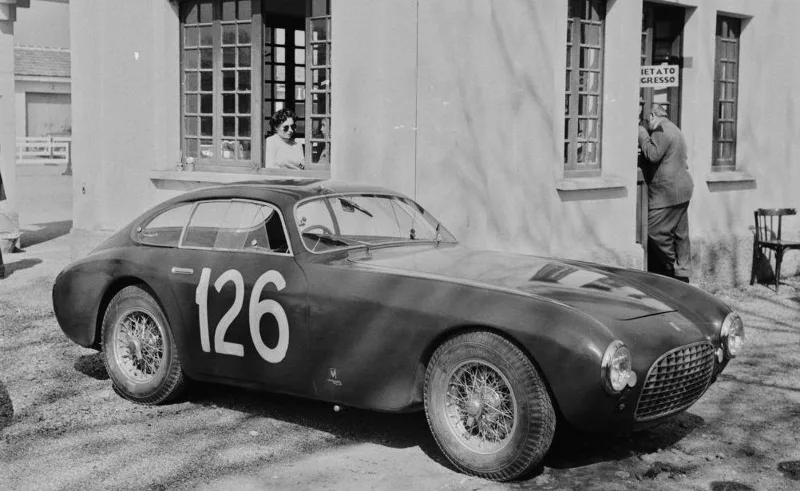
The engine was taken from the 500 F2 that had won the world championship, but it was detuned to 170 hp (127 kW). The car was extremely light at 720 kg (1,590 lb). Its first examples were spyders by Pinin Farina, while Carrozzeria Scaglietti later made a run of barchettas, and Pinin Farina built two berlinettas as well.
In total 29 Mondials were built. Pinin Farina's spyders numbered 13, and five of them were the earlier Series I type with covered headlights. The model remained competitive through the end of the decade and was still raced as late as 1962.
Why did the 750 Monza matter in 1954?
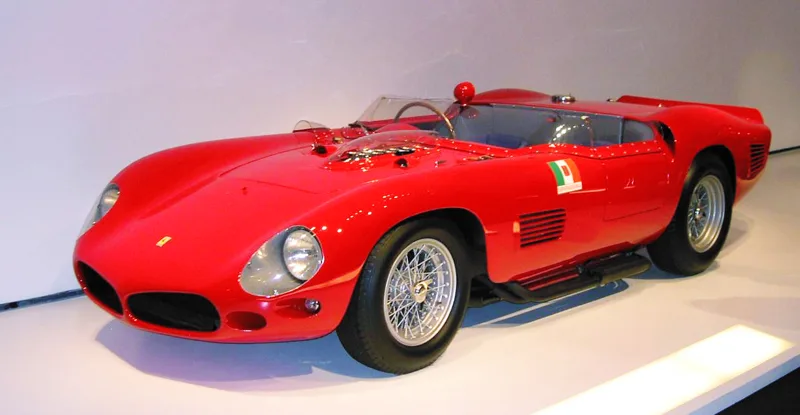
The 750 Monza was introduced in 1954 and gave Ferrari a new four-cylinder sports racer. It used a three-litre version of the 500 Mondial's engine, which made 260 PS (191 kW) and weighed only 760 kg (1,675 lb). The body was penned by Pinin Farina and hinted at the droop-nose look of the later 250 GTO.
Scaglietti's version added a faired-in headrest that suggested the flowing lines of the Testa Rossa. Mike Hawthorn and Umberto Maglioli gave the car its name by winning its very first race at Monza.
The 750 Monza was strong on track, yet the Mercedes-Benz 300 SLR took the 1955 championship. The Germans took the sports car championship that Ferrari had claimed in 1954, and Alberto Ascari was killed while testing a 750 Monza at Monza that year.
What was the 857 S?
The 857 S of 1955 was a short-lived attempt to beat the strong Mercedes-Benz team, which the 750 Monza and the 376 S and 735 LM had failed to do. A 750 Monza chassis was fitted with a bigger Lampredi four, measuring 3.4 litres (3,431.93 cc) and producing 280 hp (206 kW).
The car was not competitive at the 1955 Tourist Trophy, so Lampredi returned to the drawing board for the following season. Castellotti drove the 857 S to third overall at the 1955 Targa Florio. The following year Olivier Gendebien and Phil Hill finished second in the 1000 km race at Buenos Aires.
How did the 860 Monza win in 1956?
Once Mercedes-Benz left international sports car racing, the 860 Monza and the 290 MM performed strongly through 1956, and the sports car world title went back to Modena. Jaguar's new D-Type took Le Mans that year under the restrictions there, and the Maserati 300 S won the 1000 km Nurburgring.
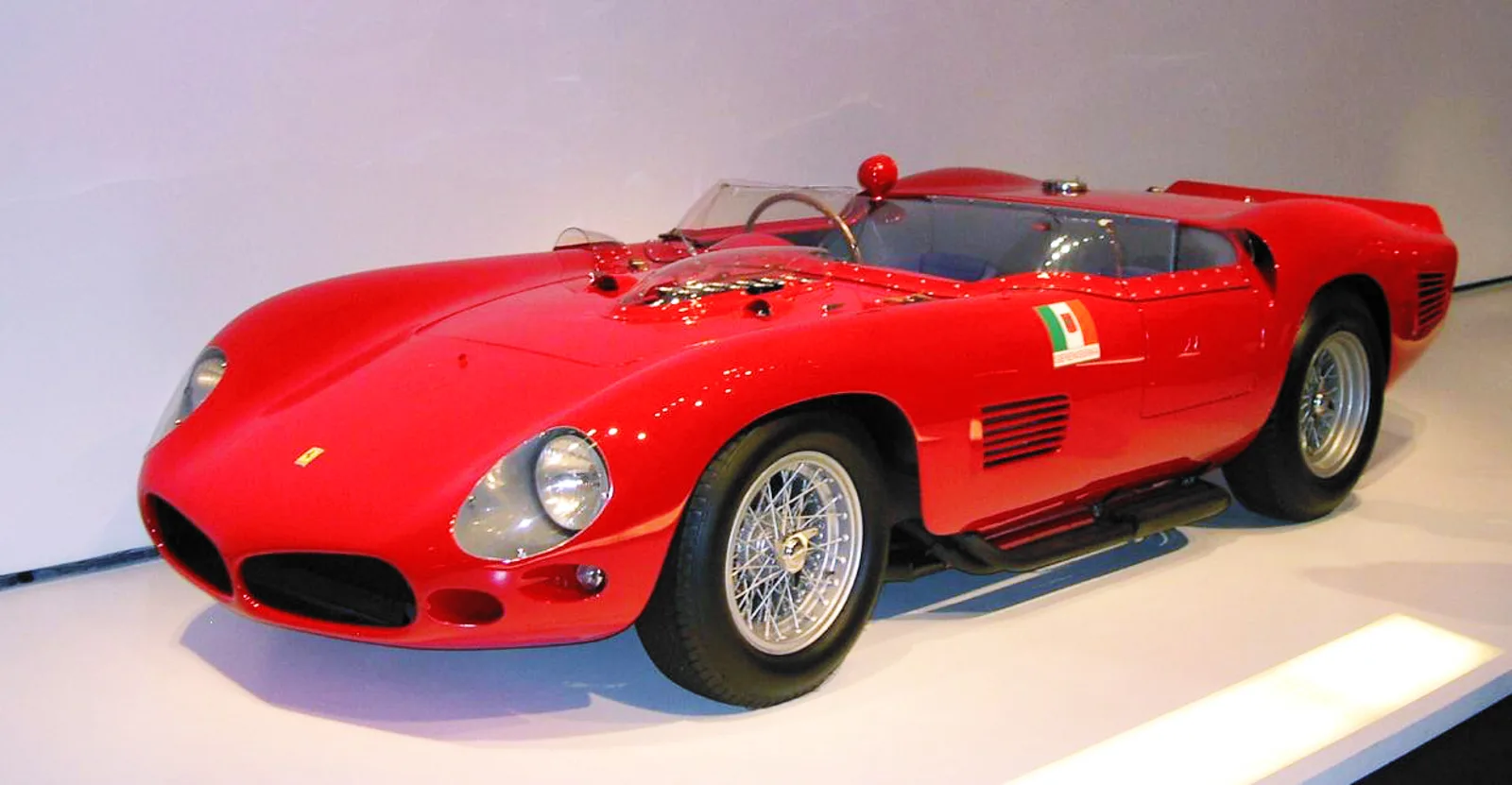
The 860 Monza was little changed on paper from the 857 S, but it was much more competitive. Its engine had a 102 mm bore and a 105 mm stroke for 3.4 litres (3431.93 cc), still producing 280 PS (206 kW). The wheelbase grew by 100 mm to 2,350 mm (93 in), and a new front coil spring suspension, as used on the 500 TR, let the car handle well despite weighing 100 kg (220 lb) more.
At the 1956 12 Hours of Sebring, Fangio and Castellotti won, with Musso and Schell in second place. During the Mille Miglia, two 860 Monzas placed second and third overall.
How did the 625 LM reach Le Mans?
After the 1955 Le Mans disaster, the ACO cut engine size and restricted prototype entries for the 1956 race to control speed and danger. Ferrari could not enter its 3.4-litre 860 Monza or its 3.5-litre 290 MM, so it modified three 500 TR barchettas to take a 2.5-litre engine and entered them as the 625 LM.
The 625 F1 engine needed little work: compression dropped to 9:1 and two Weber 42DCO/A carburettors handled the fuel. Only the car of Gendebien and Trintignant finished, placing third behind the privately entered Ecurie Ecosse Jaguar D-Type and a factory Aston Martin DB3S. Those two models counted as production sports cars, so they escaped the 2.5-litre prototype limit.
Three of the four-cylinder cars were bodied by Carrozzeria Touring, and the design copied the 750 Monza, including the faired-in headrest.
What happened to the four-cylinder line in 1957?
At the close of 1956 Ferrari let customers take over the four-cylinder sports racers. Scuderia Ferrari itself raced the Jano V12-powered 315 S and 335 S, along with the Colombo V12-powered 250 Testa Rossa.
The 500 TRC was the last four-cylinder racing car that Ferrari built. It was an altered 500 TR that met Annex C of the International Racing Code. To comply, The cockpit was widened and a passenger side door added. A full-width windscreen with wipers went in, along with a 120-litre fuel tank and a stowable convertible top.
What were the 500 TRC specifications?
The 500 TRC kept the Scaglietti-built body with a lower hood and slightly reshaped wheel arches. It used the 2,350 mm (93 in) wheelbase derived from the 860 Monza, with coil springs all round and a live rear axle. It tipped the scales at 680 kg (1,500 lb), with 180 hp (132 kW) on tap.
The 500 TRC run totalled 19 chassis, all built in 1956 and 1957. Scuderia Ferrari never raced the car as a works entry, but independent teams and drivers did. A 500 TRC finished seventh overall at the 1957 24 Hours of Le Mans, winning the 2,000 cc class, and a second example took the 2,000 cc class at the 1958 Targa Florio.
Two 500 TRCs were later upgraded by the factory to 2.5-litre specification, creating the rare 625 TRC. Both were owned and raced by John von Neumann of the Ferrari Representatives of California dealership. One car was refitted with the 3.4-litre 860 Monza engine and then, in 1958, with a 3.0-litre 250 Testa Rossa unit. The other sold at RM Sotheby's auction in Monaco on 12 May 2012 for EUR 5 million.
| Model | Engine | Output | Weight |
|---|---|---|---|
| 625 TF (1953) | 2.5-litre (2498 cc) four | 220 hp (164 kW) at 7,000 rpm | 730 kg (1,610 lb) |
| 500 Mondial | 2.0-litre (1984.86 cc) four | 170 hp (127 kW) | 720 kg (1,590 lb) |
| 750 Monza (1954) | three-litre four | 260 PS (191 kW) | 760 kg (1,675 lb) |
| 500 TR (1954) | 2.0-litre four | 180 hp (132 kW) | 680 kg (1,500 lb) |
| 857 S (1955) | 3.4-litre (3431.93 cc) four | 280 hp (206 kW) | n/a |
| 860 Monza (1956) | 3.4-litre (3431.93 cc) four | 280 PS (206 kW) | 100 kg heavier than the 857 S |
| 500 TRC (1956 and 1957) | 2.0-litre four | 180 hp (132 kW) | 680 kg (1,500 lb) |
What are the Monza SP1 and SP2?
The SP1 and SP2 are small-run sports cars that draw on the earlier Monzas, especially the 750 and the 860. They were introduced in 2018 and start a new lineage called the Icona series, a programme for special cars based on classic Ferrari models and made in limited numbers.
The SP1 is a single seater and the SP2 has two seats. Fewer than 500 are expected to be produced.