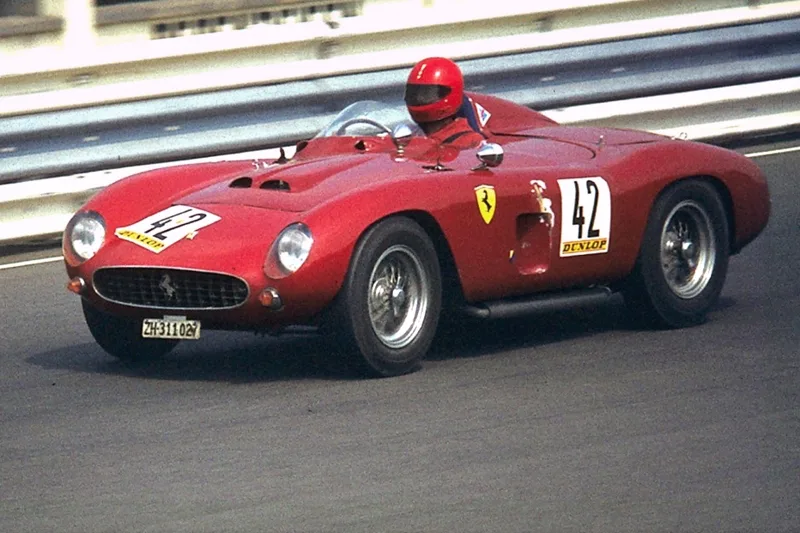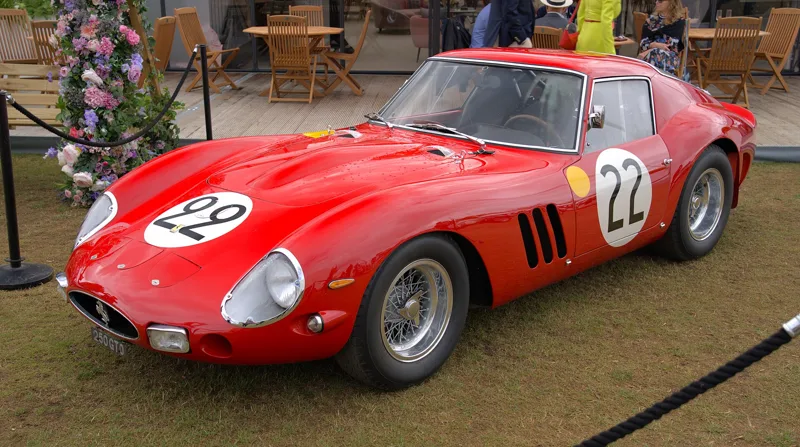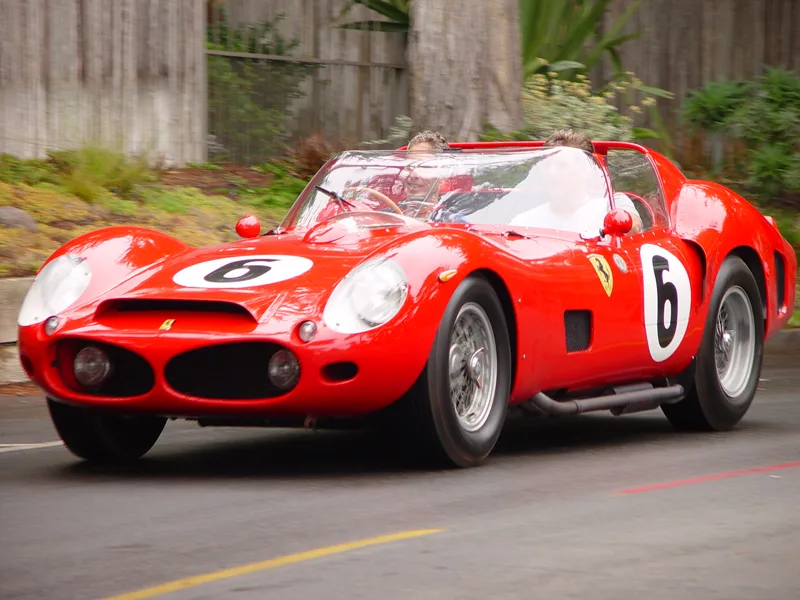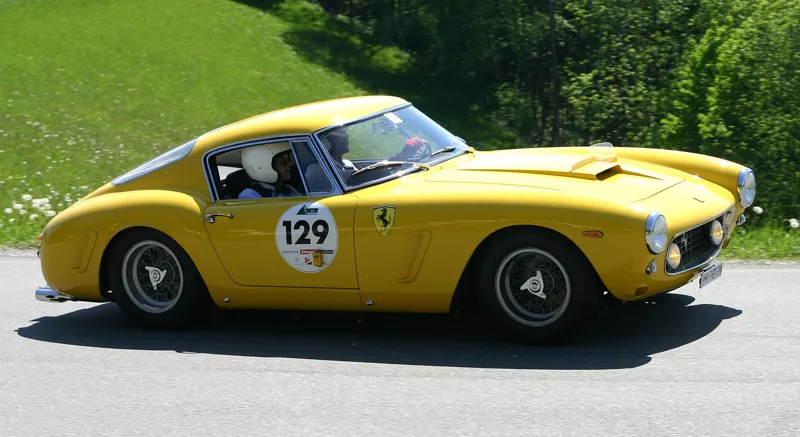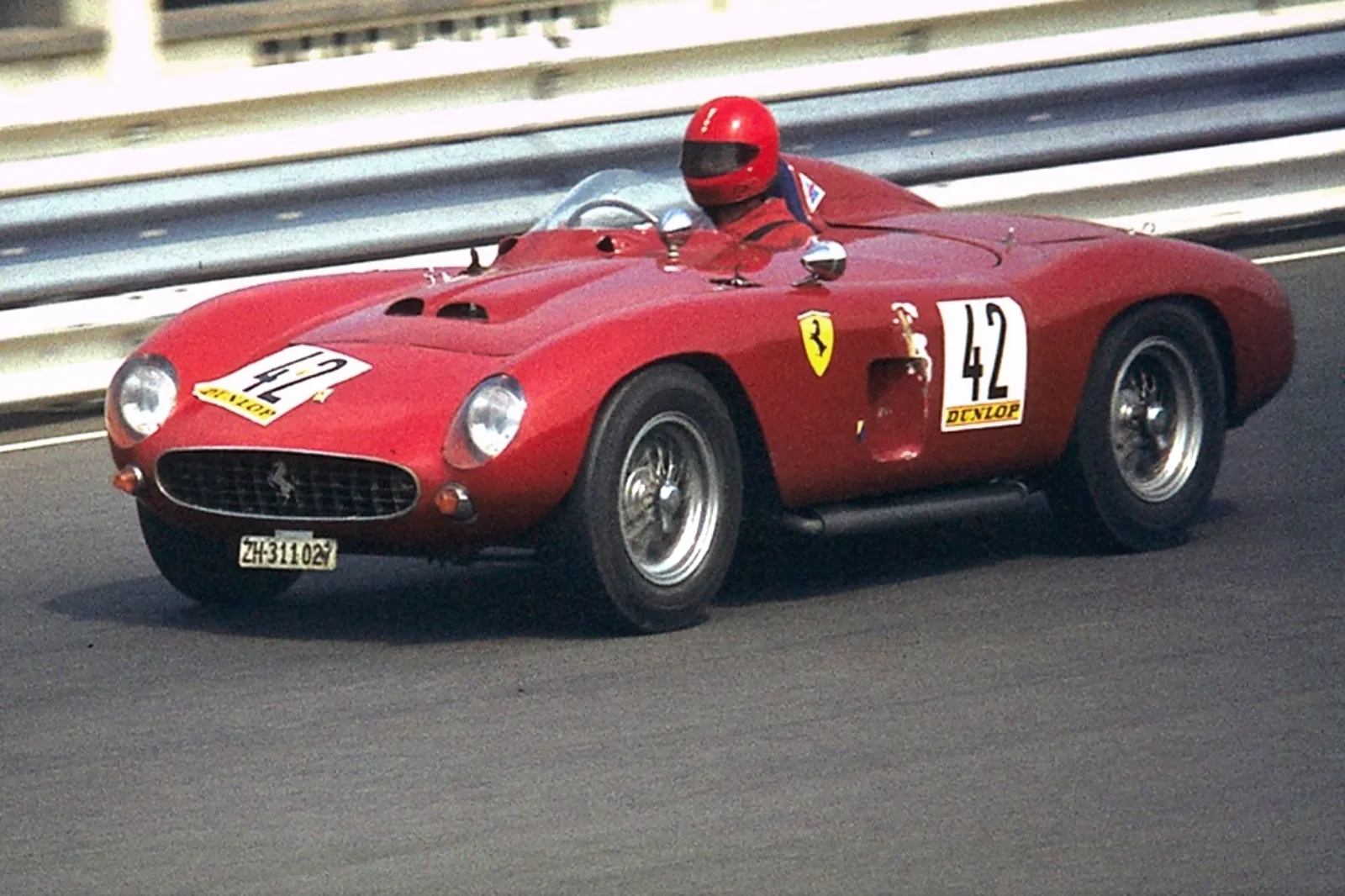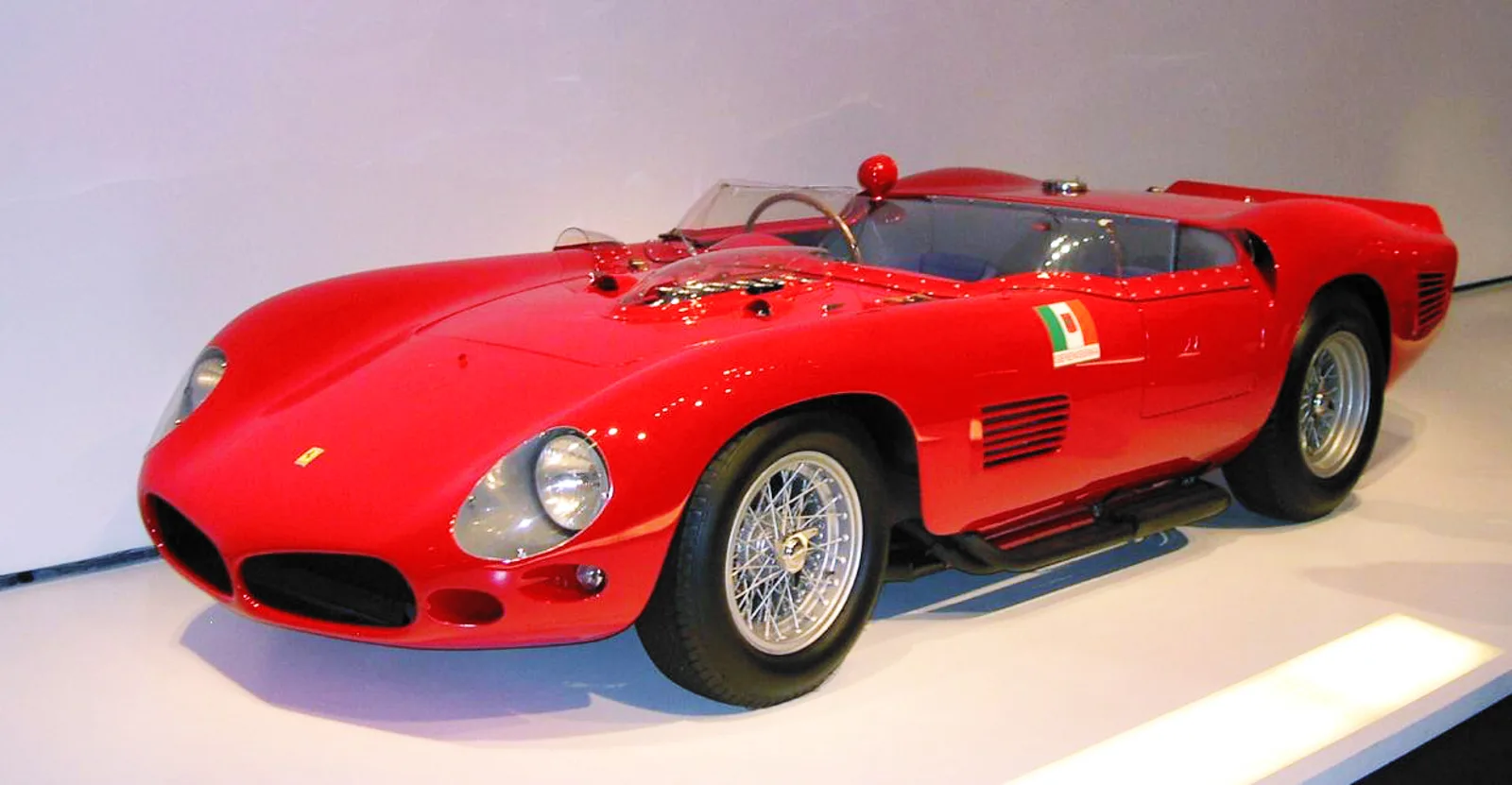
A front-engined V12 racer from 1957 to 1961, built for the three-litre rules, with pontoon fenders, a sharknose and the red cam covers that gave it its name.
The 250 Testa Rossa was a front-engined Ferrari sports racer built from 1957 to 1961 with a 3.0-litre V12. It won Le Mans in 1958, 1960 and 1961, and it helped Ferrari take three constructors' titles.
The Ferrari 250 Testa Rossa was a sports racing car built from 1957 to 1961 to meet a new three-litre engine limit. Its variants collected ten championship victories, and they carried Ferrari to the constructors' title in 1958, 1960 and 1961.
Where did the 250 Testa Rossa come from?
The car was developed to answer rule changes that limited engines to three litres for Le Mans and the World Sports Car Championship. Ferrari fitted a V12 of three litres, drawn from the 250 GT family, into an improved version of the 500 TR chassis, and the car first appeared at the end of the 1957 season.
The three-litre limit was a response to the 1957 Mille Miglia accident. The unlimited-displacement class was ended, and the rulers of motor racing tried to make the sport safer by cutting engine power. Ferrari supported the new limit.
Carlo Chiti was chief designer during 250 TR development, and his constant experimentation kept the car competitive through 1962. Enzo Ferrari, meanwhile, demanded absolute reliability from every component, which produced a conservative design aimed at endurance success. Giotto Bizzarrini helped with aerodynamic changes for 1961, and Andrea Fraschetti helped develop the first prototype before he died in a test drive in 1957.
Chiti's continual experimentation counterbalanced Enzo Ferrari's conservatism, and it led to the many revisions that kept the car competitive through 1962.
Scuderia Ferrari raced the car from 1957 to 1962. In total 33 250 TRs of all types were built, and 19 of them were customer cars sold to independent teams in place of the 500 TRC.
A front-engined V12 racer built for a rule change, which won Le Mans three times and gave its name to a red-headed tradition.
What engine did the 250 Testa Rossa use?
The engine was the 250 GT family's V12 in reworked form, with a capacity of 2953 cc, a 73 mm bore and a 58.8 mm stroke. It produced 300 hp (220 kW) at 7000 rpm, a figure of 100 hp per litre that Ferrari was particularly proud of.
Six two-barrel Weber 38 DCN carburettors replaced the three typical of 250 GT engines. The cylinder heads used helical double-coil valve springs, a first for Ferrari, and they were secured with 24 studs instead of 18, which improved head gasket sealing.
Each cylinder had a single spark plug, placed outside the vee between the exhaust ports. Piston connecting rods were machined from steel billet, and the cam covers were painted bright red. That red cam cover tradition came from the 500 TR, and it gave the 250 TR its name, which means red head.
Independent teams raced the 250 TR alongside Scuderia Ferrari cars from 1958, although the most developed versions stayed with the factory-sanctioned teams. Many privateers modified their cars or bought ex-Scuderia machines to stay competitive.
The 250 engine proved durable enough that the 250 GTO and 250 P used the same basic unit well into the 1960s. Gearboxes changed through the years. The 1957 and 1958 cars had four speeds and the 1959 cars a five-speed unit, with customer cars using a transmission directly behind the engine and team cars sometimes using rear-mounted transaxles.
Every 250 TR was a two-seat spider. The open interior was simple and utilitarian, without the trim of Ferrari's GT cars, and the instruments and controls were grouped around the driver. Like other Ferrari sports cars of the period, it used an open gated shifter and a Nardi wooden steering wheel.
The helical valve springs were much smaller than the torsion springs they replaced, which allowed the cylinder heads to be strengthened and secured with more studs. Steel billet connecting rods also resisted stress at high revs, which mattered for an engine that spent its life near the top of the rev range.
How was the chassis and suspension built?
The 250 TR used a tubular steel spaceframe similar to that of the 500 TR, with a wheelbase extended by 10 cm to 2.35 m. Every 250 TR had independent front suspension with coil springs, while customer cars kept live rear axles.
Factory team cars used live or de Dion rear axles before 1960. The 1960 TRI60 and 1961 TRI61 adopted independent rear suspension, and in 1960 the TRI60 raced alongside a TR60 that kept the conventional de Dion axle.
Brakes were drums on all four wheels in 1957 and 1958. Enzo Ferrari insisted on them because he thought they faded in a more predictable way than newer discs, but drivers disliked the effort they took without servo assist. Dunlop disc brakes replaced them for the 1959 race season.
Why did the 250 TR have pontoon fenders?
The 1958 cars had a cut-away nose and pontoon fenders that enveloped each front wheel. The design funnelled cooling air towards the brake drums, which were prone to heat fade.
The look came at a price. Racing showed that the design created significant aerodynamic drag and high-speed instability, which told against the car on fast circuits such as the Circuit de la Sarthe, where it met the Maserati Tipo 61 and Jaguar D-Type. The Scaglietti bodywork was revised repeatedly from 1958 to 1961.
The 1957 prototype, chassis 0666TR, had been hastily prepared on a 290 MM chassis, with a body by Scaglietti close to the 500 TR apart from a large hood bulge.
The 1958 body was the most recognised shape of the car. It had a cut-away nose reminiscent of a Formula One car, with a protuberant central air intake flanked by deep channels. The lower body was recessed behind the front wheels to vent heat from the brakes and exhaust, and the bonnet carried a large bulge with an air intake that faced forward on some cars and backward on others.
Even in 1958 some Scuderia Ferrari cars kept more conventional bodies in the style of the 1957 prototype, which shows how freely the team experimented. The prototype itself made its debut at the 1957 Nurburgring 1000 km, before the 1958 season began.
The 1959 cars were lightly revised by Pinin Farina, with Fantuzzi building the bodies. The cutaway nose and pontoon fenders were gone, replaced by a more aerodynamic shape that still carried plenty of ventilation grilles.
What changed for 1960 and 1961?
The 1960 cars adopted dry sump lubrication, which lowered the engine and the car's centre of mass. New regulations also required a taller windscreen, and that larger screen added drag. A 1960 car reached 161 mph (259 km/h) down the Mulsanne Straight, while a Maserati Tipo 61 reached approximately 175 mph (282 km/h).
For 1961 Giotto Bizzarrini and Carlo Chiti redesigned the bodywork. The TRI61 had a split sharknose intake, a very high rear and a truncated Kamm tail. The split nose had been used on Maserati 250F bodies that Fantuzzi re-bodied in 1958.
A deflector panel fitted along the top of the rear bodywork was first meant to keep exhaust fumes out of the cockpit. Richie Ginther found that high-speed stability improved with only a slight loss of top speed, so the panel stayed on every 1961 body.
Historians track the changes with a suffix based on production year, so a 1961-style car is called a 250 TR61, and descriptors such as Spider Fantuzzi mark cars with Fantuzzi bodies. The hand-built nature of the cars means that differences are best explained by the history of each individual chassis.
How did the 250 TR perform in racing?
Le Mans fell to the car in 1958, 1960 and 1961, and it also took the Sebring 12-hour race in 1958, 1959 and 1961. Other victories came at the Targa Florio in 1958, at Pescara in 1961 and at Buenos Aires in 1958 and 1960.
The car faced strong competition from the Aston Martin DBR1 and the small 1.5-litre rear mid-engined Porsche 718. Stirling Moss won the 1958 1000 km Nurburgring in a DBR1, and DBR1s went on to beat 250 TRs at the 1959 Le Mans, Nurburgring and Tourist Trophy races, which cost Ferrari the 1959 constructors' title.
Porsche had a strong run of its own. It won the Targa Florio in 1956, 1959 and 1960, and the 1960 12 Hours of Sebring. Porsche led the 1960 World Sportscar Championship until Le Mans, and the two makers finished level on 22 points. Ferrari took the tie-break with two third places against Porsche's one.
Phil Hill, Olivier Gendebien and Luigi Musso were among the drivers, alongside Peter Collins, Dan Gurney, Wolfgang von Trips and Mike Hawthorn. The 1961 season brought Ferrari's mid-engined V6 cars, and Porsche remained winless that year.
The 1962 rules expanded the championship to no less than 15 races. Sports cars were split into 1000cc, 2000 and 3000cc classes, and the 250 TR's era came to an end. The 330 TRI/LM carried the front-engined layout to one more Le Mans win.
Why does the 250 TR still matter?
The engine lived on in the 250 GTO, 250 P and 250 LM. Experiments on the bodies from 1957 to 1962 gave Ferrari engineers valuable experience in low-drag and stability-promoting shapes, and the 250 GTO, SP sports racers and the 250, 275 and 330 P all benefited from that knowledge.
The 250 TR was the last development of the Testa Rossa platform before mid-engined cars such as the 250 P took over the sports racing category. Its legacy lies as much in that handover as in its trophies.
Ferrari later honoured the car with the 1984 to 1991 Testarossa road car. That car was a different proposition. It used a mid-mounted flat-12 and was designed as a road-going sports car, while the 250 TR was a front-engined racer with a V12 up front.
How much is a 250 Testa Rossa worth?
The 250 TR is among the most valuable vintage Ferraris, partly because only 33 of the type were built. Chassis 0714TR sold for 9,020,000 euros at RM Sotheby's Maranello sale in 2009, and prototype chassis 0666TR sold for US$16.39 million at the 2011 Gooding Pebble Beach auction.
The cars are regular visitors to prestige shows, and 250 TRs often appear at the Pebble Beach Concours d'Elegance and the Goodwood Festival of Speed.
Chassis 0704 reportedly changed hands privately in 2014 for US$39.8 million. The 250 GTO is generally considered to carry the greater monetary value, although true prices are hard to pin down because few cars come to auction.
Ralph Lauren's collection includes two 250 TRs, a 1958 Scaglietti car and a 1961 250 TR/61 Spider Fantuzzi. Reproductions are also common, and some have been passed off as original factory cars. In at least one case a reconstructed car has created a disputed identity for a factory chassis number.
250 TR key figures
| Item | Detail |
|---|---|
| Production | 33 of all types, 1957 to 1962 |
| Engine | 2953 cc Colombo V12, Tipo 128 |
| Bore and stroke | 73 mm by 58.8 mm |
| Carburettors | Six two-barrel Weber 38 DCN |
| Power | 300 hp (220 kW) at 7000 rpm |
| Wheelbase | 2.35 m |
| Gearbox | Four-speed in 1957 and 1958, five-speed from 1959 |
| Brakes | Drums in 1957 and 1958, Dunlop discs from 1959 |
| 1960 top speed | 161 mph (259 km/h) at Le Mans |