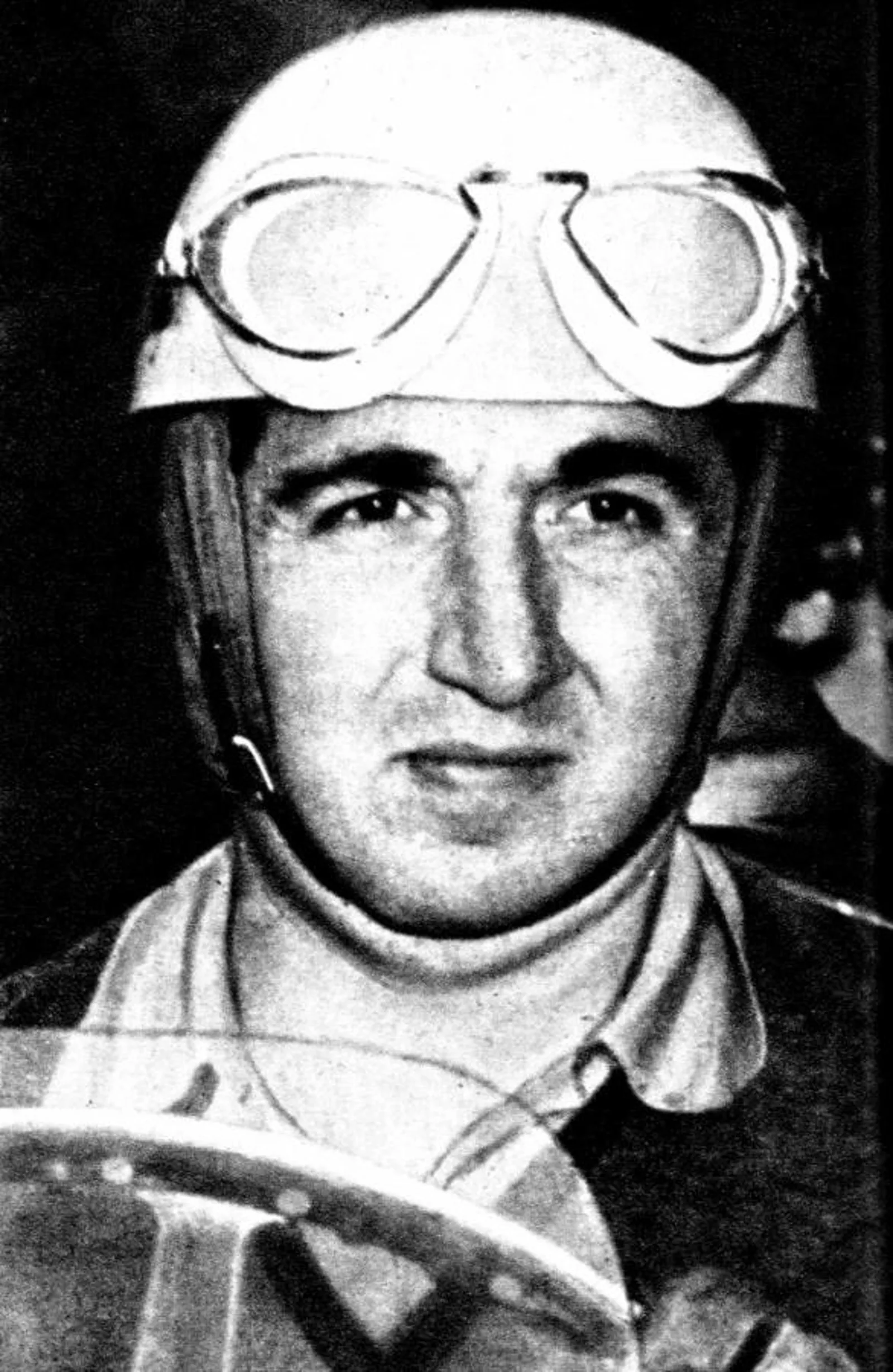
Two Formula One titles with Ferrari in 1952 and 1953, a year at Lancia that became his low point, and a fatal test session at Monza in 1955.
Alberto Ascari was an Italian driver who won the Formula One World Drivers' Championship in 1952 and 1953 with Ferrari. He competed from 1950 to 1955, won 13 Grands Prix and took the 1954 Mille Miglia with Lancia.
Alberto Ascari was born in Milan in 1918 and died at Monza in 1955, during a test session. In between he became the first Ferrari-powered Formula One world champion and the first driver to win the title in two consecutive seasons. His career was short, but it set records that stood for decades.
Who was Alberto Ascari?
Alberto Ascari was an Italian racing driver who competed in Formula One from 1950 to 1955. He won the World Drivers' Championship in 1952 and 1953 with Ferrari, and he won 13 Grands Prix across six seasons. He also won the Mille Miglia in 1954, driving a Lancia sportscar.
Before cars he raced motorcycles, and at 19 he was signed to ride for the Bianchi team. As of 2025 he was still the last Italian to win the World Drivers' Championship.
Ascari's career was short, but the records he set in two title-winning years still shape how Formula One remembers him.
How did Ascari's childhood shape his racing?
Ascari's father, Antonio Ascari, was a Grand Prix star of the 1920s who raced Alfa Romeos. He was killed while leading the 1925 French Grand Prix at the Autodrome de Linas-Montlhery, a fortnight before Alberto's seventh birthday.
The young Ascari was drawn to racing anyway. He twice left school for the track and sold his textbooks to pay for racing. Motorcycles came first, and when he was 19 he was signed to ride for Bianchi.
In 1940 he entered the Mille Miglia in an Auto Avio Costruzioni 815 supplied by Enzo Ferrari, a close friend of his father. From then on he raced regularly on four wheels.
The Second World War interrupted his plans. The family garage was conscripted to maintain military vehicles, and Ascari and his friend Luigi Villoresi set up a transport business supplying fuel to army depots in North Africa. Their work for the war effort kept them out of military service.
How did Ascari become a Grand Prix driver after the war?
After the war Ascari began racing Grands Prix in a Maserati 4CLT, with Villoresi as his teammate and mentor. The pair were successful on circuits in northern Italy, and he earned the nickname Ciccio, meaning Tubby.
The transitional years from 1946 gave him the chance to win often. His first win came at the 1948 San Remo Grand Prix, and he took second place at the 1948 British Grand Prix at Silverstone. That race is generally considered the first British Grand Prix. He then won the first 1949 Buenos Aires Grand Prix with Maserati.
His biggest move came when he and Villoresi signed for Scuderia Ferrari. Enzo Ferrari had been a close friend and teammate of Ascari's father, and he had followed the younger man's progress with interest. In 1949 Ascari won three more races for Ferrari, including a third Buenos Aires Grand Prix win.
What happened at Ascari's first World Championship race?
Ferrari made its World Championship debut at the 1950 Monaco Grand Prix, with Ascari, Villoresi and the French driver Raymond Sommer on the team. Ascari finished second, one lap behind Juan Manuel Fangio, and in doing so became the youngest driver to score points and a podium in Formula One, at 31 years and 312 days.
The rest of 1950 was a mixed season. The supercharged Ferrari 125 F1 was too slow against the dominant Alfa Romeo team, and a good deal of the year went on enlarging the team's 2-litre Formula Two engine step by step. The full 4.5-litre Ferrari 375 F1 arrived for the Italian Grand Prix, the final round.
At Monza Ascari gave Alfa Romeo its sternest challenge of the year before retiring. He then climbed into teammate Dorino Serafini's car and finished second. The new Ferrari went on to win the non-championship Penya Rhin Grand Prix later that year.
How close did Ascari come to the title in 1951?
In 1951 Ascari was a real threat to Alfa Romeo, although unreliability undid him at first. He won the German Grand Prix at the Nurburgring and then the Italian Grand Prix, and he went into the Spanish Grand Prix only two points behind Fangio in the standings.
At the Spanish race Fangio won and secured his first title, and Ascari became the youngest runner-up at 33. He had taken pole, but a poor tyre choice left the Ferraris unable to challenge Fangio, and Ascari finished fourth.
How did Ascari win the 1952 title?
For 1952 the World Championship switched to 2-litre Formula Two regulations, and Ascari drove the Ferrari 500. He missed the 1952 Swiss Grand Prix because he was qualifying for the Indianapolis 500, which counted towards the world title at the time. He was the only European driver to race at Indianapolis during the eleven years it was on the World Championship schedule, and his race ended after 40 laps when a wheel collapsed.
Returning to Europe, he won the remaining six rounds to clinch the title. He also took five non-championship wins that season and recorded the fastest lap in each championship race. Because only the best four of eight scores counted, he scored the maximum number of points a driver could earn.
At 34 Ascari became Formula One's youngest champion, a record that held until the 29-year-old Mike Hawthorn won in 1958. Hawthorn had been Ascari's teammate in 1951. Fangio had missed most of the 1952 season after a crash at the Italian Grand Prix in June.
What did the 1953 season add?
Ascari won three more consecutive races to open 1953, which gave him nine straight championship wins before the streak ended with a fourth place at the French Grand Prix. He won twice more later in the year, and that was enough for a second consecutive World Championship, making him Formula One's first two-time champion.
He was 35 when he took the second title, which made him the youngest two-time champion and the youngest back-to-back champion. Jack Brabham, aged 34, beat both records in 1960 as the average age of Formula One drivers fell.
The season opened at the 1953 Argentine Grand Prix in Buenos Aires, where Ascari faced Fangio's home crowd and a Maserati challenge led by Fangio himself. Ascari took pole and the first win of the season, setting him on course for the title. The season is generally regarded as the high point of his career.
Why did Ascari switch to Lancia in 1954?
After a dispute over his salary, Ascari left Ferrari at the end of 1953 and joined Lancia for 1954. The Lancia car was not ready for the early races, so Gianni Lancia allowed him to drive for Maserati, sharing the fastest lap at the British Grand Prix, and driving once for Ferrari.
He won the 1954 Mille Miglia in a Lancia sportscar, despite terrible weather and the failure of a throttle spring. The spring was swapped for a rubber band as a stopgap. When the Lancia D50 was ready, Ascari took pole on its debut at the Spanish Grand Prix and led impressively early on, before retiring with a clutch problem.
The Lancia move is generally seen as the low point of his career. The promised new car and extra money arrived only near the end of the season, by which time Fangio's Mercedes were out of reach. Ascari finished 1954 without completing any of the four Grands Prix he entered.
What happened in Ascari's final season?
The 1955 season started well. Lancia won the non-championship races at Turin's Parco del Valentino and at the Naples Grand Prix, where the Lancias beat the Mercedes. In the 1955 Argentine Grand Prix, a world championship event, Ascari retired.
At the 1955 Monaco Grand Prix on 22 May, he was leading when he missed a chicane late in the race. He may have been distracted by the reaction to Stirling Moss's retirement or by the lapped Cesare Perdisa close behind. He took the only available line and drove his D50 through the barriers into the harbour, missing a substantial iron bollard by about 30 cm.
The car sank, but Ascari was pulled into a boat and escaped with a broken nose.
How did Ascari die at Monza?
On Thursday 26 May 1955, Ascari was at the Autodromo Nazionale Monza to watch his friend Eugenio Castellotti try a Ferrari 750 Monza sports car. The two were due to co-drive the car in a sports car race, and Ascari was not scheduled to drive that day. He decided to try a few laps anyway, in street clothes and wearing Castellotti's white helmet.
On the third lap he emerged from a fast curve, the Curva del Vialone, and the car inexplicably skidded, turned on its nose and somersaulted twice. Thrown onto the track, Ascari suffered multiple injuries and died a few minutes later. He was 36 years and 10 months old, the same age his father had been at his death.
The reasons for the accident, including why Ascari drove another driver's car and without his own helmet, were never fully established. The corner was later renamed in his honour and replaced by the Variante Ascari chicane.
Lancia withdrew from motor racing that year, handing its team, drivers, cars and spare parts to Ferrari. His death is often seen as a contributing factor, although the company was also in serious financial trouble.
How did rivals and crowds react to his death?
More than a million people filled the streets of Milan for his funeral, and he was buried beside his father in the city's Cimitero Monumentale. Fangio said he had lost his greatest opponent, and that his own title of the previous year had lost some of its value without Ascari to fight him for it.
Stirling Moss judged Ascari very good indeed, possibly as fast as Fangio but without Fangio's polish. Mike Hawthorn went further and called Ascari the fastest driver he had ever seen, including Fangio.
What do the statistics show?
In 34 entries and 32 race starts, Ascari recorded 13 wins, 17 podiums, 14 pole positions and 12 fastest laps. He won two World Championships, becoming the first double world champion and the first back-to-back winner.
His rivalry with Fangio was one of the greatest in Formula One. The two combined for 27 wins, 30 pole positions and 27 fastest laps from 31 starts each. In 1952 the margin between Ascari and the second-placed driver was the largest in the championship's history, measured by an adjusted points-per-race calculation.
| Measure | Ascari's figure |
|---|---|
| Entries | 34 |
| Race starts | 32 |
| Grand Prix wins | 13 |
| Podiums | 17 |
| Pole positions | 14 |
| Fastest laps | 12 |
| World Championships | 2, in 1952 and 1953 |
| Ferrari wins | 13 in 27 races |
Which records did Ascari hold?
Ascari recorded seven hat-tricks, meaning pole, fastest lap and race win in the same event, and five Grand Chelems. The Grand Chelem is taking pole, fastest lap, the race win and leading every lap. He also held the record for consecutive hat-tricks, with four.
He also holds records for seven consecutive fastest laps and 304 consecutive laps in the lead. His seven consecutive race wins stood for 51 years, until Michael Schumacher equalled them in 2004. Sebastian Vettel broke the record with nine in 2013, and Max Verstappen took it to ten in 2023.
How is Ascari remembered today?
Ascari was inducted into the International Motorsports Hall of Fame in 1992 and into the FIA Hall of Fame in December 2017. He was included in the Walk of Fame of Italian sport in 2015, and the British sports car maker Ascari Cars, founded in 1994, takes its name from him.
Monza has a chicane named after him, the Variante Ascari, which was named in 1972. A street in Rome carries his name, and Mario Andretti counted him among his racing heroes after watching him at Monza as a boy.
Rankings have kept him high. An Autosport survey of Formula One drivers in 2009 placed him 16th greatest, and the BBC listed him as 9th greatest in 2012. In 2020 the Carteret Analytics ranking put him fourth-best of all time, and he remains Ferrari's only Italian world champion.