How a wartime bomber airfield became a circuit for a 65-lap race, and how a Maserati tachometer failure could not stop Luigi Villoresi.
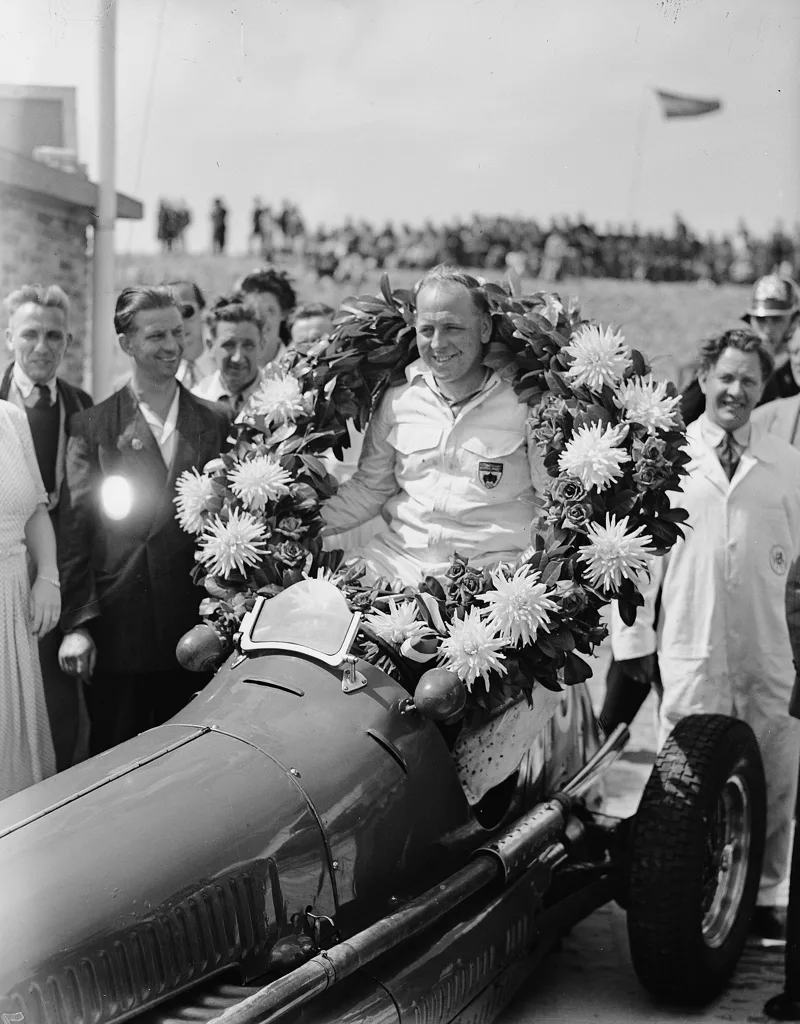
The 1948 British Grand Prix was a 65-lap race held on 2 October 1948 at Silverstone Airfield in Northamptonshire. Luigi Villoresi won in a Maserati 4CLT/48 ahead of Alberto Ascari. The event opened the Silverstone circuit and marked a fresh start for British Grand Prix racing.
What was the 1948 British Grand Prix?
Staged on 2 October 1948 at Silverstone Airfield in Northamptonshire, this 65-lap contest carried the Royal Automobile Club's International Grand Prix name. It is often cited as the first modern British Grand Prix, and it doubled as the opening meeting of a new circuit on a former wartime site.
New Formula One rules, which had largely superseded the pre-war formula, governed the event, staged two years ahead of the first world drivers' championship. Luigi Villoresi won in a Maserati 4CLT/48, and the same day included a 500 cc support event.
The site was not a permanent facility. The RAC held it on a one-year loan from the Air Ministry, and the airfield had served as a bomber station during the Second World War.
A 65-lap race on a former bomber airfield, won by a driver whose tachometer had jammed beneath his clutch pedal.
Why was there no major British circuit ready in 1948?
The club's earlier Grands Prix had been staged at Brooklands, the banked Surrey track, in 1926 and 1927. Donington Park staged four unranked Grands Prix from 1935 to 1939, yet the conflict left British racing trailing its continental rivals. That gap is why an airfield became the answer.
When racing was ready to return, neither of the two main British venues could be used. Donington still had wartime debris from its time as a supply depot, and Brooklands had served as a centre for aircraft work, with much of its track built over.
The end of hostilities left a surplus of airfields, which offered space for new circuits. One was RAF Silverstone, a former bomber station that was chosen to become the venue for the post-war Grand Prix.
How was the Silverstone circuit laid out?
The RAC took a one-year lease on the airfield in early 1948 and began building a course. The site followed the standard wartime RAF pattern of three long, wide runways in a triangle, linked at their ends by a narrow perimeter road.
For the first year the organisers chose a long circuit, using the full length of the two longest runways and big stretches of the perimeter.
Competitors started on the western perimeter and headed north to Woodcote Corner, a fast right-hander. From there they followed the northern perimeter edge to Copse Corner and turned onto the main runway, a straight called Segrave for the event.
Where the two largest runways met, straw bales narrowed the track, forcing the cars through a 130 degree left hairpin onto the second runway. The cars then rejoined the perimeter near the old Becketts Corner and ran along Hangar Straight, the long road in front of the main hangar complex.
At the end of that straight, now Stowe Corner, the field returned to the main runway, a southern section now named the Seaman Straight. A second narrowing and another left-hand hairpin sent them back out to the perimeter at Club Corner, and the final run to the line passed through the flat-out Abbey Curve.
Measured roughly, the lap ran to 5.9 km (3.7 miles). It was far longer than the classic Silverstone course of 4.7 km (2.9 miles) and outstripped today's 5.1 km (3.2-mile) version. This layout hosted only this one Grand Prix, because from 1949 the circuit ran on its perimeter roads alone.
Everyone who completed either the Grand Prix or the 500 cc race was given the RAC Silverstone Plaque to mark the opening. Despite the improvised nature of the venue, the event drew in excess of 100,000 spectators.
Who entered the 1948 Grand Prix?
The entry list was a mix of new cars and older machinery. Brand new, full works cars came from Maserati, Talbot-Lago and Ferrari, while most of the remaining field were privateers with mostly pre-war cars. The organisers were pleased to attract Maserati, which entered two new 4CLT/48 Sanremo models.
One went to the works driver Luigi Villoresi, and the other to British privateer Reg Parnell. A third was later entered for the factory driver Alberto Ascari, and a fourth was held in reserve for the local driver Leslie Brooke. Talbot-Lago contributed four T26C machines, one for the pre-war star Louis Chiron, with a fifth in reserve from Lord Selsdon.
Scuderia Ferrari had two of its 125s entered, but it chose at the last minute to focus on mainland Europe and did not arrive. Alfa Romeo, whose 158 Alfetta cars would have been the favourites, also stayed away.
Older cars came from the Scuderia Plate and White Mouse Stable teams, both running Maserati 4CLs for Toulo de Graffenried and Prince Bira, who had both won major races before. ERA, strong among the local privateers, was boosted by a factory entry from Raymond Mays. David Hampshire brought R1A, the first ERA car ever built, which dated from 1934.
The 1935 Bimotore Alfa Romeo was one of the oddities. Only one of its two engines was running, and Tony Rolt, a former prisoner of war who later developed four-wheel drive, was at the wheel.
What happened in the 500 cc support race?
The Grand Prix card included a 500 cc race, a class that later became Formula 3. It was dominated by privateer Cooper entries, including Stirling Moss and John Cooper, both in the new MkII. Ken Wharton, later a four-time British Hill Climb Champion, was also in a field of well over 30 cars.
The 500 cc race was the first competitive event ever run on the Silverstone Circuit, and it ran two hours before the main event. The start was chaotic. Only two of the 34 starters were set when Lord Howe, president of the BRDC, let the flag fall.
Eric Brandon, a seasoned 500 cc racer who had already won one of these events in Britain, was still climbing into his car when the flag fell. He recovered to finish fifth. Moss had led the British 500 cc season so far, yet a loss of drive ended his day, and Rhiando took victory in his Cooper MkII.
John Cooper finished second, and Sir Francis Samuelson, a 58-year-old baronet who also drove a Cooper MkII, took third.
How did qualifying play out?
The works Maseratis were held up on the journey to Silverstone, which left qualifying to Louis Chiron. Louis Chiron, from Monaco, set pole in an Ecurie France Talbot-Lago in 2:56.0, one second up on Toulo de Graffenried. The grid order set up everything that followed.
Philippe Etancelin was third in another Talbot-Lago, a further second behind de Graffenried. Bob Gerard then put a car a decade older than those ahead of him in fourth. His ERA R14B was two-tenths of a second behind Etancelin, with Leslie Johnson's ERA E-type in fifth.
Villoresi and Ascari had missed official practice, so they started at the back in 24th and 25th. In unofficial practice just before the race, however, Ascari set a lap of 2:54.6, more than a second quicker than Chiron's pole time.
How did the race begin?
De Graffenried got the best start, but Chiron, Parnell and Johnson passed him before the first corner at Woodcote. Prince Bira, Etancelin and Gerard formed the next group. As the leaders reached Woodcote, Johnson drew level with Chiron, but then the driveshaft on his ERA failed and he retired on the spot.
Further back, Salvadori went straight to his pit box for an oiled spark plug. That pause cost half a lap and left him at the back. Parnell, who had been tailing Chiron, was out on the opening lap, his month-old Maserati's fuel tank losing its drain plug to a stone.
Within two laps the Maseratis of Villoresi and Ascari had worked up from the back, aided by attrition, and were now breathing down Chiron's neck. Lap three saw both overtake Chiron, with Villoresi going ahead. The same lap also brought the retirement of Gianfranco Comotti, whose Talbot's brakes failed.
What happened to the leaders in the middle laps?
Brake trouble also hit Bira, who had pressed the leaders early on and then dropped back into the pack. Tony Rolt's Bimotore lost its remaining working engine on lap six, and he was forced out. On lap 23 Geoffrey Ansell's ERA rolled, throwing him from the car. He was unhurt.
De Graffenried's engine went out of tune and began to overheat, and he dropped steadily back. He ended six laps adrift of the leaders. On lap 17 Chiron's pace fell away, and Bira moved past into third.
Etancelin's engine began to overheat, and he had to make repeated stops to top up the radiator. A 45-second stop to examine the Talbot's handling was followed by his retirement, a seized gearbox on lap 37.
During refuelling Gerard got ahead of Bira, his crew four seconds quicker in the pits. Rosier went by them both, having skipped a fuel stop. Gerard reeled Rosier in again on lap 52 and went past for third.
How did the Maserati duel decide the race?
The two works Maseratis ran within seconds of each other and traded the lead often. Villoresi and Ascari pitted for fuel on laps 27 and 29. Ascari changed both rear wheels during his stop, which left him 50 seconds behind his team-mate, though he held second.
A second stop cost Ascari another 16 seconds, leaving him close to a minute adrift. Villoresi recorded the quickest lap of the race, 2:52.0, despite a rare fault: the tachometer's mountings gave way.
The instrument fell out of the dashboard and lodged under the clutch pedal, which stopped him from using the clutch for the rest of the race. He also lost his reading of engine speed. He kept the lead, finishing 14 seconds in front of Ascari and half a lap clear of Gerard.
Rosier's Talbot-Lago was the only other car on the leaders' lap, only seconds from being lapped.
What was the final result?
| Driver | Car | Outcome |
|---|---|---|
| Luigi Villoresi | Maserati 4CLT/48 | Winner, fastest lap 2:52.0 |
| Alberto Ascari | Maserati 4CLT/48 | Second, 14 seconds behind |
| Bob Gerard | ERA | Third, half a lap behind the winner |
| Louis Rosier | Talbot-Lago | Only other finisher on the leaders' lap |
| Louis Chiron | Talbot-Lago | Pole position, retired on lap 37 |
| Leslie Johnson | ERA E-type | Retired at Woodcote, driveshaft failure |
| Reg Parnell | Maserati 4CLT/48 | Retired on lap one |
De Graffenried also finished, six laps behind the winners. The front of the field, however, was settled by the works Maseratis and the cars that stayed in the hunt for the podium, and that was the story the day told.
Why does the 1948 race still matter?
It is frequently treated as the start of the modern British Grand Prix. It came under the new Formula One regulations and was run with a new circuit that owed its existence to the end of the war. Its legacy is tied to that airfield track.
Silverstone's place in the sport began here. The 1948 layout used the two longest runways and large sections of the perimeter road, and it was never used again for a Grand Prix. From 1949 the circuit used only the perimeter roads, which shaped the layout that followed.
The event's legacy also lies in the way a wartime airfield was turned into a motor racing venue. Its success attracted more than 100,000 spectators to an improvised track, and it showed that Britain could host a major race again while its older circuits were out of action.