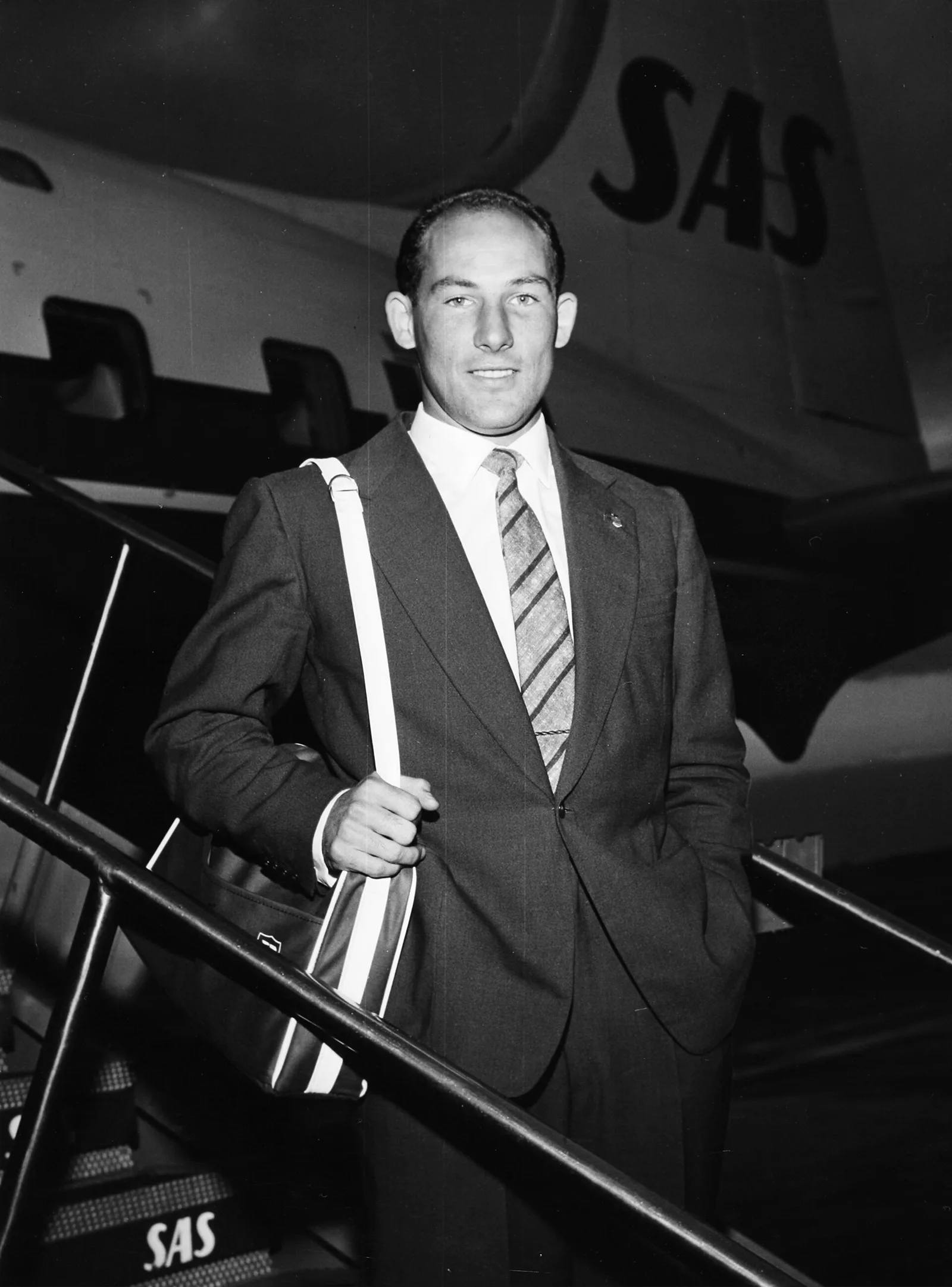
A furniture manufacturer's son who won the 1948 Spa 24 Hours, helped launch the Jaguar XK120 in America and set endurance records at Montlhery.
Johnson, a Walthamstow-born driver who died in 1959 aged 46, won the 1948 Spa 24 Hours and set endurance records at Montlhery in a Jaguar XK120. He also finished third at Le Mans in 1952 with a Nash-Healey.
Johnson was a British driver who took part in rallies, hill climbs, sports car races and Grands Prix from the late thirties to the early fifties. He won the 1948 Spa 24 Hours in a prototype Aston Martin, gave the Jaguar XK120 its first European and American victories, and set a string of endurance records at the Montlhery banked oval near Paris. He died in 1959 at the age of 46.
Who was Leslie Johnson?
Leslie George Johnson was born on 22 March 1912 in Walthamstow, then one of London's poorest districts. He was a British driver who never made a full commitment to racing, because his business interests remained his main focus. His furniture business funded his motor sport career, and his friends in the industry included Jaguar founder William Lyons.
Johnson was also a serious endurance driver. His endurance programme took in five Le Mans starts, two Spa 24 Hours and four Mille Miglias, plus five Grands Prix. He broke several world speed records for production cars, which is why his name is still associated with the XK120 and the Montlhery banking.
A furniture maker's son who won Spa, set the XK120's first American victory and drove the fastest endurance record of his era.
How did Johnson start in motor sport?
Johnson first came to motor sport through rallying, racing for the Rootes factory squads in four Monte Carlo Rallies and one Alpine Rally. He won the Scottish Rally and the Torquay Rally in 1937, both in a BMW 328, and he finished third in the RAC Rally in both 1938 and 1939 in the same car.
After the Second World War he moved from rallies to hill climbs, sports car racing and single-seaters. His early hill climb results in 1946 included a first and second at the Shelsley Walsh International, in a Talbot-Lago and a BMW 328. At the Bo'ness Speed Hill Climb that September he took first place and set a course record on his first acquaintance with the course.
In the Monte Carlo Rally he was part of the winning team prize in 1953, alongside Stirling Moss and Jack Imhof in Sunbeam-Talbot cars. The following year he won the team prize again with Moss and Sheila van Damm, but during the event he suffered a heart attack. Norman Garrad, who was in the car with him, recalled that Johnson had arrived in Monte Carlo unconscious, and he nearly died that night in hospital.
His heart condition finally forced him to retire from competition in 1954. Rallying had given him his first success, but the mix of medical and business demands meant he never returned to full-time competition.
How good was Johnson at sports car racing?
Johnson's sports car results began in 1946 at the Brussels International Sports Car Race at Spa, where he finished second overall with the fastest lap in a BMW. The Motor described his driving as that of a budding Dick Seaman, and Louis Chiron said he had the flair of Nuvolari. That early reputation followed him for years.
His biggest victory came at Spa in 1948, sharing the driving with St. John Horsfall in an Aston Martin prototype. It was Aston Martin's first postwar victory. In 1949 he finished third at Spa in an Aston Martin DB2 with Charles Brackenbury, and he also won the Silverstone National Allcomers Race in a Bentley 8 Litre owned by Forrest Lycett.
Johnson's Jaguar results were the most important. He won the Daily Express International Sports Car Race at Silverstone in 1949, the first race for the XK120. He also took class victory and fourth overall at Palm Beach Shores in Florida in 1950, the XK120's first American race. He was granted an American racing licence for that event because his entry was not sanctioned by the RAC, and the car was unmodified from standard specification.
His Le Mans career brought mixed fortunes. In 1949 he retired from fifth place in an Aston Martin DB2 after six laps when the water pump failed. In 1950 he was running at the front of the Jaguar XK120 in the middle of the race, but a clutch failure after 21 hours ended his effort, a result that persuaded William Lyons to invest in Le Mans. In 1951 a Jaguar C-Type retired with no oil pressure.
Johnson's best Le Mans result came in 1952 in a Nash-Healey. Built hastily for the race, the car finished third overall out of 57 starters, behind two factory Mercedes-Benz 300SLs. It also took first in its class, beating Luigi Chinetti's Ferrari, and it won the Gold Challenge Cup. He finished eleventh out of 60 starters in the 1953 race in a Nash-Healey.
What were Johnson's single-seater results?
From 1946 to 1950 his single-seater outings were in Delage, Talbot-Lago and ERA machinery. His first proper racing car drive came in the 1946 Ulster Trophy at Ballyclare, in a supercharged straight-eight Delage that had been raced by Earl Howe, Dick Seaman and Prince Bira. A clutch failure at the start forced a push-start, and he was forced out with a melted spark plug four laps from the end.
In 1947 he ran his ten-year-old Talbot-Lago in three Grands Prix. He finished sixth at the Jersey International Road Race, seventh at the Belgian Grand Prix at Spa, and retired in the Swiss Grand Prix at Bern. In that race his Talbot-Lago locked a brake, and it struck spectators, killing two.
In November 1947 he acquired English Racing Automobiles, together with one of its prewar E-Type single-seaters. The car was fast but fragile. In 1948 he set a lap record and took pole at the Grand Prix du Salon at Montlhery, but the fuel tank split during the race. At Silverstone for the British Grand Prix he started fifth on the grid, but a driveshaft universal joint failed before Woodcote.
The ERA story continued to be difficult. The G-Type, designed for both Grands Prix and Formula 2, was unsuccessful even with Stirling Moss driving it. In 1951 Johnson was due to drive a new 600 bhp V16 BRM at Monza, but he could not reach the circuit in time for the test session, and Hans Stuck took the drive. The car blew up in practice and did not race.
What endurance records did Johnson set?
Johnson's world records came at the Autodrome de Montlhery, the banked oval near Paris. Each one used a Jaguar or Sunbeam sports car and a team of drivers who took turns over long periods. The records helped establish the XK120's reputation for speed and durability far beyond its British market.
| Year | Record attempt | Result |
|---|---|---|
| 1950 | 24 hours, XK120 roadster JWK 651 with Stirling Moss | 107.46 mph, 2,579.16 miles |
| 1951 | One hour, solo in the XK120 | 131.83 miles; best lap 134.43 mph |
| 1952 | Seven days and seven nights, XK120 FHC coupe | 100.31 mph; 16,851.73 miles |
| 1953 | One hour, Sunbeam Alpine | 111.2 mph average |
The 1950 run marked the first occasion on which a production car averaged more than 100 mph across a full day. Johnson and Moss drove in three-hour shifts, with a best lap of 126.2 mph. In 1952 the seven-day effort was done in the same shifts, with Moss, Bert Hadley and Jack Fairman joining the rota.
How did the 1952 seven-day record unfold?
The 1952 seven-day record was the most demanding of the series. The car had to be kept at high speed for a week, and its drivers spent their stints in a rhythm of banking laps close to the lip. Moss recalled that the speed bowl lap was under a minute at high speed, and the Jaguar was running within four feet of the banking lip.
The record was nearly lost when a spring broke well into the run. No spare was carried, and an outside replacement would have made the car ineligible for further records. Johnson drove for nine hours to keep the speed on the broken spring until he could stop for the repair. When the car finally rejoined the record run, it had taken several world and class records at 105.55 mph and 101.17 mph, before completing the full seven days at an average of 100.31 mph.
What was the Oslo to Lisbon run?
That December, Johnson, Moss, the rally driver David Humphrey and navigator John Cutts took a Humber Super Snipe Mark IV from Oslo in Norway to Lisbon in Portugal. The journey covered 16 countries and 3,380 miles and took 3 days, 17 hours and 59 minutes. Rootes wanted publicity for the model, which it had launched six weeks before.
The team stopped only for meals, refuelling, changing drivers and one wheel change after a puncture. Traffic, sheet ice, blizzards and deep snowdrifts slowed them, yet they arrived at Lisbon 30 hours earlier than the company's competition manager, Norman Garrad, had expected. The last three hours into Lisbon were covered by Johnson at an average of 64 mph.
How did Johnson's business life shape his racing?
Johnson's business life began when he took charge of his father's cabinet making firm, which he ran with a loyalty and dedication from its employees that his managers later recalled. Those profits funded his racing, and his business brain helped him acquire the ERA company after the war. He also negotiated Stirling Moss's first commercial sponsorship with Shell.
He was close to Jaguar founder William Lyons, who presented him with a gold XK120 FHC for the 1952 record run, and to Mercedes-Benz engineer Rudolf Uhlenhaut, whose road cars he used himself. He ran a company called Prototype Engineering, which made precision components for the nuclear industry, and late in life he owned several racehorses.
Johnson died on 8 June 1959 at Foxcote House, the family home in Foxcote, Gloucestershire. He was 46. His racing record remains a reminder of how far a man of business could go in motor sport when the money and the talent were both present.