A Wolverhampton cycle brand that built Edwardian cars, aero engines and record breakers, then lived on under Rootes and Chrysler until 1981.
Sunbeam was a British car maker that began as a Wolverhampton cycle brand, with its car company formed in 1905. It built Edwardian cars, aero engines and record-breaking racers before a 1934 receivership, and its name ended with the Talbot Sunbeam in 1981.
Sunbeam began as a Wolverhampton cycle brand and grew into a car maker, an aero engine builder and a land speed record contender. It was absorbed into Darracq's STD group, sold to the Rootes brothers after a 1934 receivership, and its name survived as a Rootes and Chrysler model name until 1981.
Who founded Sunbeam and how did the name start?
The Sunbeam name was first registered in 1888 by John Marston, a Wolverhampton tinplate maker who turned to cycle manufacturing. Motor car manufacture began in 1901, and a separate Sunbeam Motor Car Company was formed in 1905 to keep the car business apart from the cycle works.
Marston had been apprenticed to Edward Perry, a tinplate-works master who was twice mayor of Wolverhampton. In 1859, aged 23, Marston bought two other tinplate manufacturers in Bilston and set up on his own account. When Perry died, Marston bought his Jeddo Works in Paul Street, Wolverhampton.
Marston set up his Sunbeamland Cycle Factory in 1897 to make and assemble pedal bicycles under the Sunbeam name. The trademark was registered for motor cars in 1900, and John Marston Limited, a company formed in 1895, had already taken over his business.
Cycles, cyclecars, aero engines and a 203 mph record, then a sports car name that outlived its makers.
Who was Thomas Cureton and what was the first Sunbeam car?
Thomas Cureton, a Rugby-educated former apprentice, rose to be Marston's deputy in the cycle works, and he was the careful voice pushing for a motor venture. The board was not keen, but Marston and Cureton went ahead. Between 1899 and 1901 Sunbeam built experimental cars that were driven around Wolverhampton but never sold.
The first announcement of the new autocar appeared in The Autocar in September 1900, and no full description reached the public until February 1901. It had a two-seat body on a channel steel frame and a 4-horsepower horizontal engine with electric ignition, designed to run at 700 rpm. Its drive ran by belt to differential gears on a live axle, and it weighed 10 cwt.
What was the Sunbeam Mabley cyclecar?
The first production car branded Sunbeam was not Marston and Cureton's own design. It was the Mabley, created by the young architect Maxwell Mabberly-Smith, with a single-cylinder De Dion engine of two and three-quarter horsepower. Two passengers sat close together facing the roadside, with the driver behind them.
The Mabley was described as a sociable, and its wheels were arranged in a diamond formation. Several hundred were sold in 1901 and 1902 at 130 pounds sterling. A catalogue entry from early 1904 still listed it with a 327 cc engine, two speeds and a price of 120 pounds sterling.
How did Sunbeam's Edwardian cars develop?
At the Stanley Cycle Show in November 1902, Sunbeam displayed a 12-horsepower four-cylinder car beside the Mableys. It had its engine at the front, four equal-sized wheels on pneumatic tyres and a price of 500 guineas, or 525 pounds sterling. By February 1904 it had a six-cylinder 16-horsepower stablemate.
Thomas Pullinger joined Sunbeam in 1902. He had worked in France for Humber's venture with Gladiator and later with Alexandre Darracq. He reported to the directors on 11 November 1902, advising Sunbeam to buy cars in from an established maker, Berliet, and gradually make more of the components itself. He also urged that the remaining Mabley stock be sold quickly.
In January 1905 the Sunbeam Motor Car Company Ltd was formed to take the car business and its Villiers Street works out of John Marston Limited. The shares were offered to the public in stages, and the company was formally listed on the London Stock Exchange in January 1912.
Who was Louis Coatalen?
Louis Coatalen, a Breton designer, joined Sunbeam from Hillman-Coatalen in 1909 and became chief designer. He moved almost all production in-house, instead of relying on outside suppliers of variable quality. His first design, the 14/20, was the first Sunbeam with a shaft-driven rear axle.
By 1911 Sunbeam was building 853 cars a year and was regarded as a substantial manufacturer. Coatalen also designed the 12-16 passenger car. Wolseley sold 3,000 cars of similar quality in 1913, while Ford sold 6,000 Model Ts that year at Trafford Park in Manchester. In 1914 Ford began Britain's first moving assembly line, building cars at a rate of 21 an hour.
How did Sunbeam make aero engines in the First World War?
Sunbeam began building aircraft engines in 1912, and its series of engines was not a commercial success. Coatalen favoured bespoke designs for individual aircraft over an engine that designers could build their aircraft around. The troublesome V8 Arab, ordered in quantity in 1917, suffered from continual vibration and reliability problems.
The V12 Cossack was more successful. Coatalen continued to experiment with odd designs, including the star-layout Malay, which never got beyond a prototype, the air-cooled Spartan and the diesel Pathan. Sunbeam was nonetheless an early builder of aluminium single-block engines, a feature that only became widespread in the 1930s.
During the war Sunbeam built trucks and ambulances and joined a pool of aircraft designs shared among British builders. It produced 15 Short Bombers with Sunbeam Gurkha engines, 20 Short Type 827s, 50 Short 310s and Avro 504 trainers, and it had made 647 aircraft of various types when its lines closed in early 1919.
How did Darracq and STD take over Sunbeam?
In June 1920 Darracq bought the Sunbeam Motor Car Company. Darracq had already bought the London maker Clement-Talbot in 1919. On 13 August 1920 Darracq renamed itself S T D Motors, with the initials standing for Sunbeam, Talbot and Darracq.
Each brand kept its own identity. Sunbeam cars continued at Moorfield Works in Wolverhampton, Talbots were made in North Kensington, and Darracqs were built at Suresnes near Paris, with shared buying, selling and advertising departments in Britain.
The company's founding family faced losses of its own. Roland Marston, the third son, was expected to lead the company but died suddenly in March 1918, and his father died the morning after the funeral, aged 82. Thomas Cureton was already in poor health and died in 1921.
What were the most successful Sunbeam cars of the 1920s?
The best-selling Sunbeams of the 1920s were the 16 hp, known as the 16.9, and the 20 hp, known as the 20.9, both built from 1926 to 1930. The 16 was solid and reliable but a little underpowered at 2.1 litres. The 20.9 used a 3-litre engine producing 70 bhp and could reach 70 mph (110 km/h).
Coatalen's obsession with improvement meant that models changed from year to year, so that few parts were interchangeable. A 3-litre Super Sports, Sunbeam's rival to the Bentley, arrived in 1926. The range later included the 18.2, the 23.8, the Speed 20, the Twenty and Twenty-Five, and the Dawn, which had a 12.8 engine and independent front suspension.
Sunbeam built its own bodies and also supplied the coachbuilding trade. Many limousines were built on Sunbeam chassis, and the sales catalogue illustrated the standard body designs.
Why did Sunbeam fall into receivership in 1934?
Sunbeam did not survive the Great Depression. Financial difficulties arose in the early years of the slump, and just before the October 1934 Olympia Motor Show an application was made to the court for a receiver and manager for Sunbeam and for the French Talbot subsidiary of STD. Clement-Talbot stayed profitable and was sold to the Rootes brothers.
The directors could not avoid a receiver for Sunbeam Motor Car Company, and STD could not complete its sale to Rootes. Six months later, in July 1935, Rootes Securities announced that it had bought the Sunbeam Motor Car Company and its commercial vehicle subsidiary.
How did Rootes turn Sunbeam into a sports car name?
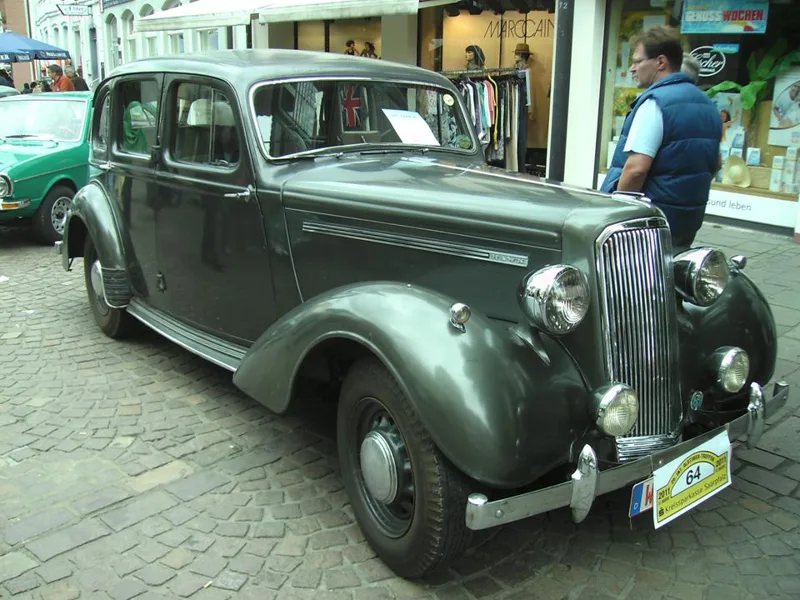
Rootes intended to sell luxury cars under the Sunbeam name, but in 1938 it created the Sunbeam-Talbot marque. It combined Talbot coachwork with Hillman and Humber chassis, and the first models were the Sunbeam-Talbot 10 and a 3-litre, followed by 2-litre and 4-litre versions. Production continued after the war until 1948.
In the summer of 1948 the Sunbeam-Talbot 80 and 90 arrived with a streamlined design. The 90 was renamed the 90 Mark II and then the Mark III in 1954, when the Talbot name was dropped. In 1953 the Alpine, a two-seater sports roadster first built as a rally car by a Bournemouth dealer, went into hand-built production, and close to 3000 were made before production ceased in 1955.
A Sunbeam saloon won the Monte Carlo Rally in 1955, and a new Alpine was introduced in 1959. Ian Garrad, director of the company's US West Coast operations, admired the AC Cobra, which fitted a small-block V8 into a small AC frame. He had Carroll Shelby build a prototype Alpine with a Ford engine, and the result was the Sunbeam Tiger, released in 1964.
The Tiger sold 7,000 units in its three years of production, against 70,000 sold over nine years for the small-engined car. It was dropped in 1967 after an attempt to fit a Chrysler engine failed.
What happened to Sunbeam under Chrysler?
In 1964 Chrysler bought 30% of the company, together with 50% of its non-voting shares, as it sought a foothold in the European market. Its experience of the Rootes empire was unhappy. Models were abandoned while Chrysler tried to build one brand from the best parts of each company, and loyalty eroded when former marques were dropped.
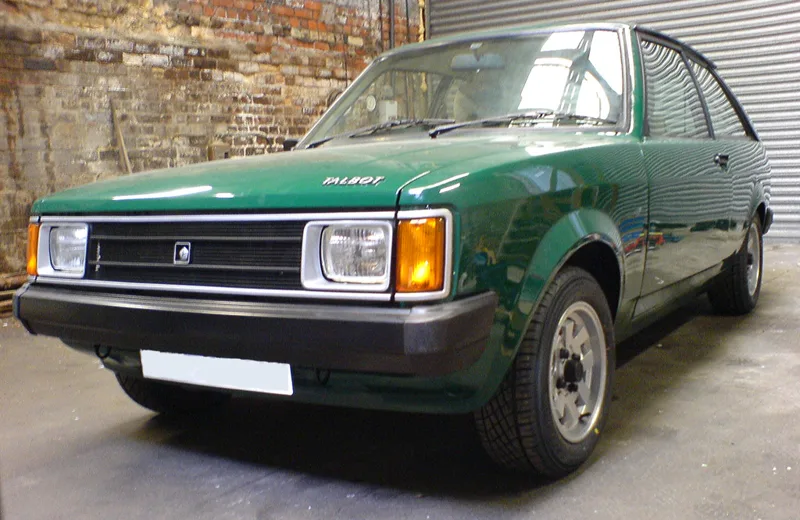
The last Sunbeam produced was the Rootes Arrow Alpine and Rapier fastback, built from 1967 to 1976, after which Chrysler disbanded the marque. A Hillman Avenger-derived hatchback kept the Sunbeam name as a model from 1977, and after PSA Group took over Chrysler Europe it was branded the Talbot Sunbeam until 1981. The Sunbeam name has not been used on a production car since then.
What were Sunbeam's land speed record cars?
Sunbeam's Brooklands racer, the 350HP, set three land speed records. The first was set by Kenelm Lee Guinness at 133.75 mph in 1922. Malcolm Campbell then bought the car, painted it in his distinctive colours, named it Blue Bird and in September 1924 reached 146.16 mph at Pendine Sands in South Wales, raising the record to 150.76 mph soon after.
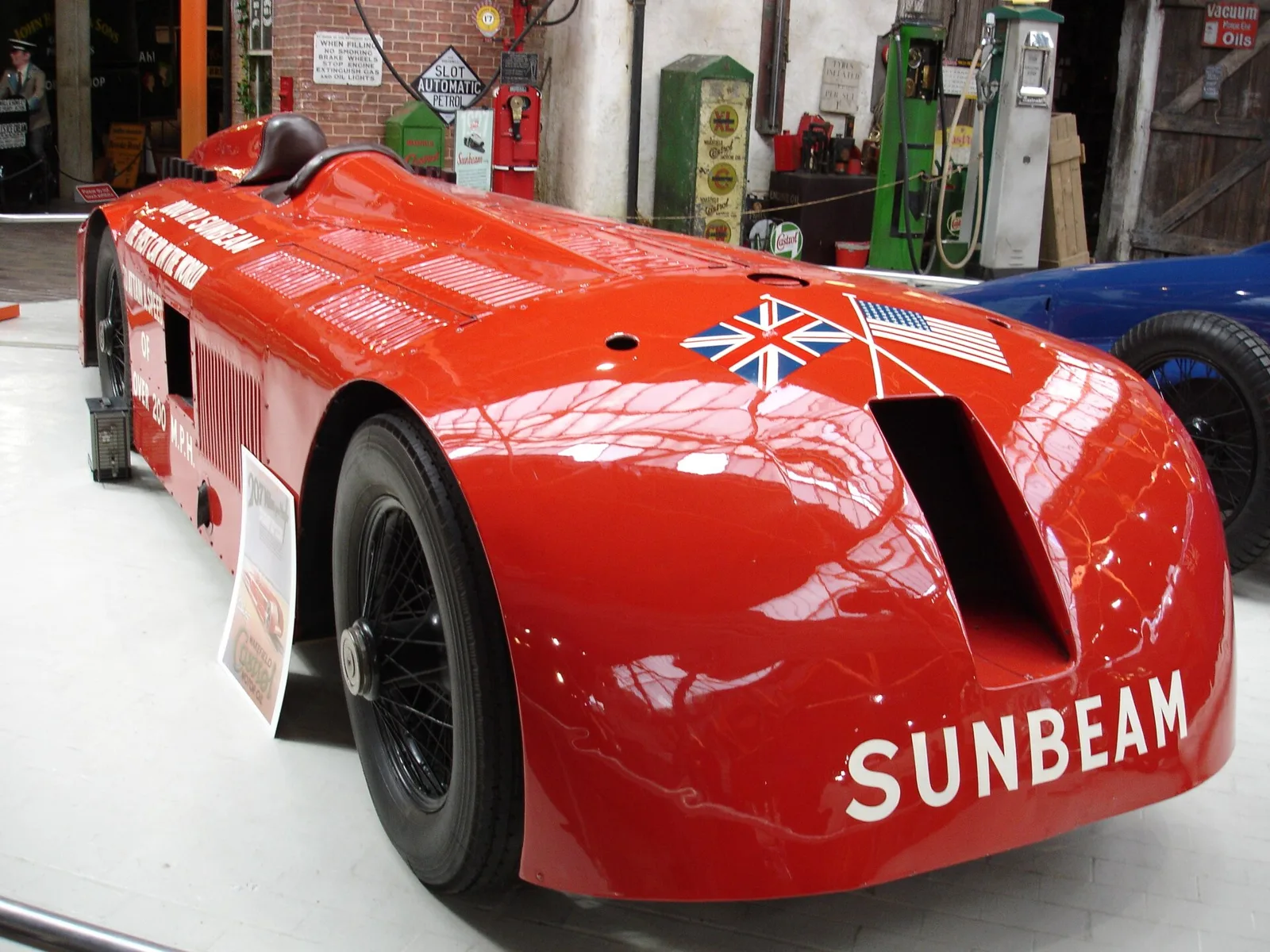
Henry Segrave won the French and Spanish Grands Prix in 1923 and 1924 in Sunbeam-built cars. In 1926 he took the land speed record in a 4-litre V12 racer originally named Ladybird and later renamed Tiger. Coatalen then built the Sunbeam 1000HP, powered by two 450 hp Matabele engines, which reached 203.792 mph (327.971 km/h) on 29 March 1927.
The 1000HP is now at the National Motor Museum at Beaulieu. A later record attempt with the 1930 Silver Bullet failed to set a record or deliver the hoped-for advances in aero engines, and that car is now almost forgotten.
How did Sunbeam race on the road circuits?
Sunbeam built Grand Prix cars designed by Ernest Henry. A straight-eight twin-cam car with four valves per cylinder won the 1922 Tourist Trophy in the hands of Jean Chassagne, and a team of 2-litre 1922 Grand Prix Sunbeams took part in that year's French Grand Prix. A 1923 Grand Prix car was also built by Sunbeam.
The 3-litre Super Sports, a twin-cam car, came second at Le Mans soon after its introduction, beating Bentley. It was described as the first production twin-cam car in the world, and it showed that Sunbeam's engineering could hold its own on the long-distance stage.
What commercial vehicles did Sunbeam build?
Car production ended after the 1935 sale, but trolleybus production continued. Karrier's trolleybus business moved from Huddersfield to the Moorfield works and was combined with Sunbeam. During the war the factory produced the only trolleybus available in Britain, a four-wheeled double decker known as the W4.
In 1946 J. Brockhouse and Co bought Sunbeam Commercial Vehicles. In 1948 the trolleybus side went to Guy Motors, which built Sunbeam trolleybuses until the last one was completed in 1964. Sunbeam also made double-decker buses such as the Sikh and the Pathan, and Brisbane City Council in Australia imported single-deck trolleybus chassis from 1951 to 1960.
What are the key Sunbeam figures?
| Item | Figure |
|---|---|
| Sunbeam trademark for motor cars | Registered in 1900 |
| Company formed | 1905, Sunbeam Motor Car Company Limited |
| Cars built in 1911 | 853 a year |
| Aircraft built | 647 of various types by early 1919 |
| Moorfields staff in the 1920s | 3,500 on a 50-acre site |
| Receivership | 1934, followed by sale to Rootes in 1935 |
| Alpine production | Close to 3000, 1953 to 1955 |
| Tiger sales | 7,000 units in three years |
| Land speed record | 203.792 mph (327.971 km/h), 1927 |
| Last model using the name | Talbot Sunbeam, 1979 to 1981 |
How is Sunbeam remembered?
Sunbeam is remembered for its Edwardian cars, its record-breaking Blue Bird and the 1000HP, and for the Alpine and Tiger sports cars of the Rootes years. Its Moorfield site still appears in local names such as Sunbeam Gardens, near a housing estate built in the early 1990s.
The name also appeared in popular culture, from a 1922 P. G. Wodehouse book to Grace Kelly's 1953 Alpine in To Catch a Thief. James Bond drove a Series II Alpine in Dr. No, and a Sunbeam Tiger appeared in Get Smart. Owners today follow the marque through the Sunbeam Talbot Alpine Register.