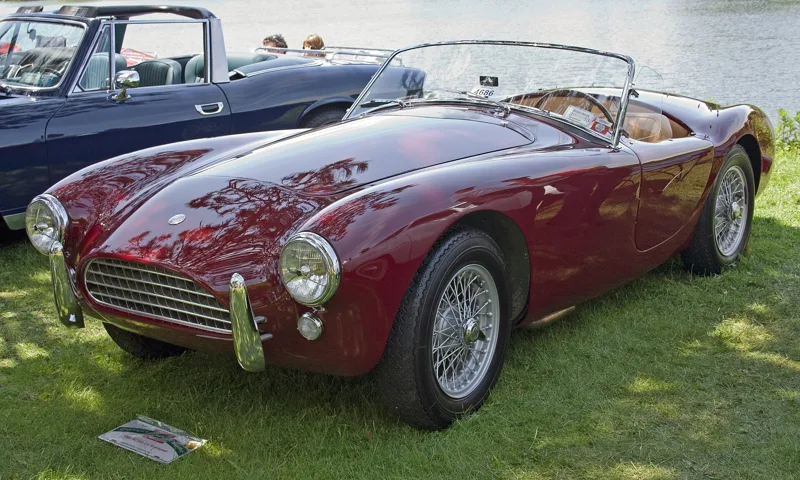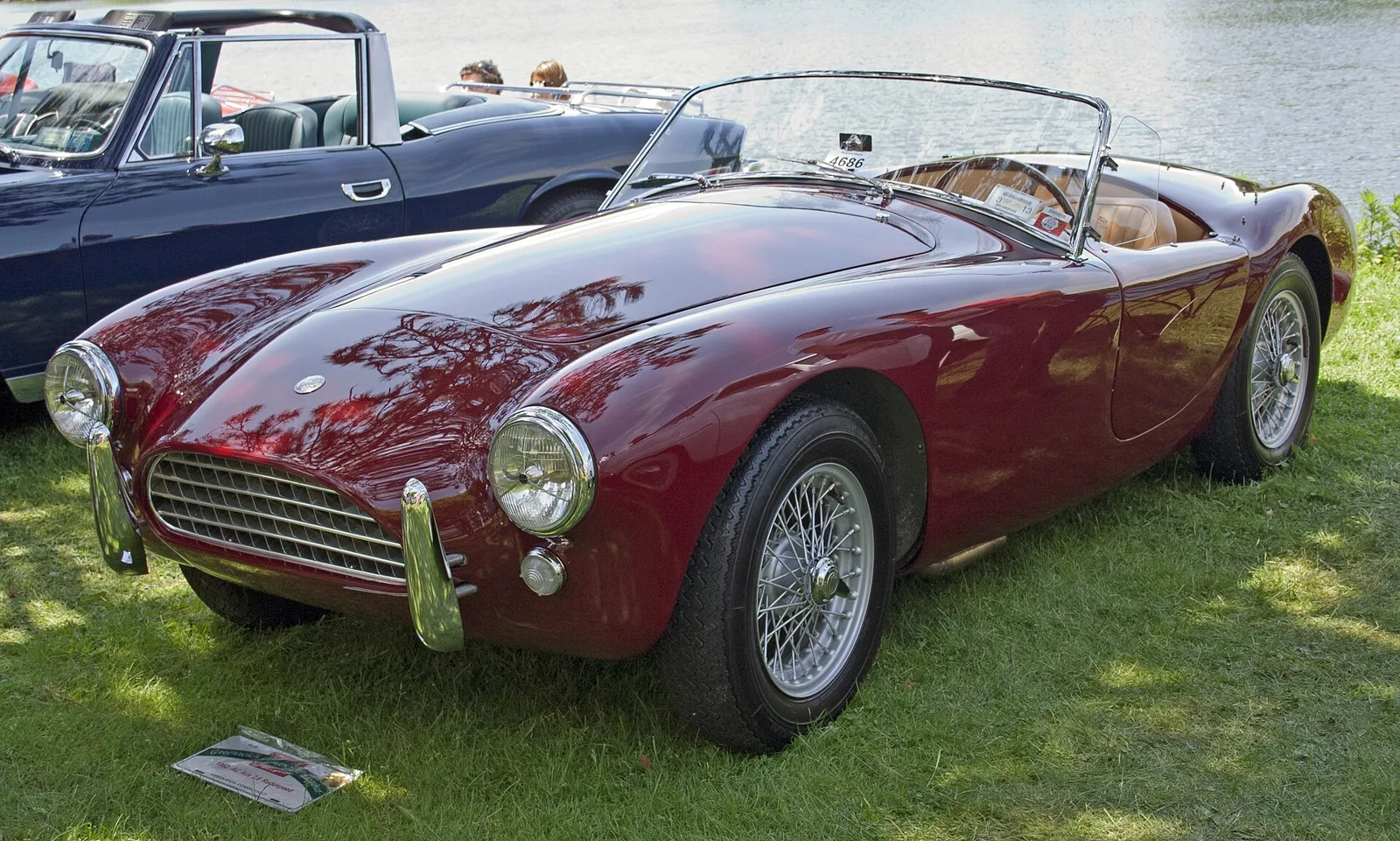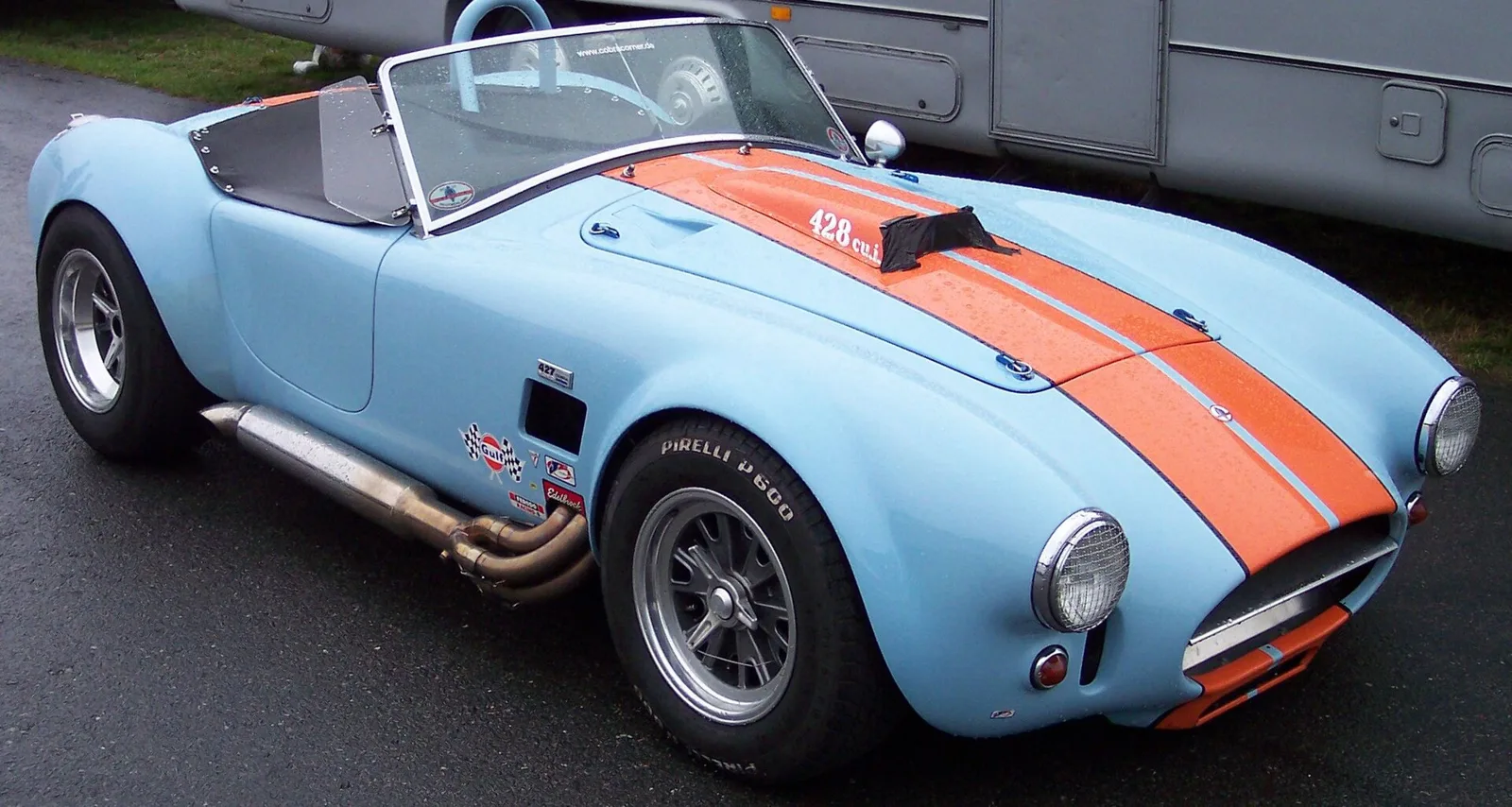
A lightweight British roadster given an American V8 by Carroll Shelby, which became a race winner, a Snake-badged special and a long run of replicas.
Built from 1962 to 1967, the Cobra paired a lightweight British chassis with Ford V8 power. The Mark III 427 produced 317 kW (425 hp; 431 PS) in standard form, and replicas called continuation cars have been made since the late 1980s.
The AC Cobra was a British sports car built by AC Cars with an American Ford V8 under its bonnet, first in England and later in the United States. Built from 1962 to 1967, it combined a light Ace-based chassis with the power of Ford's small-block and then 427 engines. Its name and its Shelby version became some of the most recognised cars of the decade.
Where did the Cobra come from?
AC Cars had been building the two-seat Ace roadster since 1953. The Ace used a steel ladder chassis with 3-inch (76 mm) tubular rails and an aluminium body shaped by hand on wheeling machines. Its earlier engines were AC's own Light Six, a Bristol six and finally a 2.6-litre Ford Zephyr 6, which let AC lower the nose and remove the moustache lines below the headlamps.
In September 1961 Ford supplied Carroll Shelby with two of its new 221 cu in (3.6 L) small-block V8s, and one was shipped to AC in England. The team fitted the V8 to an Ace prototype, chassis CSX2000, which was completed in January 1962. The only change to the front end was a steering box moved outwards to clear the wider engine.
A stronger rear differential was needed for the extra power. AC fitted a Salisbury 4HU unit with inboard disc brakes, the same unit used on the Jaguar E-Type. The chassis was air-freighted to Shelby in Los Angeles on 2 February 1962.
A British roadster given an American heart, which became one of the most famous sports cars of its decade.
How did the first Cobra reach production?
Shelby's crew fitted the drivetrain to CSX2000 in under eight hours at Dean Moon's shop in Santa Fe Springs, California. The small-block had grown to 4.3 L (260 cu in) by then, and the car was road-tested straight after the installation.
Production followed a split arrangement. AC exported painted, trimmed cars without an engine or gearbox to Shelby, who fitted the drivetrain in his workshop in Los Angeles and corrected body flaws caused by the sea journey. The inboard brakes were moved outboard to cut cost, and the fuel filler moved from the fender to the centre of the trunk.
The first 75 Mk1 models, including the prototype, carried the 4.3 L Windsor V8. The remaining 51 Mk1 cars had the larger 4.7-litre (289 cu in) engine, and Shelby offered that upgrade to owners of the earlier cars. Most accepted it, so cars with the smaller engine are rare today.
What changed with the Mark II?
In late 1962 Alan Turner, AC's chief engineer, redesigned the front end to take rack and pinion steering while keeping the transverse leaf spring. The new car entered production in early 1963 as the Mark II, and its steering rack came from the MGB while the column came from the VW Beetle.
About 528 Mark II Cobras were produced from 1963 until the summer of 1965. The last car bound for the United States left the factory in November 1964. The Ace 2.6 had been discontinued in 1963, so AC could concentrate on cars for Shelby American.
Did the Cobra win races?
The Cobra was built to take the crown from Ferrari in the GT class, and it raced hard in the sports car classes. Shelby experimented with a 390 cu in (6.4 L) Ford FE engine in chassis CSX2196, but the car was not developed properly because the team was busy with the GT programme.
Ken Miles raced the FE-powered Mark II at Sebring and found it close to undriveable, which he nicknamed The Turd. At Nassau the car was revised with an aluminium 6.4-litre engine and had built a long lead by the end of the first lap, but it failed to finish because of brake problems. The Nassau race placed the Cobra against a prototype Ford GT40, Grand Sport Corvettes and a Lola Mk6.
Some Cobra chassis were converted into coupes for endurance racing. Six Shelby Daytona Cobra coupes were built to improve top speed on the Mulsanne Straight at Le Mans, and AC built a one-off Le Mans coupe, A98, which ran in the 1964 race. Its engine was tuned for reliability, giving 265 kW (355 hp; 360 PS) against the Daytona's 287 kW (385 hp; 390 PS).
What was the Cobra 427?
The Cobra 427 used a new Mark III chassis designed with Ford in Detroit. Coil springs replaced the transverse leaf spring at the front and rear, and the car carried the 7.0-litre (427 cu in) FE side-oiler engine. In standard form it produced 317 kW (425 hp; 431 PS) at 6000 rpm and 651 N m (480 lb ft) of torque at 3700 rpm.
The standard model reached 264 km/h (164 mph). The semi-competition S/C version was tuned to 362 kW (485 hp; 492 PS) and topped out at 298 km/h (185 mph). After two prototypes went to the United States in October 1964, Mark III output started on 1 January 1965.
Only 56 of the 100 competition cars needed for homologation were built when the FIA arrived in April. Of those, 31 unsold cars were fitted with windscreens and production 427 engines for street use. An original S/C car can now sell for US$1.5 million, which makes it one of the most valuable Cobras.
How many street Cobra 427s were built?
About 260 Cobra 427s were produced as street cars. The first 100 had dual-quad top-oiler 427 engines, and the next 105 received Ford's 428 FE. The final 55 cars reverted to the side-oiler 427, with a single four-barrel carburettor on most of them.
The 1966 Police Interceptor trim made about 360 hp. The Cobra was a financial failure, and it led Ford and Carroll Shelby to stop importing cars from England in 1967.
What were the Snake packages?
Shelby offered several special packages. The Dragon Snake was a drag racing kit that won several NHRA National events with CSX2093, and only six 289 Dragon Snake Cobras came from the factory, plus one 427 Dragon Snake, numbered 3198. Customers also prepared their own Cobras to the same specification.
The Slalom Snake was built for autocross, with two examples, CSX2522 and CSX2537. The Super Snake was a 1966 conversion of the competition car CSX 3015 into a street-legal machine with twin Paxton superchargers. Shelby also built a second Super Snake, CSX 3303, from a street version and gave it to his friend, the comedian Bill Cosby.
CSX 3015 was sold at the Barrett-Jackson auction in Scottsdale on 22 January 2007 for $5 million (~$7.27 million in 2024) plus commission, a record for a vehicle made in the United States at the time.
What happened to AC after Shelby?
AC kept building variants of its own. The AC 428 Frua used a stretched Mark III chassis with a steel body by Pietro Frua, and it was built until 1973. The coil-spring AC Roadster with narrow fenders and a small-block 289 was built and sold in Europe until late 1969.
In 1986 Autokraft bought AC Cars, with Ford joining the venture in 1987. Its AC Mk IV Cobra used a 4.95-litre Ford V8 producing 186 kW (250 hp; 253 PS), with a top speed of 215 km/h (134 mph) and 0-62 mph in 5.2 seconds. At the 1990 Geneva show a Lightweight version weighed 1,070 kg (2,360 lb) and produced 276 kW (370 hp; 375 PS).
Pride Automotive bought the company in 1996 and launched the aluminium Superblower in 1997, with a supercharged V8 making 239 kW (320 hp; 324 PS). The carbon-bodied Carbon Road Series used a 168 kW (225 hp; 228 PS) version of the same engine. Twenty-two Superblowers and 37 CRS cars were built between 1997 and 2001.
In 2001 the factory moved to Frimley in Surrey, and by August 2002 the company was in financial difficulty. A new company called AC Motor Holdings, formed in Malta, took over branding, and the Frimley operation was closed in October 2003. A co-production with Shelby followed, with only a handful of cars built before the company's later reorganisations.
Were there counterfeit Cobras?
In 1993 the Los Angeles Times exposed a scheme by Shelby to issue titles for Cobras that did not officially exist. With the price of an original 7-litre Cobra rising sharply, Shelby obtained 43 duplicate titles from the California Department of Motor Vehicles for vehicles that had no record in company files.
AC Cars confirmed that the chassis numbers involved were never manufactured by AC. Only 55 of the 7-litre cars had been produced from a block of numbers reserved for 100, and Shelby admitted that the chassis were built in 1991 and 1992 by McCluskey Ltd in Torrance, California. Shelby denied misleading anyone and blamed a rival, Brian Angliss, who owned AC at the time.
Are continuation Cobras still being built?
Continuation Cobras have been built since the late 1980s, mainly in Las Vegas, Nevada. The first series, CSX4000, continued the 427 S/C line from around chassis CSX3360, and it was completed from chassis built by Mike McCluskey, Shelby's personal mechanic since the 1960s.
The CSX4001 to CSX4999 run took roughly 20 years and several business relationships to finish. The 4000 series was concluded in 2009, and production continued under the CSX6000 numbers with coil-over suspension.
What are the AC Cobra specifications?
| Specification | Detail |
|---|---|
| Built | 1962 to 1967, United Kingdom and United States |
| Mark I engine | 4.3 L (260 cu in) Windsor V8, first 75 cars; 4.7 L (289 cu in) on the next 51 |
| Mark II output | About 528 cars, 1963 to summer 1965 |
| Mark III engine | 7.0 L (427 cu in) FE, 317 kW (425 hp; 431 PS) at 6000 rpm |
| Mark III torque | 651 N m (480 lb ft) at 3700 rpm |
| Mark III top speed | 264 km/h (164 mph) |
| S/C top speed | 298 km/h (185 mph), 362 kW (485 hp; 492 PS) |
| Street 427s | About 260 cars |
| Lightweight (1990) | 1,070 kg (2,360 lb), 276 kW (370 hp; 375 PS) at 5,750 rpm |