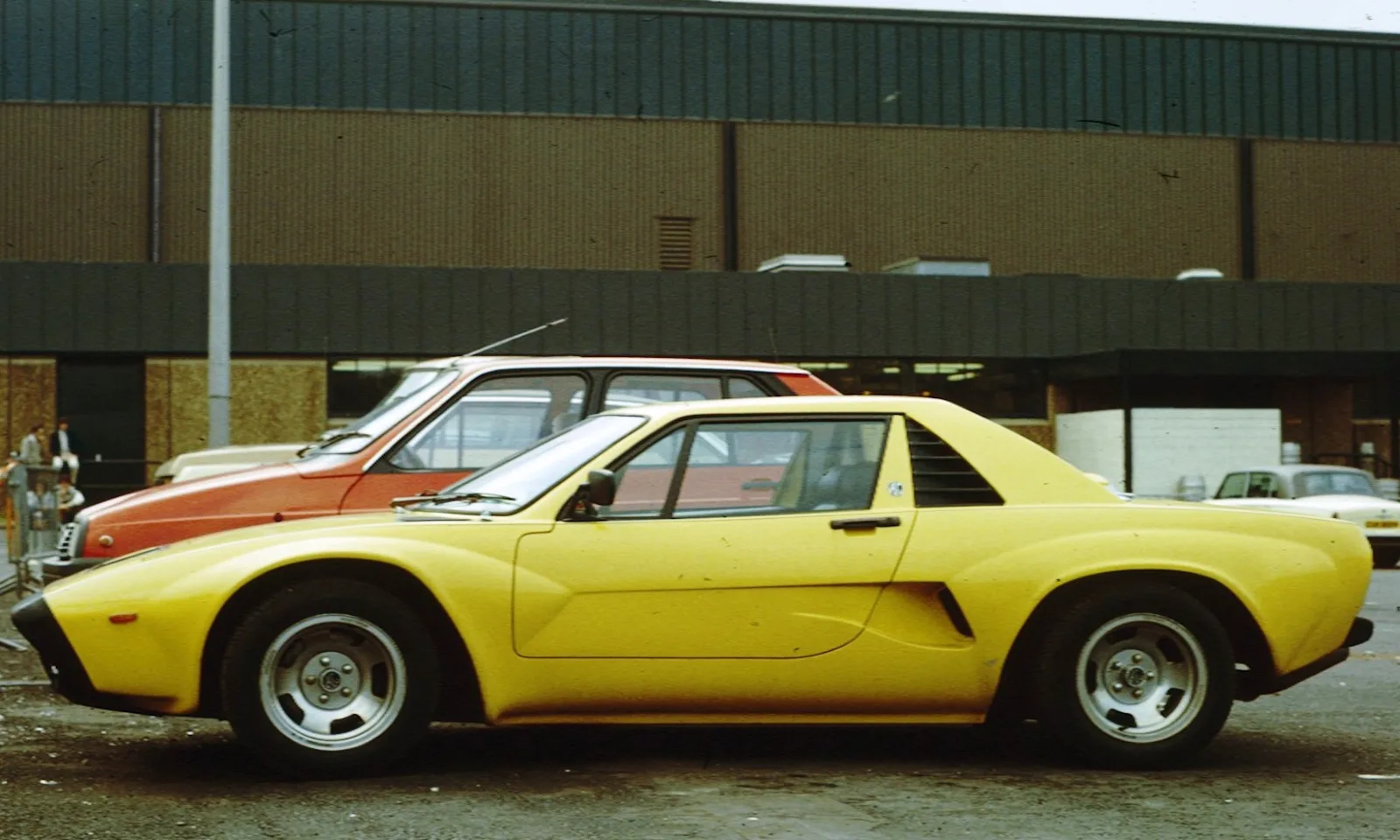
A mid-engined coupe with a Ford V6, a long gestation from 1973, Scottish-built cars and a run of unsuccessful spin-off prototypes.
Built by AC Cars from 1979 to 1984, the 3000ME was a coupe with a Ford V6 behind the seats. It grew out of the Diablo prototype, passed to a Scottish firm for a short time and was finished by 1985.
The AC 3000ME was a mid-engined two-door coupe that AC Cars first showed at the 1973 London Motor Show. Sales began in 1979 and continued until 1984, with a Ford V6 mounted behind the seats. Production later passed to other companies, and the car's story ends with a receivership in 1985 and a single prototype that never reached showrooms.
Where did the AC 3000ME come from?
The 3000ME grew out of the Diablo, a mid-engined prototype built by Bohanna Stables that was exhibited in 1972 at the London Racing Car Show. Its designers were Peter Bohanna, a body structures engineer, and Robin Stables, a former racing mechanic and Lotus dealer.
Bohanna had worked with fibreglass structures on boats and had spent time with Ford's advanced vehicle operation in the UK. In 1968 the pair won a design contract from Piers Weld-Forester for a two-seat mid-engined car. They planned to use the 2.2 L inline six of BMC's E-series engine, code-named ARO25, but that engine was delayed until 1972.
The 1972 Diablo prototype used a 1.5 L inline four and a 5-speed transaxle taken from the Austin Maxi. Bohanna and Stables had already approached AC and TVR before the car was shown. Its path to production ran through AC's Keith Judd, who drove it to Thames Ditton and persuaded owner Derek Hurlock to take it on.
A mid-engined Ford V6 coupe whose delays left it out of date before the first customer car was delivered.
How did AC turn the Diablo into a production car?
AC bought the design rights and gave the development work to engineers Alan Turner and Bill Wilson. The tubular steel frame was rebuilt from the ground up, and a Ford V6 replaced the planned E-series engine because British Leyland needed its own engines for its models. The first prototype appeared at the 1973 London Motor Show.
Bohanna and Stables remained involved as consultants on the redesign. Early company statements hoped to build 10 to 20 cars a week, with a price between GBP 3000 and GBP 4000 expected. The first show car was called the AC 3 Litre or AC 3000, and later pre-production cars were badged AC ME 3000.
Development ran on for years. Styling was not settled until 1974, and one prototype did not pass the crash section, run at 30 mph (48 km/h), of the Type Approval tests introduced in 1976. The chassis was redesigned and the revised car passed at the next attempt. Pre-production cars numbered eight, nine or eleven, depending on the account.
When did the 3000ME finally go on sale?
The car officially went on sale at the 1978 NEC Motor Show under the name AC 3000ME, with a list price of GBP 11,300. First customer deliveries came in 1979, by which time newer rivals such as the Lotus Esprit were already on the market. The delays meant the design was dated before buyers saw it.
Prices kept climbing. Autocar put one through its paces in March 1980, recorded GBP 13,238 and voiced reservations about the handling when the car was pushed. Several other contemporary reviews raised similar misgivings.
Could the 3000ME be turbocharged?
Not at the factory. AC planned a turbocharged version as early as August 1975, with Broadspeed expected to supply the system, but the factory never offered one. Turbo conversions instead came from engineer and photographer Robin Rews, whose Rooster Turbos company upgraded 19 cars.
Rews' semi-competition conversion relied on a Garrett AiResearch turbo that blew through a Reece Fish carburettor on a custom intake manifold. Boost was held to 7.0 psi, and low-compression heads brought the compression ratio down to 8:1. The conversion raised output to 200 bhp (149.1 kW), and Rews reworked the rear suspension, adding toe-in that was meant to sharpen the handling.
A December 1983 road test showed the kit had moved on. It used an IHI turbocharger, and Cosworth pistons lowered the compression ratio to 7.2:1 so that higher boost could be run. A waste-gate and dump valve controlled boost. The conversion cost GBP 1180 until 1984, when the price rose to GBP 2000.
Rews and Rooster Turbos also built at least one twin-turbo car. It used Cosworth pistons and Weber carburation, with water injection to cool the intake air, and its output was estimated at 300 bhp (223.7 kW).
Why did production move to Scotland?
Derek Hurlock had been in poor health for a long stretch, and sales never reached the volumes that had been hoped for. Fewer than 80 cars had been built when production stopped at Thames Ditton in 1984. The name and licence then passed to AC (Scotland) plc, which set up in a new factory at Hillington, Glasgow.
The company was run by David McDonald and set a goal of 40 cars per week. Only 30 more cars were made to the first 3000ME specification, and Scottish cars can be spotted by intakes and grilles finished in body colour.
Chassis 129, registration VPC 634X, had been a factory demonstrator and Managing Director Andrew Hurlock's personal car. AC (Scotland) used it as a development mule under Aubrey Woods, a former BRM production engineer. The Ford V6 gave way to a 2.5-litre Busso V6 from Alfa Romeo, and the suspension was revised to cure the unpredictable handling at the limit.
A Mark 2 prototype was nearly complete when the company entered receivership in June 1985. The licence held from AC Cars came to an end in November 1985.
What was the 3000ME's engineering like?
The 3000ME used a perimeter frame of folded sheet steel that carried a roll-over bar built into the structure, with subframes at both ends. The body was glass-reinforced plastic, and the car's weight was split 40/60 between front and rear. Some reviewers call the central tub a monocoque, although its structure is a frame.
Suspension used A-arms at top and bottom, coil springs and telescopic dampers at both ends, with anti-dive and anti-squat geometry. AC made the arms and uprights itself, and production cars had no anti-roll bars. Each wheel had a Girling caliper on an AC-made rotor, fed by dual hydraulic circuits.
Early cars wore 195/60VR-14 Pirelli tyres, later growing to 205/60VR-14, on Wolfrace alloys that measured 7 in (178 mm) across.
How did the engine and gearbox work?
The powerplant was a 3.0-litre Ford Essex V6, an all-cast-iron overhead-valve unit with its banks set at 60 degrees. It made 138 bhp (102.9 kW), with torque of 192 lb ft (260.3 Nm), and it sat transversely behind the seats. The gearbox was a five-speed manual that was also mounted transversely.
The transaxle was an AC design with an aluminium case, but its gear set came from Hewland. A Renold triplex chain carried the drive, and the gear lever worked a gated, Ferrari-like pattern. Equipment also covered electric windows, an adjustable steering column, a radio with a powered antenna and Pilkington Sundym laminated glass.
What variants and one-offs were built?
The 3000ME spawned several spin-offs: the Ecosse Signature, the AC Ghia show car, the Lincoln Quicksilver and the AC-Chrysler 2.2 Turbo, which became the Shelby ME 2.2 Turbo. None of them reached the showroom, and each relied on a different outside partner.
Ecosse Signature
When the Scottish company's assets came up for sale, former racing driver John Parsons and Aubrey Woods bought them and formed the Ecosse Car Company Ltd in Knebworth, Hertfordshire. Because the AC name had passed to another owner, they renamed the car the Ecosse Signature. Peter Stevens restyled the exterior, and a turbocharged Fiat Twin Cam from the Croma replaced the Alfa V6.
The revised car went on display at the 1988 Birmingham Motor Show, but the company could not raise the GBP 350,000 needed to restart production. Its prototype turned up again in 2017 in a derelict industrial storage unit, and in unrestored condition it was offered for GBP 8000.
AC Ghia
In July 1980 Bob Lutz, who chaired Ford of Europe, and his vice president Karl Ludvigsen were checking projects at Carrozzeria Ghia in Turin. Ghia's chief designer, Filippo Sapino, mentioned a need for a mid-engined Ford platform, and the 3000ME, with its Ford engine, was proposed as the base. Ludvigsen saw it as a possible successor to the Mark II Escort, a rally car that had just been retired, and he circulated a memo on 22 September linking the car with the 1982 Group B rules.
AC supplied two cars, one complete and one rolling chassis, on condition that it could be shown at the 1981 Geneva Motor Show. The fully built car set off from Thames Ditton on 16 October, reaching Turin days later. The resulting AC Ghia measured 150 in (3,810 mm) long, shorter and narrower than the original.
The show car earned favourable reviews at Geneva, but Ford's rally programme had shifted to a newer turbocharged Escort, so the Ghia was no longer aimed at that role. Neither Ford nor AC could find the resources to put it into production, and the prototype was auctioned in 2002.
Lincoln Quicksilver
Ghia released another show car in 1983, built on the second rolling chassis supplied by AC. The Quicksilver's chassis was 280 mm (11.0 in) longer than the original, which allowed a full four-door sedan body with a roofline that ran back over the engine bay and ended abruptly. The car kept the mid-engine layout and recorded a drag coefficient of 0.30.
Some sources say the Essex V6 gave way to a Cologne V6, still mated to the 5-speed transaxle. The Quicksilver stayed on the show car circuit until 1986. Ford sold it at auction in 2002 for $45,825, and it was offered again at auction in January 2014 before passing into private hands.
AC-Chrysler 2.2 Turbo
American partners Steve Hitter and Barry Gale brought the car into the United States as chassis 161, which arrived in February 1981. Attempts to source a Chevrolet V6 failed, and a Ford 1.6 L four was rejected as underpowered. The car went to Arkay Incorporated in Hawthorne, California, where a Buick V6 was fitted before Buick pulled out of the project.
Carroll Shelby became involved after Ray Geddes saw the car at Arkay, and Shelby agreed to take the project on after talks at the SEMA event in Las Vegas. Work moved to the Chrysler-Shelby facility in Santa Fe Springs. The team began with a non-turbo 2.2 L Chrysler engine, then moved to a turbocharged G-24 unit and a five-speed transaxle, and the car took the Shelby ME 2.2 Turbo name.
Metalcrafters completed the bodywork and paint, and Chrysler president Lee Iacocca was shown the prototype. Chrysler decided not to produce the car, so it became a Shelby test mule until the Los Angeles facility closed. The prototype survives.
Did the 3000ME compete in motorsport?
Yes, though only a handful of cars were converted for competition. Chassis 119 became a Lightweight special for hill climbs and sprints, chassis 156 was taken to Australia for rally use, and a tube-frame Supersports special was built around a heavily modified 3000ME body.
Robin Rew did much of the Lightweight work, adding single and then twin turbos. The car was eventually made road-legal again, though many of its upgrades stayed, and it appeared on the cover of Sports Car Monthly in September 1986.
Chassis 156 gained an FIA-compliant roll cage along with complete suspension and engine overhauls, and it was also considered for historic racing. The Supersports car, which used a Cosworth BDA engine and a Hewland transaxle, featured in Cars and Car Conversions in February 1992.
What are the AC 3000ME specifications?
| Specification | Detail |
|---|---|
| Layout | Mid-engined, two-door coupe |
| Engine | 3.0-litre Ford Essex V6, mounted transversely behind the seats |
| Output | 138 bhp (102.9 kW) |
| Torque | 192 lb ft (260.3 Nm) |
| Transmission | 5-speed manual transaxle, Hewland gears, Renold chain drive |
| Weight distribution | 40/60 front/rear |
| Chassis | Perimeter frame of folded sheet steel, glass-reinforced plastic body |
| Tyres | 195/60VR-14 early, 205/60VR-14 later, on 7 in (178 mm) wheels |
| Launch list price | GBP 11,300 at the 1978 NEC Motor Show |
| Turbo conversion | 200 bhp (149.1 kW); twin-turbo estimate 300 bhp (223.7 kW) |
| Production | Fewer than 80 cars at Thames Ditton; 30 more by AC (Scotland) |